
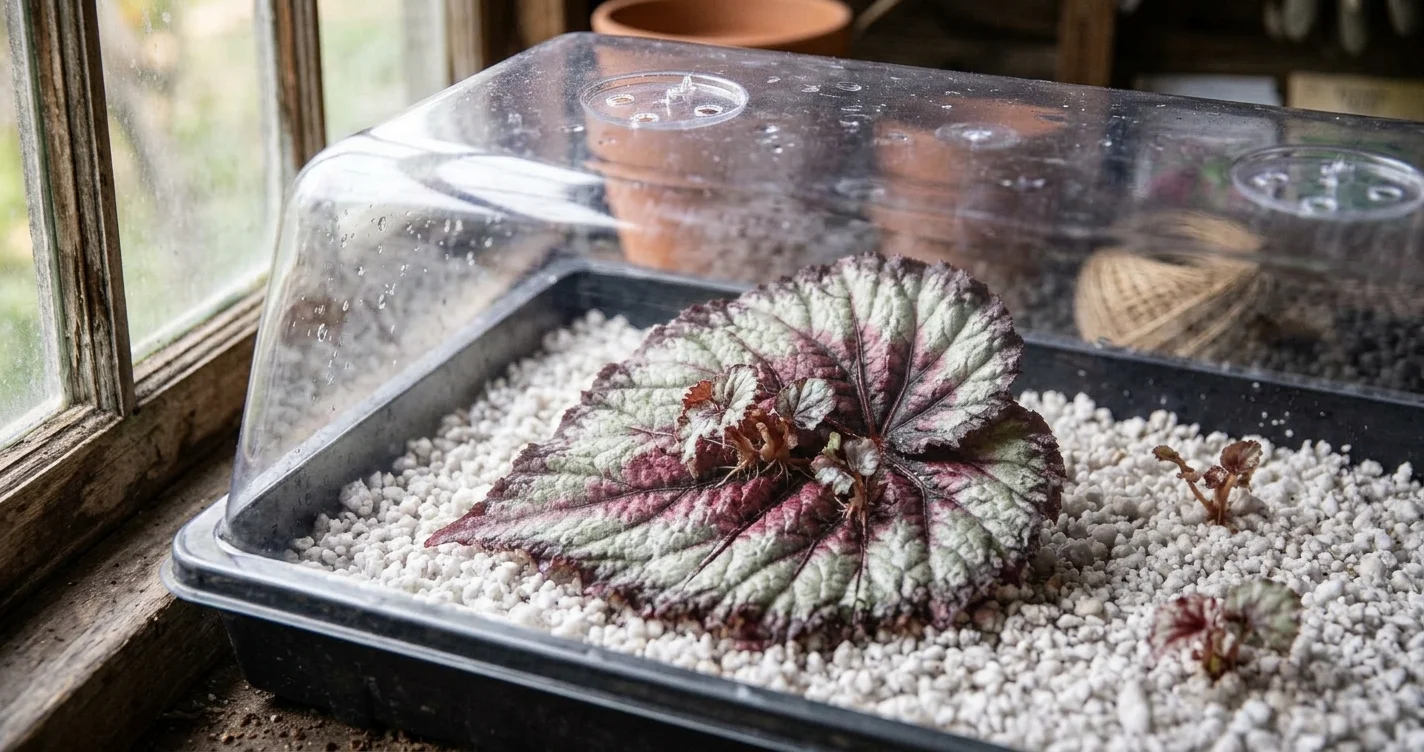
A single rex begonia leaf can sometimes produce several entirely new plants. Even more surprisingly, those baby plants may emerge from small cuts made across the leaf’s veins rather than from a traditional stem cutting.
It sounds almost impossible. A leaf lies flat against moist soil, tiny wounds begin to heal, and eventually miniature begonias appear where there were once only colorful veins.
Learning how to propagate rex begonia from leaf cuttings reveals one of the most fascinating abilities in the plant world: the capacity of certain plant tissues to regenerate roots and shoots.
With a healthy leaf, a clean blade, a suitable growing medium, and careful humidity control, gardeners can multiply their favorite rex begonias without purchasing additional plants.
The process requires patience, but watching new growth emerge from a leaf is a remarkable experience.
Table of Contents
- What Makes Rex Begonias So Special?
- Can You Really Grow a Rex Begonia From One Leaf?
- How to Propagate Rex Begonia From Leaf Vein Cuttings
- Why Leaf Vein Cuttings Produce New Plants
- The Best Growing Conditions for Rex Begonia Propagation
- How Long Does Rex Begonia Propagation Take?
- Common Problems and How to Prevent Them
- Other Ways to Propagate Rex Begonias
- In Your Own Yard: A Simple Propagation Station
- Frequently Asked Questions
What Makes Rex Begonias So Special?
Rex begonias are among the most visually striking foliage plants grown indoors.
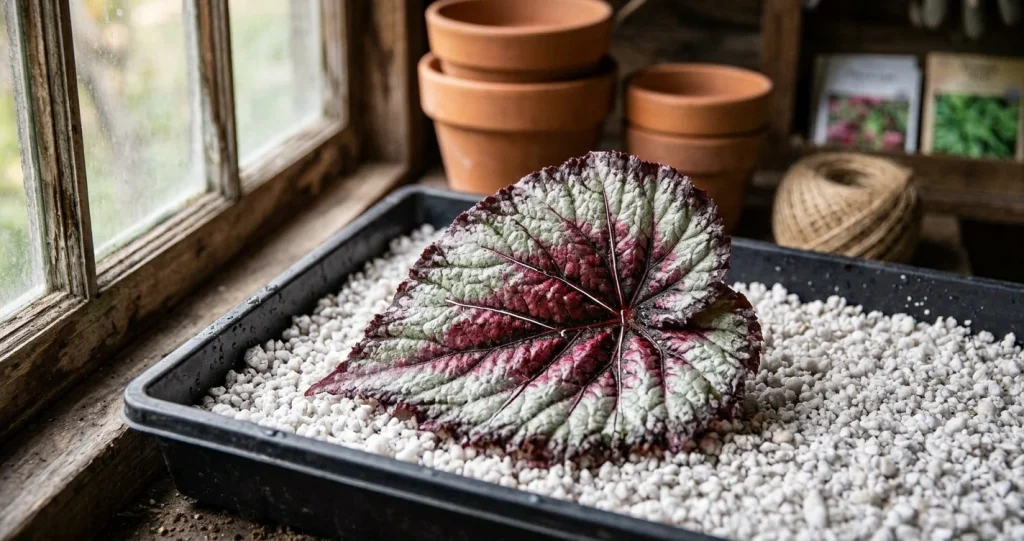
Their leaves can display dramatic combinations of silver, burgundy, pink, green, purple, and nearly black. Many have swirling patterns, metallic highlights, or textured surfaces that seem almost painted.
Most cultivated rex begonias belong to the Rex Cultorum Group, a collection of hybrids with ancestry that includes Begonia rex.
Unlike flowering houseplants grown mainly for their blooms, rex begonias are prized for their extraordinary foliage.
A Plant With Remarkable Leaves
Rex begonia leaves often have an asymmetrical shape, with one side larger than the other.
Their surfaces may be smooth, puckered, hairy, or deeply textured.
The veins form branching networks that support the leaf and transport water and nutrients.
These veins also play an important role in one of the plant’s most unusual propagation methods.
Why Gardeners Propagate Rex Begonias
Propagation allows gardeners to preserve favorite cultivars, replace aging plants, and share them with friends.
Leaf cuttings are particularly appealing because a single healthy leaf can sometimes produce multiple plantlets.
When propagated vegetatively, new plants generally retain the characteristics of the parent cultivar, although occasional variations can occur.
This makes leaf propagation useful for maintaining distinctive foliage patterns.
Can You Really Grow a Rex Begonia From One Leaf?
Yes. Many rex begonias can produce new plants from leaf tissue.
This ability is different from the way most common houseplants are propagated.
For example, a pothos cutting generally needs a stem node to develop into a complete new plant.
Rex begonias can sometimes regenerate both roots and shoots from suitable leaf tissue under favorable conditions.
The Difference Between Leaf and Stem Cuttings
Stem cuttings include a section of stem, often containing nodes where new growth can develop.
Leaf cuttings rely on the regenerative capacity of the leaf itself.
In rex begonias, wounded leaf tissue near major veins may produce new growth when it remains in contact with a moist propagation medium.
The process is not equally successful with every cultivar, and some begonias respond better to other propagation techniques.
Why Veins Matter
Leaf veins contain vascular tissues that move water and nutrients throughout the leaf.
When a vein is cut, cells near the wound may participate in healing and regeneration.
Under suitable conditions, new roots and shoots can develop near these wounded areas.
This is why gardeners often make several small cuts across major veins rather than simply placing an intact leaf on the soil.
The cuts create multiple potential sites for plantlet formation.
How to Propagate Rex Begonia From Leaf Vein Cuttings
The leaf-vein method is especially interesting because it uses an entire leaf blade as the starting material.
Instead of inserting a long stem into water, the gardener places a prepared leaf against a moist growing medium.
Here is how the process works.
Step 1: Choose a Healthy, Mature Leaf
Select a fully developed rex begonia leaf with strong color and no obvious signs of disease.
Avoid leaves that are yellowing, severely damaged, or beginning to decay.
A healthy, mature leaf generally provides better starting material than a very young or deteriorating one.
Choose a leaf large enough to handle comfortably.
Step 2: Prepare a Clean Propagation Container
Use a shallow tray, small pot, or propagation box with drainage.
Fill it with a fine, well-drained medium.
A mixture containing perlite and peat-free propagation substrate can work well. Fine vermiculite or other suitable sterile propagation media may also be used.
Moisten the medium evenly before placing the leaf.
It should feel damp but not waterlogged.
Step 3: Remove the Leaf From the Parent Plant
Use clean, sharp scissors or a sanitized blade to remove the selected leaf.
Leave a short petiole temporarily if it makes handling easier.
For the flat leaf-vein method, trim away most or all of the petiole so the leaf blade can rest against the propagation medium.
Handle the leaf gently to avoid tearing its delicate tissue.
Step 4: Make Small Cuts Across the Main Veins
Turn the leaf over so the underside is facing upward.
Identify several prominent veins, especially those branching from the central region.
Using a clean, sharp blade, make short cuts across selected major veins on the underside.
Each cut should interrupt the vein without unnecessarily shredding the surrounding leaf.
Space the cuts apart so developing plantlets have room to grow.
Several carefully placed cuts are generally preferable to numerous large wounds.
Step 5: Place the Leaf Flat Against the Medium
Position the leaf with its underside facing downward and the cut veins touching the moist medium.
Gently press it into place.
Small clean pebbles, propagation pins, or pieces of bent wire can help keep the leaf in contact with the surface.
Avoid covering the entire leaf with soil.
The important detail is consistent contact between the wounded veins and the growing medium.
Step 6: Create a Humid Environment
Cover the container with a transparent humidity dome or a clear plastic cover.
High humidity helps reduce water loss while the leaf has limited ability to replace moisture.
Keep the cover from pressing directly against the leaf whenever possible.
Place the container in bright, indirect light.
Avoid direct sunlight, which can overheat a covered propagation tray.
Step 7: Monitor Moisture and New Growth
Check the propagation container regularly.
The medium should remain lightly and evenly moist, while the leaf surface should not stay excessively wet.
Remove decaying tissue if it begins affecting neighboring material.
Over time, roots and small shoots may appear near some of the cut veins.
Not every cut will necessarily produce a plantlet.
Step 8: Separate and Pot the New Plantlets
Wait until the new plants have developed several leaves and a usable root system.
Carefully separate them from the original leaf tissue.
Plant each young begonia in a small pot containing a loose, well-drained houseplant mix.
Keep the young plants in bright, indirect light and gradually acclimate them to normal room humidity.
Why Leaf Vein Cuttings Produce New Plants
The science behind leaf-vein propagation is just as fascinating as the gardening technique.
Plants contain living cells that can sometimes change their developmental activity after injury.
Under the right conditions, certain cells can contribute to the formation of new organs.
This regenerative ability varies widely among plant species.
Plant Cells Can Respond to Injury
When a leaf vein is cut, the surrounding tissue responds to the wound.
Some cells may divide and participate in tissue repair.
In species capable of leaf regeneration, new root and shoot structures can sometimes develop near wounded areas.
These new structures are called adventitious organs because they arise from locations other than the plant’s usual root or shoot growing points.
The Role of Plant Hormones
Plant development is influenced by signaling molecules, including auxins and cytokinins.
These hormones help regulate cell division, root formation, and shoot development.
The balance of hormonal signals, along with the physiological condition of the tissue, can influence whether regeneration occurs.
However, the exact cellular processes involved in rex begonia leaf-vein propagation can vary and should not be assumed to follow one identical pathway in every cultivar.
Why the Leaf Must Stay Moist
A detached leaf no longer receives water through the parent plant’s root system.
Until new roots develop, water loss is a major challenge.
High humidity reduces evaporation from the leaf surface.
A consistently moist propagation medium supports the living tissue and developing roots.
But excessive moisture can encourage microbial growth and decay.
Successful propagation therefore depends on balancing humidity with adequate air circulation.
Why Some Cuts Produce Plants and Others Do Not
Even when several veins are cut, only some wounds may develop new plantlets.
Differences in tissue maturity, wound depth, contact with the medium, moisture, and local conditions can affect the outcome.
Some cultivars regenerate more readily than others.
This variability is normal and is one reason gardeners often prepare more than one leaf cutting.
The Best Growing Conditions for Rex Begonia Propagation
A suitable environment can make a major difference in propagation success.
Rex begonias generally prefer warm, humid conditions without intense direct sunlight.
Temperature
Temperatures around 68–75°F (20–24°C) are often suitable for propagation.
Cool conditions can slow growth, while excessive heat may stress the leaf or encourage problems in a closed container.
Avoid placing propagation trays near cold windows, heating vents, or drafty doors.
Light
Bright, indirect light is ideal.
A location near an east-facing window may work well, provided direct sunlight does not overheat the container.
A suitable LED grow light can also provide consistent illumination.
Strong direct sun is especially risky when the leaf is enclosed beneath a clear cover.
Humidity
High humidity helps keep the detached leaf from drying out.
However, a completely stagnant, saturated environment may increase the risk of fungal or bacterial decay.
Monitor condensation and leaf condition.
If the container remains excessively wet, allow a little additional air exchange.
Growing Medium
A fine-textured, well-drained propagation medium provides good contact with the wounded veins.
It should retain enough moisture to support new growth while allowing oxygen to reach the tissue.
Avoid dense, compacted garden soil.
Clean containers and fresh propagation medium can reduce the introduction of pathogens.
How Long Does Rex Begonia Propagation Take?
Rex begonia leaf propagation requires patience.
Under favorable conditions, roots and early signs of regeneration may develop within several weeks.
Visible plantlets often take longer.
A rough expectation of four to eight weeks for initial plantlet development is reasonable in many home-growing situations, although some cuttings may respond sooner or considerably later.
What Early Growth Looks Like
At first, the original leaf may appear unchanged.
Small roots may develop beneath the leaf, hidden from view.
Eventually, tiny green or colored shoots may emerge near a wounded vein.
These shoots gradually develop recognizable begonia leaves.
The first leaves may look different from the mature foliage of the parent plant.
When to Transplant
Wait until each plantlet has several leaves and enough roots to tolerate separation.
Transplanting too early can damage fragile roots.
Young begonias often benefit from a gradual transition away from the very humid propagation environment.
Common Problems and How to Prevent Them
Leaf-vein propagation is rewarding, but some attempts fail.
Understanding common problems helps gardeners adjust their methods.
The Leaf Turns Brown or Mushy
This often indicates decay associated with excessive moisture, poor airflow, damaged tissue, or contamination.
Remove severely rotting material.
Check that the medium is moist rather than saturated.
Use clean tools and fresh propagation material for future attempts.
The Leaf Dries Out
Low humidity or insufficient contact with the growing medium can cause a detached leaf to lose water.
Make sure the wounded veins touch the moist substrate.
A transparent humidity cover can help, provided the environment does not become excessively wet.
Roots Form but No Shoots Appear
Root formation does not always guarantee successful shoot regeneration.
The leaf may need more time, or the cultivar may respond poorly to the method.
Continue providing suitable conditions while the tissue remains healthy.
The New Plantlets Collapse
Young plantlets can struggle if separated before their root systems are sufficiently developed.
Sudden exposure to dry room air may also cause stress.
Transplant carefully and reduce humidity gradually.
Other Ways to Propagate Rex Begonias
Leaf-vein cuttings are not the only propagation option.
Some gardeners prefer methods that require fewer cuts or provide easier handling.
Leaf Wedge Cuttings
A mature leaf can be divided into wedge-shaped sections.
Each section should include part of a major vein.
The wedges are inserted into a suitable moist propagation medium with the cut vein area positioned for contact.
Under favorable conditions, new plants may develop near the cut surfaces.
Leaf Petiole Cuttings
Some begonias can be propagated by inserting a leaf petiole into moist growing medium.
The leaf remains above the surface while roots and shoots may develop near the buried petiole base.
Success varies among begonia groups and cultivars.
Rhizome Division
Many rex begonias grow from creeping rhizomes.
A healthy rhizome can sometimes be divided into sections containing viable growing points.
Each section is then planted in a suitable growing medium.
Rhizome division can produce established plants more quickly than leaf regeneration, particularly when divisions already contain roots and shoots.
In Your Own Yard: A Simple Propagation Station
You do not need a greenhouse to try rex begonia leaf-vein propagation.
A small indoor workspace with stable warmth and indirect light is often enough.
Begin with a healthy parent plant and a clean, shallow propagation tray.
Prepare a loose, lightly moistened medium, then select a mature leaf.
Make several short cuts across the main veins on the underside.
Lay the leaf flat against the medium and secure it gently.
Cover the container with a clear humidity dome and place it where temperatures remain comfortably warm.
Check the setup regularly for moisture, condensation, and signs of decay.
As small plantlets appear, allow them time to develop roots before moving them into individual pots.
Once established, rex begonias can decorate shaded patios during warm weather or remain indoors as colorful houseplants.
In most parts of the United States, they should be protected from frost and brought indoors before temperatures become too cold.
Keep the parent plant healthy by providing bright, indirect light, suitable humidity, and a well-drained potting mix.
A single well-maintained plant can become the starting point for an entire collection.
Frequently Asked Questions
1. Can you propagate a rex begonia from a leaf without a stem?
Yes. Many rex begonias can regenerate new plants from leaf tissue when suitable veins are wounded and placed in contact with moist propagation medium.
A stem node is not required for the flat leaf-vein method.
However, success varies among cultivars and growing conditions.
2. Should rex begonia leaf cuttings be placed in water?
Some begonias can root from leaf or petiole cuttings in water, but the flat leaf-vein method is generally performed on a moist propagation medium.
The medium helps maintain contact with the wounded veins and provides support for developing roots and shoots.
For producing multiple plantlets from one leaf, the flat method is often more suitable.
3. Do rex begonia leaf cuttings need rooting hormone?
Rooting hormone is usually unnecessary for the traditional leaf-vein method.
Healthy tissue, appropriate moisture, warmth, and good contact with the propagation medium are generally more important.
Additional hormone treatments are not guaranteed to improve regeneration and may affect different cultivars differently.
Conclusion
A rex begonia leaf is more than a beautiful piece of foliage.
Under suitable conditions, it can become the starting point for several new plants, each developing from a small region of living tissue near a wounded vein.
Learning to propagate rex begonia from leaf cuttings offers gardeners a practical way to multiply favorite cultivars while observing an extraordinary example of plant regeneration.
The essential ingredients are simple: a healthy leaf, carefully placed vein cuts, a clean and moist growing medium, warm temperatures, and patience.
Not every cutting will succeed, and different varieties may respond at different speeds. But when tiny leaves finally appear along the original leaf’s veins, the result can feel almost magical.
That is the wonder of rex begonia propagation: one colorful leaf can sometimes become an entire new generation of plants.
External Sources
1. How to Propagate Houseplants by Leaf Vein Cuttings
Support the complete propagation method, including cutting major veins, securing the leaf to the medium, maintaining humidity, and transplanting plantlets. It also discusses the typical six-to-eight-week development period. Iowa State University Extension and Outreach
2. Plant Propagation Techniques for the Florida Gardener
Explain why cuts across the underside of major leaf veins can produce new roots and shoots, and why firm contact with the propagation medium matters, University of Florida IFAS Extension.
Support recommendations for propagation temperatures of approximately 64–75°F, high humidity, indirect light, and transplanting young plants once they develop two or three leaves. Royal Horticultural Society (RHS)
Confirm that rex begonias can produce young plants from wounded primary leaf veins and explain the importance of securing the leaf to the rooting medium. University of Illinois Extension