
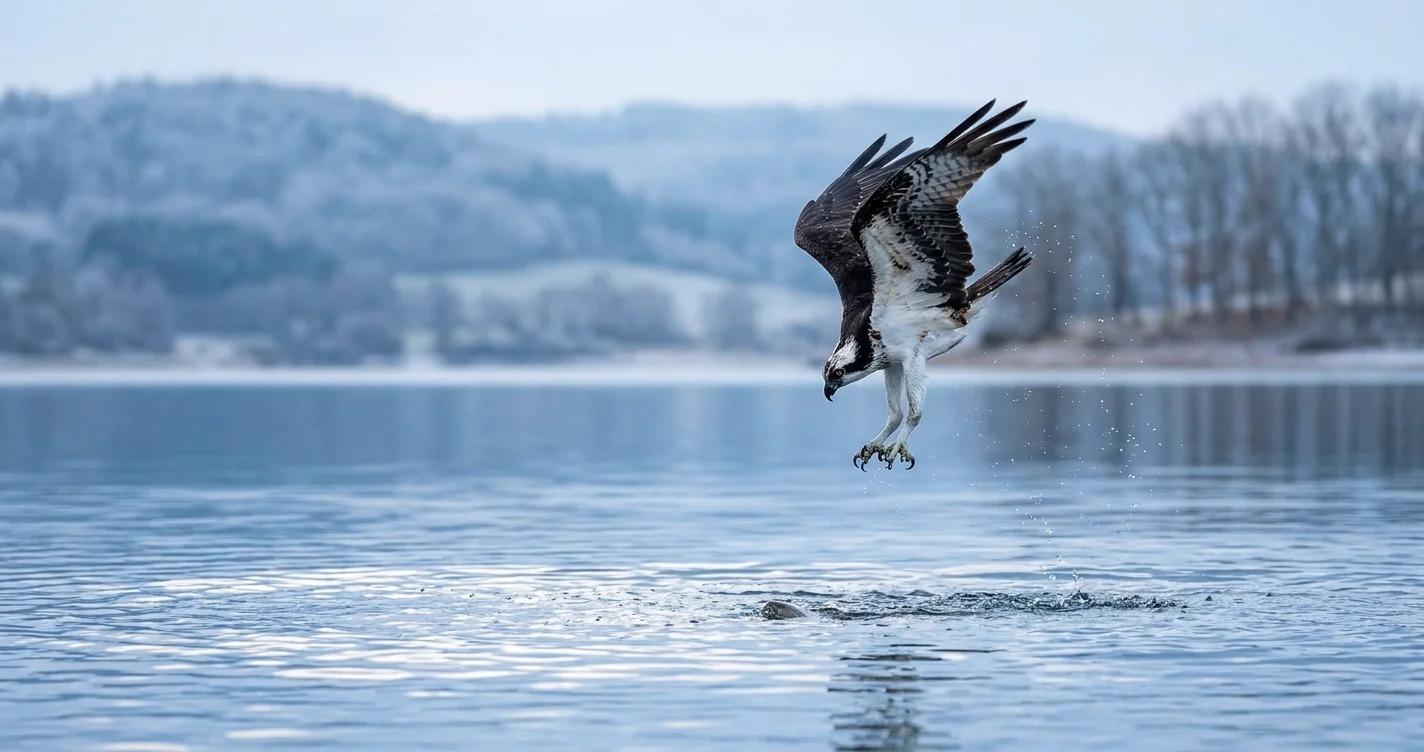
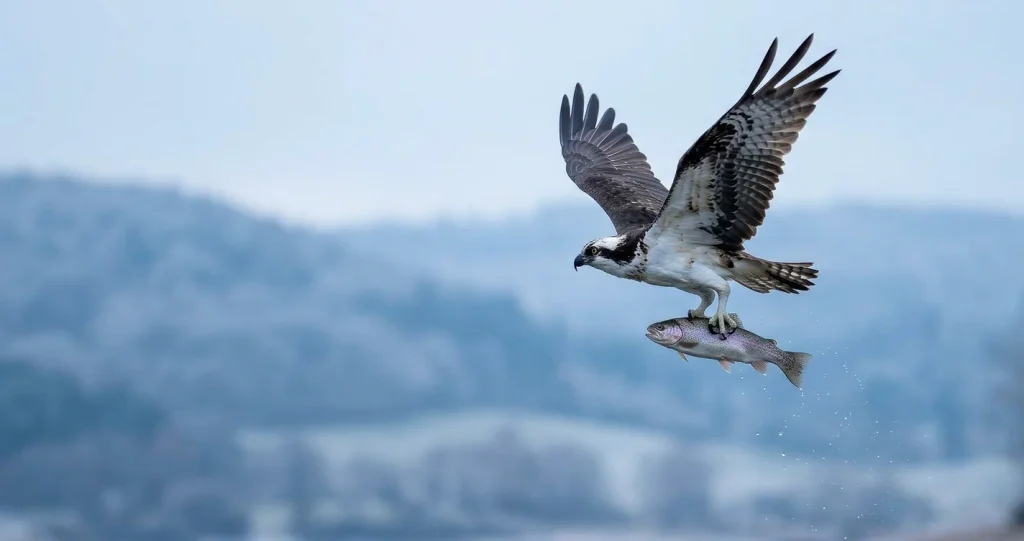
A large bird plunges toward a lake, disappears into a splash of water, and rises moments later with a fish locked in its talons. As it flies away, something remarkable happens: the fish turns until its head points forward, reducing resistance against the rushing air.
This is osprey fishing, one of the most spectacular hunting behaviors in the bird world.
The osprey (Pandion haliaetus) is a specialized fish-eating raptor found across much of North America and many other parts of the world. Unlike most hawks, it relies overwhelmingly on fish for its diet. Its eyes, feet, feathers, and flight behavior all contribute to an extraordinary fishing technique.
But catching a slippery fish while diving from the sky is only half the challenge. The osprey must also hold its prey securely, escape the water, and carry its catch to a safe feeding place.
Understanding how it accomplishes these tasks reveals an impressive example of adaptation in the natural world.
Table of Contents
- Meet the Osprey: A Hawk Built for Fishing
- Where Ospreys Live and Hunt
- How Osprey Fishing Works: From Dive to Delivery
- The Remarkable Anatomy of an Osprey’s Feet
- What Ospreys Eat and How They Feed
- How to Identify an Osprey in Flight
- Ospreys and the Health of Aquatic Ecosystems
- In Your Own Yard: Helping Ospreys and Water Birds
- Frequently Asked Questions
Meet the Osprey: A Hawk Built for Fishing
At first glance, an osprey resembles a large hawk with long wings and a pale underside. Look more closely, however, and its specialized lifestyle becomes obvious.
Adult ospreys typically have dark brown upperparts, white underparts, and a distinctive dark stripe running through each eye. Their long wings often appear bent at the wrists during flight, producing a recognizable M-shaped silhouette.
The species belongs to the family Pandionidae and is the only living species commonly recognized in the genus Pandion.
Although people sometimes call it a fish hawk, the osprey is sufficiently distinctive to be placed in its own family.
A Raptor With an Unusual Diet
Most familiar hawks hunt a variety of animals, including rodents, birds, reptiles, and insects.
Ospreys are different.
Fish make up nearly all of their diet in most locations. This specialization shapes where they live, how they hunt, and even the structure of their feet.
An osprey may occasionally take other prey, but fish remain its principal food source.
Why Ospreys Are So Widely Distributed
Ospreys occur on every continent except Antarctica.
In North America, they breed around many lakes, rivers, reservoirs, wetlands, and coastal waters.
Some populations migrate long distances between breeding and wintering areas, while others remain in suitable regions throughout the year.
Their broad distribution reflects their ability to exploit many aquatic environments where accessible fish are available.
Where Ospreys Live and Hunt
Ospreys are closely associated with water, but they do not require a single type of aquatic habitat.
They can hunt over freshwater lakes, tidal estuaries, coastal bays, rivers, and reservoirs.
What matters most is access to suitable fish and conditions that allow the birds to locate and capture them.
Clear Water Can Improve Hunting Opportunities
Ospreys commonly hunt by looking down into the water from the air.
Water clarity, surface glare, wave conditions, and fish depth can influence their ability to detect prey.
In relatively clear, calm water, fish near the surface may be easier to locate.
However, ospreys also hunt successfully in many environments where visibility changes throughout the day.
Perches and Nesting Structures
Ospreys often use tall trees, poles, platforms, and other elevated structures for nesting or resting.
Their nests can become large accumulations of sticks reused or rebuilt over multiple seasons.
In some regions, artificial nesting platforms provide suitable alternatives where natural nest sites are limited or where birds might otherwise nest on hazardous utility equipment.
The location and construction of such platforms require careful planning.
How Osprey Fishing Works: From Dive to Delivery
Watching an osprey hunt can feel like witnessing a carefully coordinated aerial maneuver.
Yet the process is not always smooth. Ospreys may abandon dives, miss fish, or make repeated attempts before capturing prey.
A successful hunt involves several distinct stages.
Step 1: Searching From Above
An osprey often patrols over water with steady wingbeats, scanning the surface for movement.
It may circle, slow down, or briefly hover while examining a promising location.
Its forward-facing attention and excellent visual abilities help it track potential prey beneath the surface.
The bird must also account for the way light bends as it passes between water and air.
This refraction makes submerged objects appear displaced from their actual positions.
Step 2: Positioning for the Dive
After selecting a target, the osprey adjusts its flight path.
It may pause in a hover before beginning its descent.
As it dives, the bird changes the position of its wings and extends its legs toward the water.
Its feet are directed toward the fish, preparing for a forceful grab.
Unlike plunge-diving seabirds that routinely enter the water headfirst, ospreys generally strike with their feet first.
Step 3: Entering the Water
The osprey hits the water with its talons extended.
Depending on the height of the dive and the location of the fish, the bird may become partly or almost completely submerged.
Its wings can spread across the water’s surface as it attempts to secure the catch.
Water entry is a demanding moment because the bird must maintain its grip while coping with the impact and resistance of the water.
Step 4: Gripping the Fish
An osprey’s feet are exceptionally well adapted to holding slippery prey.
Its toes are strong, and the undersides contain rough, pointed scales known as spicules.
These structures help increase friction against the fish’s body.
The bird’s long, sharply curved talons penetrate and hold its prey.
Together, these adaptations make it possible to retain a fish that would be difficult for many other birds to grasp.
Step 5: Lifting Off
Once the fish is secured, the osprey must escape the water.
It uses powerful wingbeats to rise, sometimes appearing to struggle momentarily against the water’s resistance.
A large fish can make takeoff particularly challenging.
Not every attempt succeeds. An osprey may lose its catch or abandon a difficult capture.
Successful lift-off depends on several factors, including prey size, water conditions, and the bird’s ability to maintain a secure grip.
Step 6: Turning the Fish Headfirst
One of the most recognizable moments in osprey fishing occurs after the bird leaves the water.
The osprey often adjusts its grip so the fish points headfirst in the direction of flight.
This streamlined position can reduce aerodynamic drag compared with carrying the fish sideways.
It is a striking example of how prey handling continues after the actual capture.
The osprey may then transport the fish to a perch or nest, where it can feed or deliver food to its young.
The Remarkable Anatomy of an Osprey’s Feet
The osprey’s feet are among its most specialized hunting tools.
They are not simply oversized versions of ordinary songbird feet.
Several anatomical features work together to improve the bird’s grip.
A Reversible Outer Toe
Ospreys have a reversible outer toe, allowing them to arrange their toes with two pointing forward and two backward.
This configuration is called a zygodactyl-like grip.
It provides a secure hold around slippery fish.
The osprey can adjust its toe arrangement according to the task, making its feet particularly versatile.
Rough Scales for Extra Grip
The undersides of an osprey’s toes contain small, sharp projections called spicules.
These help the bird maintain contact with wet, slippery prey.
The projections are especially useful because fish have smooth bodies that can be difficult to restrain.
Strong Curved Talons
Osprey talons are long and sharply curved.
They help pierce and hold prey during capture, takeoff, and flight.
The combined effect of reversible toes, spicules, and strong talons gives the osprey an effective natural gripping system.
Feathers Adapted to a Watery Lifestyle
Ospreys have plumage that helps them cope with repeated contact with water.
Their feathers provide some resistance to wetting, although they are not completely waterproof.
After fishing, an osprey may shake water from its body during flight.
Its nostrils also have adaptations that help reduce water entry during a dive.
These features complement the specialized feet and hunting behavior.
What Ospreys Eat and How They Feed
Fish dominate the osprey’s diet, but the particular species taken depends on local availability.
Freshwater populations may catch fish from lakes and rivers, while coastal birds exploit marine and estuarine species.
Choosing Accessible Fish
Ospreys often catch fish swimming relatively close to the surface.
They are not deep-diving birds and generally rely on prey within reach of a plunge from the air.
The size of captured fish varies considerably.
A fish must be large enough to provide worthwhile food but manageable enough for the bird to lift and carry.
Feeding on a Perch
After capturing a fish, an osprey may fly to a tree, pole, or other elevated perch.
It commonly uses its feet to hold the fish while tearing pieces away with its hooked bill.
At an active nest, adults may carry fish to their young.
Food delivery and feeding behavior change as chicks develop and become more capable of handling prey themselves.
How to Identify an Osprey in Flight
Ospreys are distinctive once you learn a few field marks.
Look for Long, Angled Wings
Their wings are long and relatively narrow.
In flight, the wrists often appear bent, giving the wings an angular shape.
This differs from the broad, rounded appearance of many soaring hawks.
Notice the White Underside
An osprey typically shows pale underparts contrasting with darker wing patches.
The head is largely white, with a bold dark stripe extending through the eye.
This facial pattern is one of its most useful identification features.
Watch the Hunting Technique
An osprey hovering over water before diving feetfirst is displaying a highly characteristic hunting behavior.
Other raptors may catch fish, but the osprey’s repeated aerial searches and dramatic plunges are especially distinctive.
Behavior should be considered alongside plumage and body shape for reliable identification.
Ospreys and the Health of Aquatic Ecosystems
Ospreys depend heavily on aquatic food webs.
Their survival and reproduction are influenced by fish availability, suitable nesting locations, and environmental conditions.
Because fish can accumulate certain contaminants, ospreys may also be affected by pollution moving through aquatic ecosystems.
A Conservation Success With Important Lessons
During the twentieth century, some North American osprey populations declined because of environmental contaminants, particularly DDT and related compounds.
These substances interfered with successful reproduction in many birds of prey.
Following restrictions on DDT and conservation efforts, numerous osprey populations recovered.
Their recovery is often cited as an important example of how environmental protections can benefit wildlife.
However, regional threats remain, including habitat disturbance, collisions, entanglement, and certain contaminants.
Why Healthy Waterways Matter
Healthy aquatic habitats support fish populations and the many organisms connected to them.
Protecting water quality, shorelines, wetlands, and natural vegetation benefits more than one charismatic bird.
It supports the broader ecological communities on which ospreys depend.
In Your Own Yard: Helping Ospreys and Water Birds
Most backyard gardens are not suitable osprey nesting habitats.
However, homeowners living near lakes, rivers, or coastal areas can take practical steps to reduce wildlife hazards.
Protect Natural Shoreline Vegetation
Native shoreline plants help stabilize soil and can reduce erosion.
Vegetated buffers may also help filter runoff before it enters waterways.
Where possible, preserve natural shoreline habitat rather than replacing it entirely with lawns or hard surfaces.
Reduce Fishing-Line Hazards
Discarded fishing line can entangle birds and other wildlife.
Collect used line and dispose of it through appropriate recycling or waste programs.
Never leave hooks, tackle, or loose line near water.
This simple action can reduce preventable injuries.
Respect Active Nests
Ospreys may become sensitive to disturbance around occupied nests.
Observe from a distance, especially during incubation and chick-rearing periods.
Avoid approaching nests for photographs or attempting to feed the birds.
In the United States, ospreys are protected under the Migratory Bird Treaty Act.
Support Clean Water
Reduce unnecessary fertilizer and pesticide runoff from your property.
Maintain vegetation where rainwater flows toward streams, ponds, or wetlands.
Use locally appropriate landscaping practices that help keep soil and pollutants out of waterways.
These actions can support aquatic life even if an osprey never visits your yard.
Frequently Asked Questions
1. Do Ospreys Always Catch Fish When They Dive?
No. Ospreys sometimes miss their targets or abandon an attempt before entering the water.
Hunting success varies with conditions such as fish availability, water clarity, weather, and individual experience.
Repeated dives are a normal part of osprey hunting behavior.
2. Why Do Ospreys Carry Fish Headfirst?
Ospreys often rotate captured fish so the head points in the direction of flight.
This orientation can reduce air resistance, making the fish easier to transport.
It is one of the most distinctive features of their prey-handling behavior.
3. Can Ospreys Swim?
Ospreys can become substantially submerged while catching fish and use their wings to regain the surface and take off.
However, they are not specialized swimming birds like ducks or loons.
Their hunting strategy depends on capturing fish from the air and returning to flight.
Conclusion
A fish disappears beneath the surface, a bird drops from the sky, and moments later a powerful raptor rises with its catch.
What appears to be a single dramatic movement is actually a sequence of specialized actions.
From spotting prey through the water to diving feetfirst, gripping with rough-scaled toes, and carrying fish in a streamlined position, osprey fishing combines remarkable anatomy with precise behavior.
The osprey reminds us that even familiar landscapes can hold extraordinary natural events.
The next time you visit a lake, river, or coastal wetland, watch the sky above the water. That sudden splash may be the beginning of one of nature’s most impressive aerial fishing displays.
External Sources
1. Osprey : Explains reversible toes, gripping spicules, water-related adaptations, and recovery following DDT restrictions.
National Wildlife Federation, Read the National Wildlife Federation profile
2. Osprey Field Guide : Supports feet-first dives, carrying fish headfirst, range, identification, and conservation history.
National Audubon Society, Read Audubon’s osprey field guide
3. Osprey Species Profile : Provides explanations of specialized feet, diving behavior, and carrying fish with reduced drag.
National Park Service, Read the National Park Service profile