
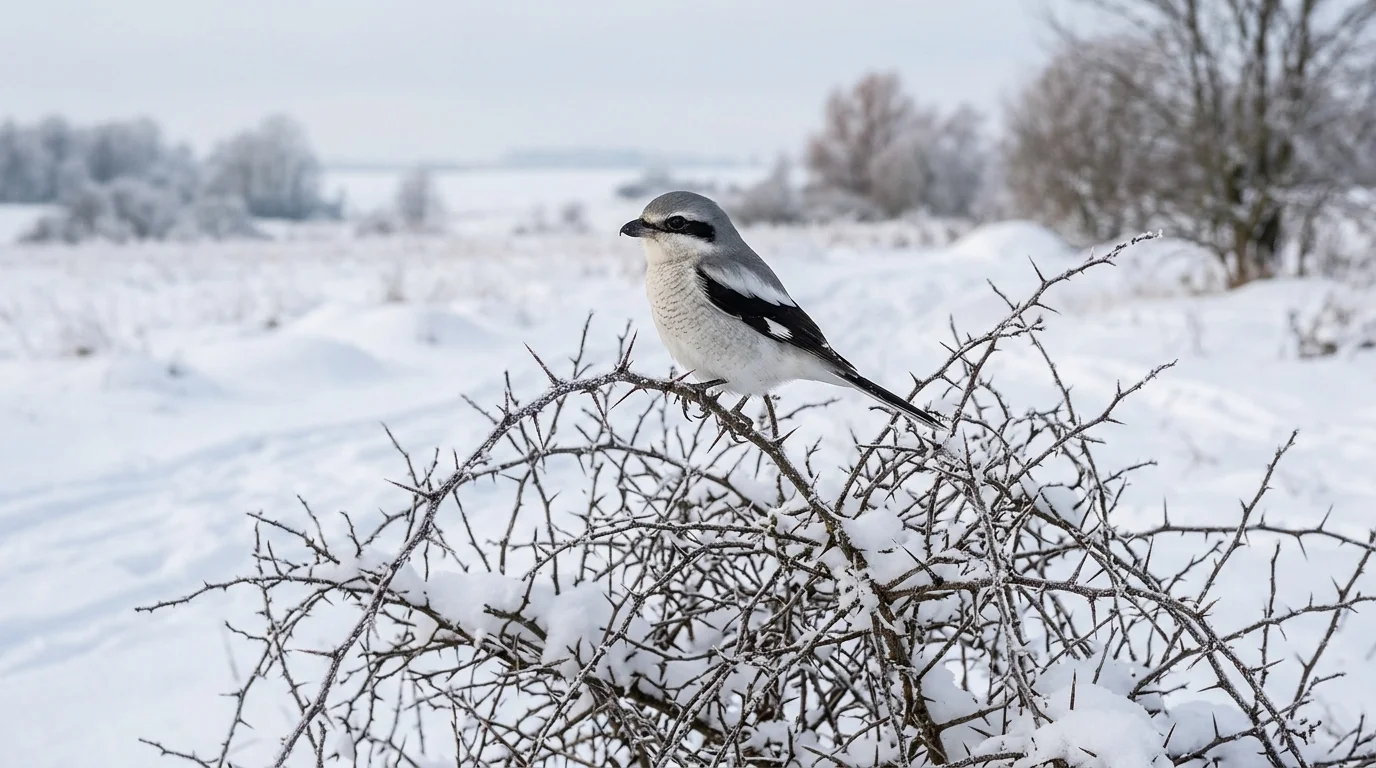
Imagine walking past a thorny shrub on a cold winter morning and noticing something unexpected: a small mouse or insect caught on a sharp branch. It might look like the work of a mysterious predator, but the hunter responsible could be a songbird.
Meet the northern shrike, one of North America’s most fascinating winter visitors. With its handsome gray feathers, black facial mask, and surprisingly predatory habits, this bird challenges almost everything we expect from a songbird.
Unlike hawks and owls, the northern shrike belongs to a family of perching birds. Yet it hunts small mammals, birds, and insects, sometimes securing its prey on thorns or sharp twigs. This unusual behavior has earned shrikes the memorable nickname butcherbirds.
Behind that dramatic reputation lies a remarkable story of adaptation, survival, and the surprising complexity of nature.
Table of Contents
- Meet the Northern Shrike
- Where Northern Shrikes Live
- Why Northern Shrikes Hang Food on Thorns
- What Northern Shrikes Eat
- How to Identify a Northern Shrike
- Northern Shrikes and Their Role in Nature
- In Your Own Yard: Supporting Winter Wildlife
- Frequently Asked Questions
Meet the Northern Shrike: A Songbird With a Hunter’s Instincts
The northern shrike (Lanius borealis) is a medium-sized predatory songbird belonging to the shrike family, Laniidae.
At first glance, it resembles an unusually large, gray songbird. Its upperparts are mostly gray, its underside is pale, and a striking black mask stretches across its face. Black wings marked with white patches and a relatively long tail complete its distinctive appearance.
Its most revealing feature, however, is its bill.
Rather than the simple, slender beak typical of many insect-eating songbirds, the northern shrike has a strong, hooked bill. Near the tip is a specialized projection that helps it handle and dispatch prey.
This adaptation gives the bird a hunting advantage despite its relatively small size.
Why Is It Called a Butcherbird?
The nickname comes from the shrike’s habit of fastening prey to sharp objects, including thorns, pointed branches, and sometimes barbed wire.
The result can resemble food hanging in a butcher’s shop, although the bird’s reasons are entirely practical.
Shrikes are unusual among songbirds because they routinely capture vertebrate prey. Their behavior demonstrates that familiar bird categories do not always predict how an animal makes its living.
Is the Northern Shrike Really a Songbird?
Yes. Northern shrikes are passerines, belonging to the same broad order as sparrows, finches, and many other familiar backyard birds.
They also produce vocalizations and songs, although their hunting behavior often attracts more attention than their voices.
Their combination of songbird ancestry and predatory behavior makes them especially interesting to birdwatchers and wildlife researchers.
Where Northern Shrikes Live
Northern shrikes breed primarily in northern environments, including boreal forest edges, open woodland, and tundra-like habitats across parts of Alaska and Canada.
These landscapes often provide scattered shrubs, low trees, and open hunting areas.
During colder months, some northern shrikes move south into parts of the northern United States. Their winter distribution varies from year to year, influenced by conditions and food availability.
Winter Visitors to the United States
For many American birdwatchers, winter offers the best opportunity to encounter a northern shrike.
Look for them in open habitats such as brushy fields, grasslands, wetland edges, and agricultural landscapes with scattered trees.
A shrike may perch prominently on the top of a shrub or a utility wire, scanning the ground for movement.
Its upright posture and habit of watching from exposed perches can make it noticeable even from a distance.
Why Open Landscapes Matter
Northern shrikes often hunt by watching an open area from a suitable perch.
Dense vegetation can conceal potential prey, while completely treeless landscapes may provide fewer elevated observation points.
A mixture of open ground, shrubs, and scattered perches creates opportunities for both hunting and shelter.
This relationship between habitat structure and hunting behavior helps explain why shrikes are frequently associated with edges and open country.
Why Northern Shrikes Hang Food on Thorns
The most remarkable part of northern shrike behavior is not simply that it catches other animals. It is what the bird sometimes does after making a capture.
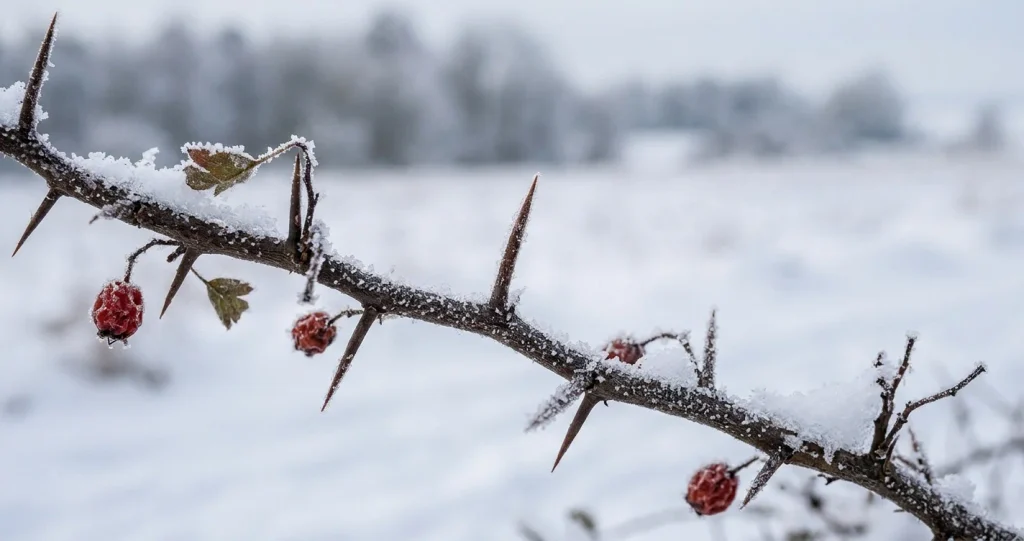
A shrike may carry its prey to a thorny shrub and secure it on a sharp projection. This behavior is known as impaling.
Although it looks dramatic, impaling serves several useful purposes.
1. A Practical Way to Hold Prey
Unlike hawks and falcons, shrikes lack the powerful grasping talons typically associated with birds of prey.
Their feet are useful for perching and holding objects, but they are less specialized for restraining struggling prey.
Securing an animal against a thorn or forked branch can provide a stable anchor.
This allows the shrike to pull apart food with its hooked bill more effectively.
For a relatively small predator, the ability to hold prey securely can make handling difficult food much easier.
2. Creating a Temporary Food Cache
Sometimes a shrike leaves captured prey attached to a thorn or another suitable surface.
This creates a food cache, a stored meal that the bird may return to later.
Caching can be especially useful when hunting opportunities fluctuate.
A successful hunting period may provide more food than the bird immediately needs. Storing some of that food can help it take advantage of the opportunity.
Not every impaled animal is necessarily saved for later, however. Some prey is secured mainly to make eating easier.
3. Making Large Prey Easier to Handle
A mouse or another small bird can be a substantial meal for a northern shrike.
Even after capture, such prey may be difficult to manipulate.
By fastening it to a thorn or branch, the shrike can use its bill to remove manageable portions.
This method partly compensates for the bird’s lack of raptor-like feet.
The behavior is an example of how animals can solve physical challenges through specialized actions rather than relying on size or strength alone.
4. Using the Landscape as a Tool
A thorny shrub is more than a place to perch.
For a northern shrike, it can function as a natural food-handling station.
Shrikes may also use pointed twigs, branch forks, and human-made objects such as barbed wire.
The important feature is a structure capable of securing prey.
This does not mean the bird consciously designs a tool in the human sense. Rather, its behavior makes effective use of features already present in the environment.
5. Why This Behavior Matters in Winter
Cold weather can make food availability unpredictable.
Small mammals may remain beneath snow or vegetation, insects become less accessible, and hunting success can vary.
Food caching may help northern shrikes manage some of this uncertainty.
However, the importance of caching can differ with local conditions, prey availability, and individual behavior.
The thorn is therefore both a feeding aid and, in some circumstances, a convenient place to store food.
What Northern Shrikes Eat
Northern shrikes are opportunistic predators whose diet changes with season, habitat, and available prey.
Small Mammals
Voles, mice, and other small rodents can be important prey, particularly during colder periods.
A shrike may watch from an elevated perch before flying toward movement on the ground.
Its ability to capture relatively large prey is impressive for a bird of its size.
Small Birds
Northern shrikes sometimes hunt other birds.
Potential prey includes small songbirds encountered in open habitats.
Their ability to pursue and capture birds distinguishes them from many familiar backyard insectivores.
Insects and Other Invertebrates
Large insects can also form part of the diet, especially when they are seasonally abundant.
Grasshoppers, beetles, and other invertebrates may provide accessible meals during warmer periods.
This flexibility allows northern shrikes to exploit different food sources across their broad range.
How to Identify a Northern Shrike
A northern shrike can resemble several other gray birds, particularly the closely related loggerhead shrike.
Careful observation is useful because identification can be challenging where their ranges overlap.
Look for the Black Mask
Northern shrikes have a dark facial mask that contrasts with their pale gray head.
Compared with the loggerhead shrike, the northern shrike often shows a narrower mask, with pale markings around the eye and bill.
These differences can be subtle, especially at a distance.
Notice the Bill and Body Shape
The northern shrike has a sturdy, hooked bill and a relatively long tail.
Its gray upperparts, pale underside, and white wing markings help distinguish it from unrelated songbirds.
Some individuals show fine barring on the underside, particularly younger birds.
Watch Its Behavior
Behavior can provide valuable clues.
A bird sitting upright on an exposed perch, repeatedly scanning open ground, and making sudden hunting flights may be worth examining closely.
However, behavior alone cannot reliably separate northern shrikes from other shrike species.
Photographs showing the head, bill, wings, and tail are particularly helpful for identification.
Northern Shrikes and Their Role in Nature
The northern shrike occupies an interesting position in northern food webs.
It is a predator of small mammals, birds, and insects, yet it is itself small enough to face threats from larger predators.
By feeding on several types of prey, it participates in the natural movement of energy through its habitat.
Its presence also highlights the ecological value of open landscapes with native shrubs, grasses, and scattered trees.
More Than a Winter Curiosity
A shrike perched above a snowy field may seem like an isolated hunter.
In reality, it is connected to the entire surrounding ecosystem.
Rodent populations, insect abundance, vegetation structure, weather, and available perches can all influence its opportunities to find food.
Protecting habitat diversity supports these ecological relationships, including species that people rarely notice.
In Your Own Yard: Supporting Winter Wildlife
Northern shrikes are not typical backyard feeder birds, and most American gardens will never host one.
Still, a wildlife-friendly property can support the broader habitat features that benefit native birds and other animals.
Preserve Native Shrubs and Natural Edges
Where appropriate, maintain native shrubs, hedgerows, and patches of natural vegetation.
These features can provide cover, nesting opportunities, and habitat for insects and small animals.
Native plant choices should match your region and growing conditions.
Leave Some Natural Habitat Undisturbed
A completely cleared yard offers fewer hiding places and overwintering sites for many wildlife species.
Leaving selected areas of leaf litter, grasses, and standing vegetation can support invertebrates and other organisms.
Avoid unnecessary disturbance of active nests and wildlife shelters.
Observe Without Interfering
If you encounter a northern shrike, watch from a respectful distance.
Binoculars or a camera with a telephoto lens can reveal its hunting behavior without requiring close approach.
Never place live animals, meat, or other food near a shrike to encourage a dramatic photograph.
If you discover impaled prey, leave it undisturbed. The bird may return to feed.
Reduce Preventable Hazards
Keep domestic cats safely contained or supervised, particularly in areas used by wild birds.
Use bird-friendly window treatments where collisions are a concern.
Limit unnecessary pesticide applications, and prioritize habitat management that supports native biodiversity.
These actions benefit many species, even where northern shrikes are uncommon.
Frequently Asked Questions
1. Do Northern Shrikes Really Impale Their Prey?
Yes. Northern shrikes sometimes secure prey on thorns, pointed branches, or other sharp objects.
This helps them handle food and may also allow them to store meals temporarily.
The behavior is natural and serves practical feeding functions.
2. Are Northern Shrikes Dangerous to Humans?
Northern shrikes are not considered a danger to people.
Their hunting adaptations are directed toward relatively small prey animals.
As with any wild bird, they should be observed without handling or disturbing them.
3. Can Northern Shrikes Be Seen in American Backyards?
Occasionally, especially where properties border open fields, grasslands, or brushy habitats.
They are generally more likely to be encountered in suitable open country than in densely developed neighborhoods.
Winter birdwatching trips through appropriate habitat often provide better opportunities than waiting beside a backyard feeder.
Conclusion
A small animal fastened to a thorn might seem like one of nature’s strangest mysteries.
But the northern shrike reveals a practical explanation behind the scene.
This remarkable songbird uses its hooked bill, keen observation, and specialized feeding behavior to hunt in environments where survival can be challenging.
Its habit of impaling prey demonstrates how an animal can turn an ordinary feature of its surroundings into a useful feeding aid.
The next time you explore a winter field or pass a thorny hedgerow, look carefully at the highest branches. A quiet gray bird wearing a black mask may be watching the landscape below.
And somewhere nearby, a thorn may be holding the evidence of its latest hunt.
External Sources
1. Northern Shrike Life History
Covers diet, hunting techniques, prey impaling, and caching. All About Birds
Cornell Lab of Ornithology, Read Cornell’s species account
2. Northern Shrike Field Guide
Supports winter range, habitat preferences, diet, and feeding behavior. Audubon Field Guide, National Audubon Society, Read Audubon’s field guide.
3. What Makes Shrikes So Unique?
Explains the butcherbird nickname, predatory habits, and identification differences between shrike species. American Bird Conservancy
American Bird Conservancy, Read the American Bird Conservancy article
4. Northern Shrike IdentificationCategory
Provides physical characteristics, size, markings, habitats, and identification guidance. All About Birds, Cornell Lab of Ornithology, View identification details
5. 10 Fun Facts About the Northern Shrike
Published October 22, 2026. Additional information about prey handling, winter ecology, and shrike biology. Audubon.
National Audubon Society, Read Audubon’s recent feature