
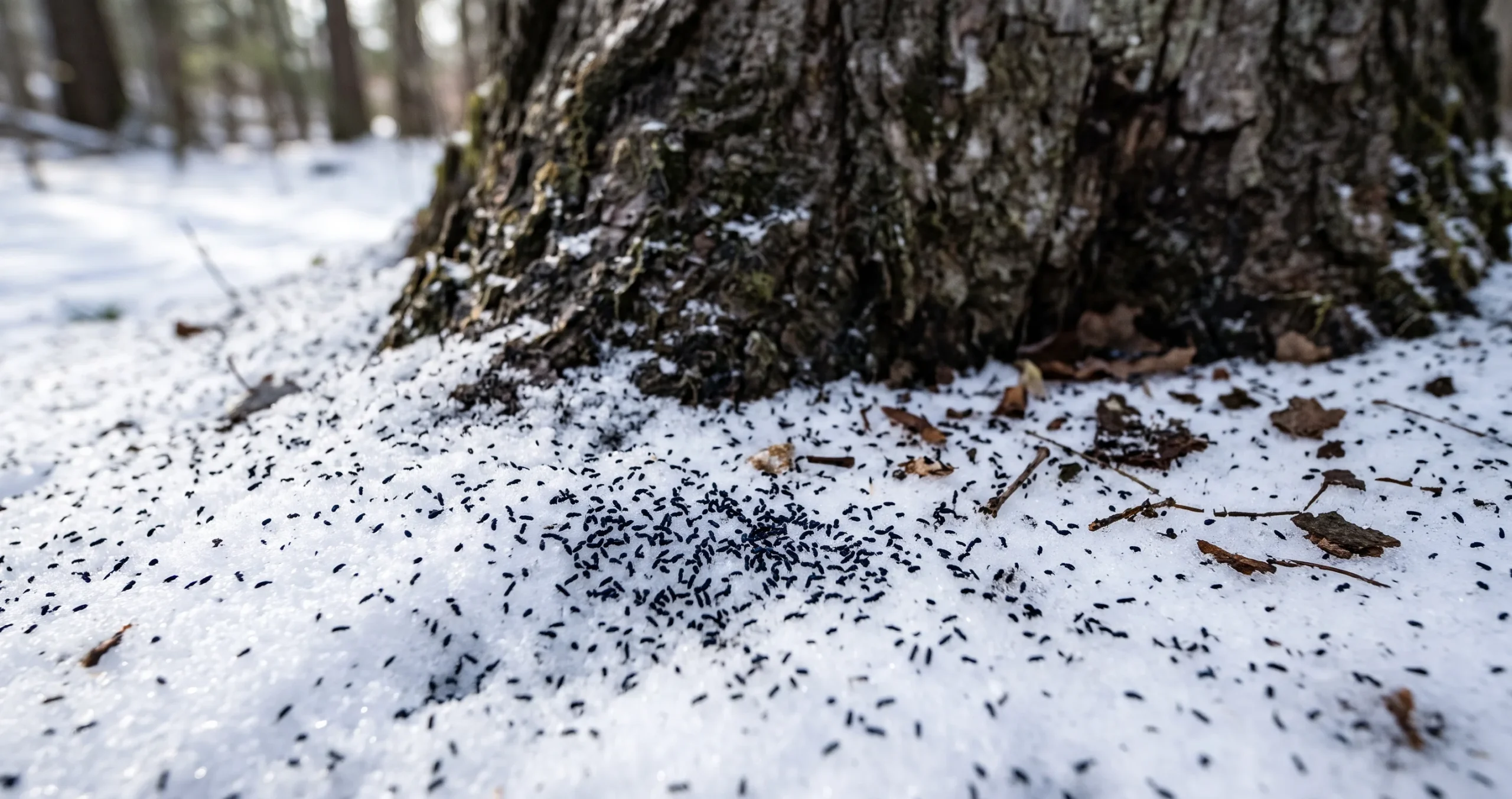
Imagine walking through a quiet, snow-covered forest when something unusual catches your eye. The white snow beneath your boots appears sprinkled with black pepper. Then, suddenly, some of those tiny dark specks begin to jump.
The snow is alive.
These remarkable creatures are commonly called snow fleas, but they are not fleas at all. They are tiny springtails, soil-dwelling animals that sometimes emerge in astonishing numbers on the surface of winter snow.
While most insects remain hidden during freezing weather, snow fleas can become surprisingly active on milder winter days.
Their appearance reveals a fascinating world beneath the snow, where microscopic life continues even when the landscape seems completely frozen.
From their extraordinary jumping mechanism to their unusual cold tolerance, snow fleas demonstrate how much life can remain active during winter.
Table of Contents
- What Are Snow Fleas?
- Why Snow Fleas Appear on Winter Snow
- How Snow Fleas Jump and Survive the Cold
- Are Snow Fleas Dangerous to People or Pets?
- Where Snow Fleas Live Throughout the Year
- Why Snow Fleas Matter to Forest Ecosystems
- In Your Own Yard: Finding Snow Fleas
- Snow Fleas and Other Tiny Winter Creatures
- Frequently Asked Questions
What Are Snow Fleas?
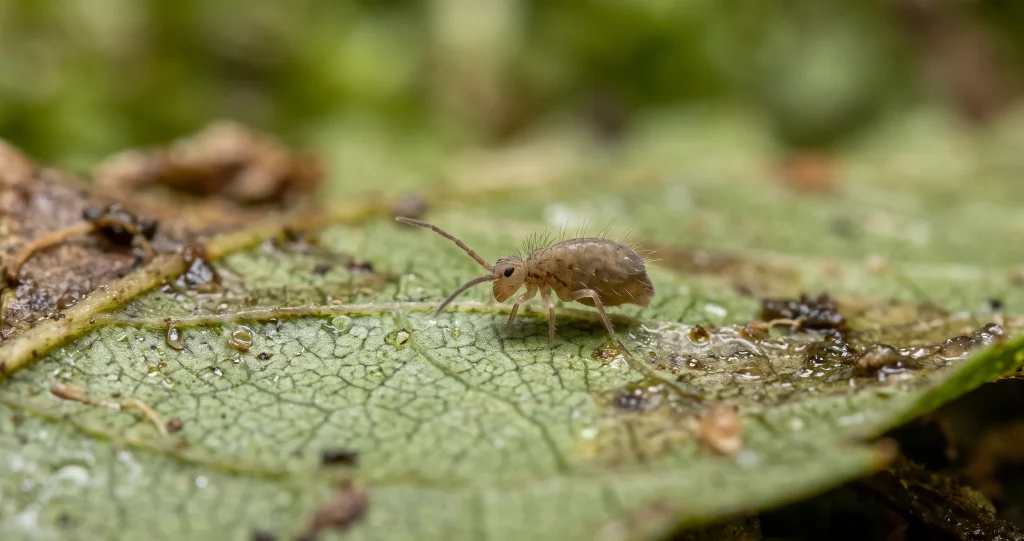
Snow fleas are small, wingless arthropods belonging to a group called springtails, scientifically known as Collembola.
Despite their common name, they are not true fleas.
True fleas are insects that feed on the blood of mammals and birds. Springtails belong to a separate evolutionary lineage of six-legged arthropods and generally feed on microscopic organic material.
One familiar North American snow flea is Hypogastrura nivicola, a dark-colored springtail associated with snowy woodland environments.
However, the name “snow flea” is sometimes applied to several cold-active springtail species.
Tiny Creatures With a Big Presence
Most snow fleas are extremely small, often measuring only a few millimeters or less.
Their bodies are usually dark blue, purple, or nearly black, although coloration varies among species.
Individually, they are easy to overlook.
When hundreds or thousands gather on snow, however, they can create noticeable dark patches.
Against a bright white background, even a tiny animal becomes surprisingly visible.
Why They Are Called Springtails
The name springtail refers to a specialized structure found in many members of the group.
This structure, called the furcula, is located beneath the abdomen.
It acts as a spring-loaded jumping device, allowing the animal to launch itself away from danger.
Not every springtail has an equally developed furcula, and jumping ability varies among species.
For snow fleas, however, the mechanism is one of their most recognizable features.
Why Snow Fleas Appear on Winter Snow
Snow fleas are present in woodland environments throughout much of the year.
Yet most people notice them only during winter.
The reason is partly biological and partly visual.
Snow Makes Them Easier to See
During warmer months, springtails often live among soil particles, fallen leaves, decaying wood, and other organic material.
Their dark bodies blend into these surroundings.
Snow changes everything.
Against a clean white surface, the same tiny animals become much easier to notice.
A concentration of springtails that might go completely unnoticed in autumn leaf litter can look dramatic on fresh snow.
Mild Winter Weather Encourages Activity
Snow fleas are often observed during relatively mild winter conditions, particularly when temperatures approach or rise above freezing.
They may become active on the snow surface while the surrounding forest remains covered in ice.
Their activity depends on local temperature, moisture, snow conditions, and the species involved.
Not every warm winter afternoon produces a visible gathering.
Sometimes springtails remain beneath the snow or within the soil, even when conditions seem favorable.
The Hidden World Beneath the Snow
A thick layer of snow can act as insulation.
Although the air above it may become bitterly cold, temperatures near the soil surface can remain more stable.
This sheltered zone beneath the snow is known as the subnivean environment.
It provides habitat for many small organisms during winter.
Springtails can remain active within suitable microhabitats, feeding and moving through moist spaces among soil particles and decomposing plant material.
When conditions allow, some emerge onto the snow surface.
How Snow Fleas Jump and Survive the Cold
The most remarkable thing about snow fleas is not simply that they appear in winter.
It is how their bodies allow them to function in conditions that would immobilize many other small arthropods.
Their survival involves specialized anatomy, behavior, and cold-adaptation mechanisms.
The Furcula: A Built-In Jumping Device
Many springtails possess a forked structure called the furcula beneath the rear portion of their bodies.
When the animal is resting, this structure is usually held against the underside of the abdomen.
A small retaining structure helps keep it in position.
When released, the furcula snaps downward and pushes against the surface.
The springtail is propelled into the air.
This movement can happen so quickly that the animal appears to vanish and reappear nearby.
Unlike the controlled jumping motion of a grasshopper, a springtail’s leap can involve tumbling or rotation.
The primary advantage is often escape.
A sudden jump may help a tiny springtail avoid predators or move away from a disturbance.
Why Their Jumps Look So Dramatic
A springtail may travel a distance many times its own body length.
That sounds extraordinary, but body size matters.
For an animal only a few millimeters long, even a short leap can represent a large distance relative to its size.
On snow, these movements are particularly noticeable.
Dark specks appear to bounce across the white surface, creating the impression that the snow itself is moving.
How Snow Fleas Cope With Freezing Temperatures
Cold tolerance is another fascinating part of snow flea biology.
Some cold-adapted springtails possess physiological mechanisms that help them function in low temperatures.
Researchers have studied antifreeze proteins in the snow flea Hypogastrura nivicola.
These proteins can interact with ice crystals and help limit their growth under certain conditions.
Such adaptations are important because ice formation inside living tissues can damage cells.
However, antifreeze proteins are only one part of cold survival.
Body chemistry, moisture conditions, temperature exposure, and behavior can also influence whether an individual survives freezing weather.
Antifreeze Proteins Are Not Magic
It is tempting to imagine snow fleas as creatures that can survive any amount of cold.
That is not the case.
Cold tolerance has limits, and those limits vary among species and environmental conditions.
Even organisms with specialized cold-adaptation mechanisms can be harmed by sufficiently severe temperatures or prolonged exposure.
Snow fleas also benefit from sheltered environments.
Their ability to survive winter is therefore a combination of physiology and access to suitable microhabitats.
Why They Remain Active When Other Animals Are Hidden
Winter does not completely stop biological activity.
Microorganisms continue functioning in many protected soil environments, and some small invertebrates remain active whenever conditions permit.
Snow fleas are part of this winter ecosystem.
Their presence demonstrates that seasonal dormancy is not universal.
Different organisms have evolved different strategies for coping with cold weather.
Are Snow Fleas Dangerous to People or Pets?
Despite their alarming name, snow fleas are generally harmless to humans and household pets.
They do not behave like the blood-feeding fleas commonly associated with dogs and cats.
They Do Not Feed on Blood
Snow fleas do not need a blood meal.
Their diets generally consist of materials such as decaying organic matter, fungi, microorganisms, and associated microscopic food sources.
Diet varies among springtail species and habitats.
Their mouthparts are adapted to feeding on these materials rather than piercing mammalian skin.
They Are Not Household Flea Infestations
Finding snow fleas outdoors does not mean your pets have fleas.
The two groups are biologically different.
Springtails occasionally appear around damp areas of buildings, but their presence is usually associated with moisture and suitable organic material.
They are not evidence of a blood-feeding parasite problem.
In most outdoor situations, snow fleas can simply be observed and left undisturbed.
Where Snow Fleas Live Throughout the Year
Snow fleas are often associated with snowy forests, but their lives are not limited to the winter surface.
Like many springtails, they depend on moist microhabitats.
Forest Soil and Leaf Litter
The layer of fallen leaves beneath trees provides shelter and food for numerous tiny organisms.
As leaves decompose, fungi and bacteria help break down plant material.
Springtails often live within this complex environment.
Some graze on fungi or microbial growth, while others consume decaying organic particles.
These feeding activities connect springtails to the broader process of decomposition.
Beneath Logs and Around Moss
Moist areas beneath fallen logs, around moss, and within decaying vegetation can also support springtail populations.
Such places provide protection from drying conditions and sudden temperature changes.
Different springtail species occupy different microhabitats.
The particular species seen jumping on snow may not be the same as those commonly found in garden compost or flowerpots.
Seasonal Changes in Activity
Springtail activity changes with temperature and moisture.
Some species are most noticeable during cool, wet weather.
Others are abundant during warmer seasons.
Snow fleas stand out because their winter activity occurs at a time when people expect very little movement outdoors.
Why Snow Fleas Matter to Forest Ecosystems
Snow fleas may be tiny, but they participate in important ecological processes.
Their greatest contribution is not something easily observed with the naked eye.
It happens in the soil.
Helping Organic Matter Break Down
Springtails are members of the soil food web.
Many feed on fungi, microorganisms, and decomposing organic material.
Through feeding and movement, they interact with the organisms responsible for breaking down fallen leaves and other plant remains.
They do not perform decomposition alone.
Instead, they participate in a larger community that includes fungi, bacteria, mites, worms, and many other organisms.
Together, these communities help recycle nutrients through forest soils.
Supporting Other Small Animals
Springtails also serve as prey for various predators.
Depending on habitat and season, spiders, mites, beetles, and other small invertebrates may feed on them.
This makes springtails part of the energy transfer between microorganisms and larger soil animals.
Their ecological importance becomes clearer when viewed as members of an interconnected food web rather than isolated winter curiosities.
A Sign of Life in the Soil
Seeing snow fleas can be a reminder that the ground beneath winter snow is biologically active.
However, their presence alone is not a reliable measurement of soil health.
Springtail populations vary naturally with moisture, habitat, season, and species.
A location without visible snow fleas is not necessarily unhealthy.
In Your Own Yard: Finding Snow Fleas
You do not need to travel deep into a wilderness area to observe these tiny animals.
In suitable parts of the United States, snow fleas may appear in wooded backyards, parks, and gardens near trees.
Look During Mild Winter Weather
Choose a winter day when temperatures are relatively mild and snow remains on the ground.
Examine areas near trees, fallen leaves, and woodland edges.
Small dark patches on the snow may turn out to be groups of springtails.
Watch closely for sudden jumping movements.
A hand lens can help reveal their body shape.
Observe Without Disturbing Their Habitat
Snow fleas are delicate.
Rather than collecting large numbers, observe them where they naturally occur.
Avoid applying pesticides to snow or soil simply because springtails are present.
They generally pose no threat to garden plants, people, or pets.
Make Your Garden Friendly to Soil Life
A garden with healthy soil structure and suitable organic matter can support a diverse community of decomposers.
Consider leaving some fallen leaves beneath shrubs or trees where practical.
Maintain appropriate soil moisture, use mulch thoughtfully, and minimize unnecessary soil disturbance.
These practices can benefit many soil organisms, although they do not guarantee that snow fleas will appear.
The goal is to support a functioning soil ecosystem rather than attract one particular species.
Snow Fleas and Other Tiny Winter Creatures
Snow fleas are not the only small animals capable of activity during winter.
Certain spiders, mites, and insects may also move across snow when conditions are suitable.
Winter Stoneflies
Some stoneflies become active during colder months and may be seen walking on snow near streams.
Unlike snow fleas, adult stoneflies are true insects and usually have wings.
Their appearance and habitat provide useful identification clues.
Other Springtails
Not every springtail seen outdoors in winter is necessarily Hypogastrura nivicola.
Several springtail species can occur in cold environments.
Color, body shape, habitat, and microscopic anatomical features may be needed for accurate identification.
For casual observers, recognizing the animal as a springtail is often more realistic than identifying its exact species.
Frequently Asked Questions
Are snow fleas actually fleas?
No. Snow fleas are springtails, members of the group Collembola. They are not the blood-feeding fleas that infest mammals and birds. Their common name comes from their small size and jumping behavior. They generally feed on fungi, microorganisms, and decomposing organic material rather than blood.
Why do snow fleas appear on top of snow?
Snow fleas may emerge onto snow during suitable winter conditions, often when temperatures become relatively mild. Their dark bodies are highly visible against the white surface. They also live in sheltered soil and leaf-litter environments beneath the snow, where conditions can be more stable than in the exposed winter air.
Should I remove snow fleas from my garden?
Usually, there is no reason to remove them. Snow fleas are generally harmless and participate in soil food webs. They do not bite people or pets and are not considered typical garden pests. Observing them without disturbance is normally the best approach.
Conclusion
The next time you notice what looks like black pepper scattered across fresh snow, look a little closer.
Those moving specks may be snow fleas, tiny springtails equipped with remarkable jumping structures and adaptations for cold weather.
They are not parasites, and they are not signs that something is wrong with the snow.
Instead, they reveal a hidden world of winter activity.
Even when the forest appears silent and frozen, life continues beneath the surface—and sometimes, it jumps right into view.
External Sources
1. University of Minnesota — Snow Flea: Snow Flea: Appearance, Jumping, and Winter Activity.
Explains how snow fleas jump using their furcula, why they appear on melting snow, and how they contribute to soil decomposition.
2. University of Maine — Springtails: Springtails: Identification, Habitat, and Behavior
Describes snow fleas (Hypogastrura nivicola), their appearance on winter snow, feeding habits, and why they are harmless to people.
5. Springer Nature — Alpine Snow Fleas and Winter Ecology
Alpine Blooming of “Snow Fleas”: The Importance of Snow for Alpine Springtails.