
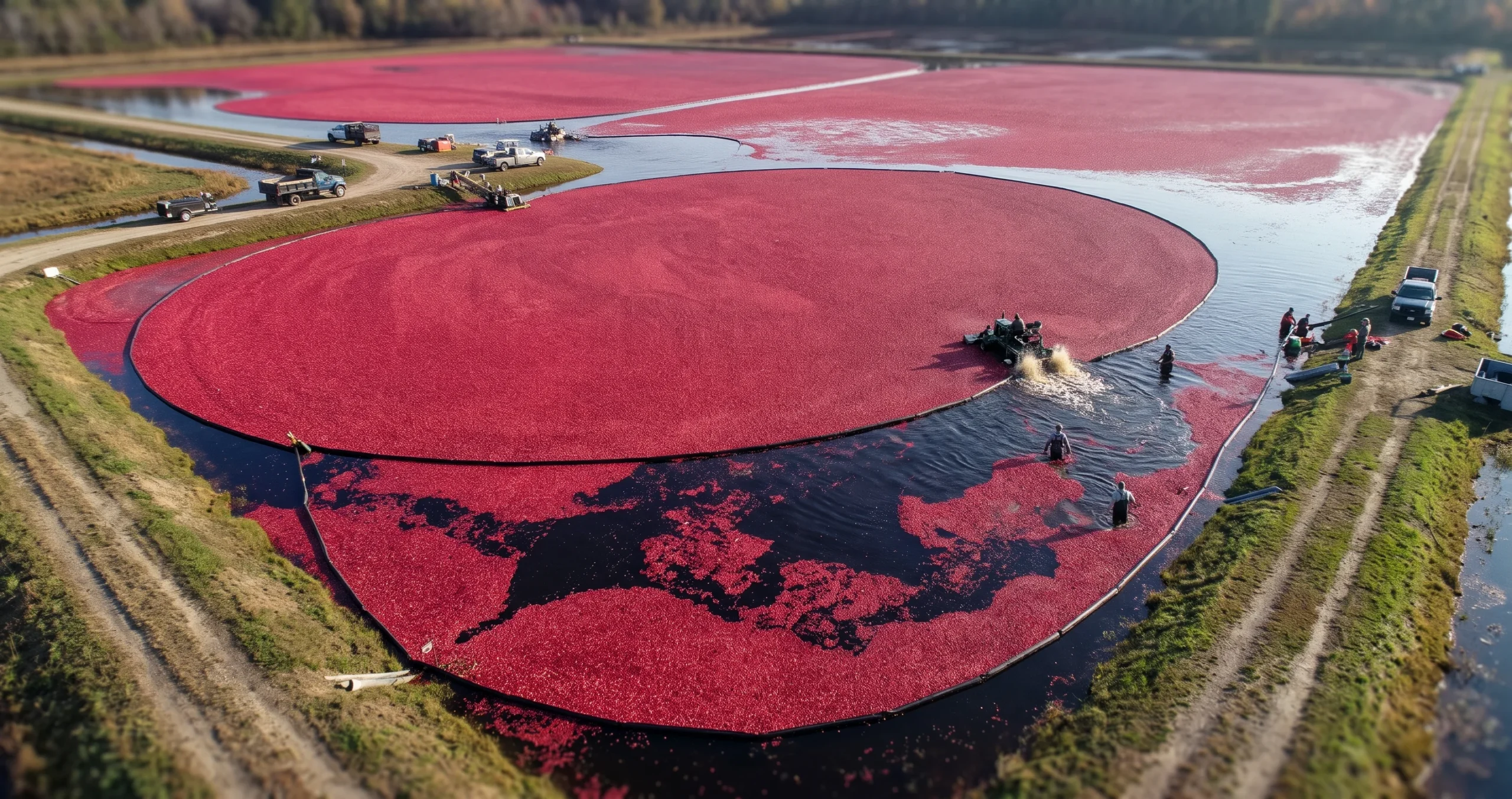
Imagine standing beside a cranberry farm in autumn and watching an entire field turn bright red. Thousands of berries drift across the water, forming a floating carpet that looks almost too colorful to be real.
The surprising part is that cranberries don’t grow underwater.
They grow on low, woody vines rooted in acidic soil. The water comes later, when farmers deliberately flood certain fields to collect the ripe fruit.
This unusual cranberry harvest method combines plant biology, carefully managed water, and specialized farming equipment. Even more fascinating, the berries float because of tiny air-filled spaces hidden inside them.
Understanding how this works reveals why cranberry farming looks so different from harvesting apples, blueberries, or strawberries.
Table of Contents
- Cranberry Harvest: Why Farmers Flood the Bog
- Why Cranberries Float: The Science Behind the Berries
- Cranberry Harvest Process: Step-by-Step Guide
- Wet vs. Dry Cranberry Harvest: Key Differences
- Where Cranberries Are Grown in the United States
- Cranberry Farming and the Surrounding Ecosystem
- In Your Own Yard: Growing Cranberries at Home
- Frequently Asked Questions About Cranberry Harvesting
Cranberry Harvest: Why Farmers Flood the Bog
The famous flooded cranberry fields seen in photographs are part of a method called wet harvesting.
Instead of picking every berry individually, growers temporarily cover the cranberry bed with water. Specialized equipment loosens the ripe berries from their vines, allowing them to rise to the surface.
Farmers then gather the floating fruit into concentrated areas, where it can be collected efficiently.
This technique is especially useful for cranberries destined for processing into juice, sauce, dried fruit, and other products.
However, flooding is not necessary for cranberries to grow. It is a harvesting technique, not their normal growing environment.
Cranberries Grow on Vines, Not in Water
The American cranberry (Vaccinium macrocarpon) is a low-growing evergreen plant native to North America.
Its slender, woody stems spread across the ground, producing upright shoots that carry flowers and fruit.
Cranberry plants thrive in carefully managed beds with acidic growing conditions, suitable drainage, and access to irrigation.
Commercial cranberry farms are often called bogs, although many modern production beds are engineered agricultural systems rather than untouched natural wetlands.
The plants grow in soil, commonly with a substantial sand component, and their roots require oxygen just like those of other terrestrial plants.
Keeping cranberry vines permanently submerged would not create the conditions needed for healthy growth.
Why Water Makes Harvesting Easier
Cranberries are relatively small, and harvesting large fields by hand would require enormous amounts of labor.
Water provides an efficient way to collect berries across a broad area.
Once the ripe fruit is detached from the vines, the berries float upward. Farmers can then move them across the flooded bed rather than collecting them individually from the ground.
The result is one of agriculture’s most visually remarkable harvests.
A flooded cranberry field may appear to be a lake filled with red fruit, but underneath the water, the vines remain rooted in their growing beds.
Why Cranberries Float: The Science Inside Every Berry
The secret behind floating cranberries is hidden beneath their smooth, colorful skin.
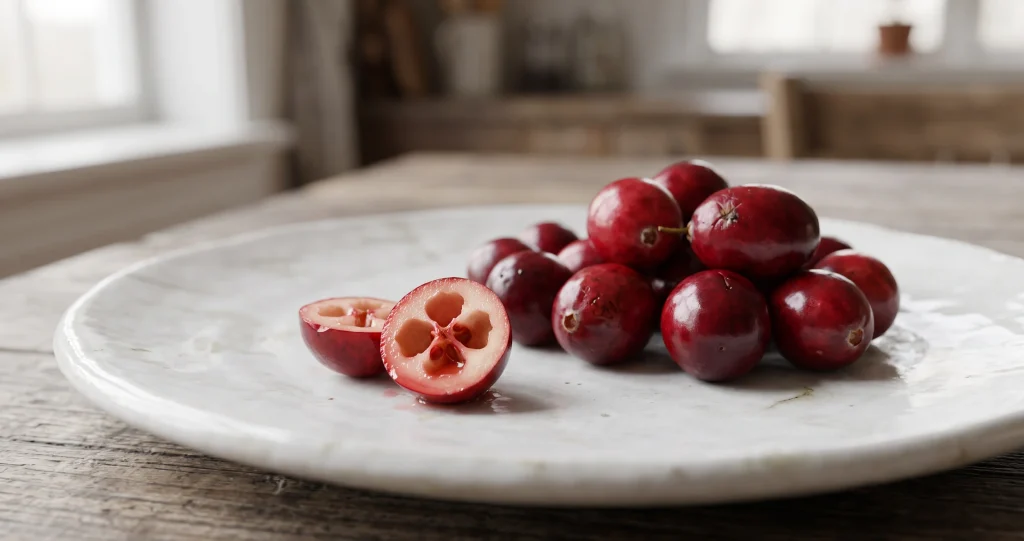
Cut a cranberry in half, and its interior looks surprisingly different from the juicy flesh of a grape.
Inside are small air-filled chambers separated by thin internal tissues.
These spaces help explain why cranberries can float.
Tiny Air Chambers Create Buoyancy
Whether an object floats depends largely on its overall density compared with the liquid surrounding it.
Freshwater has a density of approximately one gram per cubic centimeter under ordinary conditions.
A cranberry contains water, plant tissue, seeds, and internal air spaces.
Because those air spaces contribute volume without adding much mass, the intact berry can have a lower average density than the water around it.
As a result, many sound, ripe cranberries float naturally.
This is the same general principle that allows certain other fruits and lightweight natural materials to remain at the water’s surface.
The berry does not need to produce gas or actively move upward. Its internal structure provides the buoyancy.
The Berry’s Structure Matters
Cranberries belong to the heath family, Ericaceae, which also includes blueberries.
Although these fruits are related, their internal structures differ.
Cranberries are notable for their relatively firm texture and distinct internal chambers.
The fruit’s skin helps enclose its tissues, while the internal air spaces contribute to its floating behavior.
Not every damaged or deteriorating berry will behave identically. Changes in the fruit’s structure can affect its buoyancy.
For farmers, however, the natural tendency of healthy cranberries to float makes wet harvesting practical on a commercial scale.
Why Cranberries Bounce
Cranberries have another unusual characteristic: firm, sound berries can bounce.
Their resilient outer skin and internal structure allow them to rebound when dropped onto a hard surface.
Historically, bouncing was used as part of cranberry sorting. Modern equipment can also use physical differences between fruit to help with grading.
Floating and bouncing are not exactly the same property, but both reflect the distinctive structure of cranberry fruit.
Together, they help explain why cranberries are so different from many familiar berries.
How Farmers Harvest Cranberries Step by Step
A wet cranberry harvest is carefully planned. It involves much more than simply opening a gate and allowing water to cover the field.
Growers must consider fruit maturity, weather, water availability, equipment, and the condition of the vines.
Step 1: Waiting for the Cranberries to Ripen
In major U.S. cranberry-growing regions, harvesting generally takes place during the fall.
The exact timing varies with location, cultivar, and seasonal weather.
As the fruit matures, many varieties develop their familiar red color, although the intensity and distribution of color can differ.
Farmers evaluate the crop before beginning harvest.
Fruit quality, intended use, and local conditions all influence the decision.
Step 2: Flooding the Cranberry Bed
For wet harvesting, growers introduce water into the production bed until the vines are submerged beneath a relatively shallow flood.
The water level must be sufficient for harvesting equipment to operate and for detached berries to float freely.
Commercial farms often have systems of ditches, pumps, gates, and reservoirs that allow growers to manage water levels.
This infrastructure is essential because cranberry production requires water management throughout the year, not only during harvest.
Step 3: Loosening the Berries From the Vines
Once the bed is flooded, growers use specialized harvesting machines.
These machines move through the water and agitate the vines, helping detach ripe fruit.
The equipment is designed to remove berries while limiting unnecessary damage to the plants.
The detached cranberries rise toward the surface because of their natural buoyancy.
Gradually, the flooded bed becomes dotted with floating red fruit.
Step 4: Gathering the Floating Cranberries
Farm workers use floating barriers, often called booms, to corral the berries.
The barriers guide the fruit into a smaller collection area.
As more cranberries accumulate, the water surface becomes densely covered with red berries.
This is the stage commonly photographed from above.
The striking red appearance comes from the concentration of floating fruit, not from the water itself changing color.
Step 5: Removing and Transporting the Fruit
After the berries are gathered, specialized equipment removes them from the water.
Depending on the operation, growers may use pumps, conveyors, or other collection systems.
The cranberries are transported for cleaning, grading, and processing.
Fruit collected through wet harvesting is commonly intended for processed cranberry products rather than long-term fresh-fruit sales.
Once harvesting is complete, growers manage the water and restore the bed to the conditions needed for the vines.
Wet Harvesting vs. Dry Harvesting
Not every cranberry farm harvests its fruit by flooding.
Growers also use dry harvesting, in which berries are collected directly from the vines without submerging the bed.
The choice depends on the intended market and the farm’s equipment and production system.
Wet Harvesting for Processing
Wet harvesting allows large quantities of cranberries to be collected efficiently.
It is widely associated with berries destined for products such as cranberry juice, sauce, and dried cranberries.
Because the fruit is loosened mechanically and handled in water, it may experience conditions that make it less suitable for extended fresh storage.
That does not mean wet-harvested berries are automatically poor quality. It means the harvesting method is generally matched to the product’s intended use.
Dry Harvesting for Fresh Cranberries
Dry harvesting uses specialized mechanical harvesters or other collection methods to remove fruit from vines without flooding the field.
It generally involves more selective handling and is commonly used for cranberries intended for the fresh market.
Fresh cranberries sold in grocery stores are often harvested this way.
Dry harvesting can require more time and labor, but it helps preserve fruit quality for packaging and storage.
Both methods play important roles in commercial cranberry production.
Where Cranberries Are Grown in the United States
Cranberry production is strongly associated with several regions of the northern United States.
Wisconsin and Massachusetts are especially well known for commercial cranberry farming.
Other producing areas include New Jersey, Oregon, and Washington.
These regions offer combinations of climate, growing conditions, and agricultural infrastructure suitable for cranberry cultivation.
Why Acidic Soil Is Important
Cranberries are adapted to acidic growing conditions.
Their root systems and nutrient requirements differ from those of many common garden vegetables.
Commercial growers carefully manage soil conditions, irrigation, drainage, and plant nutrition.
The plants also benefit from suitable winter conditions, although climate requirements vary among cultivars and production regions.
Cranberry Bogs Are Managed Landscapes
The word bog can create the impression that cranberries are simply scattered across natural wetlands.
In reality, modern cranberry production frequently relies on engineered beds and extensive water-control systems.
Farmers may use water for irrigation, frost protection, harvest, and certain winter management practices.
These activities require careful planning because water availability and environmental conditions influence the entire growing season.
Commercial cranberry beds are agricultural landscapes, even when they resemble natural wetlands from a distance.
Cranberry Farming and the Surrounding Ecosystem
Cranberry farms exist within larger landscapes that may include forests, streams, ponds, and wetlands.
These surrounding habitats can support birds, insects, amphibians, and other wildlife.
However, the ecological effects of cranberry agriculture depend on local land management and environmental conditions.
Pollinators Help Produce Cranberries
Cranberry flowers depend on insect pollination to produce fruit successfully.
Bees are particularly important.
Commercial farms may rely on managed honey bees, bumble bees, and wild pollinators, depending on the location and farming system.
Healthy pollinator populations can contribute to successful fruit production.
Water Management Has Environmental Consequences
Water is essential to cranberry cultivation, but its use must be managed responsibly.
Water withdrawals, drainage, nutrient runoff, and surrounding habitat conditions can influence nearby ecosystems.
Conservation practices may help reduce unwanted environmental impacts.
It is therefore important to distinguish between the beauty of a flooded cranberry harvest and the broader ecological questions associated with agricultural water management.
In Your Own Yard: Growing Cranberries at Home
A backyard cranberry patch will look very different from a commercial cranberry farm.
The good news is that you do not need a flooded bog to grow cranberries.
In suitable climates, gardeners can cultivate them in acidic beds, raised growing areas, or appropriately managed containers.
Start With the Right Growing Conditions
Cranberries generally prefer acidic soil, often around pH 4.0–5.5, although specific recommendations vary.
A soil test is the best starting point before changing soil chemistry.
The growing medium should retain adequate moisture while allowing oxygen to reach the roots.
Cranberries typically need plenty of sunlight for productive growth.
Choose varieties suited to your region and obtain plants from a reputable nursery.
Keep the Soil Moist, Not Permanently Flooded
Home gardeners should not imitate commercial wet harvesting by leaving cranberry plants underwater.
Regular moisture management is much more important.
Avoid allowing the root zone to dry excessively, especially while plants are becoming established.
At the same time, prolonged waterlogging can create unfavorable growing conditions.
Mulching and appropriate irrigation can help maintain more consistent moisture.
Encourage Pollinators
Cranberry flowers benefit from insect visitors.
Growing suitable flowering plants nearby can help support local pollinators.
Avoid unnecessary insecticide applications, particularly when plants are flowering.
A diverse garden with flowering plants across the growing season can provide resources for many beneficial insects.
Harvest Your Cranberries by Hand
In a small garden, ripe cranberries can be collected by hand.
There is no practical reason to flood a backyard bed simply to gather a modest crop.
Look for mature fruit appropriate to the variety and local growing season.
Handle harvested berries carefully, remove damaged fruit, and follow reliable food-storage recommendations.
For a simple science demonstration, place a few sound cranberries in a bowl of water and observe how they float.
Cut one open afterward to examine its internal structure.
This small experiment reveals the same biological feature that makes large-scale wet harvesting possible.
Frequently Asked Questions
Do cranberry farmers keep their fields flooded all year?
No. Cranberries grow on vines rooted in soil, not permanently underwater. Farmers use carefully managed flooding for particular purposes, including wet harvesting, some frost-protection practices, and winter management in certain regions. Water levels and timing depend on the farm’s conditions and production needs.
Why do cranberries float while many other fruits sink?
Cranberries contain internal air-filled chambers that reduce the fruit’s overall density. When an intact cranberry is less dense than the surrounding water, it floats. Other fruits vary in their structure and density, so they do not all behave the same way in water.
Can cranberries grow in an ordinary backyard garden?
Yes, in suitable conditions. Cranberries need acidic growing media, adequate moisture, good sunlight, and appropriate seasonal conditions. Gardeners can grow them in specially prepared beds or containers, but they should not keep the plants permanently submerged.
Conclusion
The next time you see a flooded field covered with brilliant red berries, remember that the cranberries did not grow beneath that water.
They developed on low-growing vines, rooted in acidic soil, before farmers introduced water for the harvest.
The remarkable sight is possible because cranberries contain tiny internal air chambers that help them float.
What looks like an unusual agricultural spectacle is actually a clever combination of plant biology and practical farming.
From a small bowl of floating berries to an entire flooded field, the science behind the cranberry harvest remains wonderfully simple: the berries rise, and farmers bring them together.
External Sources
1. University of Maine Cooperative Extension: Cranberry Facts Explains cranberry biology, internal air pockets, floating berries, and harvesting methods.
2. Wisconsin State Cranberry Growers Association: Cranberry Farming and Harvesting Educational information about cranberry cultivation, flooded bogs, and commercial harvesting practices.
3. University of Maine Cooperative Extension: Maine Home Garden News — October 2023. Seasonal gardening information, including guidance relevant to growing cranberries at home.
5. University of Maine Cooperative Extension: Growing Cranberries Practical information about cranberry growing conditions, acidic soil, irrigation, and cultivation.