
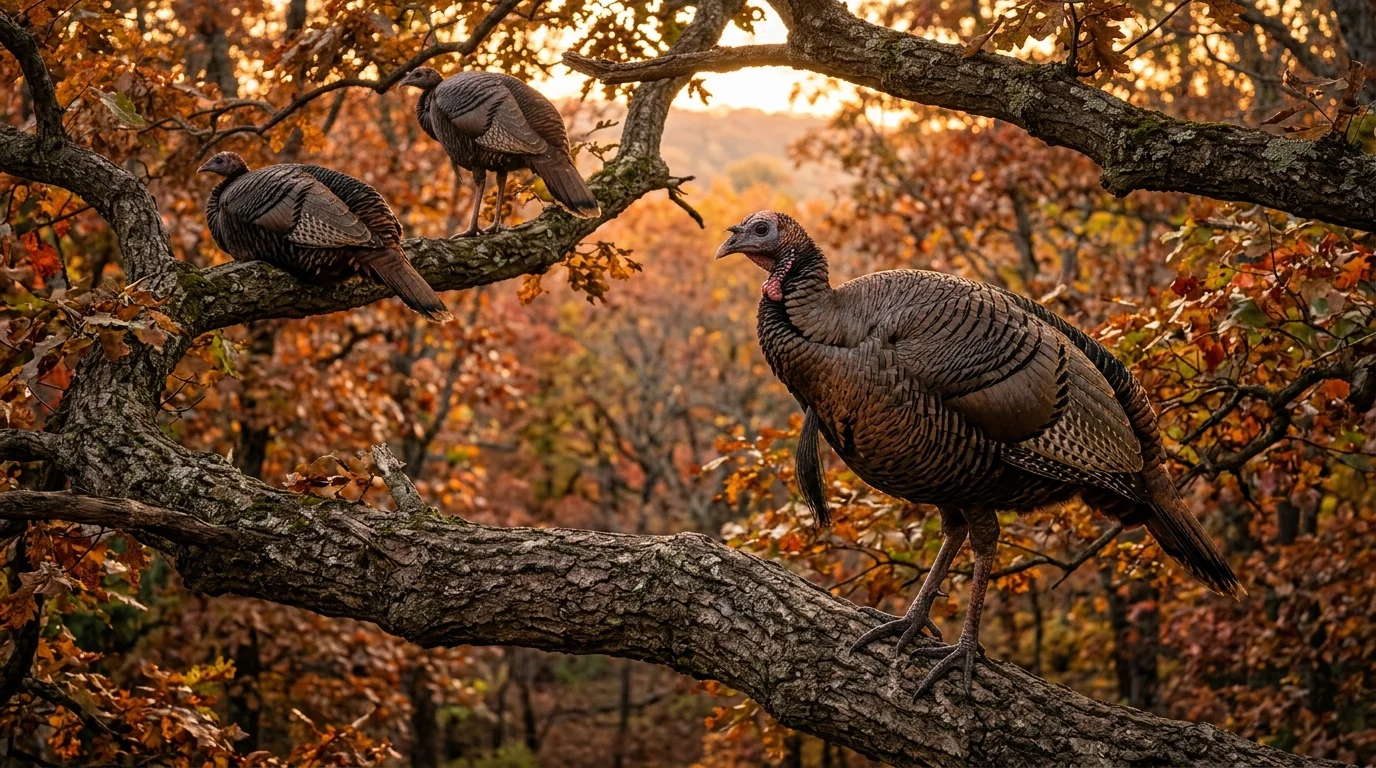
A wild turkey may weigh more than 20 pounds, yet this large woodland bird can spend the night perched high above the forest floor. For people accustomed to seeing turkeys walking through fields or searching for food beneath trees, the sight can be surprising.
However, wild turkeys sleeping in trees is a normal and important part of their natural behavior.
Across much of the United States, wild turkeys (Meleagris gallopavo) spend their days foraging on the ground. As evening approaches, they move toward suitable trees and fly upward to spend the night on sturdy branches.
This behavior is known as roosting.
Elevated roosts help reduce exposure to many ground-dwelling predators, including coyotes, foxes, and bobcats. They also provide relatively secure resting locations where birds can remain inactive until morning.
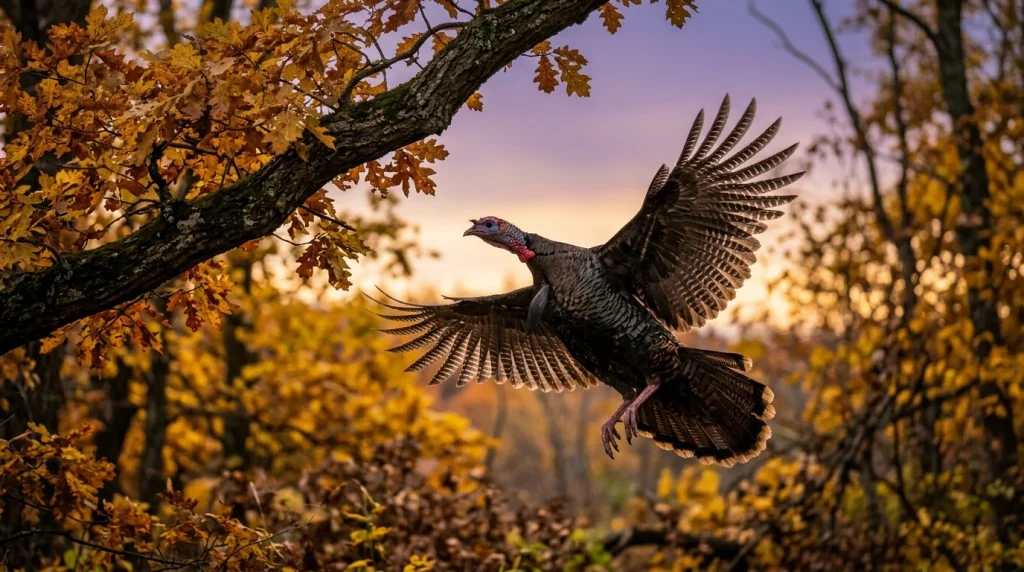
Although wild turkeys are powerful runners, they are also capable of short, strong flights that allow them to reach branches well above the ground.
Understanding wild turkey roosting behavior reveals how these remarkable North American birds balance daytime feeding, nighttime safety, and the challenges of living in changing woodland environments.
Table of Contents
- Why Wild Turkeys Sleep in Trees
- The Natural Advantages of Elevated Roosts
- How Wild Turkeys Fly Into Trees
- The Role of Strong Wings and Gripping Feet
- What Time Do Wild Turkeys Roost?
- Do Wild Turkeys Return to the Same Trees?
- Where Young Turkeys Sleep
- Regional Differences in Roosting Behavior
- Common Predators and Roosting Risks
- Frequently Asked Questions
- Conclusion
Why Wild Turkeys Sleep in Trees
Wild turkeys spend most of their waking hours on the ground, searching for seeds, nuts, insects, berries, and other available foods.
Their strong legs allow them to walk long distances while foraging, but remaining on the ground overnight would expose them to additional risks.
Unlike many mammals, birds generally cannot rely on enclosed dens for nighttime protection. Instead, wild turkeys use their ability to fly into trees.
Elevated roosting places make it more difficult for many ground predators to approach unnoticed.
A turkey resting on a branch is also positioned to detect some disturbances before a predator reaches it.
This behavior is especially important because wild turkeys are primarily active during daylight. At night, reduced visibility can make detecting approaching threats more difficult.
Tree roosting is therefore an important survival strategy, although it does not guarantee safety.
The Natural Advantages of Elevated Roosts
The most obvious advantage of sleeping in trees is separation from the forest floor.
Coyotes and foxes may travel through woodland habitats at night, but they cannot easily reach turkeys perched high on branches.
Other ground predators face similar difficulties.
Height also provides a relatively unobstructed resting location, particularly when birds choose large trees with sturdy horizontal limbs.
However, the benefits of elevated roosting extend beyond simple height.
A suitable tree must provide branches capable of supporting a turkey’s weight. The surrounding vegetation and approach to the roost also influence whether birds can enter and leave safely.
Wild turkeys often use mature trees that offer appropriate perching structures.
Roosting above the ground may also reduce contact with damp vegetation and some ground-level disturbances.
Nevertheless, elevated roosts remain vulnerable to climbing predators, large birds of prey, severe weather, and human disturbance.
Tree roosting reduces certain risks rather than eliminating predation.
How Wild Turkeys Fly Into Trees
Despite their heavy appearance, wild turkeys are capable of surprisingly powerful short-distance flight.
Their broad wings generate the lift needed to leave the ground and reach elevated branches.
When approaching a roost, a turkey may move through nearby woodland openings before launching into a strong upward flight.
The bird uses rapid wingbeats to gain height and then maneuvers toward a suitable branch.
Some turkeys reach their roosts in a single flight, while others use intermediate branches or nearby trees.
The exact approach depends on the surrounding habitat, available space, and the location of the roost.
Once perched, a turkey adjusts its position to maintain balance.
Wild turkeys are not adapted for prolonged soaring or long-distance continuous flight. Their flight abilities are particularly useful for escaping danger and reaching elevated resting places.
The National Wild Turkey Federation describes tree roosting as an essential part of wild turkey behavior and habitat use.
The Role of Strong Wings and Gripping Feet
Two important anatomical adaptations make tree roosting possible: powerful wings and feet capable of gripping branches.
Wild turkeys have substantial flight muscles that support rapid bursts of flight.
Their broad wings help produce the lift needed for short flights into trees, even though the birds spend most of their lives walking.
Once a turkey reaches a branch, its feet become especially important.
Like many perching birds, wild turkeys have three forward-facing toes and one backward-facing toe.
This arrangement allows the bird to grasp a branch and maintain its position while resting.
However, turkey feet are relatively large and robust, reflecting their ground-dwelling lifestyle.
They are well suited to walking, scratching through leaf litter, and balancing on substantial branches.
Turkeys generally choose branches that offer adequate support rather than the thin twigs used by smaller songbirds.
These physical adaptations illustrate how a primarily terrestrial bird can still depend on trees for nighttime survival.
What Time Do Wild Turkeys Roost?
Wild turkeys generally begin moving toward their nighttime roosts as daylight fades. Their exact schedule changes with sunset, season, weather, and local conditions.
During the final part of the day, birds may continue feeding before traveling toward suitable woodland cover. As evening approaches, they become increasingly focused on finding secure resting places.
Turkeys commonly fly into trees around sunset. Some initially land on lower branches and then move upward to more suitable perches.
Once settled, they generally remain in the trees throughout the night, unless disturbed.
At dawn, the birds become active again. They may call to other flock members before flying down to resume feeding.
These predictable daily movements are an important part of turkey nighttime habits.
According to the Cornell Lab of Ornithology’s Wild Turkey guide, turkeys often enter lower tree limbs around sundown and move toward higher roosting positions.
Do Wild Turkeys Return to the Same Trees?
Wild turkeys sometimes return to familiar roosting locations, but they do not necessarily sleep in the same tree every night.
Suitable roost sites may be used repeatedly, particularly when they provide dependable shelter and convenient access to feeding areas.
However, turkeys also change locations as they move through their home ranges.
Food availability, flock movements, weather conditions, and disturbances can influence where they spend the night.
A group feeding near an oak woodland may select nearby trees, while another flock traveling through different habitat may use a completely different roost.
Seasonal changes also influence these patterns.
During fall and winter, wild turkeys often gather into larger flocks. These groups may use communal roosting areas containing several suitable trees.
The National Wild Turkey Federation explains that traditional roosting locations may be reused, although birds commonly move between individual trees.
This flexibility allows wild turkeys to respond to changing environmental conditions without depending on one permanent sleeping location.
Where Young Turkeys Sleep
Young wild turkeys, called poults, cannot immediately fly into trees after hatching.
Unlike many songbirds, turkey poults leave the nest shortly after emerging from their eggs. They can walk, follow their mother, and begin feeding, but their wings are not yet sufficiently developed for reliable flight.
During their earliest days, poults remain on the ground with their mother.
The female turkey, known as a hen, provides warmth and protection while guiding her young through suitable feeding and sheltering areas.
This period is particularly dangerous because small poults are vulnerable to numerous predators.
As their flight feathers and muscles develop, young turkeys gradually become capable of reaching low branches.
Many poults begin tree roosting at approximately two to four weeks of age, although timing varies with development and environmental conditions.
The National Wild Turkey Federation reports that poults can begin flying at around 10 days old and may start roosting above ground with their mothers during the following weeks.
The transition from ground sleeping to elevated roosting represents an important developmental milestone.
Once young turkeys can reach trees, they gain access to the same protective advantages used by adults.
However, successful tree roosting does not eliminate the risks associated with predators, severe weather, or limited food.
Regional Differences in Roosting Behavior
Wild turkeys inhabit a wide variety of environments across the United States, including eastern hardwood forests, southeastern pine woodlands, western mountains, and wooded river corridors.
Their roosting habits reflect these regional differences.
Eastern Hardwood Forests
In the eastern United States, wild turkeys frequently occupy landscapes containing mature oak, hickory, and other hardwood trees.
Large branches provide suitable nighttime perches, while surrounding woodland openings offer daytime feeding opportunities.
The combination of forest cover and nearby open habitat can support both roosting and foraging.
Southeastern Pine Forests
In parts of the Southeast, turkeys may roost in mature pine trees or hardwoods growing along streams and forest edges.
Pine branches can provide useful resting locations, while evergreen foliage may offer additional cover.
The availability of suitable trees is often more important than the presence of one particular tree species.
Western Mountains and River Corridors
In western regions, wild turkeys may occupy mountainous forests or wooded valleys.
Where surrounding landscapes contain extensive grassland or shrubland, trees along rivers and streams can provide especially valuable roosting habitat.
These wooded corridors may contain some of the few large trees available in the surrounding area.
Across these environments, suitable turkey woodland habitat generally combines secure roosting trees, accessible food, and appropriate daytime cover.
Common Predators and Roosting Risks
Although elevated roosts provide important protection, wild turkeys remain vulnerable to predators.
Common wild turkey predators include coyotes, bobcats, foxes, raccoons, and several birds of prey.
Predation risk depends partly on the bird’s age, habitat, and location.
Ground Predators
Coyotes, foxes, and bobcats may hunt wild turkeys while the birds are feeding or traveling on the ground.
Tree roosting makes many nighttime encounters with these predators less likely.
However, turkeys can still be vulnerable when entering or leaving their roosts.
Climbing Predators
Raccoons are capable climbers and can reach many tree branches.
Although large adult turkeys are not easy prey, climbing predators demonstrate why elevation alone cannot guarantee protection.
Birds of Prey
Great horned owls and certain large raptors can prey on wild turkeys.
Great horned owls are particularly relevant to nighttime risk because they hunt during darkness.
Predation may occur at roosts or elsewhere, depending on circumstances.
Weather and Human Disturbance
Severe storms, strong winds, and damaged branches can also create hazards.
Human disturbance may cause turkeys to leave their roosts unexpectedly, potentially exposing them to additional risks.
The Cornell Lab of Ornithology identifies several mammalian and avian predators of wild turkeys, including coyotes, bobcats, raccoons, and great horned owls. All About Birds
The central point is that sleeping in trees reduces exposure to many ground predators but does not eliminate predation risk.
Maintaining suitable native vegetation and mature trees, where safe, can contribute to valuable wildlife habitat.
Frequently Asked Questions
1. Do wild turkeys really sleep in trees?
Yes. Adult wild turkeys normally roost on tree branches at night. Elevated resting places help reduce exposure to many predators that hunt on the ground.
2. How high do wild turkeys sleep?
Roosting height varies with tree size, branch structure, and habitat. Turkeys often select relatively high branches when they provide stable, accessible perches.
3. Can wild turkeys fly despite their large size?
Yes. Wild turkeys are capable of powerful short flights. Their wings allow them to escape danger and reach elevated nighttime roosts, although they spend most of their time walking.
4. Do wild turkeys sleep in groups?
Frequently. Wild turkeys are social birds, and several individuals may roost in the same tree or nearby trees. However, individual birds sometimes roost alone.
5. Where do baby wild turkeys sleep?
Newly hatched poults sleep on the ground under the protection of their mother. Once they develop sufficient flight ability, they begin using low branches and eventually higher tree roosts.
Conclusion
The sight of wild turkeys sleeping in trees reveals an important survival adaptation in one of North America’s most recognizable birds.
Although wild turkeys spend much of their lives walking and feeding on the ground, their powerful wings allow them to reach elevated branches when darkness approaches.
These nighttime roosts reduce exposure to many ground predators and provide resting locations within suitable woodland habitat.
Strong wings, gripping feet, and the ability to select appropriate branches make this behavior possible.
Roosting patterns also vary with geography, season, flock movements, and the availability of mature trees.
Young turkeys gradually develop the ability to roost above ground, marking an important transition in their early lives.
Ultimately, wild turkey roosting behavior illustrates how an animal’s physical adaptations and habitat requirements work together.
Protecting mature woodland trees and maintaining diverse natural habitats can help ensure that these remarkable birds continue finding suitable places to rest.
External Sources
- Cornell Lab of Ornithology — Wild Turkey Life History
Covers daily behavior, tree roosting, social groups, and predators.
Read the Cornell Wild Turkey Life History Guide - National Wild Turkey Federation — Wild Turkey Behavior
Explains feeding, communication, nighttime roosting, and roost-site reuse.
Read Wild Turkey Behavior - National Wild Turkey Federation — Wild Turkey Habitat
Describes roosting trees, woodland habitat, seasonal cover, and conservation needs.
Read the Wild Turkey Habitat Guide