
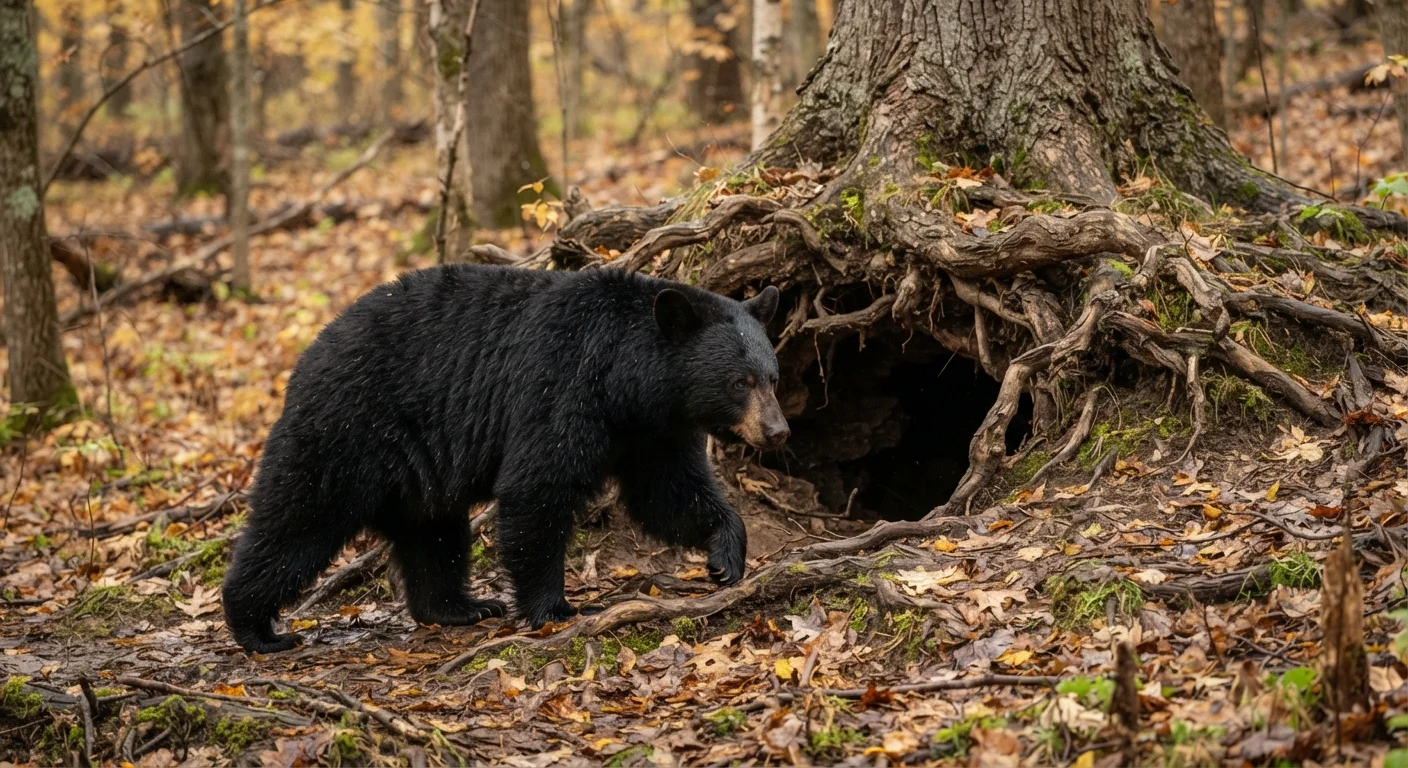
As autumn progresses across North America, American black bears (Ursus americanus) begin preparing for one of the most remarkable periods of their annual lives. In regions with cold winters and limited natural food, many bears retreat into protected shelters where they remain largely inactive for weeks or months.
These shelters, commonly called winter dens, are surprisingly diverse. Some black bears rest inside hollow trees, while others settle beneath exposed roots, between rocks, or in shallow depressions on the forest floor. Certain individuals even excavate their own shelters.
Understanding black bear winter dens offers a fascinating glimpse into how these adaptable mammals survive seasonal changes.
Unlike animals that depend on a single type of shelter, black bears can use several different natural structures. Their choices depend on local habitat, available cover, weather conditions, and individual needs.
Denning behavior also varies considerably across the United States. A bear living in northern Minnesota may spend much longer inside its winter shelter than one inhabiting a relatively warm region of the Southeast.
The following guide explores five natural shelters black bears use, the biological changes that occur during winter denning, and why protecting these quiet resting places matters for wildlife conservation.
Table of Contents
- Why Black Bears Need Winter Dens
- Five Natural Shelters Black Bears Use
- What Makes a Good Black Bear Den?
- What Happens Inside a Bear’s Winter Den?
- Do All Black Bears Hibernate for the Same Length of Time?
- Regional Differences in Black Bear Denning
- Why Winter Dens Should Never Be Disturbed
- Frequently Asked Questions
- Conclusion
Why Black Bears Need Winter Dens
For many American black bears, winter creates a major challenge: natural food becomes less available just as colder weather increases the difficulty of remaining active.
During late summer and autumn, bears often enter a period of intense feeding known as hyperphagia. They consume substantial amounts of food to accumulate fat reserves that help support them through periods of reduced activity.
Their autumn diets may include acorns, beechnuts, berries, and other seasonally available foods. The exact composition varies with geography and habitat.
When winter conditions make foraging less productive, denning allows bears to conserve energy by dramatically reducing their metabolic demands.
Black bear hibernation is a specialized form of winter dormancy. Unlike many small hibernating mammals, black bears maintain relatively high body temperatures while substantially reducing their heart rate and metabolism.
They can also respond to disturbances and become active when necessary.
Winter dens provide sheltered places where bears can remain relatively undisturbed while relying primarily on stored energy.
Pregnant females have an additional reason to seek secure shelter: they generally give birth inside their winter dens and care for their newborn cubs during the denning period.
Five Natural Shelters Black Bears Use
1. Hollow Trees
Hollow trees provide some of the most distinctive black bear winter dens.
Large, mature trees occasionally develop internal cavities through decay, broken limbs, or other natural processes. When an opening is large enough, a black bear may climb into the hollow trunk or enter through a cavity near its base.
These enclosed spaces can provide protection from wind, precipitation, and direct exposure to winter weather.
Tree dens are especially interesting because black bears are skilled climbers. In suitable forests, some individuals use cavities well above ground level.
However, not every hollow tree is appropriate. The cavity must offer sufficient space and a usable entrance.
The availability of tree dens also depends on forest age, tree species, and the presence of large trees with natural cavities.
Preserving mature trees and suitable deadwood, where safe and ecologically appropriate, can help maintain shelter opportunities for numerous forest animals.
2. Rock Crevices
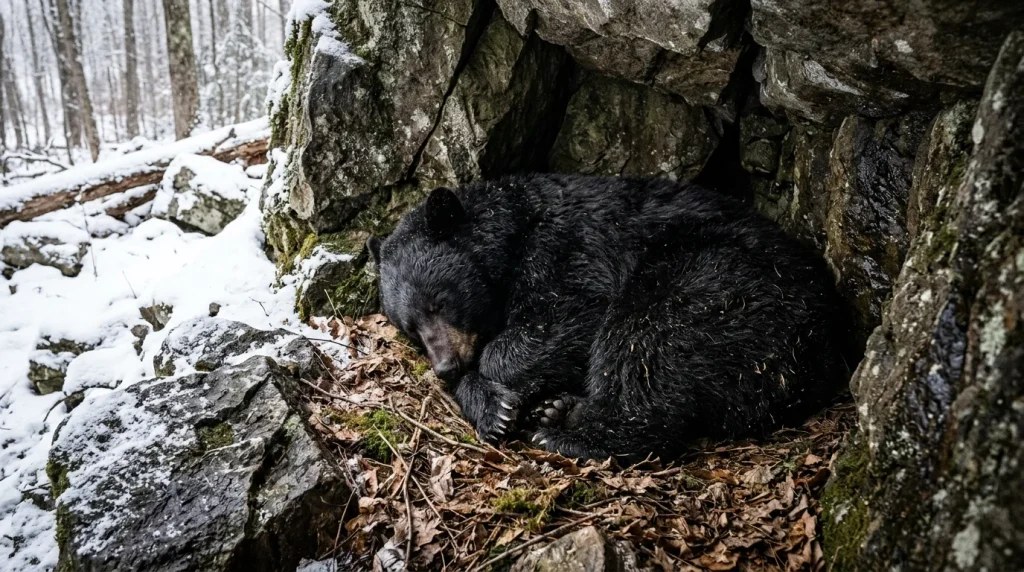
Rocky landscapes offer another natural option for winter shelter.
Black bears sometimes settle within spaces between large boulders, beneath rock overhangs, or inside sheltered crevices.
These locations may provide protection from wind and precipitation while offering a relatively secluded resting place.
Rock shelters vary considerably in shape. Some are deep cavities surrounded by stone, while others are simply protected spaces beneath large rock formations.
A bear does not necessarily require a spacious cave. A relatively compact shelter may be sufficient when it accommodates the animal and offers appropriate protection.
Rock crevices can be particularly useful in mountainous and rugged landscapes where large tree cavities are uncommon.
Their suitability depends on local conditions, including drainage, exposure, and the amount of shelter available.
3. Root Cavities
The root systems of large trees can create natural spaces that black bears use as winter dens.
When trees grow on slopes, erosion exposes roots, or a tree partially overturns, cavities may develop beneath the root structure.
These spaces can form protected chambers between the soil, roots, and surrounding vegetation.
A black bear may enlarge an existing opening or arrange nearby vegetation to make the shelter more suitable.
Root cavities are often well concealed by the surrounding forest.
They also demonstrate how ordinary forest structures can serve important ecological functions.
An overturned tree, for example, may look like a simple woodland obstacle, but its exposed root system can create habitat for mammals, amphibians, insects, and other organisms.
Maintaining natural forest complexity helps preserve these shelter opportunities.
4. Ground Depressions
Not every black bear spends winter inside a fully enclosed shelter.
Some individuals use shallow depressions on the ground, often beneath dense vegetation, fallen branches, or other natural cover.
These resting places may resemble large nests formed from leaves, grasses, and nearby plant material.
Ground dens are generally more exposed than hollow trees or enclosed rock cavities, but they can still provide suitable shelter under particular environmental conditions.
A protected depression in a secluded forest may be sufficient for a bear, especially where winter weather is relatively mild.
The surrounding vegetation can help reduce exposure and conceal the resting animal.
This flexibility is one reason black bears occupy such a wide variety of habitats across North America.
Their winter shelters do not always resemble the deep caves commonly depicted in wildlife illustrations.
5. Excavated Dens
Black bears sometimes create their own winter shelters by digging into soil, slopes, or suitable natural banks.
These excavated dens may begin as small openings beneath roots or other protective structures.
Using their powerful forelimbs and claws, bears can enlarge existing spaces or dig into suitable ground.
The resulting shelter may provide an enclosed resting chamber protected by surrounding soil.
The size and shape of excavated dens vary according to soil conditions, terrain, and the individual bear.
Digging is not possible everywhere. Rocky ground, saturated soil, and unstable slopes may limit suitable excavation sites.
Where conditions permit, however, excavated dens give bears another option when naturally occurring cavities are unavailable.
Together, these five shelter types illustrate the remarkable flexibility of American black bears.
Their ability to use different den locations contributes to their success across forests, mountains, and other habitats.
What Makes a Good Black Bear Den?
A suitable winter den does not need to be large or elaborate. In fact, many black bear dens are only slightly larger than the animals occupying them.
Several characteristics influence whether a shelter is useful.
Protection from weather is important. A hollow tree, rock cavity, or sheltered depression can reduce exposure to wind, rain, and snow.
Adequate drainage also matters. A den that regularly floods may become unsuitable, forcing the bear to relocate.
Seclusion helps reduce the likelihood of disturbance from people, other animals, and nearby activity.
Finally, sufficient space is particularly important for pregnant females, which need room to give birth and nurse their cubs.
Den selection varies with available habitat. The U.S. Forest Service identifies tree cavities, rock shelters, root systems, and ground nests among the many structures used by American black bears.
What Happens Inside a Bear’s Winter Den?
Inside a winter den, a black bear undergoes remarkable physiological changes.
Its metabolism slows, its heart rate decreases, and its body temperature falls moderately compared with the much larger temperature reductions experienced by many small hibernating mammals.
During prolonged denning, black bears generally survive on stored body fat without eating, drinking, urinating, or defecating.
Their bodies have specialized mechanisms for conserving water and recycling nitrogen, helping preserve tissues during extended inactivity.
Black bears are therefore considered hibernators, although their winter physiology differs substantially from that of small mammals such as ground squirrels.
Pregnant females typically give birth during winter. Their cubs are born very small and depend entirely on maternal warmth and milk.
The mother continues supporting her offspring while relying on her stored energy reserves.
According to the National Park Service, black bears can remain in winter dens for several months, and females with newborn cubs generally emerge later than bears without cubs.
These adaptations demonstrate how wildlife can survive seasonal food shortages through physiological changes rather than continuous feeding.
Do All Black Bears Hibernate for the Same Length of Time?
No. Black bear hibernation varies significantly among individuals and populations.
Climate is an important influence. Bears living in colder northern regions generally experience longer periods of reduced food availability and may remain denned for extended periods.
Food availability also affects the timing of den entry and emergence.
When natural food remains accessible, some bears may continue moving and feeding during portions of winter.
Reproductive status creates additional differences. Pregnant females usually enter dens earlier and remain sheltered longer because they must give birth and care for their cubs.
Age, physical condition, and local environmental circumstances can also influence denning behavior.
The Alaska Department of Fish and Game reports that black bears in northern portions of their range may remain dormant for seven to eight months, while bears farther south may occasionally emerge during winter.
There is therefore no single hibernation schedule that applies to every American black bear.
Regional Differences in Black Bear Denning
Black bears inhabit environments ranging from northern forests to relatively warm southeastern landscapes.
These differences help explain why bear den locations vary across the country.
In northern states, prolonged cold and snow cover can favor extended denning. Suitable tree cavities, rock shelters, and excavated dens provide protection during harsh weather.
In mountainous regions, bears may use rocky outcrops, slopes, and sheltered spaces beneath fallen trees.
In Florida, winter conditions are considerably milder. Some bears use ground nests in dense vegetation, and nonpregnant individuals may spend relatively short periods in dens.
Pregnant females, however, still require protected places for giving birth and nursing.
The Florida Fish and Wildlife Conservation Commission documents ground nests, tree cavities, and shelters beneath fallen trees among the den types used by Florida black bears.
These regional differences highlight the importance of considering climate, food availability, reproductive status, and individual circumstances when discussing winter wildlife adaptations.
Why Winter Dens Should Never Be Disturbed
A winter den may appear abandoned or inactive, but a bear inside can respond quickly to nearby disturbances.
Approaching a den can create serious risks for both people and wildlife.
A disturbed bear may abandon its shelter and expend valuable energy finding another suitable location.
For females with newborn cubs, disturbance can be especially consequential because the young depend on a stable, protected environment.
Wildlife observers should never enter suspected dens, attempt to photograph bears at close range, or deliberately encourage animals to emerge.
If a potential den is discovered, the safest response is to leave the area calmly and avoid further disturbance.
Protecting winter shelters also means respecting habitat features such as mature hollow trees, root cavities, and natural rock formations.
The New Mexico Department of Game and Fish notes that disturbed black bears may leave their dens, particularly when shelters become unsuitable or human activity interrupts their winter rest.
Respecting these spaces supports both wildlife conservation and public safety.
Frequently Asked Questions
1. Where do black bears sleep in winter?
Black bears may spend winter inside hollow trees, rock crevices, root cavities, excavated shelters, or protected ground nests. The shelter used depends on available habitat and local conditions.
2. Do black bears always hibernate in caves?
No. Caves are only one possible shelter. Many black bears use hollow trees, fallen logs, root systems, and shallow ground depressions instead.
3. Can black bears wake up during hibernation?
Yes. Black bears can become alert and leave their dens when disturbed or when environmental conditions change. Their winter dormancy does not prevent them from responding to potential threats.
4. Do female black bears give birth during winter?
Yes. Pregnant females generally give birth inside winter dens. Their cubs remain dependent on maternal milk and warmth until they are sufficiently developed to emerge.
5. Do black bears reuse the same winter den every year?
Sometimes, but not always. Some shelters remain suitable for repeated use, while others deteriorate or become unavailable. Bears may select different den locations in successive winters.
Conclusion
Black bear winter dens demonstrate the remarkable adaptability of one of North America’s most widespread large mammals.
From hollow trees and rocky crevices to root cavities, ground depressions, and excavated shelters, American black bears use a diverse range of natural structures to survive seasonal challenges.
Their denning behavior is closely connected to local climate, food availability, reproductive needs, and individual circumstances.
Understanding these differences helps explain why winter dormancy looks different across the United States.
Protecting natural shelters and avoiding disturbance during the denning season are practical ways to support black bears and the forest ecosystems they inhabit.
Ultimately, the story of black bear winter dens reveals an important ecological principle: even seemingly ordinary features of a forest can provide essential habitat for wildlife.
External Sources
- National Park Service — Black Bears: Covers den types, winter dormancy, and reproduction. Black Bears — National Park Service
- U.S. Forest Service — Ursus americanus Species Review: Provides detailed ecological information about den selection, habitat, and geographical differences.
American Black Bear Species Review - Alaska Department of Fish and Game — Black Bear Species Profile. Describes winter dormancy, northern denning periods, and habitat adaptations.
Black Bear Species Profile — Alaska