
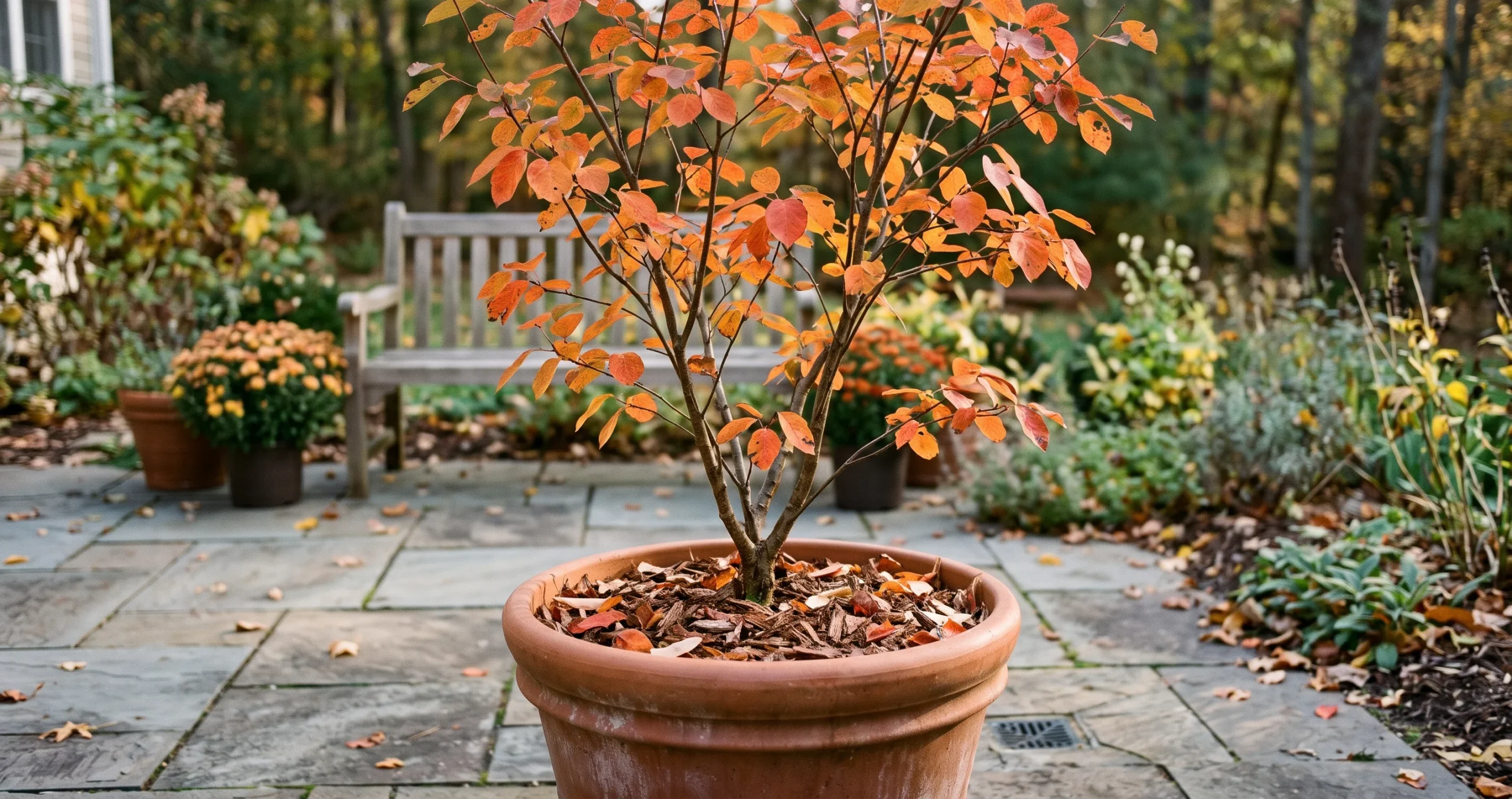
Growing serviceberry in containers is an attractive option for homeowners who want a flowering small tree or shrub without dedicating a large garden bed to it. Serviceberries belong to the genus Amelanchier and are valued for their delicate spring blossoms, edible summer berries, and colorful autumn foliage.
These North American plants can provide several seasons of interest while supporting birds and other wildlife.
Although serviceberries are often planted directly in the landscape, some species and compact cultivars can also grow successfully in large containers.
A potted serviceberry tree can become a beautiful focal point on a patio, deck, or small urban garden.
However, container growing requires more attention than planting in the ground.
Roots have limited space, potting mixes dry more quickly, and containers expose root systems to greater temperature fluctuations.
Choosing a suitable cultivar, providing adequate drainage, watering consistently, and protecting roots during winter are essential for long-term plant health.
This guide explains how to select, plant, and care for serviceberries in containers while recognizing when a growing plant may eventually need a larger pot or a permanent garden location.
Table of Content
- Why Grow Serviceberry in a Container?
- Choosing the Best Serviceberry Variety
- Selecting the Right Container
- Choosing the Best Potting Mix
- How to Plant Serviceberry in a Container
- Sunlight and Watering Requirements
- Fertilizing Container-Grown Serviceberry
- Pruning and Maintaining a Compact Shape
- Protecting Potted Serviceberry During Winter
- Common Pests and Growing Problems
- Serviceberry Flowers, Berries, and Autumn Color
- Frequently Asked Questions
- Conclusion
Why Grow Serviceberry in a Container?
Serviceberries combine ornamental appeal with ecological value.
Their spring flowers appear before or alongside emerging leaves, creating a delicate display of white blossoms.
Depending on the species and cultivar, berries develop in late spring or early summer and gradually turn reddish to dark purple as they ripen.
The fruit is edible and has a mild, sweet flavor when fully ripe.
In autumn, many serviceberries produce attractive foliage in shades of yellow, orange, and red.
For homeowners with limited outdoor space, container cultivation offers several advantages.
A container allows the plant to become a focal point near a seating area or entrance.
It also provides greater control over the growing medium and drainage.
Young plants may be repositioned when necessary, although large containers become difficult to move.
Serviceberries can also attract birds that feed on their fruit.
However, their natural growth habits should not be overlooked.
Some species develop into substantial multi-stemmed shrubs or small trees.
A container can restrict growth, but excessive root restriction eventually reduces vigor.
For additional patio planting ideas, see Small Trees for Patios and Compact Gardens.
Choosing the Best Serviceberry Variety
Selecting the right plant is one of the most important steps in successful Amelanchier container care.
Serviceberries vary considerably in mature height, spread, branching structure, and growth rate.
Some species naturally form shrubs, while others develop into small trees.
Compact Serviceberry Options
Amelanchier alnifolia, commonly called Saskatoon serviceberry, often grows as a multi-stemmed shrub.
Certain cultivars remain smaller than larger tree-form serviceberries, although their eventual dimensions depend on the cultivar and growing conditions.
Amelanchier canadensis, or Canadian serviceberry, can develop as a shrub or small tree and may become too large for ordinary patio containers.
Amelanchier × grandiflora includes ornamental cultivars known for attractive flowers and fall foliage, but many eventually reach substantial sizes.
When shopping for a plant, examine the specific cultivar’s expected mature height and spread.
Do not assume that a serviceberry labeled as a small tree will remain suitable for a container indefinitely.
A naturally compact cultivar is generally preferable to a vigorous tree that requires frequent size reduction.
For cold climates, also verify the plant’s hardiness and suitability for local conditions.
Selecting the Right Container
A suitable container provides adequate root space, reliable drainage, and physical stability.
Container Size
For a young nursery-grown serviceberry, choose a container somewhat larger than the existing root ball.
A pot approximately 18–24 inches wide may be appropriate for some young plants, depending on their initial size.
Larger specimens require proportionally larger containers.
These measurements are starting points rather than universal requirements.
The container should accommodate the root system without forcing roots into a tightly compressed space.
As the plant grows, inspect its roots periodically.
If roots become densely circling or the potting mix dries unusually quickly, repotting may be necessary.
Large serviceberries may eventually be better suited to permanent planting in the ground.
Drainage Requirements
Drainage is essential for container-grown serviceberries.
Choose a pot with several unobstructed drainage holes.
Water should move through the potting mix and leave the container freely.
Avoid using containers that trap excess water around the roots.
Do not place gravel at the bottom as a substitute for drainage holes. Gravel layers do not reliably improve drainage and can reduce the volume of usable potting mix.
Suitable Container Materials
Several materials can work well.
Plastic and resin containers are relatively lightweight and may retain moisture longer than porous materials.
Terracotta containers allow moisture to evaporate through their walls but can dry quickly and may crack during freezing weather.
Glazed ceramic containers offer decorative appeal but can be heavy and vulnerable to freeze-thaw damage unless specifically designed for outdoor winter use.
Wooden planters can provide insulation and attractive styling, provided they are durable and drain properly.
For exposed patios, choose a stable container that will not tip during strong winds.
Choosing the Best Potting Mix
Serviceberries generally prefer well-drained soil with adequate moisture and organic matter.
In containers, use a high-quality potting mix designed for woody plants or outdoor container gardening.
A suitable mix should hold moisture while allowing excess water to drain.
Commercial potting mixes containing materials such as composted bark, peat, coir, and perlite can provide an appropriate balance.
Avoid filling containers entirely with dense garden soil.
Ordinary garden soil can compact in pots, restricting drainage and root aeration.
Serviceberries often perform well in slightly acidic to near-neutral conditions, although tolerance varies among species.
Rather than adding amendments automatically, begin with a suitable potting medium and monitor plant performance.
A light surface mulch can help reduce moisture loss during warm weather.
Keep mulch away from the main stems to avoid prolonged moisture accumulation around the crown.
How to Plant Serviceberry in a Container
Proper planting encourages healthy root establishment and reduces transplant stress.
Step 1: Prepare the Container
Select a clean pot with drainage holes.
Place it in its intended location before filling, particularly if the container will be heavy.
Step 2: Add Potting Mix
Fill the lower portion of the container with moistened potting mix.
Leave enough space to position the root ball at the correct depth.
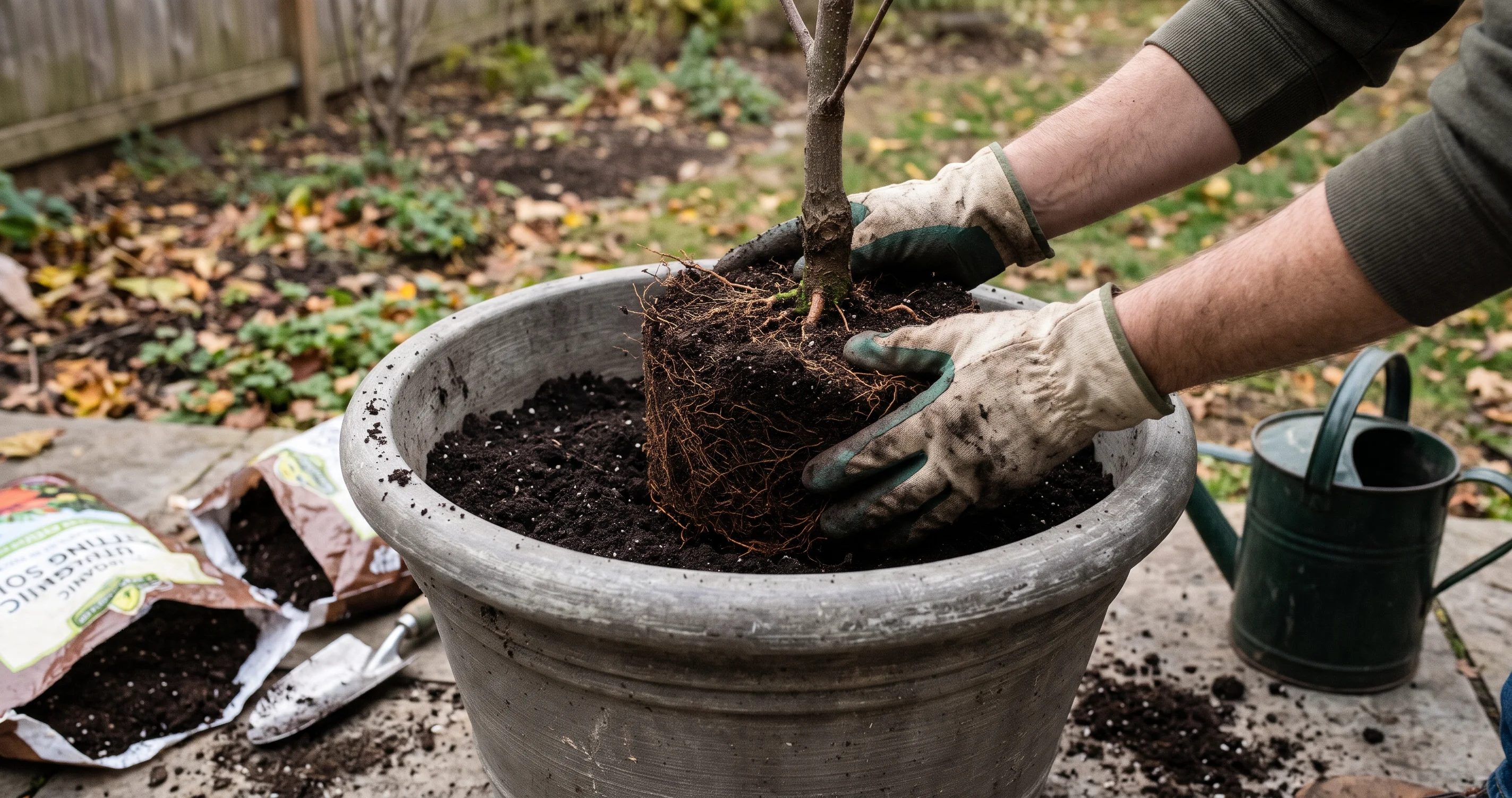
Step 3: Inspect the Roots
Remove the serviceberry from its nursery container.
Check for densely circling roots.
Gently loosen manageable roots around the outside of the root ball.
Severely root-bound plants may require more careful corrective treatment.
Step 4: Position the Plant
Place the root ball so the root flare or upper root system remains at the appropriate planting depth.
Avoid burying the trunk base beneath additional potting mix.
Step 5: Fill Around the Roots
Add potting mix around the root ball.
Firm it gently to eliminate large air pockets without excessively compressing the medium.
Step 6: Water Thoroughly
Water until moisture drains from the bottom.
This helps settle the potting mix around the roots.
Step 7: Monitor Establishment
Check soil moisture regularly during the first growing season.
Recently transplanted serviceberries may need more frequent attention while their roots establish.
Sunlight and Watering Requirements
Serviceberries generally perform well in full sun to partial shade.
A location receiving approximately six hours of direct sunlight can support flowering and fruit production for many cultivars.
In hotter regions, some afternoon shade may reduce heat stress.
However, light requirements vary with species and climate.
Watering a Potted Serviceberry Tree
Container-grown plants often dry faster than plants growing in the ground.
Check moisture regularly by examining the upper portion of the potting mix.
Water thoroughly when the surface begins to dry, while ensuring that deeper portions are not constantly saturated.
During hot, windy weather, containers may require frequent watering.
Cooler conditions generally reduce water demand.
Avoid watering according to a rigid calendar without checking the growing medium.
Persistent waterlogging can reduce oxygen availability around the roots and contribute to root problems.
The goal is consistently moist but well-drained conditions, especially during active growth.
Fertilizing Container-Grown Serviceberry
Serviceberries generally do not require heavy fertilization.
Excessive fertilizer can encourage vigorous leafy growth without improving flowering or overall plant health.
Many commercial potting mixes already contain some nutrients.
If additional fertilizer is needed, apply a balanced, slow-release product according to its label instructions.
Early spring is often a suitable time to assess nutrient needs.
Avoid excessive nitrogen applications, particularly late in the growing season.
Late-season fertilization can encourage tender growth that may not harden adequately before freezing weather.
Watch for signs such as unusually pale foliage, weak growth, or reduced vigor.
However, these symptoms can also result from poor drainage, root restriction, or other problems.
Do not assume that every struggling container plant needs fertilizer.
Pruning and Maintaining a Compact Shape
Pruning helps maintain an attractive structure and remove damaged or poorly positioned branches.
However, pruning cannot permanently transform a naturally large serviceberry into a genetically compact plant.
When to Prune
Late winter or early spring, while the plant is dormant, is a common time for structural pruning.
Removing dead, damaged, or diseased branches can also be appropriate when problems are discovered.
How to Prune
Begin by removing dead or crossing branches.
Thin crowded growth selectively to improve structure and airflow.
For multi-stemmed shrubs, occasional removal of older stems near the base may encourage renewal.
Avoid removing large amounts of healthy growth unnecessarily.
Serviceberries flower on established wood, so heavy pruning before spring can reduce the upcoming flower display.
Use clean, sharp pruning tools and make cuts at appropriate branch junctions.
Managing Root Restriction
A serviceberry that repeatedly becomes root-bound may require a larger container.
If maintaining the plant requires increasingly aggressive root pruning or frequent watering, planting it in the ground may be the healthier long-term choice.
Protecting Potted Serviceberry During Winter
Winter protection is especially important when growing serviceberry in containers in colder parts of the United States.
Although many serviceberries are hardy when planted in the ground, container roots experience more extreme temperatures.
Soil surrounding in-ground roots provides insulation that a freestanding pot cannot offer.
Winter Protection Strategies
Choose a protected location. Move manageable containers away from strong winter winds.
Insulate the container. Appropriate insulating materials can reduce rapid temperature fluctuations around the root ball.
Group containers together. Placing pots close together in a sheltered location can reduce exposure.
Use an unheated protected structure. A cold garage, shed, or similar space may be suitable if temperatures remain appropriately cool without allowing the root ball to freeze severely or dry out.
Monitor moisture. Dormant plants still require some moisture. Check the potting mix periodically and water when necessary and conditions permit.
Avoid moving dormant serviceberries into a warm living room for winter storage.
Warm indoor temperatures may interfere with normal dormancy.
Hardiness Considerations
A plant’s USDA hardiness rating generally describes its performance when grown in the ground.
Container cultivation reduces the insulating protection available to roots.
Gardeners in cold climates should choose sufficiently hardy plants and provide additional protection based on local winter conditions.
For more detailed advice, see How to Protect Potted Plants During Winter.
Common Pests and Growing Problems
Serviceberries can experience several pest and disease problems.
Cedar-Quince and Cedar-Hawthorn Rust
Certain rust fungi can affect serviceberries, sometimes producing discolored leaves or damaged fruit.
Disease development depends on the pathogen, local conditions, and nearby alternate host plants.
Fire Blight
Serviceberries belong to the rose family and can be susceptible to fire blight.
Affected shoots may wilt, darken, and develop a scorched appearance.
Proper diagnosis is important because other problems can produce similar symptoms.
Leaf Spot Diseases
Fungal leaf spots may appear during humid weather.
Good airflow and avoiding prolonged leaf wetness can help reduce favorable conditions for some diseases.
Aphids and Other Insects
Aphids may feed on tender growth.
Minor infestations often cause limited damage, while heavier populations may require management.
Root Problems
Overwatering, compacted potting mix, and inadequate drainage can contribute to root decline.
Container-grown plants may also struggle when roots become severely restricted.
Before applying pesticides or fertilizers, identify the underlying problem.
University extension diagnostic resources can help distinguish insects, diseases, and environmental stress.
Serviceberry Flowers, Berries, and Autumn Color
Serviceberries provide several seasons of ornamental and ecological interest.
Spring Flowers
Clusters of delicate white flowers appear in spring.
Flowering time varies by species, cultivar, and climate.
These blossoms provide resources for visiting insects, including some native bees.
Edible Summer Berries
Serviceberry fruits resemble small berries but are botanically classified as pomes.
They typically ripen from reddish shades to dark purple or nearly black.
Ripe fruits are edible and can be used fresh or in baked goods, jams, and other preparations.
Birds frequently consume the fruit, sometimes before gardeners have an opportunity to harvest it.
Serviceberry Fall Color
Serviceberry fall color is another reason these plants are valued in ornamental landscapes.
Depending on the species, cultivar, and growing conditions, foliage may develop yellow, orange, or reddish tones.
Autumn color intensity varies from year to year.
Wildlife Benefits
Serviceberries provide food for birds and other wildlife.
Their flowers can support pollinating insects, while the fruit attracts species such as robins, waxwings, and other fruit-eating birds.
Even a container-grown specimen can contribute seasonal resources to a patio or small garden.
However, larger landscape plantings generally provide more habitat than a single potted tree.
Frequently Asked Questions
1. Can serviceberry grow successfully in a container?
Yes. Some serviceberry species and compact cultivars can grow successfully in large containers. Adequate root space, drainage, watering, and winter protection are important. Larger varieties may eventually require planting in the ground.
2. How big should a container be for serviceberry?
A container approximately 18–24 inches wide may suit some young nursery plants, but the appropriate size depends on the root ball and cultivar. Larger plants require larger containers, and repotting may become necessary.
3. Does potted serviceberry need full sun?
Most serviceberries grow well in full sun to partial shade. Adequate sunlight generally supports flowering and fruit production, while afternoon shade may benefit plants in particularly hot climates.
4. Can serviceberry survive winter outdoors in a pot?
It can, but container roots are more exposed to freezing temperatures than roots growing in the ground. Success depends on the plant’s hardiness, container size, local climate, and the protection provided.
5. Are serviceberry fruits edible?
Yes. Ripe serviceberry fruits are edible and can be enjoyed fresh or used in recipes. Their flavor varies by species and cultivar, and birds often compete with gardeners for the harvest.
Conclusion
Growing serviceberry in containers allows homeowners to enjoy spring blossoms, edible summer fruit, and attractive autumn foliage in smaller outdoor spaces.
Successful container cultivation begins with selecting an appropriate species or compact cultivar.
A sufficiently large pot, reliable drainage, suitable potting mix, and consistent watering help support healthy growth.
Pruning can maintain an attractive structure, while winter protection reduces the risks associated with exposed container roots.
However, serviceberries are naturally shrubs or small trees, and many eventually outgrow ordinary patio containers.
Recognizing these limitations helps gardeners make informed decisions about repotting or transplanting.
With appropriate care and realistic expectations, a potted serviceberry can provide years of seasonal beauty while contributing food resources for local wildlife.
External Sources
- University of Minnesota Extension — Serviceberry: Explains serviceberry growth habits, mature sizes, sunlight requirements, soil preferences, hardiness, edible berries, and wildlife benefits. Read the Serviceberry Growing Guide
- University of Minnesota Extension — Planting and Transplanting Trees and Shrubs
Provides, Read the Tree and Shrub Planting Guide - University of Minnesota Extension — Protecting Trees and Shrubs in Winter
Explains why roots are often less cold-hardy than stems and branches. The guide discusses insulation, winter moisture, temperature fluctuations, and protecting woody plants from cold damage. Read the Winter Protection Guide - Penn State Extension — Amelanchier Diseases
Identifies diseases affecting serviceberries, including fire blight, rust, and witches’ broom. It describes symptoms and management recommendations for infected plants. Read the Serviceberry Disease Guide - University of Minnesota Extension — Plant Elements of Design: Serviceberry Varieties, Explore Serviceberry Varieties.