
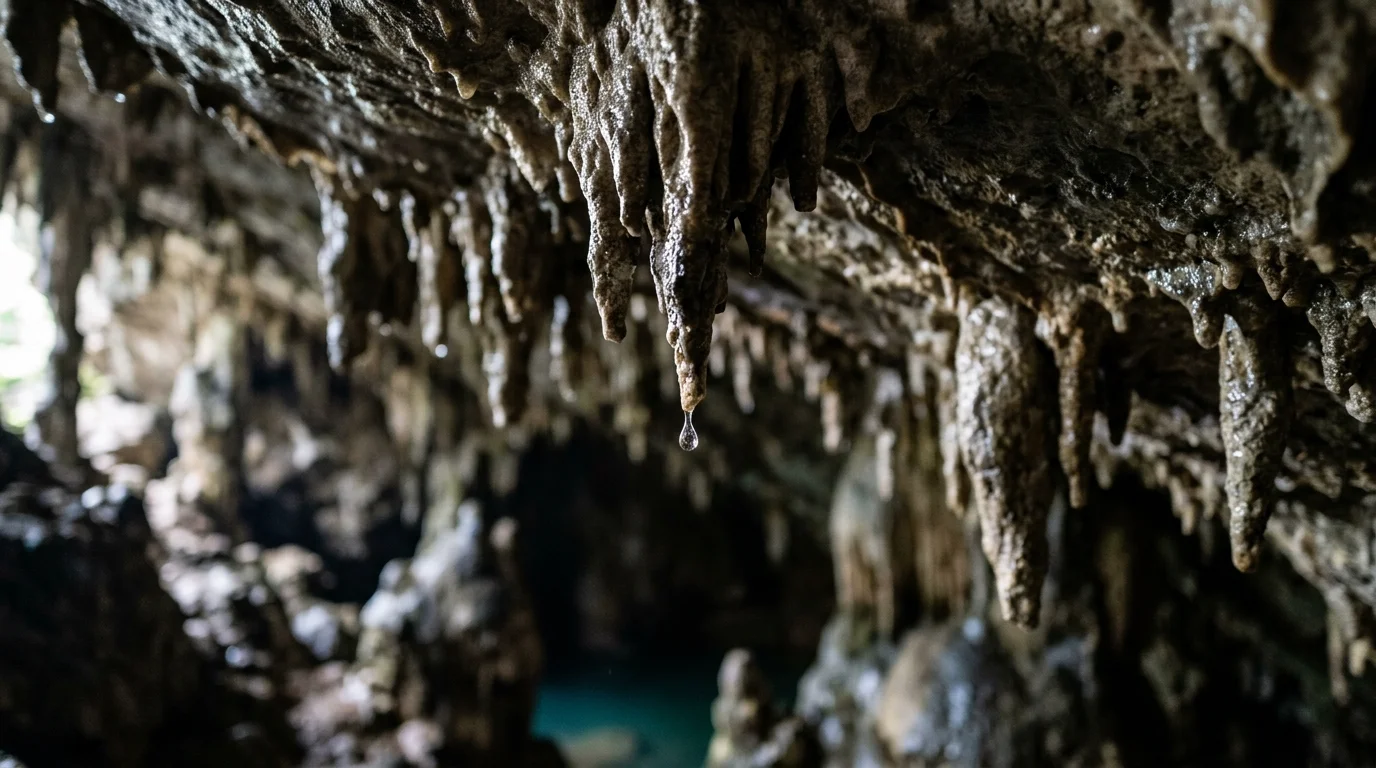
Deep beneath the Earth’s surface, a single drop of water can help build a stone sculpture that may take thousands of years to develop.
Inside limestone caves, delicate formations hang from ceilings like frozen icicles. Others rise from the ground like miniature towers. Some eventually meet, creating enormous natural columns that seem almost too carefully shaped to be the work of nature.
Yet these extraordinary structures are created without sculptors, machinery, or sudden geological events.
The secret lies in water, dissolved minerals, and time.
Understanding how stalactites form reveals one of geology’s most fascinating processes. Every drop that travels through the rock above a cave can carry tiny amounts of dissolved minerals. Under suitable conditions, those minerals gradually accumulate, producing formations that grow almost imperceptibly.
Stalactites hang from cave ceilings, while stalagmites grow upward from cave floors. Together, they reveal how water can transform empty underground spaces into remarkable natural landscapes.
Their shapes also preserve clues about past environments, rainfall, and changes in the chemistry of underground water.
Table of Contents
- What Are Stalactites and Stalagmites?
- How Stalactites Form: The Science Behind Cave Formations
- How Stalagmites Grow From Cave Floors
- Why Cave Formations Have Different Shapes
- How Long Does It Take for Stalactites to Form?
- What Stalactites and Stalagmites Reveal About Earth’s Past
- Famous Caves Where These Formations Can Be Seen
- In Your Own Yard: Discovering the Science of Mineral Deposits
- Common Myths About Cave Formations
- Frequently Asked Questions
- Conclusion
What Are Stalactites and Stalagmites?
Stalactites and stalagmites belong to a larger group of cave mineral deposits known as speleothems.
Speleothems develop when minerals dissolved in water are deposited inside caves.
Many familiar cave formations consist primarily of calcite, a crystalline form of calcium carbonate.
Calcite is also a major component of limestone, the rock in which many of these caves develop.
Stalactites: Formations That Hang From Ceilings
Stalactites grow downward from cave ceilings.
They often begin as small, hollow tubes and may eventually develop into thick, tapered formations.
Their appearance sometimes resembles stone icicles.
However, unlike ordinary icicles, stalactites are built through mineral deposition rather than the freezing of water.
Stalagmites: Formations That Rise From the Floor
Stalagmites grow upward from cave floors.
They commonly form beneath dripping stalactites or other ceiling openings.
Some resemble narrow cones, while others develop broad, rounded shapes.
Their growth depends on how mineral-bearing water reaches the floor and deposits its dissolved material.
A Simple Way to Remember the Difference
The letter C in stalactite can remind you of the ceiling.
The letter G in stalagmite can remind you of the ground.
Although the names are similar, their positions reveal where mineral deposition occurs.
How Stalactites Form: The Science Behind Cave Formations
The formation of stalactites involves a sequence of chemical and physical processes.
It begins above the cave, where rainwater interacts with soil, air, and limestone.
Step 1: Rainwater Absorbs Carbon Dioxide
Rainwater naturally contains some dissolved carbon dioxide.
As water moves through soil, it can absorb additional carbon dioxide produced by plant roots and microorganisms.
The dissolved gas reacts with water to form a weak carbonic acid solution.
This slightly acidic water can dissolve certain carbonate minerals.
The process is an important part of limestone weathering.
Step 2: Water Dissolves Limestone
Limestone consists largely of calcium carbonate.
When slightly acidic water moves through fractures and openings in limestone, some of the calcium carbonate can dissolve.
The water carries dissolved calcium and bicarbonate through the rock.
Over long periods, this chemical weathering can enlarge fractures and contribute to the development of underground passages.
Many limestone caves form through this broader process of dissolution.
However, cave formation and stalactite formation are not exactly the same thing.
The cave develops as rock is removed, while stalactites grow when dissolved minerals are deposited again.
Step 3: Mineral-Rich Water Reaches the Cave Ceiling
Eventually, water may reach an opening in a cave ceiling.
A small droplet forms where the water emerges.
At this point, the chemical conditions can change.
The cave atmosphere may contain less carbon dioxide than the water encountered underground.
As dissolved carbon dioxide escapes from the droplet, the water may become less able to keep calcium carbonate dissolved.
This creates conditions favorable for calcite precipitation.
Step 4: Calcite Begins to Accumulate
When calcite precipitates, tiny amounts of solid mineral can remain attached to the ceiling.
Repeated droplets may deposit additional material in approximately the same location.
The mineral accumulation gradually develops into a small formation.
Over time, continued deposition can extend the structure downward.
The process is usually extremely slow, although actual growth rates vary widely.
Step 5: A Soda Straw May Develop
Many stalactites begin as thin, hollow tubes called soda straws.
Water travels through the center of the tube and reaches its tip.
Minerals precipitate around the droplet’s edge, gradually extending the tube.
Because deposition occurs around the opening, the hollow center can remain intact.
These delicate formations may be surprisingly long relative to their narrow diameter.
However, they are also easily damaged.
Step 6: The Stalactite Becomes Thicker
If water begins flowing along the outside of a soda straw, minerals may accumulate on its exterior.
The formation can gradually thicken and develop the familiar tapered shape.
Changes in water supply, mineral concentration, and cave conditions influence its final appearance.
Not every soda straw becomes a large stalactite.
Some remain thin, while others stop growing when the water supply changes.
Why the Chemistry Matters
The central process involves a balance between dissolved calcium carbonate, carbon dioxide, and water.
Under certain conditions, calcium carbonate dissolves.
Under different conditions, it precipitates as solid calcite.
Temperature, water chemistry, carbon dioxide levels, and water movement can all influence this balance.
That is why cave formations do not grow at identical rates, even within the same cave.
How Stalagmites Grow From Cave Floors
Stalagmites develop through a related process, but their location changes the resulting shape.
Mineral-Rich Drops Reach the Ground
After water falls from the ceiling, it may land on the cave floor.
The droplet can spread across a small area.
If conditions favor calcite precipitation, some dissolved mineral remains behind.
Repeated drops gradually build a raised deposit.
Why Stalagmites Grow Upward
Unlike stalactites, which extend from the ceiling, stalagmites accumulate on a supporting surface.
Each new mineral layer adds material to the existing structure.
The resulting formation grows upward.
Some stalagmites become narrow and pointed.
Others develop rounded or flattened tops.
Their shape depends partly on drip height, water supply, and how droplets spread after impact.
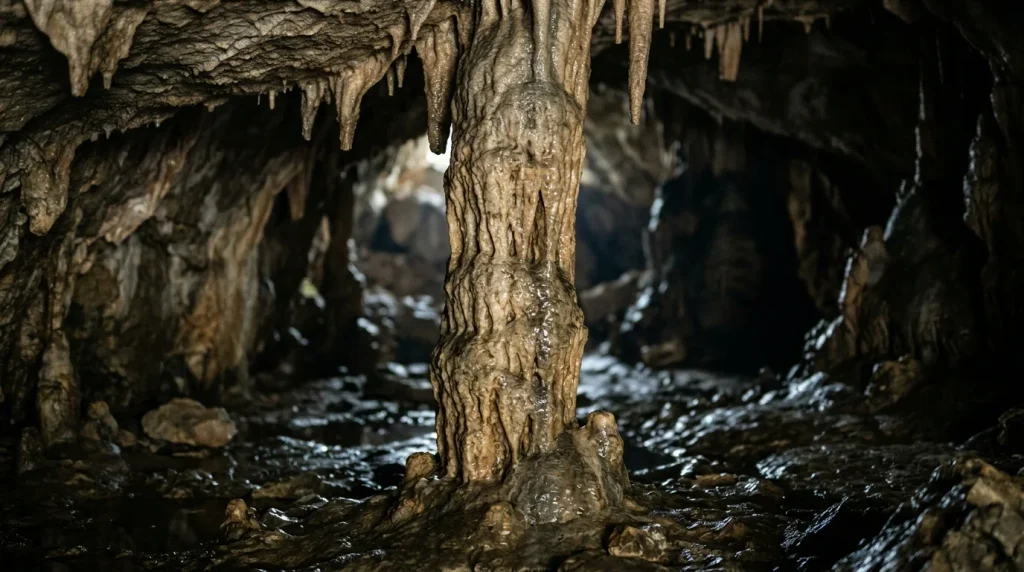
When Stalactites and Stalagmites Meet
A stalactite and stalagmite may grow toward one another.
If they eventually connect, they can form a continuous structure known as a column or pillar.
These columns may become impressive features of large cave chambers.
However, the connection can take an exceptionally long time, and many opposing formations never meet.
Why Cave Formations Have Different Shapes
Not all cave deposits resemble traditional icicles or cones.
Water can create a remarkable variety of mineral structures.
Flowstone: Frozen-Looking Mineral Waterfalls
Flowstone develops when mineral-rich water flows across cave walls or floors.
Instead of dripping from a single point, the water spreads over a broader surface.
Calcite accumulates in layers, sometimes producing smooth, rippling formations.
These deposits may resemble frozen waterfalls.
Cave Curtains and Draperies
When water travels along an inclined ceiling or sloping rock surface, mineral deposits can develop into thin hanging sheets.
These formations are called cave curtains or draperies.
Some have delicate folds that resemble fabric.
Their shape reflects the path taken by the flowing water.
Helictites: Formations That Seem to Defy Gravity
Helictites are unusual cave formations that may curve, twist, or branch in unexpected directions.
Their growth can involve capillary forces and complex mineral-deposition conditions.
Unlike ordinary stalactites, they do not always grow straight downward.
Their irregular shapes make them among the most visually surprising speleothems.
Why Some Formations Are White and Others Are Colored
Pure calcite is often white or nearly colorless.
However, natural cave formations may display yellow, orange, reddish, or brown shades.
These colors can result from impurities, including iron-bearing materials, and other substances introduced by water.
Color does not necessarily indicate a different mineral.
The appearance depends on local geological and chemical conditions.
How Long Does It Take for Stalactites to Form?
There is no single growth rate that applies to every stalactite or stalagmite.
Some formations grow relatively quickly under favorable conditions.
Others accumulate mineral deposits extremely slowly or stop growing altogether.
Factors That Influence Growth
Water availability is important.
A steady supply of mineral-rich water can support continued deposition.
However, excessive flow may change where minerals accumulate.
The concentration of dissolved calcium carbonate also matters.
Temperature, carbon dioxide conditions, and seasonal rainfall can influence growth.
Even small changes in the surrounding environment may alter deposition patterns.
Why Size Does Not Reveal Exact Age
A large stalagmite is not necessarily older than every smaller formation nearby.
Growth rates can change over time.
A formation may experience periods of rapid accumulation followed by long intervals of little or no growth.
Some deposits also undergo erosion or partial dissolution.
Scientists therefore cannot reliably determine age from height alone.
What Stalactites and Stalagmites Reveal About Earth’s Past
Cave formations are not merely beautiful geological objects.
They can preserve valuable information about past environmental conditions.
Mineral Layers as Natural Archives
As stalagmites grow, they may develop successive mineral layers.
These layers can contain chemical signals related to the water from which they formed.
Scientists analyze their composition to investigate changes in environmental conditions.
Studying Ancient Rainfall and Climate
Researchers sometimes examine oxygen and carbon isotope patterns within speleothems.
These measurements can provide clues about past climate and hydrological conditions.
However, interpretation is complicated.
The same chemical signal may be influenced by several environmental processes.
Scientists often compare cave records with other evidence before drawing conclusions.
Dating Cave Formations
Certain speleothems can be dated using uranium-series techniques.
These methods examine radioactive decay within suitable mineral samples.
They allow researchers to estimate when particular layers formed.
The resulting records can contribute to studies of past rainfall patterns, environmental changes, and regional climate history.
Famous Caves Where These Formations Can Be Seen
The United States contains remarkable cave systems where visitors can observe mineral formations.
Carlsbad Caverns, New Mexico
Carlsbad Caverns National Park contains extensive limestone cave passages and impressive speleothem displays.
Visitors can observe formations created through long periods of mineral deposition.
The park also illustrates how underground geological processes shape large cave environments.
Mammoth Cave, Kentucky
Mammoth Cave National Park is famous for its extensive passage system.
Different sections of the cave display varied geological features, including mineral formations in suitable areas.
Its geology demonstrates that not every cave passage develops abundant stalactites.
Water pathways and local conditions strongly influence where speleothems form.
Luray Caverns, Virginia
Luray Caverns is known for its striking stalactites, stalagmites, and columns.
The cave provides an opportunity to observe how mineral deposits can create intricate underground landscapes.
As with any cave, visitors should follow established paths and avoid touching formations.
In Your Own Yard: Discovering the Science of Mineral Deposits
You do not need to enter a cave to understand the basic chemistry behind stalactite formation.
Similar mineral-deposition processes can sometimes be observed in everyday environments.
Look for Mineral Deposits Around Water
In areas with hard water, mineral buildup may appear around outdoor faucets, fountains, or irrigation fixtures.
These deposits often contain calcium carbonate.
They form when changes in water chemistry allow dissolved minerals to accumulate.
Although this is not identical to every cave process, it illustrates the general principle of mineral precipitation.
Observe Limestone in Your Landscape
Limestone is used in some garden walls, paths, and decorative features.
Look for natural variations in texture and signs of weathering.
Rainwater can gradually alter exposed carbonate rock.
Avoid damaging the stone while observing its surface.
Explore Local Geology Safely
If your region contains limestone landscapes, nearby parks may offer educational trails or geological exhibits.
Interpretive signs can explain how water shapes carbonate rocks.
For cave visits, choose managed sites with established safety procedures.
Never enter abandoned mines or unfamiliar underground openings.
Protect Natural Cave Formations
Speleothems can be extremely fragile.
Touching them may transfer oils and dirt to their surfaces, potentially interfering with mineral deposition.
Breaking a formation can destroy structures that took very long periods to develop.
Responsible cave exploration means observing without disturbing.
Common Myths About Cave Formations
One common misconception is that stalactites are simply frozen water.
In reality, most familiar limestone-cave stalactites consist primarily of mineral deposits rather than ice.
Another myth is that all stalactites grow at the same rate.
Growth varies according to water supply, chemistry, and local conditions.
Some people also assume that large cave formations must have grown continuously.
However, growth can stop and restart as environmental conditions change.
Finally, stalactites and stalagmites are sometimes confused with the cave itself.
The cave usually develops through rock dissolution, while these formations grow through mineral deposition.
The two processes are related but distinct.
Frequently Asked Questions
1. What is the difference between stalactites and stalagmites?
Stalactites hang from cave ceilings, while stalagmites grow upward from cave floors. Both commonly form when mineral-rich water deposits calcium carbonate. Their shapes depend on where the water travels and how minerals accumulate.
2. How long does it take for a stalactite to grow?
Growth rates vary considerably. Some stalactites accumulate minerals relatively quickly under favorable conditions, while others grow extremely slowly or remain inactive for long periods. Their age cannot be determined reliably from size alone.
3. Can stalactites and stalagmites form outside natural caves?
Similar mineral deposits can develop in artificial underground structures, tunnels, and other environments where mineral-rich water drips or flows. However, these deposits may form under different chemical conditions and are not always directly comparable to natural limestone-cave speleothems.
Conclusion
Deep beneath the surface, a single drop of water can contribute to a geological structure that grows almost too slowly to notice.
Understanding how stalactites form reveals the remarkable relationship between water, limestone, carbon dioxide, and mineral deposition.
Stalactites descend from ceilings, stalagmites rise from floors, and countless other formations develop as water follows different paths through underground spaces.
Their shapes reflect changing environmental conditions, while their mineral layers may preserve evidence of Earth’s past.
The next time you see a photograph of a magnificent cave filled with stone columns and delicate hanging formations, remember the extraordinary process behind them.
Nature did not carve these sculptures in a single dramatic moment.
It built them, drop by drop, over immense stretches of time.
External Sources
1. National Park Service – How Stalactites and Stalagmites Form. Explains how rainwater dissolves limestone and deposits calcite, gradually creating stalactites and stalagmites. Source: NPS – How Stalactites and Stalagmites Form. National Park Service
2. National Park Service – Speleothems. Describes different cave formations, including soda straws, stalactites, stalagmites, columns, and helictites. Source: NPS – Speleothems. National Park Service
3. U.S. Geological Survey – Geology of Mammoth Cave National Park. Explains how acidic groundwater creates limestone caves and how mineral precipitation produces underground formations. Source: USGS – Geology of Mammoth Cave. USGS
4. National Park Service – Cave Geology in Depth. Examines calcite deposition, carbon dioxide release, soda straw development, and why cave formations grow at different rates. Source: NPS – Cave Geology in Depth. National Park Service
5. U.S. Geological Survey – Paleoclimate Archives. Explains how scientists analyze mineral layers in speleothems to investigate ancient rainfall and climate changes. Source: USGS – Paleoclimate Archives. USGS