
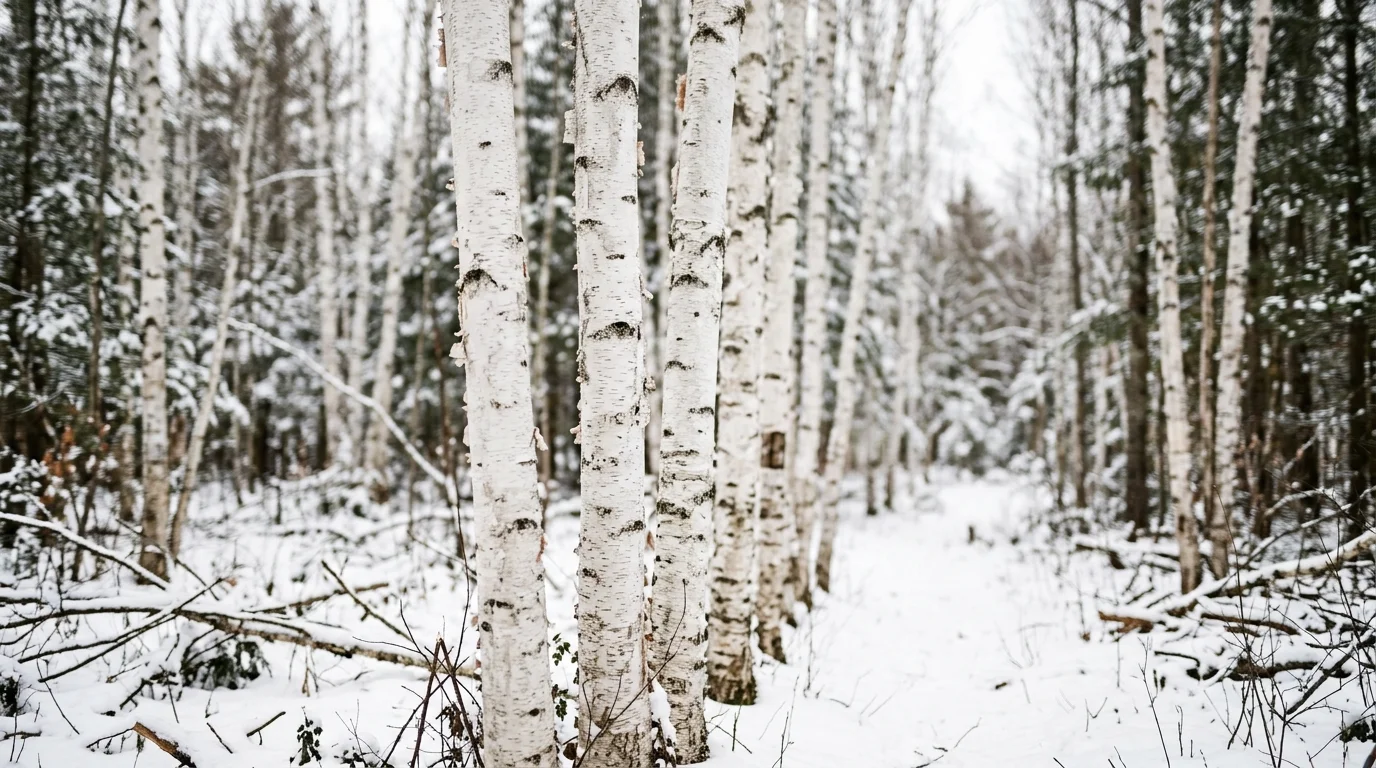
A tree can lose every leaf in winter and still reveal its identity through the patterns covering its trunk.
Some trees have smooth, pale bark that resembles polished stone. Others develop deep grooves, peeling strips, or overlapping plates that look almost like pieces of a puzzle. These textures are not random decorations. They are clues to a tree’s species, age, and growth.
Learning to identify trees by bark opens an entirely new way of exploring nature. Even when branches are bare and leaves are hidden beneath snow, the trunk can provide valuable information.
You do not need expensive equipment or professional forestry training to begin. A little observation, a few photographs, and an understanding of common bark patterns can transform an ordinary walk into a fascinating botanical investigation.
In this guide, we will explore eight recognizable North American trees, discover the science behind their bark, and learn how to distinguish similar-looking species.
Table of Contents
- What Is Tree Bark?
- How to Identify Trees by Bark: The Science Behind the Patterns
- Eight Common Trees and Their Bark Characteristics
- How Bark Changes as Trees Age
- Why Bark Matters to Wildlife and Forest Ecosystems
- In Your Own Yard: Practice Identifying Trees
- Common Mistakes When Identifying Trees
- Frequently Asked Questions
- Conclusion
What Is Tree Bark?
Tree bark is the protective tissue covering the outside of woody stems and roots.
Although people often think of bark as a single layer, it contains several tissues with different functions.
The inner bark includes phloem, which transports sugars and other organic substances produced by photosynthesis to growing and storage tissues.
Outside the vascular cambium, protective tissues develop as the stem increases in diameter.
The outer bark helps shield the tree from physical damage, temperature extremes, moisture loss, and some organisms.
Its thickness, texture, and appearance vary considerably among species.
Why Trees Have Different Bark
Bark patterns develop through a combination of genetics, growth, and environmental conditions.
Some trees retain relatively smooth bark for much of their lives.
Others develop deep fissures as their trunks expand and older outer tissues split.
In certain species, outer bark peels away in thin sheets or strips.
Environmental factors, including sunlight, moisture, injury, and disease, can also influence its appearance.
These differences make bark a useful identification feature, especially when leaves are unavailable.
However, bark alone does not always provide a definitive answer.
How to Identify Trees by Bark: The Science Behind the Patterns
Recognizing bark involves more than memorizing colors.
The most useful approach is to understand how bark develops and examine several characteristics together.
1. Observe the Overall Texture
Begin by looking at the trunk from a short distance.
Is the surface smooth, deeply furrowed, flaky, or covered with overlapping plates?
Smooth bark may appear almost unbroken, while furrowed bark has visible grooves separating raised ridges.
Some species develop scaly surfaces as outer layers crack into irregular sections.
Others produce peeling bark that separates into thin sheets.
These broad categories help narrow the possibilities.
2. Examine the Shape of Ridges and Furrows
The arrangement of bark ridges can be especially informative.
Some trees develop long vertical grooves.
Others have intersecting ridges that form diamond-shaped patterns.
A few species display irregular plates separated by shallow cracks.
The depth, spacing, and direction of these features can change with age.
For this reason, compare bark patterns on mature trees whenever possible.
3. Look for Peeling Layers
Peeling bark is one of the easiest characteristics to notice.
Paper birch often develops thin, curling sheets of pale bark.
River birch may display peeling layers in shades of salmon, tan, and brown.
Sycamores can shed patches of outer bark, revealing lighter surfaces beneath.
Although these species all shed bark, the resulting patterns are quite different.
4. Notice Color Without Relying on It Alone
Bark colors range from white and silver to reddish brown, dark gray, and nearly black.
However, color can be misleading.
Rain may darken bark temporarily.
Algae, lichens, dust, and weathering can change its appearance.
Lighting conditions also influence photographs.
Color is most useful when combined with texture and other identifying features.
5. Understand the Role of Growth
As a tree grows wider, its outer protective tissues must accommodate the expanding trunk.
Some outer tissues crack because they cannot stretch indefinitely.
The pattern of cracking depends partly on how protective tissues develop and accumulate.
This helps explain why mature trees often have rougher bark than young individuals.
A young oak and an old oak may look surprisingly different, even though they belong to the same species.
6. Combine Bark With Other Clues
Professional tree identification rarely depends on bark alone.
Leaf shape, buds, branching patterns, fruit, seeds, and habitat provide additional evidence.
For example, two trees may have similar gray bark but very different winter buds.
Observing several features together makes identification more reliable.
This is particularly important in regions where closely related species grow alongside one another.
Eight Common Trees and Their Bark Characteristics
The following species are familiar in different parts of the United States. Their geographic ranges vary, so not every species will occur naturally in every region.
1. Paper Birch — White Bark That Peels Like Paper
Scientific name: Betula papyrifera
Paper birch is famous for its pale bark, which often peels in thin, horizontal sheets.
Mature trunks commonly appear white or creamy, with dark horizontal markings called lenticels.
The peeling layers may curl away from the trunk, creating a distinctive appearance.
Young trees can have darker bark before the characteristic white surface develops.
Identification clue: Look for white bark with dark horizontal markings and thin, papery peeling layers.
Paper birch is native to northern portions of North America and is especially associated with cooler climates.
Its recognizable bark makes it a favorite subject for nature photography.
2. American Sycamore — A Trunk That Looks Like Camouflage
Scientific name: Platanus occidentalis
American sycamore has one of the most distinctive bark patterns among large eastern North American trees.
Its outer bark often breaks away in irregular patches.
This exposes lighter inner surfaces in shades of cream, pale green, tan, and gray.
The result resembles a natural camouflage pattern.
Older trunks may retain darker, rougher bark near the base, while upper branches appear much lighter.
Identification clue: Look for large, irregular patches of peeling bark that reveal contrasting pale surfaces.
American sycamores commonly grow near rivers, streams, and other moist environments.
3. Shagbark Hickory — Long Strips That Curl Away
Scientific name: Carya ovata
Shagbark hickory earns its name from its remarkable bark.
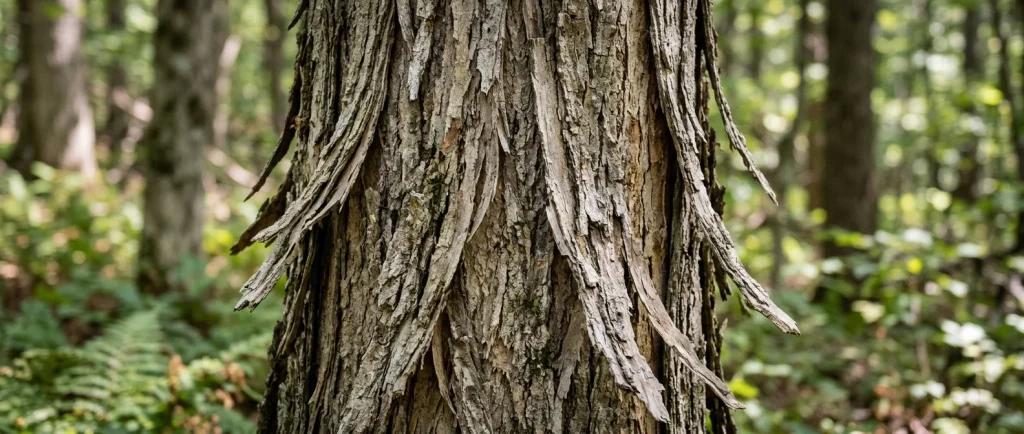
As the tree matures, long, narrow strips of gray bark loosen and curl outward.
The strips often remain attached near their centers, giving the trunk a shaggy appearance.
Young shagbark hickories may have relatively smooth bark, making them less obvious.
Identification clue: Look for long vertical plates of bark that separate and curl away from the trunk.
This species occurs across much of eastern North America.
Its distinctive bark becomes particularly noticeable on mature trees.
4. Eastern White Pine — Gray Bark With Deep Furrows
Scientific name: Pinus strobus
Eastern white pine changes considerably as it grows.
Young trees typically have relatively smooth, grayish bark.
Older trees develop darker bark with deep furrows and broad, irregular ridges.
The mature surface can appear divided into elongated plates.
Identification clue: On mature trees, look for dark gray bark with broad ridges and deep grooves.
Because several pine species develop rough bark, needles provide important confirmation.
Eastern white pine typically has soft needles arranged in bundles of five.
It is native to eastern North America and is widely planted in suitable landscapes.
5. American Beech — Smooth Bark That Resembles Gray Skin
Scientific name: Fagus grandifolia
American beech is known for its smooth, thin, gray bark.
Even mature trees often retain a relatively uniform surface compared with deeply furrowed species.
The trunk can resemble a tall gray column rising through the forest.
Occasional scars, lichens, or disease-related changes may interrupt the smooth appearance.
Identification clue: Look for a large tree with smooth, pale gray bark and few prominent ridges.
American beech grows naturally across much of eastern North America.
Its bark is particularly vulnerable to damage, so avoid carving or scratching the trunk.
6. Northern Red Oak — Long Ridges With Shiny-Looking Stripes
Scientific name: Quercus rubra
Northern red oak develops dark gray to brownish bark as it matures.
The trunk often has long vertical ridges separated by shallow furrows.
Some mature trees display lighter, relatively smooth streaks running along the tops of the ridges.
These can create a striped appearance.
Identification clue: Look for long, continuous ridges with lighter vertical streaks on mature bark.
Bark varies with age and growing conditions, so leaves, buds, and acorns are useful for confirmation.
Northern red oak is widespread in eastern North America.
7. Black Cherry — Dark Bark Resembling Burnt Potato Chips
Scientific name: Prunus serotina
Black cherry is particularly interesting because its bark changes dramatically with age.
Young trees often have relatively smooth, reddish-brown bark marked by horizontal lenticels.
Mature trunks develop dark, irregular, scaly plates.
These plates sometimes resemble overlapping burnt potato chips.
Identification clue: Look for dark, flaky plates on mature trees, often with raised edges.
Black cherry is native to much of eastern North America and occurs in additional regions.
Its fruits provide food for various birds and mammals, although its leaves and other tissues can be toxic to livestock under certain conditions.
8. River Birch — Peeling Bark in Warm Copper Colors
Scientific name: Betula nigra
River birch has attractive peeling bark that often displays several colors at once.
Young trunks may show salmon, cinnamon, tan, and creamy shades.
Thin layers curl away in irregular sheets.
As trees mature, the lower trunk can become darker and more deeply furrowed.
Identification clue: Look for curling, papery bark in reddish-brown or copper-colored layers.
River birch is native to much of the eastern and central United States.
It commonly grows near waterways and is also planted as an ornamental landscape tree.
How Bark Changes as Trees Age
One of the biggest challenges in tree identification is that bark is not static.
Young trees often have smoother, thinner outer surfaces.
As trunks expand, protective tissues develop and older layers may crack, thicken, or peel.
The result can be a dramatic transformation.
A young black cherry may have smooth bark with horizontal markings, while a mature specimen develops dark, scaly plates.
Similarly, young eastern white pines look very different from older trees with deeply furrowed trunks.
When identifying an unfamiliar tree, consider its approximate age and size.
It is also useful to examine both the lower trunk and upper branches.
Different parts of the same tree may display different bark textures.
Why Bark Matters to Wildlife and Forest Ecosystems
Bark is more than a protective covering.
Its cracks, ridges, and loose layers create habitats for numerous organisms.
Shelter for Insects and Other Small Animals
Bark crevices can provide shelter for insects, spiders, and other small invertebrates.
Some species spend part of their lives beneath loose bark or within protected cracks.
The suitability of these spaces depends on tree species, bark condition, and local climate.
Feeding Opportunities for Birds
Woodpeckers, nuthatches, and other birds search tree trunks for insects and other food.
Some probe cracks in the bark, while others investigate decaying wood.
Different bark textures can influence where prey organisms are found.
Lichens and Mosses
Tree bark also provides a surface for lichens and some mosses.
These organisms do not generally obtain their food directly from living bark tissues.
Instead, they use the surface as a place to grow.
Their presence can contribute to the visual complexity of tree trunks and provide microhabitats for small organisms.
In Your Own Yard: Practice Identifying Trees
Your backyard, neighborhood park, or local woodland can become a practical tree-identification classroom.
Start With Three Nearby Trees
Choose three accessible trees and examine their trunks.
Look for differences in color, texture, ridges, and peeling layers.
Take photographs from a distance and close up.
Include the full tree whenever possible, since overall shape can provide useful context.
Make a Simple Bark Identification Journal
Record the date, location, approximate trunk diameter, and bark characteristics.
Describe what you see using terms such as smooth, scaly, furrowed, peeling, or plated.
Add notes about leaves, buds, or seeds if they are available.
Over time, your journal can become a personal field guide.
Compare Trees Across Seasons
Winter is an excellent time to practice because deciduous trees have lost their leaves.
However, revisit the same trees in spring or summer.
Leaves and flowers can help confirm identifications made from bark.
This seasonal comparison improves accuracy.
Protect the Trees You Study
Avoid peeling bark, cutting into trunks, or carving identification marks.
Removing protective bark can expose living tissues to injury and infection.
Use photographs and visual observations instead.
If you are exploring public parks or natural areas, follow local regulations and remain on designated paths where required.
Common Mistakes When Identifying Trees
A frequent mistake is assuming that one bark pattern belongs to only one species.
Several trees can develop similar ridges or peeling surfaces.
Another mistake is ignoring age.
Young and mature trees of the same species may look very different.
Weather conditions can also mislead observers.
Wet bark often appears darker than dry bark, while sunlight can exaggerate certain colors.
Finally, relying on a single photograph may produce incorrect results.
Accurate identification is strongest when bark observations are combined with leaves, buds, branching patterns, and geographic range.
Frequently Asked Questions
1. Can you identify a tree by bark alone?
Sometimes, distinctive bark provides a strong clue. Paper birch, shagbark hickory, and American sycamore are good examples. However, bark varies with age and environmental conditions, so other characteristics should be checked whenever possible.
2. Why do some trees have smooth bark while others have deep cracks?
Bark texture depends on species-specific growth patterns and how outer protective tissues respond as the trunk expands. Some trees retain relatively smooth surfaces, while others develop thick layers that crack into ridges or plates.
3. Is peeling bark a sign that a tree is unhealthy?
Not necessarily. Peeling bark is normal for species such as river birch, paper birch, and American sycamore. However, unusual bark loss accompanied by dead branches, exposed damaged tissue, or declining foliage may indicate a problem that deserves professional evaluation.
Conclusion
A tree does not need leaves to reveal its identity.
Its trunk carries a record of growth, adaptation, and the environment in which it lives.
Learning to identify trees by bark allows you to recognize familiar species even during winter, when many other botanical clues are missing.
From the smooth gray surface of American beech to the shaggy strips of hickory and the colorful peeling layers of river birch, every species has distinctive characteristics worth discovering.
And the next time you walk past a bare tree, remember the surprising truth: even without a single leaf, it may already be telling you its name.
External Sources
1. University of Minnesota Extension – What Tree Is That ? A Beginner’s Guide to Tree ID in Your Neighborhood. Explains how bark, leaves, and other characteristics help identify trees, particularly during winter. Source: University of Minnesota Extension
2. Arbor Day Foundation – Anatomy of a Tree. Explains the structure and protective functions of tree bark, including the differences between inner and outer bark. Source: Arbor Day Foundation
3. USDA Forest Service – Silvical Characteristics of Paper Birch. Describes the distinctive white, papery bark of paper birch and its identifying features. Source: USDA Forest Service
4. USDA Forest Service – Identifying Hardwoods Growing on Pine Sites. Provides scientific descriptions and identification illustrations of hardwood trees, including oaks and hickories. Source: USDA Forest Service Research
5. Arbor Day Foundation – What Tree Is That—and Why? Explains how bark, buds, leaves, and fruit help distinguish tree species and why correct identification matters. Source: Arbor Day Foundation