
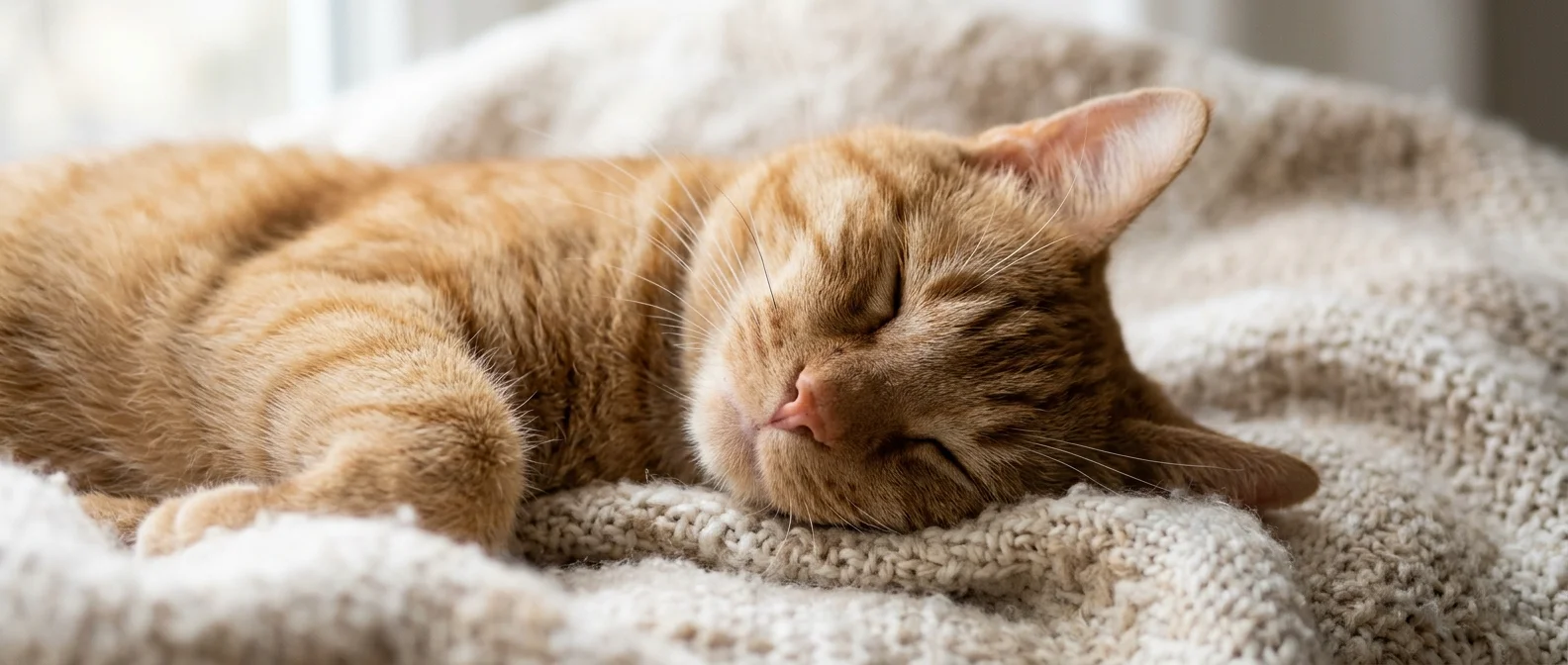
A cat can purr while curled up comfortably on your lap—and sometimes while sitting nervously in a veterinarian’s examination room.
It is the same familiar rumbling sound, but the emotions behind it may be completely different.
Most people associate purring with happiness. A relaxed cat closes its eyes, stretches its paws, and begins producing that gentle vibration. It seems like one of the clearest signs of feline contentment.
But the science of why cats purr reveals a much more complicated story.
Cats may purr during affectionate interactions, while communicating with their kittens, when requesting food, and sometimes during stressful or painful experiences.
The sound itself is only one part of their communication.
To understand what a purring cat might be expressing, we need to examine its posture, facial expressions, tail movements, ears, and surroundings.
The fascinating truth is that a purr can mean different things depending on the cat and the situation.
Table of Contents
- What Is Purring?
- Why Cats Purr: The Science Behind the Sound
- Seven Reasons Cats May Purr
- How to Read a Purring Cat’s Body Language
- When Purring May Signal Discomfort
- Do All Cats Purr the Same Way?
- In Your Own Yard: Understanding Your Cat’s Behavior
- Common Myths About Cat Purring
- Frequently Asked Questions About Cat Purring
- Conclusion
What Is Purring?
Purring is a rhythmic, low-frequency vocalization produced by domestic cats and several other feline species.
Unlike a typical meow, which usually occurs during exhalation, domestic cats can produce purring sounds during both inhalation and exhalation.
This creates the familiar continuous rumbling pattern.
The sound often feels like a vibration when you gently place a hand against a relaxed cat’s chest or throat.
Purring is generally quieter than meowing, although its intensity varies considerably between individuals.
Some cats produce a soft, almost inaudible vibration. Others can be heard from across a quiet room.
Purring Begins Early in Life
Kittens begin developing purring behavior at a very young age.
Mother cats may purr while nursing, and kittens can respond with their own vocalizations.
These sounds may help maintain contact during close interactions.
Because newborn kittens have limited vision and hearing, physical contact, scent, and vibration are particularly important in their early environment.
Purring is therefore more than an expression of adult feline relaxation.
It is also part of communication that begins during kittenhood.
Why Cats Purr: The Science Behind the Sound
For many years, researchers debated exactly how cats produce their distinctive rumbling sound.
The mechanism involves the larynx, commonly called the voice box, but scientific understanding has continued to develop.
The Role of the Larynx
The larynx contains the vocal folds, which vibrate as air passes through them.
These structures are responsible for many mammalian vocalizations.
In domestic cats, purring involves low-frequency vibrations associated with the vocal folds.
Earlier explanations emphasized repeated contractions of laryngeal muscles controlled by the nervous system.
This model suggested that rapid muscular activity helped regulate the opening and closing of the vocal folds during breathing.
However, more recent research has added important details.
What Recent Research Reveals
A study published in Current Biology in 2023 investigated the physical properties of domestic cat larynges.
The researchers found that isolated cat larynges could produce purr-like low-frequency sounds through airflow without the repeated muscle contractions previously considered necessary for each vibration.
The findings suggest that the physical structure of feline vocal folds contributes significantly to the sound.
Specialized tissue within the vocal folds appears to help support low-frequency vibration.
This does not mean the nervous system has no role in natural purring.
Living cats still need neural and muscular control to regulate breathing, vocal behavior, and the conditions under which sounds are produced.
Instead, the research indicates that the physical mechanism may be more complex than older explanations suggested.
Why Purring Sounds So Different From Meowing
Meowing and purring serve different communication functions.
A meow often involves a more obvious change in pitch and sound intensity.
Purring is generally more rhythmic and continuous.
Its low-frequency vibrations create a distinctive sound that can be felt as well as heard.
The differences reflect how the vocal system is used during each behavior.
Cats can also combine purring with other vocal elements, particularly when interacting with humans.
This makes feline communication more varied than it might initially appear.
Does Purring Have Healing Properties?
One popular theory suggests that the vibrations associated with purring may support tissue repair or recovery.
Researchers have explored relationships between mechanical vibrations and biological tissues in different contexts.
However, there is not enough direct evidence to conclude that ordinary cat purring reliably heals injuries, strengthens bones, or treats disease.
Claims about specific therapeutic frequencies should therefore be treated cautiously.
Cats sometimes purr while injured or ill, but this observation does not establish that the sound itself produces a medical benefit.
The most scientifically responsible explanation is that purring may serve several behavioral functions, while possible physiological effects remain an area of investigation.
Seven Reasons Cats May Purr
Although happiness is a familiar explanation, cats may purr in several different situations.
Understanding the surrounding behavior helps clarify what the sound might mean.
1. Relaxation and Contentment
A comfortable cat may purr while resting in a favorite sleeping spot.
Its body often appears loose and relaxed.
The ears are generally in a neutral position, and the eyes may be partly closed.
Some cats stretch their paws or settle against a familiar person.
In this context, purring often accompanies contentment.
However, the sound alone is not enough to confirm the cat’s emotional state.
2. Social Bonding With Humans
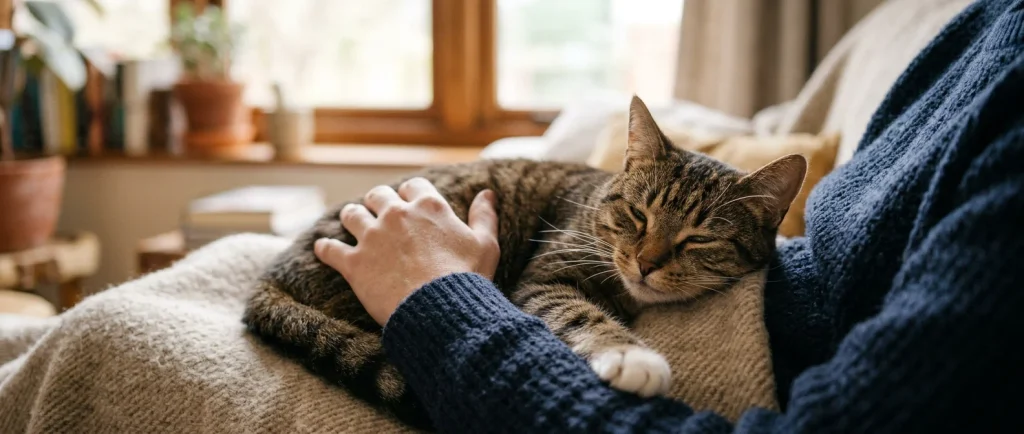
Many cats purr during friendly interactions with their owners.
They may approach voluntarily, rub against a person’s legs, or settle nearby.
Purring can accompany affectionate behavior and familiar social contact.
Some cats enjoy petting around the cheeks and head, while others prefer limited physical interaction.
Individual preferences matter.
A cat that moves away or becomes tense may be signaling that it has had enough attention, even if it was purring moments earlier.
3. Communication Between Mothers and Kittens
Purring is commonly observed during interactions between mother cats and their young.
It may contribute to close-range communication during nursing and resting.
Kittens also produce purr-like sounds early in life.
These interactions occur alongside scent recognition, touch, and other vocal signals.
Purring is therefore part of a broader communication system rather than a single-purpose behavior.
4. Requesting Food or Attention
Some domestic cats develop distinctive vocal patterns when seeking something from humans.
Research has described a form of purring that includes a higher-frequency vocal component.
This combination may make the sound especially noticeable to human listeners.
It is sometimes called solicitation purring.
A cat may use this behavior near feeding time or when attempting to gain attention.
However, not every cat produces this type of purr, and individual communication styles vary.
5. Stress or Uncertainty
Cats sometimes purr in unfamiliar or stressful situations.
A veterinary visit is one example.
The cat may be surrounded by unfamiliar smells, sounds, and people.
In such circumstances, purring should not automatically be interpreted as happiness.
Some researchers and animal behavior specialists suggest that purring may sometimes accompany attempts to regulate emotional arousal.
The exact function is not fully established.
6. Pain or Illness
Some cats purr when experiencing pain, injury, or illness.
This can surprise owners who assume that purring always indicates comfort.
A sick cat may purr while remaining unusually still, hiding, or showing reduced interest in food.
Because cats often conceal signs of vulnerability, subtle behavioral changes deserve attention.
Purring should never be used as proof that a cat is healthy.
7. Resting and Settling Down
Some cats purr while preparing to sleep.
They may knead a soft blanket, turn in a circle, and settle into a comfortable position.
These behaviors often occur in familiar, secure environments.
The purr may accompany relaxation and the transition toward rest.
Still, cats differ in how frequently they vocalize.
A quiet cat can be just as comfortable as one that purrs regularly.
How to Read a Purring Cat’s Body Language
The most useful way to interpret purring is to observe the entire animal.
Cats communicate through combinations of posture, facial expression, movement, vocalization, and context.
Signs of a Relaxed Cat
A comfortable cat often displays a loose body posture.
Its ears may point forward or rest naturally to the sides.
The eyes can appear soft or partly closed.
A relaxed cat may rest with its paws tucked beneath its body or stretch comfortably.
Slow blinking can also occur during calm social interactions.
When these signals accompany purring, contentment becomes a reasonable interpretation.
Signs of Anxiety or Discomfort
A stressed cat may hold its body low to the ground.
Its muscles can appear tense, and the ears may flatten or rotate backward.
The pupils may become enlarged, although lighting conditions also affect pupil size.
Some cats crouch, hide, or attempt to escape.
Others remain unusually still.
If a cat purrs while displaying several of these behaviors, the sound should not be assumed to indicate happiness.
Understanding Tail Movements
A cat’s tail provides useful information, but it must be interpreted in context.
A gently raised tail can accompany friendly approaches.
Rapid tail lashing or forceful twitching may indicate agitation.
A tightly tucked tail can sometimes accompany fear or insecurity.
However, tail movements are not universal emotional labels.
The same movement may have different meanings depending on the situation.
Watch for Changes in Behavior
A cat’s usual habits provide an important baseline.
Some cats purr frequently, while others rarely produce an audible sound.
A sudden change in vocalization, appetite, activity, or social behavior may be more meaningful than the purr itself.
Observing patterns over time can help owners recognize when something seems unusual.
When Purring May Signal Discomfort
Purring becomes more concerning when it appears alongside signs of illness or distress.
A cat that suddenly hides, refuses food, or becomes unusually inactive may need veterinary attention.
Other warning signs include difficulty breathing, repeated vomiting, obvious pain, or trouble moving.
A cat that is struggling to breathe requires urgent veterinary care, regardless of whether it is purring.
Changes in litter box habits also deserve attention.
Repeated attempts to urinate with little or no urine produced can indicate a medical emergency, particularly in male cats.
Do not delay veterinary assessment because a cat is still purring.
The sound is not a reliable indicator of physical well-being.
Do All Cats Purr the Same Way?
Domestic cats vary widely in their purring behavior.
Some begin purring as soon as they receive attention.
Others purr only in specific situations.
Differences in age, temperament, health, and experience may influence how frequently a cat vocalizes.
The sound itself can also vary in intensity and rhythm.
Do Wild Cats Purr?
Purr-like vocalizations occur in several feline species, but their production and behavioral roles vary.
Many smaller wild cats can produce sounds resembling domestic cat purring.
The relationship between purring and roaring is more complicated than the popular claim that cats must do one or the other.
Different species have distinct vocal anatomy and sound-producing abilities.
It is therefore better to consider each species individually rather than applying one simple rule to all cats.
In Your Own Yard: Understanding Your Cat’s Behavior
A garden or backyard can offer opportunities to observe feline behavior in a familiar environment.
However, outdoor access should always be managed with safety and wildlife protection in mind.
Observe Your Cat in a Safe Outdoor Space
A secure cat enclosure, sometimes called a catio, allows cats to experience outdoor sights and smells while reducing risks.
Watch how your cat responds to birdsong, moving leaves, and unfamiliar sounds.
Some cats remain relaxed and curious.
Others may become alert or overstimulated.
Notice whether purring occurs during resting, exploration, or interactions with you.
Create a Calm Observation Routine
Choose a quiet moment when your cat is comfortable.
Sit nearby without forcing contact.
Observe the position of its ears, eyes, tail, and body.
If the cat approaches voluntarily, offer gentle attention according to its preferences.
Stop if it moves away, becomes tense, or shows signs of irritation.
This approach helps you understand the difference between voluntary affection and unwanted handling.
Keep a Simple Behavior Journal
Record situations in which your cat purrs.
Include what happened immediately before the sound, the cat’s posture, and what it did afterward.
Over time, patterns may become noticeable.
For example, one cat may purr mainly during quiet evening interactions.
Another may produce a distinctive sound before meals.
The goal is not to assign one fixed meaning to every purr.
It is to understand your individual cat’s communication style.
Protect Backyard Wildlife
Cats are natural predators, even when they are well fed.
Allowing cats to roam freely can expose them to vehicles, parasites, conflicts with other animals, and other hazards.
It can also place pressure on local wildlife, including birds and small mammals.
Supervised outdoor time, secure enclosures, and indoor enrichment offer alternatives.
A safe outdoor environment can support feline curiosity while reducing risks to the cat and surrounding wildlife.
Common Myths About Cat Purring
One widespread myth is that a purring cat must be happy.
In reality, purring can occur during both positive and negative experiences.
Another misconception is that purring proves a cat is not in pain.
Some sick or injured cats continue to purr.
There is also a popular claim that purring automatically heals bones or injuries.
Although researchers have investigated the physical properties of purring, strong clinical evidence for such healing claims remains limited.
Finally, some people believe that every cat should purr frequently.
Normal vocal behavior varies between individuals.
A cat that rarely purrs may still be healthy, relaxed, and socially bonded with its owner.
Frequently Asked Questions About Cat Purring
1. Why does my cat purr when I pet it?
Many cats purr during enjoyable physical contact. If your cat approaches voluntarily, maintains a relaxed posture, and remains comfortable, the purring likely accompanies a positive interaction. However, watch for tension, tail lashing, or attempts to move away, which may indicate that the cat wants the interaction to stop.
2. Can cats purr when they are scared or sick?
Yes. Some cats purr during stressful situations, illness, or pain. The sound should always be interpreted alongside body language and other behavioral signs. Sudden changes in appetite, activity, breathing, or litter box habits warrant veterinary attention.
3. Why does my cat purr so loudly?
Purring volume varies between cats. Some naturally produce stronger vibrations, while others are barely audible. A loud purr is not necessarily a sign of greater happiness. If the sound changes suddenly or occurs alongside unusual behavior, consult a veterinarian.
Conclusion
A cat curled comfortably on your lap and a nervous cat waiting at the veterinarian may produce the same familiar rumbling sound.
Yet their experiences can be very different.
Understanding why cats purr means looking beyond the sound itself.
Purring can accompany relaxation, affection, communication, attention-seeking, and sometimes discomfort.
The most reliable clues come from observing the cat’s entire body, its surroundings, and its usual behavior.
And the next time your cat begins to purr, remember the surprising lesson behind that gentle vibration: the sound is only the beginning of the conversation.