
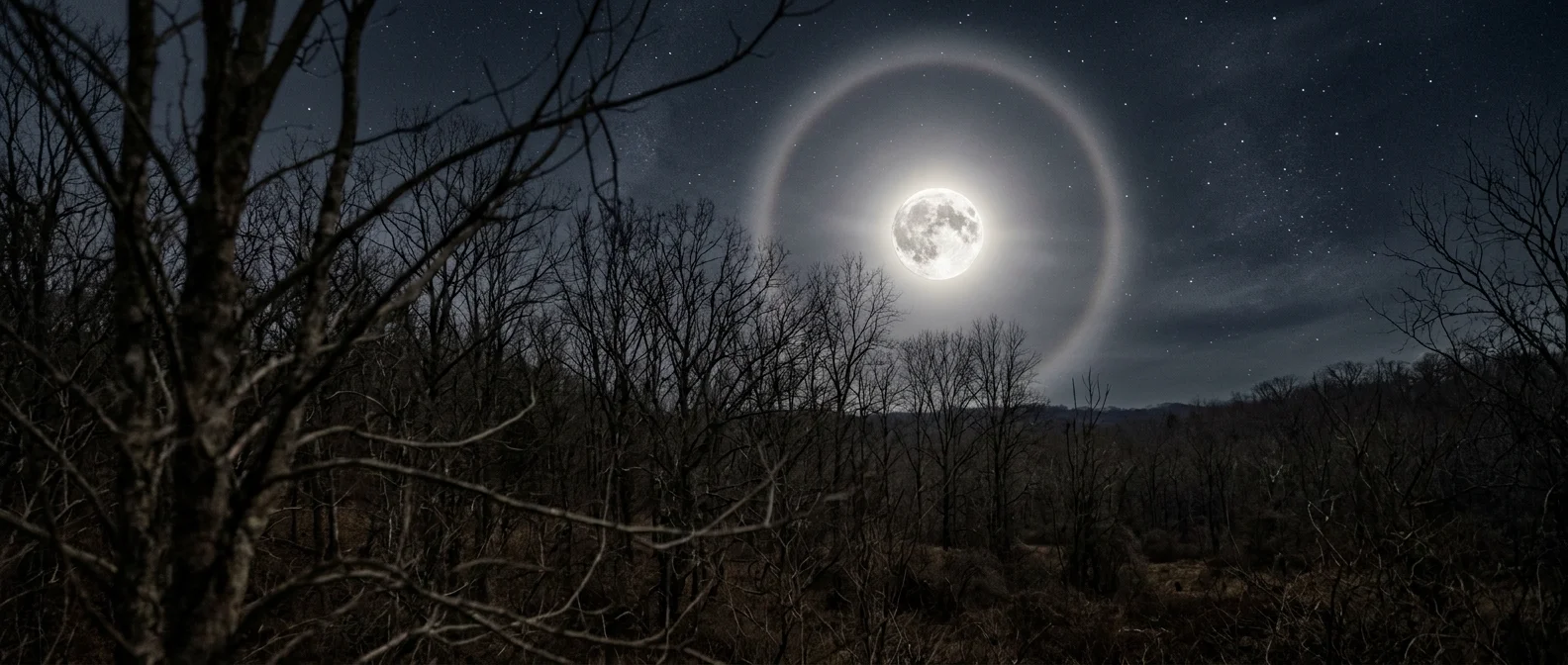
Sometimes, the Moon appears to be surrounded by a perfect circle of light, even though there is nothing visible connecting the ring to the Moon itself.
The first time you notice it, the sight can seem almost impossible. A bright, pale circle stretches across the night sky, with the Moon shining quietly at its center. The stars may still be visible, and the air might feel perfectly calm.
This remarkable phenomenon is called a moon halo, and it is one of the most beautiful optical effects produced by Earth’s atmosphere.
For centuries, people have connected rings around the Moon with changing weather. Some traditions considered them signs of approaching rain or snow. Others viewed them as mysterious messages written across the night sky.
Modern science offers an explanation that is just as fascinating.
A moon halo forms when moonlight interacts with tiny ice crystals suspended high above the ground. Those crystals bend light in a predictable way, creating a glowing circle that can sometimes stretch across a large portion of the sky.
The ring is real, but it is not an object floating around the Moon. It is an optical effect created between the Moon and the observer.
Understanding how it works reveals an extraordinary connection between clouds, light, weather patterns, and the atmosphere above your own backyard.
Table of Contents
- What Is a Moon Halo?
- The Science Behind a Moon Halo: How and Why the Ring Forms
- What a Moon Halo Might Mean for the Weather
- Why Some Moon Halos Look Different
- Moon Halos, Moonbows, and Lunar Coronas
- The Moon Halo in Folklore and Human History
- In Your Own Yard: How to Observe a Moon Halo
- Frequently Asked Questions About Moon Halos
- Conclusion
What Is a Moon Halo?
A moon halo is a luminous ring that appears around the Moon when moonlight passes through ice crystals in Earth’s atmosphere.
The most familiar type is known as a 22-degree halo.
This name refers to the approximate angular distance between the Moon and the ring, as measured from the observer’s position.
It does not describe the physical size of the ring in miles or kilometers.
The circle can appear enormous because it occupies a wide area of the sky. Its radius is approximately 22 degrees, giving the complete ring an angular diameter of about 44 degrees.
Moon halos are often pale white, although faint rainbow-like colors can sometimes be visible.
They are most easily noticed when the Moon is bright and the sky is dark enough for the ring to stand out.
The Ring Is Not Actually Around the Moon
Although a halo looks as though it surrounds the Moon, it is not located near the lunar surface.
The Moon is hundreds of thousands of miles away, while the ice crystals responsible for the halo are suspended within Earth’s atmosphere.
The circular appearance results from the way light travels through those crystals toward your eyes.
Two people watching from different locations may see slightly different halos because each observer receives light passing through a different collection of ice crystals.
In other words, the halo is an atmospheric display centered on the observer’s line of sight toward the Moon.
The Science Behind a Moon Halo: How and Why the Ring Forms
The formation of a moon halo begins with something surprisingly ordinary: frozen water.
High above the ground, certain clouds contain countless tiny ice crystals. When moonlight passes through them, the crystals can bend the light and create the familiar ring.
Several physical processes work together to produce this effect.
1. High Clouds Contain Tiny Ice Crystals
Moon halos commonly form when thin, high-altitude clouds contain suitable ice crystals.
Cirrostratus clouds are especially associated with this phenomenon.
These clouds often spread across large sections of the sky, forming a delicate, translucent layer.
They can be difficult to notice at night because they may appear almost invisible against the darkness.
Yet even a thin cloud layer can contain enormous numbers of microscopic ice crystals.
At the cold temperatures found high in the atmosphere, water can exist as solid ice rather than liquid droplets.
Many atmospheric ice crystals develop hexagonal structures, meaning their shapes have six-sided symmetry.
Some resemble tiny columns, while others form thin plates.
Their geometry is central to the formation of the halo.
2. Moonlight Bends as It Passes Through Ice
When light travels from air into ice, its speed changes.
This causes the light to change direction, a process called refraction.
The same basic principle explains why a straw appears bent when placed in a glass of water.
In the atmosphere, certain hexagonal ice crystals act like tiny prisms.
Light entering one side of a crystal and leaving through another can be redirected at a particular angle.
For a common 22-degree halo, the important geometry involves light passing through two prism faces separated by an angle of approximately 60 degrees.
Because of the refractive properties of ice, light traveling through these crystals is concentrated near a minimum deviation of roughly 22 degrees.
This creates a brighter region in the sky at that angular distance from the Moon.
The result is the circular halo.
3. Why the Halo Forms a Circle
One of the most striking features of a moon halo is its nearly perfect circular shape.
The circle forms because many ice crystals are oriented in different directions as they move through the atmosphere.
Only crystals positioned at suitable angles redirect moonlight toward a particular observer.
Across a large cloud, countless crystals can contribute light from different directions around the Moon.
Together, they create a ring centered on the Moon’s apparent position.
The halo does not require the ice crystals to form a physical circle in the sky.
Instead, the circular shape emerges from the geometry of refraction.
This is a beautiful example of how simple physical laws can create large, symmetrical patterns in nature.
4. Why the Inside of the Ring Often Looks Darker
A 22-degree halo sometimes appears to have a noticeably darker interior.
This happens because the refraction geometry of the contributing crystals does not direct much light toward the observer at angles smaller than the halo’s inner edge.
The light becomes more concentrated near the characteristic minimum deviation angle.
The result can be a bright circular boundary surrounding a relatively darker area.
The contrast varies depending on cloud thickness, crystal properties, moonlight intensity, and sky conditions.
Some halos have sharp edges, while others appear soft and diffuse.
5. Why Most Moon Halos Look White
Sunlight contains many visible wavelengths, and moonlight is primarily sunlight reflected from the lunar surface.
Different wavelengths refract through ice at slightly different angles.
This can produce subtle color separation within a halo.
The inner edge may sometimes show a faint reddish tint, with other colors appearing farther outward.
However, moon halos frequently look mostly white.
One reason is that moonlight is much dimmer than direct sunlight.
Under low-light conditions, human vision becomes less sensitive to color, making subtle differences difficult to detect.
As a result, the ring may look silvery or milky even when the underlying optical process separates colors slightly.
What a Moon Halo Might Mean for the Weather
The traditional connection between moon halos and approaching storms has a scientific basis, but it is not a dependable forecast by itself.
High Clouds Can Arrive Before a Weather System
Cirrostratus clouds sometimes develop ahead of large weather systems, including warm fronts.
As moist air rises and cools, high clouds may spread across the sky before thicker cloud layers arrive.
In some situations, this sequence eventually leads to rain or snow.
A moon halo can therefore indicate that high-altitude moisture and ice crystals are present.
If those clouds are associated with an approaching frontal system, precipitation may follow.
However, high clouds can also occur without a significant storm developing nearby.
Does a Moon Halo Mean Rain Is Coming?
Not necessarily.
A moon halo is evidence of suitable atmospheric ice crystals, not proof that rain is on the way.
Its forecasting value depends on the broader weather pattern.
Wind direction, atmospheric pressure, humidity, temperature, and the movement of cloud systems all influence what happens next.
In some cases, precipitation may arrive within a day or so. In others, the sky may clear without any rain.
For a reliable forecast, use local National Weather Service information rather than relying on the halo alone.
The ring is best understood as an interesting atmospheric clue.
Why Some Moon Halos Look Different
Not every halo appears equally bright, complete, or colorful.
Several factors influence its appearance.
The Brightness of the Moon
Moon halos are generally easier to notice when the Moon is bright.
A full or nearly full Moon provides more light for the ice crystals to refract toward the observer.
Fainter lunar phases can also produce halos, but the display may be more difficult to see.
Cloud Thickness and Crystal Conditions
Thin, widespread ice-crystal clouds can create a clear ring.
Thicker clouds may obscure the Moon or scatter light in ways that reduce the halo’s contrast.
The sizes, shapes, and orientations of ice crystals also influence the appearance of atmospheric optical displays.
A Complete Ring or a Partial Arc
Sometimes, only part of the halo is visible.
Uneven cloud cover, nearby buildings, trees, or changing atmospheric conditions can hide sections of the circle.
A partial arc does not necessarily represent a different phenomenon.
It may simply be the visible portion of a larger halo.
Moon Halos, Moonbows, and Lunar Coronas
Several nighttime optical phenomena involve circles or arcs of light, but they form through different mechanisms.
Moon Halo
A typical moon halo forms through refraction in atmospheric ice crystals.
The familiar 22-degree halo is relatively large, with a broad ring centered on the Moon.
Lunar Corona
A lunar corona usually appears much closer to the Moon.
It forms mainly through diffraction, as moonlight interacts with tiny water droplets or sometimes small particles in clouds.
Coronas often display compact, softly colored rings.
Their size can change depending on the droplets involved.
Moonbow
A moonbow is a rainbow produced by moonlight interacting with water droplets.
Like an ordinary rainbow, it involves refraction, internal reflection, and dispersion.
Moonbows are usually faint and require favorable conditions, including sufficiently bright moonlight and water droplets positioned opposite the Moon.
Understanding these differences makes nighttime skywatching even more rewarding.
The Moon Halo in Folklore and Human History
Long before scientists understood atmospheric optics, people noticed rings around the Moon.
Because halos sometimes appeared before changing weather, they became part of traditional weather lore.
In various communities, lunar rings were associated with approaching rain, snow, or storms.
Some traditions also attached symbolic or spiritual meanings to these unusual displays.
Such interpretations reflect the important role the sky played in everyday life, particularly for people whose work depended on weather conditions.
Farmers, sailors, and travelers often watched clouds, wind, and celestial appearances for practical clues.
Today, the scientific explanation does not diminish the sense of wonder.
Instead, it reveals why generations of observers noticed a genuine relationship between certain cloud conditions and changing weather.
In Your Own Yard: How to Observe a Moon Halo
You do not need a telescope or expensive equipment to enjoy this phenomenon.
A backyard, porch, or open garden can provide an excellent viewing location.
Choose a Clear View of the Sky
Find a safe outdoor location with a wide view of the Moon.
Avoid bright outdoor lights when possible, as glare can make faint atmospheric details harder to notice.
A darker garden or backyard may provide a better view.
Allow your eyes time to adjust to the nighttime conditions.
Look for Thin, High Clouds
Moon halos are often associated with a faint veil of high clouds.
If the Moon appears slightly hazy but remains clearly visible, look for a broad ring around it.
The circle may extend much farther from the Moon than expected.
Hold your hand at arm’s length to appreciate its apparent size.
A 22-degree halo has a radius of about two handspans for many people, although hand measurements vary.
Photograph the Halo
A smartphone with a night photography mode may capture a bright moon halo under favorable conditions.
Use a stable support and avoid excessive digital zoom.
Include a tree silhouette, rooftop, or garden feature to give the image a sense of scale.
A wide-angle view is often useful because the ring covers a substantial portion of the sky.
Avoid making the Moon so bright in the exposure that the surrounding halo disappears.
Record the Weather That Follows
Turn the observation into a simple backyard science activity.
Write down the date, approximate time, Moon phase, cloud appearance, and whether the halo was complete.
Then compare your observation with the weather over the following day or two.
You may notice that some halos appear before unsettled weather, while others do not.
A small observation journal can help distinguish traditional weather sayings from patterns in your local climate.
Always stay indoors during thunderstorms or other dangerous weather.
Frequently Asked Questions About Moon Halos
1. Is a moon halo rare?
Moon halos are not exceptionally rare, but they are easy to miss. They require suitable ice crystals, enough moonlight, and favorable viewing conditions. Many people simply do not spend much time observing the nighttime sky.
2. Can a moon halo appear during any season?
Yes. Moon halos can occur throughout the year because the high-altitude clouds responsible for them can contain ice crystals even when temperatures near the ground are warm. Their frequency varies with local weather patterns and cloud conditions.
3. Is a ring around the Moon dangerous?
No. A moon halo itself is a harmless optical phenomenon. It does not emit harmful radiation or indicate anything unusual happening to the Moon. However, the weather system associated with the clouds may sometimes bring hazardous conditions, so ordinary weather precautions still apply.
Conclusion
The next time you step outside and discover a glowing circle surrounding the Moon, you will know that the sky is revealing something extraordinary.
Far above your garden, tiny ice crystals are bending reflected sunlight into a pattern that stretches across the darkness.
The moon halo is not a mysterious object or a guaranteed warning of bad weather. It is a remarkable display created by the interaction of light, ice, and atmospheric conditions.
And just like that surprising ring you first noticed overhead, the explanation reminds us that some of nature’s most beautiful sights begin with processes too small to see.
External Sources
1.World Meteorological Organization (WMO) – 22° Halo. Explains how ice crystals refract moonlight to create the circular 22-degree halo. Source: https://cloudatlas.wmo.int/22-halo.html
2. NOAA National Weather Service – What Causes Halos, Sundogs and Sun Pillars?. Describes the atmospheric optical processes responsible for halos. Source: https://www.weather.gov/arx/why_halos_sundogs_pillars
3. NOAA National Weather Service – Weird Weather. Explains unusual weather phenomena and why halos can sometimes precede rain or snow. Source: https://www.weather.gov/owlie/weird-weather
4. NOAA National Weather Service – Clouds. Describes cloud formation and the high-altitude ice crystals associated with lunar halos. Source: https://www.weather.gov/arx/clouds
5. EarthSky – What Makes a Halo Around the Sun or Moon?. Explains how halos form and why their visibility changes with atmospheric conditions. Source: https://earthsky.org/space/what-makes-a-halo-around-the-moon/