
Imagine finding a large, hairy tarantula lying upside down, its legs curled slightly upward and its body almost completely motionless. At first glance, it looks like the spider has died.
But something extraordinary may actually be happening.
Tarantula molting is one of the most remarkable transformations in the spider world. During this process, a tarantula sheds its old external skeleton and emerges with a new, flexible covering that gradually hardens.
For many species, lying on the back is a normal part of this transformation. What looks like a helpless spider may be an animal performing one of the most demanding biological tasks of its life.
Even more fascinating, tarantulas repeat this process throughout their development, and some continue molting long after reaching adulthood.
Understanding why they molt, how often it happens, and what their behavior means reveals a hidden side of these misunderstood arachnids.
What Is Tarantula Molting?
Tarantulas belong to the spider family Theraphosidae, a diverse group found in tropical, subtropical, and some dry regions around the world.
Like other arthropods, tarantulas have an external skeleton called an exoskeleton.
This protective covering supports the body, provides attachment points for muscles, and helps protect internal tissues.
However, it cannot expand indefinitely as the spider grows.
To increase in size, the tarantula must periodically replace its exoskeleton through a process called ecdysis, or molting.
A New Skeleton Beneath the Old One
Before a molt, the tarantula begins preparing a new cuticle beneath its existing outer covering.
The old cuticle separates from underlying tissues, and the spider undergoes internal physiological changes that prepare it for shedding.
Once the old exoskeleton is removed, the new covering is initially soft and flexible.
Over time, it hardens and becomes more protective.
More Than a Change of Skin
Molting involves more than simply peeling away an outer layer.
The spider must free its legs, mouthparts, and other structures from their old coverings.
Even delicate body parts require careful separation.
A successful molt allows a growing tarantula to become larger, while also replacing damaged or worn external structures.
Young tarantulas may even regenerate certain lost appendages over successive molts.
Why Tarantulas Lie on Their Backs During Molting
One of the most alarming sights for an inexperienced observer is a tarantula resting upside down.
In many species, this is a completely normal molting position.
The Upside-Down Position
Many terrestrial tarantulas roll onto their backs shortly before the final shedding stage.
They may lie on a prepared silk mat that helps provide a stable surface.
This position allows the spider to work its body and appendages out of the old exoskeleton.
Not every species or individual follows exactly the same pattern.
Some tarantulas molt on their sides, and arboreal species may molt in different positions within their retreats.
Why the Spider Appears Motionless
During the early stages of ecdysis, a tarantula may remain still for extended periods.
The spider is undergoing internal changes that are not visible from the outside.
Occasional movements of the legs or abdomen may occur as the old exoskeleton begins to separate.
Because these movements can be subtle, the spider may appear lifeless.
Why Disturbing It Is Dangerous
Molting is a physically demanding and vulnerable process.
A tarantula that is moved, turned over, or handled during ecdysis may experience serious complications.
Its new exoskeleton is soft, and its appendages can be damaged.
If you observe a tarantula lying on its back in an apparent molting position, the safest response is generally to leave it undisturbed.
How Tarantula Molting Works: The Complete Process
The transformation from an old exoskeleton to a new one occurs through several overlapping stages.
Although the exact sequence and timing vary by species, age, and environmental conditions, the basic biological process is shared across tarantulas.
Stage 1: Premolt Preparation
Before shedding, a tarantula enters a period commonly called premolt.
During this stage, the spider prepares a new cuticle beneath the old one.
Its behavior may change noticeably.
Some individuals become less active, spend more time inside their retreats, or refuse food.
In certain New World tarantulas, a bald patch on the abdomen may darken as the molt approaches.
However, this is not a universal sign, and darkening alone does not prove that molting is imminent.
Stage 2: Reduced Activity and Feeding
Many tarantulas stop eating before a molt.
This can happen well before the visible shedding begins.
Young spiders may have relatively short premolt periods, while some large or slow-growing adults may spend considerably longer preparing.
A temporary feeding refusal is therefore not always a sign of illness.
Nevertheless, changes in appetite should be interpreted alongside the spider’s overall condition, hydration, and environment.
Stage 3: The Spider Takes Its Molting Position
When the final shedding process approaches, many terrestrial tarantulas settle onto a silk mat and roll onto their backs.
Others may lie on their sides or remain positioned inside a silk-lined retreat.
The spider may remain almost motionless while internal pressure and muscular activity help loosen the old covering.
Stage 4: The Old Exoskeleton Splits
The old exoskeleton begins to open along predetermined lines, commonly around the carapace.
The carapace is the hardened upper covering of the spider’s front body region.
As the split develops, the spider gradually works its body free.
The old covering may lift away, revealing the softer new cuticle beneath.
Stage 5: The Legs Are Withdrawn
One of the most delicate stages involves freeing the legs from their old exoskeletal coverings.
The spider uses controlled movements and internal pressure to withdraw its appendages.
Because each leg contains several segments, the process requires coordinated movement.
A problem during this stage can result in a stuck molt or damaged appendage.
This is one reason why intervention by an inexperienced person can make matters worse.
Stage 6: The New Exoskeleton Expands
Once the spider has emerged, its new cuticle remains flexible.
The tarantula can expand parts of its body before the exoskeleton hardens.
This expansion helps accommodate growth.
The spider may appear noticeably different from its previous form, sometimes with brighter colors or fresher-looking hairs.
Stage 7: Hardening and Recovery
After shedding, the new exoskeleton gradually hardens through processes involving cuticle stabilization and sclerotization.
The spider remains vulnerable during this period.
Its fangs also need time to harden before normal feeding resumes.
Depending on the species, size, and conditions, recovery can take days or longer.
A freshly molted tarantula should not be rushed into handling or feeding.
What Happens to the Old Exoskeleton?
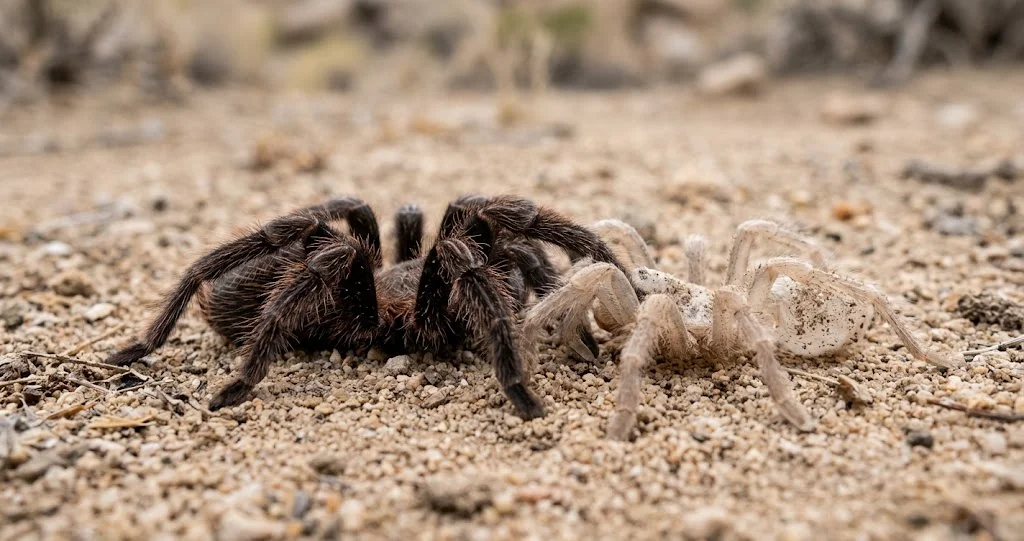
The discarded exoskeleton is called an exuvia.
It often resembles an empty spider, complete with legs and body coverings.
In some cases, it can look so realistic that an observer may mistake it for a dead tarantula.
Researchers and experienced keepers can sometimes examine an intact molt to study anatomical features, including structures used in determining sex.
The abandoned shell is evidence that the spider has successfully completed a remarkable transformation.
How Often Do Tarantulas Molt?
There is no single molting schedule that applies to every tarantula.
The frequency depends on species, age, growth rate, food availability, temperature, and reproductive maturity.
Spiderlings and Juveniles
Young tarantulas generally molt more frequently than adults because they are growing rapidly.
Some spiderlings may molt several times within a year.
As they become larger, the intervals between molts usually increase.
A rapidly growing juvenile may therefore shed its exoskeleton much more often than an older tarantula of the same species.
Adult Female Tarantulas
Adult female tarantulas can continue molting after reaching sexual maturity.
In many species, mature females molt roughly once a year, although intervals can be shorter or considerably longer.
Some slow-growing species may go more than a year between molts.
Because female tarantulas can live for many years, they may undergo numerous molts throughout their lives.
Adult Male Tarantulas
Males follow a different pattern.
In many tarantula species, males undergo a final maturation molt that produces adult reproductive structures.
After this molt, they typically stop molting.
Rare exceptions have been reported, so it is more accurate to say that mature males generally do not molt again.
Their adult lifespan is often much shorter than that of females of the same species.
Why Molting Schedules Vary
A tarantula’s growth rate reflects its biology and environment.
Temperature, nutrition, and seasonal conditions can influence development, but faster growth is not necessarily healthier growth.
For captive spiders, appropriate species-specific care is more important than trying to accelerate molting.
How to Recognize a Tarantula Preparing to Molt
Premolt behavior can be subtle, especially in species that spend much of their time hidden.
Common observations include reduced appetite, increased retreat use, and lower activity.
Some tarantulas create a silk mat before molting, while others close their burrow entrances.
A darker abdominal patch may be noticeable in species that possess urticating hairs.
However, these signs are not definitive. A tarantula may also refuse food because of stress, reproductive behavior, or unsuitable environmental conditions.
Tarantula Molting vs. a Dying Spider
An upside-down tarantula is not automatically a dying tarantula.
The position and overall context matter.
The Normal Molting Position
During a typical molt, a terrestrial tarantula may lie on its back with its legs extended or partially raised.
The spider may remain still before gradually working free of its old exoskeleton.
If this behavior follows a period of premolt signs, molting is a reasonable possibility.
The So-Called Death Curl
A severely weakened or dying spider may develop tightly curled legs beneath its body.
This appearance is sometimes called a death curl.
However, leg curling alone cannot establish whether a tarantula is dying, dehydrated, injured, or experiencing another problem.
The safest response depends on the full situation.
If a captive tarantula appears unwell without clear signs of molting, consult an experienced exotic-animal veterinarian rather than attempting forceful intervention.
In Your Own Yard: Observing Tarantulas Safely
In parts of the American Southwest, wild tarantulas may be encountered near burrows, trails, rocky areas, or open grasslands.
Their behavior offers opportunities for fascinating wildlife observation.
Respect Burrows and Retreats
Tarantulas often spend considerable time in sheltered locations.
Avoid digging into burrows or pulling spiders from their retreats.
Disturbing a hidden spider may expose it to predators, dehydration, or injury.
Never Handle a Molting Tarantula
A spider undergoing ecdysis is especially vulnerable.
Do not turn it over, poke it, or attempt to remove its old exoskeleton.
Observe from a distance and allow the process to continue naturally.
Give Captive Tarantulas Time to Recover
For pet tarantulas, maintain appropriate environmental conditions and access to water according to the species’ needs.
Remove live feeder insects before an expected molt when practical, since uneaten prey can injure a vulnerable spider.
After molting, wait until the spider has recovered and its fangs have hardened before offering food.
The appropriate waiting period depends on the tarantula’s size and species.
Observe Without Collecting
Finding an old exoskeleton can be an interesting discovery.
Photographing the molt where it lies is usually enough to appreciate the animal’s transformation.
There is no need to capture a wild tarantula or disturb its shelter.
Why Molting Matters for Tarantula Survival
Molting allows tarantulas to grow beyond the limitations of their existing exoskeleton.
It also provides opportunities to replace worn external structures and, in some cases, regenerate lost appendages.
Regeneration is not instantaneous. A replacement leg may initially be smaller and become more developed through later molts.
For young tarantulas, repeated molting is essential to development.
For adult females, continued molting helps maintain and renew the external covering throughout a potentially long life.
Yet every molt also creates a period of vulnerability.
The spider must successfully shed its old skeleton while protecting its soft new body.
This balance between growth and risk makes molting one of the most important events in a tarantula’s life.
Frequently Asked Questions
1. Is it normal for a tarantula to lie on its back?
Yes. Many terrestrial tarantulas lie on their backs during molting. This position helps them shed their old exoskeleton. Avoid touching or repositioning a spider that appears to be molting.
2. How long does tarantula molting take?
The visible shedding process may take several hours, although the timing varies widely. Premolt preparation can last much longer, and the new exoskeleton may require days or longer to harden sufficiently for normal activity and feeding.
3. How many times does a tarantula molt in its lifetime?
There is no universal number. Young tarantulas molt repeatedly as they grow, adult females generally continue molting, and mature males of most species do not molt again. The total depends on species, sex, growth rate, and lifespan.
Conclusion
A tarantula lying motionless on its back may seem like a disturbing sight, but it can actually be preparing for an extraordinary transformation.
Tarantula molting allows these remarkable spiders to grow, renew their protective covering, and sometimes regenerate damaged or missing appendages.
Young tarantulas molt relatively frequently, while adults generally molt less often. Many mature females continue shedding throughout life, but adult males usually stop after their final maturation molt.
The most important lesson is simple: a molting tarantula needs time and protection, not interference.
That seemingly lifeless spider may be doing something remarkable—emerging from its old skeleton into a new stage of life.
External Source
- Encyclopaedia Britannica — Tarantula — General information about tarantula biology and behavior.