
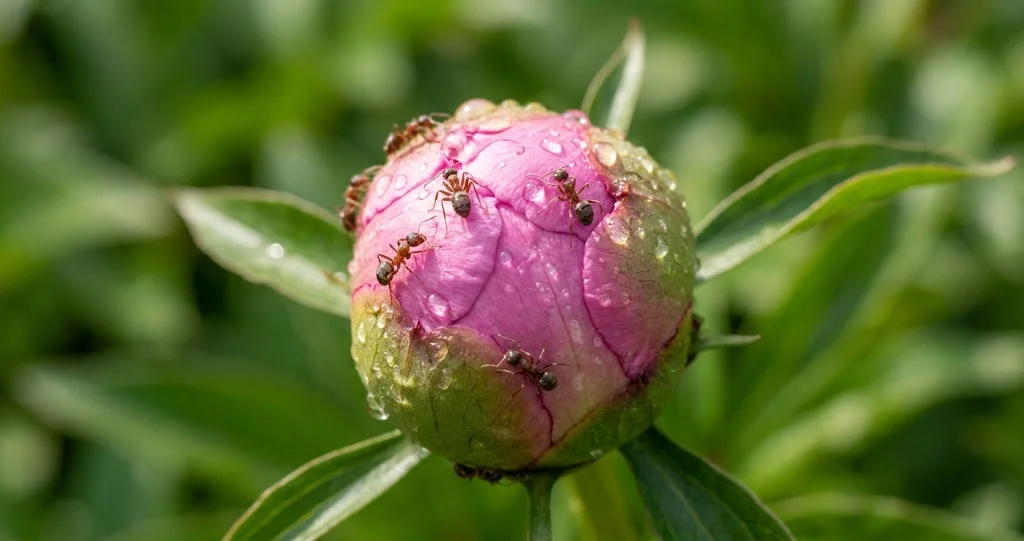
A peony bud is about to bloom, but something unexpected is happening on its surface. Tiny ants are climbing over the rounded green bud, gathering near its sticky edges, and moving from one flower to another.
At first glance, it looks like an insect invasion. Some gardeners worry that the ants are eating the buds, spreading disease, or preventing the flowers from opening.
But the truth about ants on peonies is far more interesting.
In many cases, the ants are simply collecting a sugary substance produced naturally by the plant. They are not responsible for opening the flowers, and their presence usually does not indicate a serious problem.
This familiar springtime scene reveals a fascinating connection between plant secretions, insect behavior, and the small ecological relationships unfolding in an ordinary backyard.
Why Ants Gather on Peony Buds
Peonies are among the most recognizable spring-flowering garden perennials. Their large blossoms, colorful petals, and rounded flower buds make them favorites in American gardens.
During the weeks before blooming, gardeners may notice ants moving across the buds.
The insects are usually attracted by a food source rather than the flower petals themselves.
Peony Buds Produce Sugary Secretions
Many herbaceous peonies produce nectar from specialized tissues on the outside of developing flower buds.
These secretions contain sugars that attract nectar-feeding insects, including ants.
The nectar-producing areas are often associated with the green structures surrounding the unopened flower.
Because this nectar is produced outside the flower’s reproductive structures, it is commonly described as extrafloral nectar.
Ants can collect it without entering an open flower.
Why the Buds Sometimes Look Sticky
The sugary material may accumulate on the bud surface, creating a slightly glossy or sticky appearance.
Ants detect and exploit this accessible food source.
A developing bud can therefore become a temporary feeding station for nearby ant colonies.
The amount of visible secretion varies with the plant, bud development, and environmental conditions.
Not every peony bud attracts the same number of ants.
How and Why Ants Visit Peonies
The relationship between peonies and ants is a useful example of how insects respond to resources provided by plants.
It also explains why the ants appear most frequently during a particular stage of flower development.
Step 1: A Peony Bud Develops
As a peony prepares to bloom, its flower bud expands.
The green outer structures protect the developing petals while the flower remains closed.
During this stage, nectar-producing tissues may release small amounts of sugary liquid.
The secretion is accessible on the bud’s exterior.
Step 2: Foraging Ants Discover the Nectar
Worker ants routinely explore vegetation, soil, and other surfaces while searching for food.
When an ant encounters a suitable sugar source, it may feed and return to its colony.
In some ant species, successful foragers can recruit additional workers through chemical trails or other communication mechanisms.
This helps explain why a bud that initially attracts one or two ants may later have several visitors.
However, ant recruitment behavior differs among species.
Step 3: Ants Collect the Sugary Liquid
Ants use their mouthparts to collect nectar.
The sugar provides an energy source that can support worker activity.
The ants are not normally chewing through healthy flower buds to reach this food.
Instead, they are taking advantage of a secretion already available on the surface.
Step 4: The Bud Opens Naturally
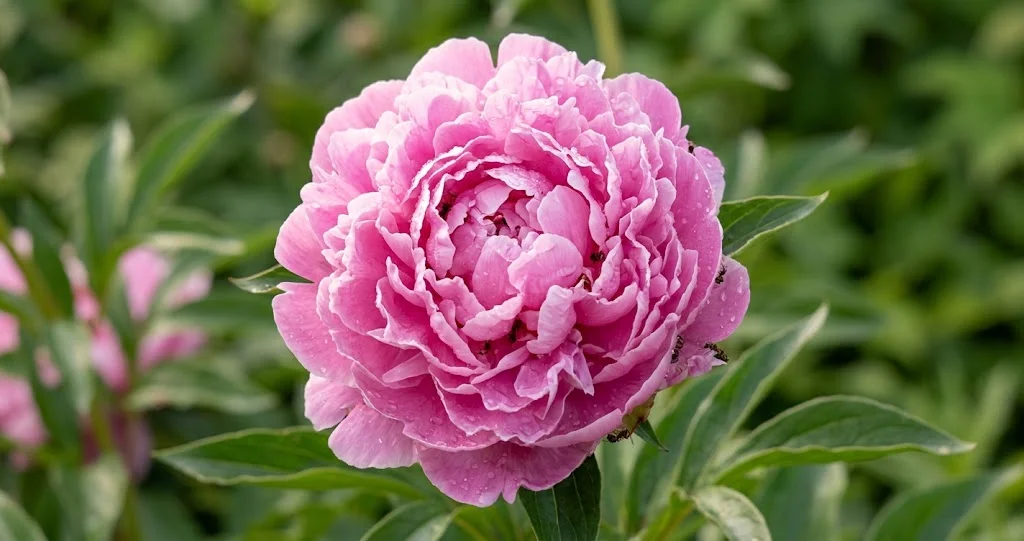
As the flower matures, the petals expand and the bud opens through normal plant development.
The ants do not need to pull the petals apart or remove a sticky coating.
Once the flower opens and the external nectar becomes less available, ant activity often decreases.
The insects may then move to other food sources.
Is the Relationship Beneficial to the Peony?
In some plant species, extrafloral nectar attracts ants that defend the plant against herbivorous insects.
Ants may chase away, attack, or consume certain insects they encounter while foraging.
This kind of relationship can provide defensive benefits to plants.
However, it would be inaccurate to assume that every ant visiting a peony protects it from pests.
The outcome depends on the ant species, the other insects present, and local conditions.
For garden peonies, the clearest and most consistent observation is that ants are attracted to sugary bud secretions.
Any protective effect should be described as possible rather than guaranteed.
Do Peonies Need Ants to Bloom?
One of the most persistent gardening myths is that peonies need ants to open their flower buds.
According to this belief, the ants eat away a sticky substance that would otherwise hold the petals closed.
It is an appealing story, but it is not how peony flowers develop.
Ants Do Not Unlock the Buds
Peonies can bloom successfully without ants.
Their flowers open through internal developmental processes involving petal growth and changes in the flower’s tissues.
Ants are visitors, not essential mechanical helpers.
A peony grown in a location with very little ant activity can still produce normal blossoms.
Why the Myth Became Popular
The misunderstanding probably developed because ants and opening buds often appear together.
Gardeners observe ants on tight buds, followed by the emergence of large flowers.
It is easy to interpret one event as the cause of the other.
But the timing reflects the availability of nectar during bud development rather than a requirement for insect assistance.
Why Some Peony Buds Fail to Open
When peony buds remain closed or deteriorate, other causes are more likely.
These may include late frost damage, insufficient sunlight, plant stress, or fungal diseases such as Botrytis blight.
Some buds may also fail to develop properly after unfavorable weather.
Ants feeding on normal bud secretions are not generally responsible.
Are Ants on Peonies Harmful?
For most established garden peonies, a few ants moving across healthy buds are not a reason for concern.
The insects are usually feeding rather than damaging plant tissues.
When Ant Activity Is Normal
Normal activity often includes ants walking across unopened buds, gathering near nectar-producing areas, and moving between nearby stems.
Healthy buds should continue developing normally.
The leaves remain green, and the stems show no obvious signs of injury.
When to Look More Closely
Not every group of ants on a plant is visiting extrafloral nectar.
Ants may also be attracted to honeydew, a sugary waste product produced by sap-feeding insects such as aphids and certain scale insects.
If ants are concentrated around leaves or stems covered with sticky residue, inspect the plant carefully.
Look for clusters of small insects, distorted new growth, or other signs of pest activity.
In those situations, the underlying problem may be the sap-feeding insects rather than the ants.
Ants Are Not a Substitute for Pest Control
Even if some ants discourage certain herbivores, they should not be relied upon to prevent garden pests.
Some ant species protect honeydew-producing insects from predators.
The same general insect group can therefore have different effects depending on the ecological relationship involved.
Understanding what attracts the ants is more useful than assuming their presence is always beneficial or harmful.
The Ecological Relationship Between Ants and Peonies
A peony bud covered with ants offers a small glimpse into the larger world of plant-insect interactions.
Plants do not interact only with bees and butterflies. They also provide food and habitat for ants, beetles, flies, wasps, and many other organisms.
Extrafloral Nectar Is Different From Floral Nectar
Floral nectar is typically associated with attracting pollinators to a flower’s reproductive structures.
Extrafloral nectar is produced outside those structures.
Its ecological role often involves attracting insects that may discourage plant-eating organisms.
The nectar found around peony buds is an example of this second category.
According to University of Illinois Extension, peony buds produce sugary secretions around the scales enclosing the developing flower. These secretions attract ants even though the insects are not needed for blooming.
A Possible Mutualistic Relationship
Ecologists use the word mutualism when two organisms benefit from an interaction.
The ants receive an accessible food source.
In return, their presence may discourage some insects that would otherwise feed on developing flower tissues.
The University of Missouri Integrated Pest Management program describes this peony-ant association as an example of mutualism.
However, the degree of protection is not necessarily the same in every garden.
Some ant species are more defensive than others, and the types of potential pests vary among locations.
Ants Are Part of a Larger Garden Food Web
Ants also participate in soil disturbance, scavenging, predation, and seed movement, depending on the species.
Some are important predators of small insects, while others obtain much of their energy from plant nectar or honeydew.
This diversity explains why ants should not automatically be labeled either beneficial or harmful.
Their ecological role depends on what they are doing and which organisms they interact with.
Why Some Peonies Have More Ants Than Others
Two peony plants growing a few feet apart may attract noticeably different numbers of ants.
Several factors can help explain the difference.
Differences in Bud Development
The amount of accessible nectar changes as buds develop.
A tight bud that has begun producing sugary secretions may attract numerous ants, while a younger bud may attract very few.
Ant activity commonly decreases as the flowers finish opening and nectar production declines.
Local Ant Populations
A peony near an active ant colony may receive more visitors than one farther from established foraging routes.
Different ant species also vary in their food preferences and ability to discover resources.
Weather and Seasonal Conditions
Ant foraging activity responds to temperature, moisture, and other environmental conditions.
Cool or rainy weather may temporarily reduce visible activity.
A warm, calm day may bring more insects onto the buds.
Consequently, the absence of ants is not a reliable indication that a peony is unhealthy.
Plant Variety and Growing Conditions
Peony varieties differ in flower shape, bud characteristics, and development.
The quantity and accessibility of nectar may also vary.
These differences can influence insect visitation, although they do not establish that one variety is necessarily healthier than another.
In Your Own Yard: What to Do About Ants on Peonies
For most gardeners, the best response to ants on healthy peony buds is surprisingly simple: leave them alone.
There is usually no reason to interfere with insects collecting naturally produced nectar.
1. Observe the Buds Before Taking Action
Look closely at the plant.
Healthy buds should appear firm and continue developing as the flowering season progresses.
A few ants walking over their surfaces are normal.
If the buds are turning brown, becoming soft, or developing fuzzy mold, investigate plant health rather than blaming the ants.
2. Avoid Unnecessary Insecticides
Spraying peony buds solely because ants are present is generally unnecessary.
Insecticides can affect other insects visiting the flowers and surrounding vegetation.
Kansas State University Extension specifically advises that ant activity on peony buds is common and does not justify insecticide treatment.
3. Check for Aphids When Appropriate
If ants are gathering around distorted leaves, tender stems, or sticky deposits away from the buds, inspect for sap-feeding insects.
Aphids are small, soft-bodied insects that may gather on new growth.
Their honeydew can attract ants.
An actual aphid infestation should be evaluated separately from normal ant feeding on peony nectar.
4. Bring Cut Peonies Indoors Without the Ants
Peonies make beautiful cut flowers, but gardeners understandably prefer not to bring insects into the house.
Choose buds that are beginning to show petal color and have softened enough to suggest they are approaching bloom.
After cutting, hold each stem upside down outdoors and gently shake the flower to dislodge ants.
Inspect the petals and sepals before bringing the arrangement inside.
If needed, a gentle rinse can remove remaining insects, although delicate petals should be handled carefully.
Place the stems in a clean vase with fresh water.
5. Support Healthy Peony Growth
Peonies generally perform best in well-drained soil with adequate sunlight.
Many garden varieties flower most reliably in full sun, although some tolerate partial shade.
Avoid planting herbaceous peony crowns too deeply, since excessive planting depth can interfere with flowering.
Provide adequate air circulation, especially in regions with humid spring weather.
These growing conditions matter much more to flower development than whether ants visit the buds.
For additional care recommendations, the American Peony Society’s plant-care guide covers .
When Peony Bud Problems Have Nothing to Do With Ants
Sometimes a gardener notices ants on buds that later fail to bloom.
The timing may suggest that the insects caused the problem, but other explanations deserve attention.
Bud Blast
The term bud blast describes flower buds that fail to develop or open normally.
Potential contributing factors include environmental stress, unfavorable weather, and problems affecting plant vigor.
A peony experiencing bud blast may produce buds that remain small, dry out, or fail to open.
Botrytis Blight
Botrytis fungi can infect peony tissues under favorable conditions, especially during cool, wet weather.
Symptoms may include browning buds, wilting shoots, and fuzzy gray fungal growth.
Affected tissues should be removed and discarded according to local extension recommendations.
Planting Depth and Light
Herbaceous peonies planted too deeply may produce abundant foliage but few flowers.
Insufficient sunlight can also reduce flowering.
The correct planting depth varies somewhat with climate and peony type, so local extension advice is valuable.
The Iowa State University Extension guide to peony problems explains several causes of poor flowering and disease symptoms.
Frequently Asked Questions
1. Do ants help peony buds open?
No. Peony flowers open naturally without ants. The insects visit developing buds to collect sugary secretions, not to loosen petals or remove a coating that prevents blooming.
2. Should I spray ants on my peonies?
Usually not. Ants feeding on healthy peony buds generally do not harm the plant. Spraying is unnecessary in most cases and may affect other beneficial garden insects.
3. Will ants on peonies come into my house?
Ants visiting outdoor peonies do not automatically indicate an indoor infestation. If you cut flowers for a vase, gently shake and inspect them outdoors before bringing them inside.
Conclusion
That surprising cluster of ants on peonies is usually not an invasion at all.
The insects are often collecting nectar naturally produced around developing flower buds. Their activity may also discourage some other insects, although any protective benefit varies with local conditions.
Peonies do not need ants to bloom, and healthy buds generally require no treatment simply because ants are present.
The next time you notice tiny insects gathering on a peony bud, look a little closer. What first appears to be a garden problem may actually be a small, fascinating example of the relationships connecting plants and insects.