
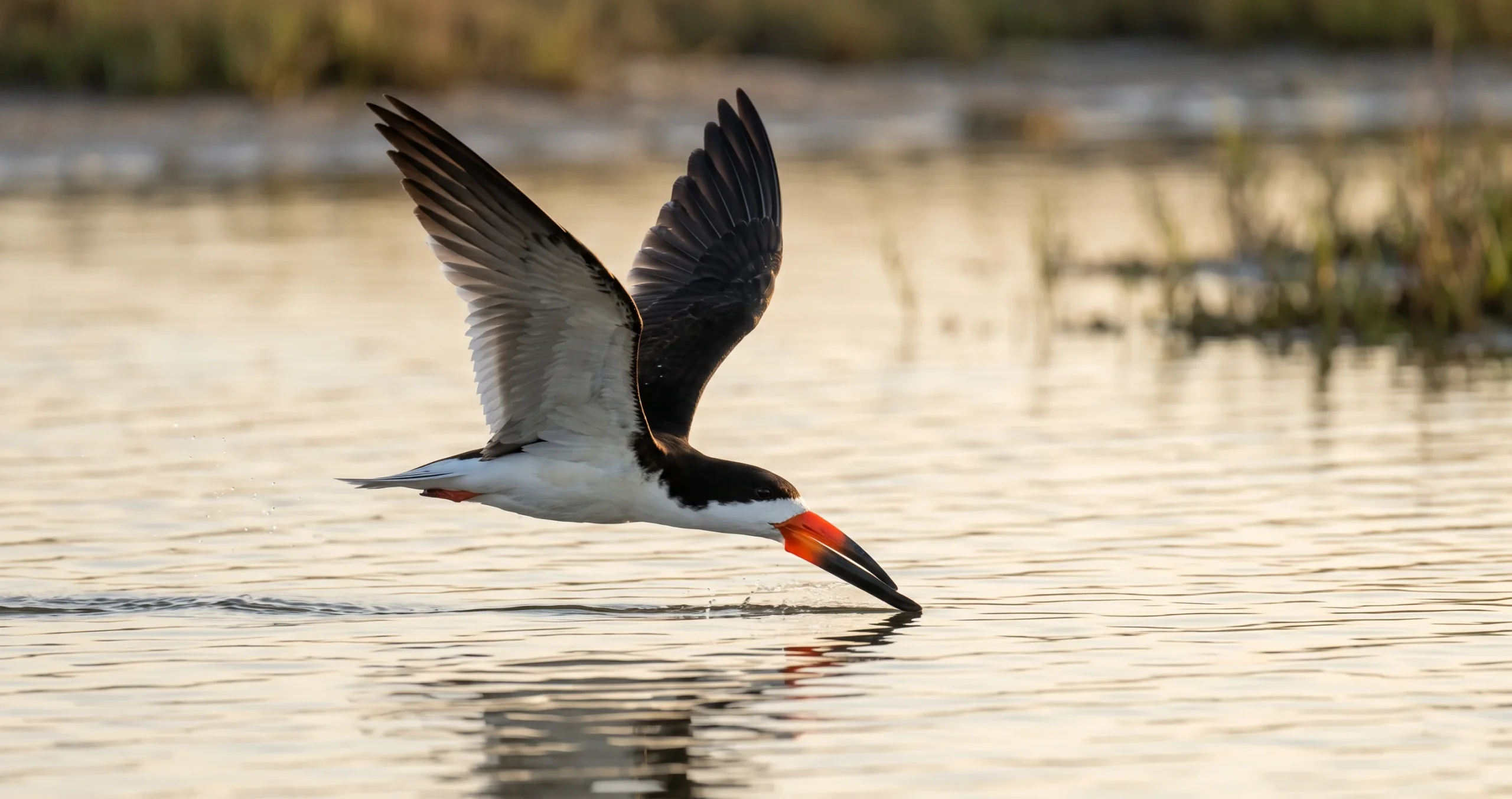
A dark-winged bird glides just inches above a quiet coastal lagoon. Its wings move in long, graceful beats, but something unusual is happening beneath its head. The bird’s lower bill is cutting through the water, leaving a narrow trail of ripples behind it.
Suddenly, the bill snaps shut. The bird has caught a fish without plunging beneath the surface.
This is the black skimmer (Rynchops niger), a coastal bird with one of the most specialized feeding techniques in the avian world.
Unlike most birds, the black skimmer has a lower mandible that extends noticeably beyond its upper mandible. This unusual anatomy allows it to search for prey by touch while remaining airborne.
Its feeding method is only part of the story. Black skimmers also possess remarkable flight control, distinctive social behaviors, and breeding habits closely tied to fragile coastal habitats.
Understanding these adaptations reveals how a seemingly unusual body feature can become an effective survival tool—and why protecting the places these birds depend on matters.
Table of Contents
- Meet the Black Skimmer
- The Unusual Anatomy of Its Beak
- How Black Skimmers Catch Fish While Flying
- Five Fascinating Black Skimmer Adaptations
- What Black Skimmers Eat
- Black Skimmer Nesting and Family Life
- Threats Facing Black Skimmers
- Black Skimmer vs. Common Tern
- Frequently Asked Questions
- Conclusion
Meet the Black Skimmer
Physical Appearance and Identification
The black skimmer belongs to the family Laridae, alongside gulls and terns.
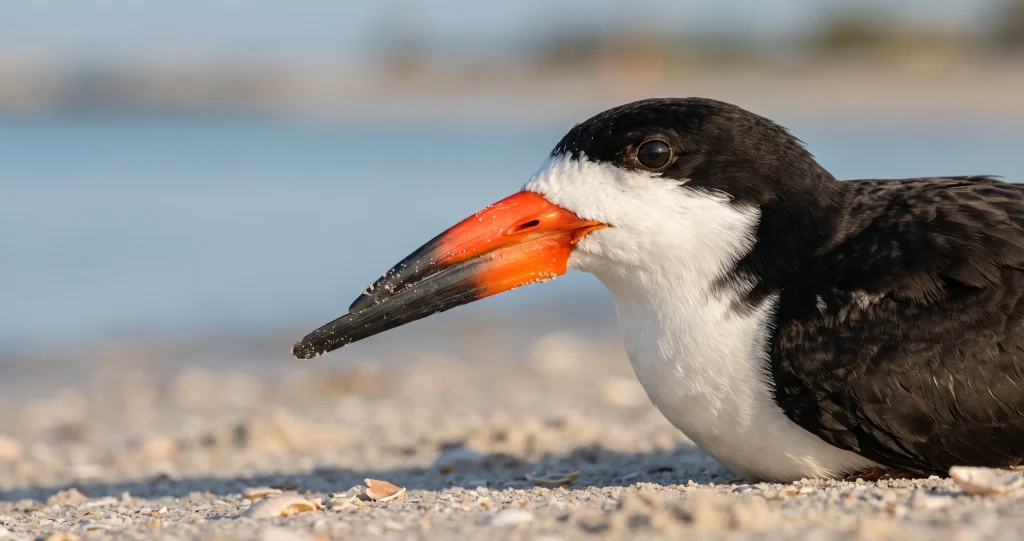
Adults have predominantly black upperparts, bright white underparts, short reddish legs, and a distinctive orange-red bill with a black tip.
The bird’s most recognizable feature is its unequal mandibles. The lower portion of its bill extends farther forward than the upper portion.
Its long, pointed wings give it an elegant flight silhouette. When feeding, it travels close to the water, with its lower bill creating a visible wake.
Where Black Skimmers Live
Black skimmers occur throughout parts of North, Central, and South America.
In the United States, they are especially associated with Atlantic and Gulf Coast beaches, estuaries, bays, and coastal lagoons.
They also inhabit suitable inland river systems and freshwater environments in parts of their broader range.
These birds need access to productive feeding waters and relatively open nesting areas. Sandy beaches, exposed sandbars, and similar coastal environments can provide important breeding habitat.
How Large Black Skimmers Grow
According to the Cornell Lab of Ornithology’s All About Birds, adult black skimmers measure approximately 15.7–19.7 inches (40–50 centimeters) in length.
Their wingspan is approximately 42.9–45.3 inches (109–115 centimeters).
Despite their relatively streamlined bodies, those long wings provide the control needed to maintain a low flight path over water.
The Unusual Anatomy of the Black Skimmer’s Beak
A Lower Mandible Longer Than the Upper
Most birds have upper and lower mandibles that meet near the same point.
The black skimmer is different.
Its lower mandible projects beyond the upper, creating a narrow structure capable of slicing through the water while the bird flies.
This adaptation allows the skimmer to search for fish without submerging its entire head or body.
A Specialized Bill for Detecting Prey
The black skimmer’s feeding technique depends heavily on physical contact.
As the submerged lower bill encounters a fish or other suitable prey, sensory information helps trigger rapid closure of the bill.
This means the bird does not need to visually track every fish beneath the surface before capturing it.
The technique is particularly useful when visibility is limited, although successful feeding still depends on prey availability and suitable water conditions.
How Young Skimmers Develop Their Distinctive Bills
Black skimmer chicks do not hatch with the dramatically unequal mandibles seen in adults.
Initially, the upper and lower portions of their bills are much closer in length.
As the chicks develop, the lower mandible grows proportionally longer, gradually producing the specialized structure used by adult birds.
Young chicks depend on food delivered by their parents before they become capable of hunting independently.
How Black Skimmers Catch Fish While Flying
The black skimmer fishing technique is a coordinated combination of specialized anatomy, flight control, and tactile detection.
Step 1 — Flying Close to the Water
The bird approaches a suitable feeding area and lowers its flight path until it is traveling just above the water.
Its long wings provide the lift and control needed to maintain this position.
Step 2 — Lowering the Extended Bill
The skimmer opens its bill and lowers the longer mandible into the water.
As it continues flying, the submerged lower bill cuts through the surface, leaving a narrow wake.
The upper bill remains above the water.
Step 3 — Detecting Contact With Prey
When the submerged bill contacts a fish, the bird rapidly closes its mandibles.
This response enables the skimmer to capture prey through touch rather than relying entirely on underwater vision.
Step 4 — Securing and Swallowing the Fish
Once a fish is caught, the skimmer lifts its bill from the water and manipulates the prey for swallowing.
It can consume small fish while airborne, allowing it to continue searching for food.
The entire sequence can happen remarkably quickly, making successful captures difficult to observe without close attention.
Five Fascinating Black Skimmer Adaptations
1. Unequal Mandibles
The elongated lower mandible is the black skimmer’s defining physical adaptation.
Rather than catching fish by plunging underwater, the bird uses its bill to probe the water’s surface while flying.
This structure is highly specialized, making the bird particularly well suited to surface feeding.
2. Sensitive Bill Contact
The skimmer relies on tactile information to detect prey.
Contact with a fish triggers a rapid feeding response, helping the bird capture animals it may not have seen beforehand.
This ability is especially valuable in murky water or under low-light conditions.
3. Low-Altitude Flight
Black skimmers possess long, narrow wings that support controlled flight just above the water.
Their wingbeats help them maintain a consistent height while keeping their bodies clear of the surface.
When hunting, they make subtle adjustments in response to changing water conditions.
4. Feeding in Low Light
Unlike birds that depend primarily on seeing fish, black skimmers can hunt around dusk, during the night, and near dawn.
Their tactile feeding technique makes this possible.
Their eyes also have unusual vertically narrowing pupils, which help manage intense light reflected from water and sand.
However, nocturnal feeding does not mean skimmers are exclusively nighttime hunters. They also forage during daylight.
5. Colonial Nesting
Black skimmers frequently nest in colonies, sometimes alongside other coastal birds.
Group nesting can provide opportunities for collective vigilance and predator detection.
However, colonies also concentrate vulnerable eggs and chicks in relatively small areas.
A single disturbance or flooding event can therefore affect numerous nests.
What Black Skimmers Eat
Small Fish and Other Aquatic Prey
The black skimmer’s diet consists primarily of small fish swimming near the water’s surface.
Depending on location and availability, its prey can also include shrimp and other small aquatic invertebrates.
The bird’s specialized bill is most effective when suitable prey is accessible close to the surface.
Where They Find Food
Black skimmers commonly forage in estuaries, tidal creeks, sheltered bays, lagoons, and other relatively calm waters.
These environments can support concentrations of small fish and provide suitable conditions for surface skimming.
In parts of South America, black skimmers also use major inland rivers.
How Water Conditions Affect Feeding
Smooth water generally makes it easier for skimmers to maintain their specialized feeding posture.
Strong waves and turbulent conditions can interfere with keeping the lower bill at an appropriate depth.
Wind, tides, and fish movements also influence where prey becomes available.
As conditions change, skimmers may move between feeding areas rather than remaining in one location.
Black Skimmer Nesting and Family Life
Nesting on Open Sand
Black skimmers often breed on exposed sandy beaches, islands, and sandbars.
Their nests are simple depressions scraped into the ground, with little or no additional nesting material.
These open habitats provide space for colonies but leave eggs and chicks exposed to weather and disturbance.
Eggs and Chick Development
Cornell Lab of Ornithology reports a typical clutch of one to five eggs and an incubation period of approximately 21–25 days.
Both parents participate in caring for their offspring.
Newly hatched chicks are covered in down and can move around relatively soon after hatching, but they continue depending on adults for food.
Parents provide fish until the young develop the strength and coordination needed for independent feeding.
Protecting Vulnerable Colonies
Because black skimmers nest directly on the ground, breeding colonies are particularly vulnerable to disturbance.
People walking through nesting areas may accidentally approach camouflaged eggs or chicks.
Repeated disturbance can also force adults away from nests, exposing young birds to heat, predators, and other hazards.
Respecting posted nesting boundaries and observing colonies from a distance can reduce these risks.
Threats Facing Black Skimmers
Despite their remarkable feeding adaptations, black skimmers face several conservation challenges.
Coastal development can eliminate nesting habitat, while shoreline erosion reduces the amount of suitable open sand.
Recreational activity, unleashed pets, and vehicle traffic may disturb nesting colonies or damage nests.
Storm surges and coastal flooding can also destroy eggs and chicks, especially when severe weather coincides with the breeding season.
Changes in coastal ecosystems may affect the availability of small fish and suitable feeding areas.
Importantly, these threats vary geographically. A population facing severe local declines does not necessarily represent the condition of the species throughout its entire range.
Audubon identifies the black skimmer as Least Concern at the global IUCN level, while regional conservation concerns remain significant in parts of the United States.
Black Skimmer vs. Common Tern
Although black skimmers and common terns share similar coastal environments, their fishing methods differ considerably.
| Feature | Black Skimmer | Common Tern |
|---|---|---|
| Bill shape | Lower mandible longer | Mandibles approximately equal |
| Feeding method | Skims water while flying | Plunge-dives and surface-feeds |
| Appearance | Black upperparts, white underside | Gray-white body, black cap |
| Flight behavior | Low flight with bill in water | Hovering, searching, and diving |
Both birds are effective predators of small aquatic animals.
The difference lies in how they reach their prey: the black skimmer uses specialized tactile feeding, while the common tern typically locates fish visually before capturing them.
Frequently Asked Questions
Why is the black skimmer’s lower beak longer?
The black skimmer’s lower mandible is longer because it is specialized for catching fish at the water’s surface. During flight, the bird lowers this extended portion into the water while keeping its upper bill above the surface. When it contacts suitable prey, the bill rapidly closes. This unusual anatomy allows the bird to catch fish without diving.
Can black skimmers catch fish at night?
Yes. Black skimmers regularly forage during low-light conditions, including at night. Unlike birds that must visually locate individual fish before capturing them, skimmers use touch to detect prey. This feeding strategy allows them to hunt when underwater visibility is limited. They also feed during daylight, particularly when water and prey conditions are favorable.
Do black skimmers dive underwater?
Black skimmers generally do not dive underwater to capture fish. Their characteristic hunting method involves flying close to the surface with the lower mandible submerged. When the bill contacts a fish, the bird closes its jaws and lifts the prey from the water. Occasionally, skimmers may also catch fish while wading in very shallow water.
Where can black skimmers be found?
Black skimmers inhabit coastal and inland aquatic environments throughout parts of the Americas. In the United States, they are particularly associated with Atlantic and Gulf Coast shorelines, estuaries, and sheltered bays. They also occur along the Pacific coast in certain regions. Farther south, populations use coastal habitats and major inland rivers.
Are black skimmers endangered?
The black skimmer is classified as Least Concern globally by the IUCN, according to the conservation status reported by Audubon. However, that designation does not mean every population is secure. Regional declines and threats affect some breeding populations, particularly where coastal development, human disturbance, erosion, and flooding reduce suitable nesting habitat.
What makes black skimmers different from terns?
The most obvious difference is the black skimmer’s unusual bill, with its lower mandible extending beyond the upper. Skimmers primarily catch fish by dragging this lower bill through the water while flying. Common terns typically locate prey visually and capture it through plunge-diving or surface feeding. Both belong to the family Laridae but have different feeding specializations.
Conclusion
The black skimmer demonstrates how an unusual physical feature can support a highly specialized way of life.
Its elongated lower mandible, sensitive feeding response, and precise low-altitude flight work together to create a fishing technique unlike that of most other birds.
Rather than diving underwater, this remarkable coastal bird catches fish while remaining airborne, sometimes even hunting successfully after darkness falls.
Yet its survival depends on more than extraordinary anatomy. Healthy estuaries, productive feeding waters, and undisturbed nesting beaches are essential to sustaining black skimmer populations.
Protecting these environments helps preserve not only a distinctive bird but also the complex coastal ecosystems it inhabits.
The next time a black skimmer glides across a quiet lagoon, its unusual bill offers a reminder that some of nature’s most effective adaptations are also its most unexpected.
External Sources
The following authoritative resources support the article’s descriptions of black skimmer anatomy, behavior, reproduction, habitat, and conservation.
1. Cornell Lab of Ornithology — Black Skimmer Identification. Physical characteristics, measurements, flight behavior, and habitat. Black Skimmer Identification — Cornell
2. Cornell Lab of Ornithology — Black Skimmer Life History. Feeding behavior, nesting, reproduction, and chick development. Black Skimmer Life History — Cornell
3. National Audubon Society — Black Skimmer Field Guide. Distribution, feeding behavior, breeding biology, and conservation status. Black Skimmer — Audubon Field Guide
4. American Bird Conservancy — Black Skimmer. Species ecology, feeding behavior, nesting colonies, and conservation. Black Skimmer — American Bird Conservancy
5. National Audubon Society — Black Skimmer Gulf Restoration. Coastal habitat threats, nesting disturbance, and conservation challenges. Black Skimmer Conservation — Audubon
6. Cornell Lab of Ornithology — Black Skimmer Overview. General identification and distinctive tactile fishing technique. Black Skimmer Overview — Cornell