
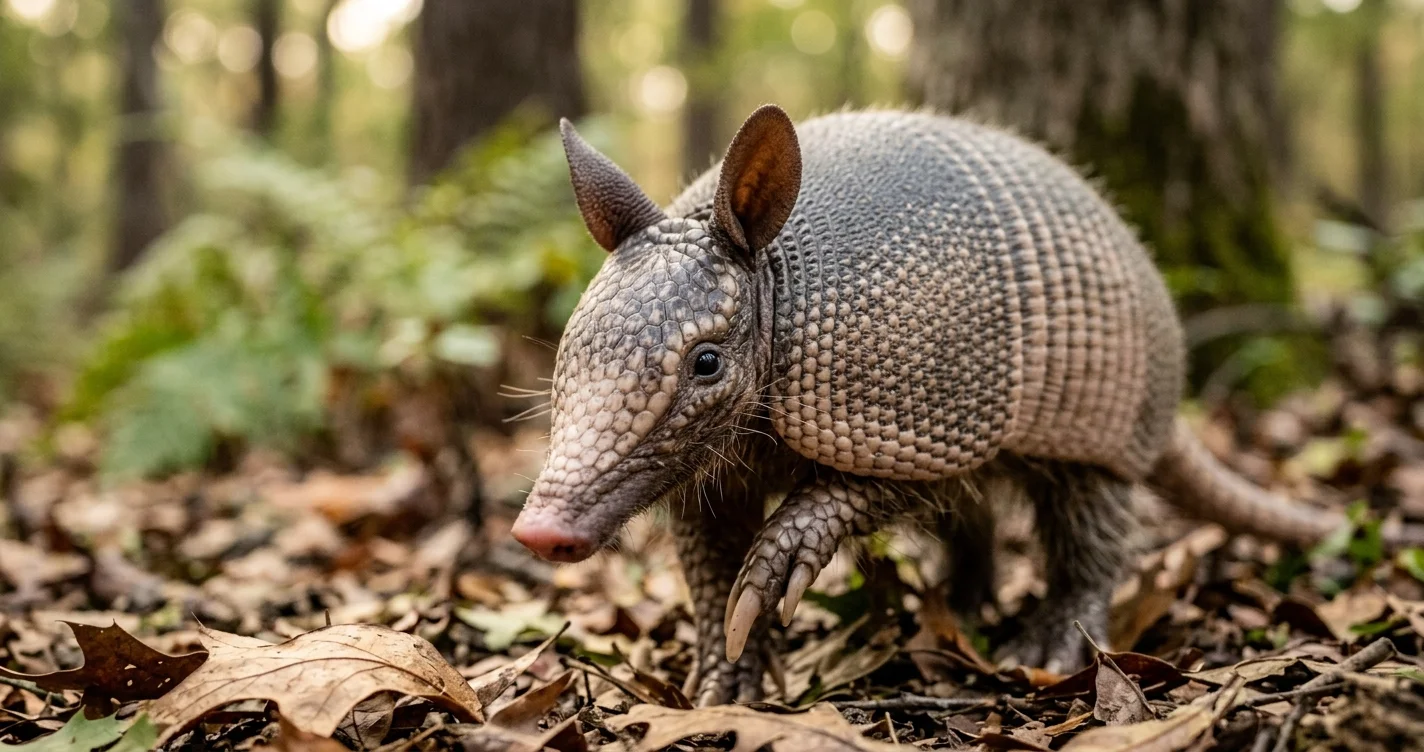
Most mammals produce offspring from separate eggs, but the nine-banded armadillo follows an extraordinary reproductive pattern. A single fertilized egg normally develops into four genetically identical babies, making armadillo quadruplets one of the most remarkable examples of reproduction in the animal kingdom.
Even more surprising, the mother can delay the beginning of pregnancy’s next developmental stage for months. Scientists have studied this unusual combination of identical siblings and delayed implantation for decades, yet some questions about its evolutionary origins remain unanswered.
From the underground burrows of the southern United States to newly occupied habitats farther north, these armored mammals offer a fascinating look at how evolution can produce reproductive strategies unlike those of most other mammals.
Table of Contents
- What Makes Nine-Banded Armadillos So Unusual
- How Armadillo Quadruplets Develop From One Egg
- Delayed Implantation: A Remarkable Reproductive Pause
- The Possible Evolutionary Advantages of Identical Quadruplets
- How Nine-Banded Armadillos Live
- Where Armadillos Live and Why Their Range Is Expanding
- Common Myths About Armadillos
- Frequently Asked Questions
- Conclusion
What Makes Nine-Banded Armadillos So Unusual
The nine-banded armadillo (Dasypus novemcinctus) is a distinctive mammal known for its protective armor, powerful digging claws, elongated snout, and unusual reproductive biology.
Its name comes from the flexible bands across the middle of its armored body. Despite the name, individual animals do not always have exactly nine movable bands.
Unlike most mammals, which can produce different numbers of offspring from independently fertilized eggs, nine-banded armadillos normally produce four offspring originating from one fertilized egg.
These babies are genetically identical siblings and are almost always the same biological sex. They share the same genetic origin, much like identical human twins, but develop as four separate individuals.
This reproductive process is called polyembryony, a biological phenomenon in which multiple embryos develop from one fertilized egg.
An Exception Among Mammals
Identical twins occasionally occur in humans and other mammals. However, producing four genetically identical offspring as a regular reproductive pattern is exceptionally unusual.
Some other armadillo species also exhibit polyembryony, although the number of offspring can differ between species.
The nine-banded armadillo is particularly well known because its reproductive pattern is so consistent. It provides scientists with a valuable natural example of how genetically identical mammals develop.
How Armadillo Quadruplets Develop From One Egg
The formation of armadillo quadruplets begins with a process that initially resembles reproduction in many other mammals.
A female releases an egg, and fertilization occurs after mating. The resulting single-celled zygote begins dividing into more cells as early embryonic development progresses.
However, instead of developing into one individual, the early embryo eventually gives rise to four distinct embryos.
Step 1: One Egg Is Fertilized
Only one fertilized egg normally contributes to the litter.
That single egg contains genetic material from both parents, establishing the genetic blueprint that the four offspring will share.
Step 2: The Embryonic Material Separates
During early development, the embryonic tissue becomes organized into four separate embryonic units.
Each develops into an individual offspring, producing a litter of four siblings that originate from the same fertilization event.
This is not the same as a female releasing four separate eggs. The four embryos share a common genetic origin.
Step 3: Four Embryos Develop
Following implantation and embryonic differentiation, the four developing young are supported within the mother’s uterus.
Each embryo develops its own body and associated fetal structures, while the embryos share the same maternal reproductive environment.
By birth, the mother typically delivers four fully formed young armadillos.
Step 4: Four Genetically Identical Babies Are Born
Because all four originate from one fertilized egg, they have essentially the same inherited nuclear DNA.
They are normally the same sex and often look extremely similar, although differences in development, nutrition, and environment can influence their individual characteristics.
Scientists distinguish this process from ordinary fraternal multiple births, in which separate eggs are fertilized independently.
Delayed Implantation: A Remarkable Reproductive Pause
Another extraordinary feature of nine-banded armadillo reproduction is delayed implantation, also called embryonic diapause.
After fertilization, the developing embryo does not immediately implant in the uterus. Instead, it remains in a temporarily suspended developmental state.
This delay commonly lasts several months, allowing the timing of subsequent development to differ substantially from the timing of mating.
How the Delay Works
Nine-banded armadillos generally mate during summer, but implantation often occurs later in the year.
The early embryo remains unattached to the uterine lining during the delay. Once implantation occurs, active fetal development continues for approximately four to five months.
As a result, births in much of the United States commonly occur during spring.
The precise timing varies with geography and reproductive conditions, so the entire process should not be understood as a rigid calendar.
The Biological Importance of Timing
Delayed implantation can help align births with conditions that are more favorable for raising offspring.
Spring often brings warmer temperatures and greater activity among the invertebrates that armadillos consume.
However, researchers distinguish the observed reproductive schedule from hypotheses about its evolutionary advantages. The fact that delayed implantation occurs does not establish one single reason it evolved.
The Possible Evolutionary Advantages of Identical Quadruplets
The evolutionary explanation for armadillo quadruplets is more complicated than the mechanism itself.
Scientists understand that polyembryony occurs, but the reasons this reproductive strategy became established in certain armadillo lineages remain an area of scientific discussion.
Producing Several Offspring From One Fertilization
One possible advantage is that a successful fertilization can produce several offspring rather than just one.
For a solitary mammal whose encounters with potential mates may be relatively limited, producing multiple offspring from one reproductive event could be beneficial.
However, this remains a proposed explanation rather than a conclusively demonstrated evolutionary advantage.
Developmental Constraints May Matter
Another possibility is that polyembryony emerged through changes in early embryonic development and persisted because it did not substantially reduce reproductive success.
Evolution does not always produce traits because they are uniquely optimal. Some traits become established through historical developmental changes, natural selection, and inherited biological constraints.
Genetically Identical Does Not Mean Behaviorally Identical
Although the four offspring share nearly identical inherited DNA, they do not necessarily behave in exactly the same way.
Differences in developmental conditions, individual experiences, and environmental exposure can influence their growth and behavior.
This makes nine-banded armadillos especially interesting for scientists studying the relationship between genetics and environmental influences.
How Nine-Banded Armadillos Live
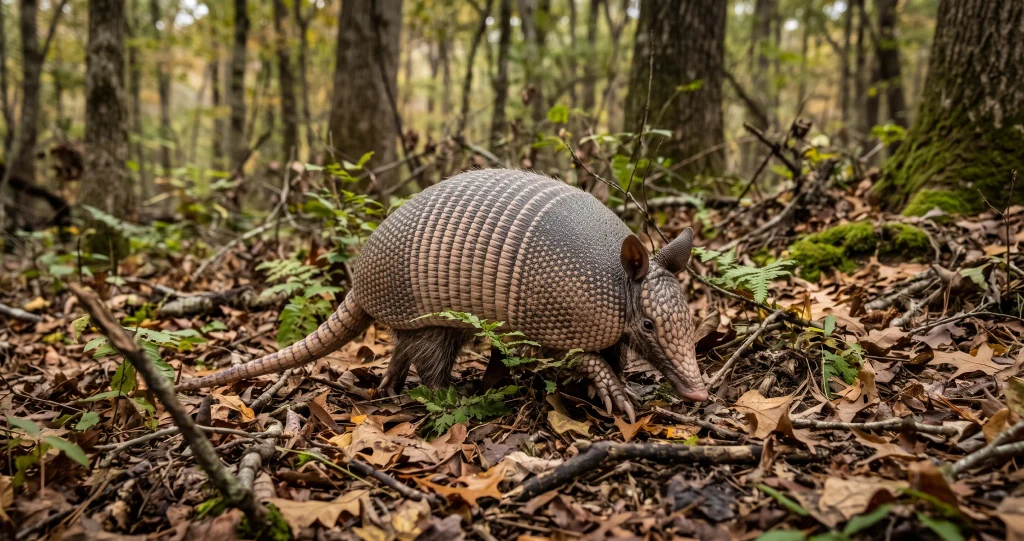
Nine-banded armadillos are primarily solitary animals that spend much of their time searching for food near or beneath the soil surface.
They have a highly developed sense of smell, which helps them locate underground prey.
Their Diet
Their diet consists largely of insects and other invertebrates, including beetles, ants, termites, and insect larvae.
They also consume other small animals and occasionally plant material.
Using their powerful front claws, armadillos dig into soil, leaf litter, and decaying material to uncover food.
Their digging can disturb lawns and gardens, but it also contributes to soil movement and creates small patches of exposed ground.
Burrows and Shelter
Nine-banded armadillos construct burrows for protection, resting, and shelter from unfavorable temperatures.
Burrows may be located near trees, brush piles, slopes, and other areas offering suitable soil and cover.
Abandoned burrows can sometimes provide shelter for other wildlife, making armadillos part of a broader network of habitat interactions.
Their Armor Is Made of Bone and Keratin
The armadillo’s characteristic shell consists of bony plates covered by keratinized tissue.
The flexible bands allow movement while providing protection against some physical threats.
However, armor does not make armadillos invulnerable to predators, vehicles, or environmental hazards.
Where Armadillos Live and Why Their Range Is Expanding
The nine-banded armadillo has a broad geographic distribution extending from parts of South America through Central America, Mexico, and into the United States.
It is the armadillo species most familiar to people in the southeastern United States.
Expansion Across the United States
Historically, nine-banded armadillos were not widespread throughout the United States.
Over time, their range expanded northward and eastward, and established populations now occur across much of the Southeast and into portions of the central United States.
Armadillos have also been documented beyond their older, established range boundaries.
Factors Supporting Expansion
Several factors may contribute to this expansion, including suitable habitat, landscape changes, and the species’ ability to exploit different food sources.
Warmer winters may also help armadillos survive in areas where prolonged freezing temperatures previously limited their establishment.
However, individual sightings do not necessarily prove that a self-sustaining breeding population exists.
Cold Weather Remains a Limitation
Armadillos have relatively low body temperatures compared with many other placental mammals and are poorly equipped for extended periods of severe cold.
Frozen ground also makes it difficult for them to dig for food.
These limitations help explain why northern expansion does not mean armadillos can thrive in every climate.
Common Myths About Armadillos
Despite their familiar appearance, armadillos are surrounded by several misconceptions.
Myth 1: All Armadillos Give Birth to Identical Quadruplets
Not all armadillo species reproduce in this way.
The regular production of four genetically identical offspring is characteristic of the nine-banded armadillo and certain related reproductive patterns within the genus Dasypus.
Other armadillo species can have different litter sizes and reproductive strategies.
Myth 2: Nine-Banded Armadillos Roll Into Perfect Balls
The three-banded armadillos are famous for their ability to roll into a nearly complete protective ball.
Nine-banded armadillos cannot perform the same complete rolling behavior because of differences in their shell structure.
Instead, they rely on behaviors such as fleeing, digging, and seeking shelter.
Myth 3: Every Armadillo Carries Leprosy
Some nine-banded armadillos can carry Mycobacterium leprae, the bacterium associated with Hansen’s disease.
However, not every armadillo is infected, and the presence of this bacterium varies across populations and geographic regions.
Human infection associated with armadillo exposure is uncommon, but avoiding direct contact with wild armadillos and handling or consuming their meat is a sensible precaution.
Myth 4: Armadillos Are Completely Blind
Armadillos have relatively poor eyesight, but they are not completely blind.
Their strong sense of smell and sensitive hearing help them navigate and locate food.
Myth 5: Four Identical Babies Must Have Identical Personalities
Shared genes do not guarantee identical personalities or behavior.
Individual experiences, environmental conditions, and developmental differences can influence each animal throughout its life.
Frequently Asked Questions
Do nine-banded armadillos always have four babies?
They typically produce four offspring from one fertilized egg, but exceptions and reproductive failures can occur. Four is the characteristic litter size, not an absolute guarantee for every pregnancy.
Are armadillo quadruplets really identical?
They originate from one fertilized egg and therefore share essentially the same inherited nuclear DNA. Small biological differences can still develop through mutation, gene regulation, and environmental influences.
Are all four armadillo babies the same sex?
Yes, under the usual reproductive process, the four offspring share the same chromosomal sex because they develop from one fertilized egg.
How long are nine-banded armadillos pregnant?
The total interval from mating to birth can last roughly eight to nine months, including several months of delayed implantation. Active development following implantation occupies a shorter period.
Can armadillos have twins instead of quadruplets?
The nine-banded armadillo’s normal reproductive pattern produces four embryos, but not every embryo necessarily survives. Consequently, the number of live offspring may occasionally be lower.
Are armadillos dangerous to people?
They generally avoid people and are not aggressive under ordinary circumstances. Nevertheless, wild armadillos should not be handled because they can bite or scratch and may carry pathogens.
Why are armadillos appearing farther north?
Their distribution has expanded through a combination of habitat availability, dispersal, landscape conditions, and potentially milder winters. Severe cold and frozen soil remain important limitations.
Conclusion
The reproductive biology of the nine-banded armadillo is one of nature’s most unusual mammalian adaptations.
Through polyembryony, one fertilized egg normally produces four genetically identical offspring. Delayed implantation adds another remarkable feature, allowing the beginning of sustained embryonic development to occur months after mating.
Although scientists understand much of the biological process, the evolutionary reasons for this reproductive strategy are still being investigated.
From their unusual family biology to their expanding geographic range, nine-banded armadillos demonstrate how much remains to be discovered about even relatively familiar wildlife.
External sources
1. University of Georgia Cooperative Extension — Natural History Series: Nine-Banded Armadillo. Covers polyembryony, delayed implantation, breeding, and development. Read the extension publication.
2. U.S. Geological Survey — Current Distribution of the Nine-Banded Armadillo in the United States (2025). Provides recent research on geographic expansion and habitat suitability. Read the USGS research.
3. Peer-reviewed research — Population Dynamics and Range Expansion in Nine-Banded Armadillos. Examines reproductive biology, population dynamics, and range expansion. Read the research article.