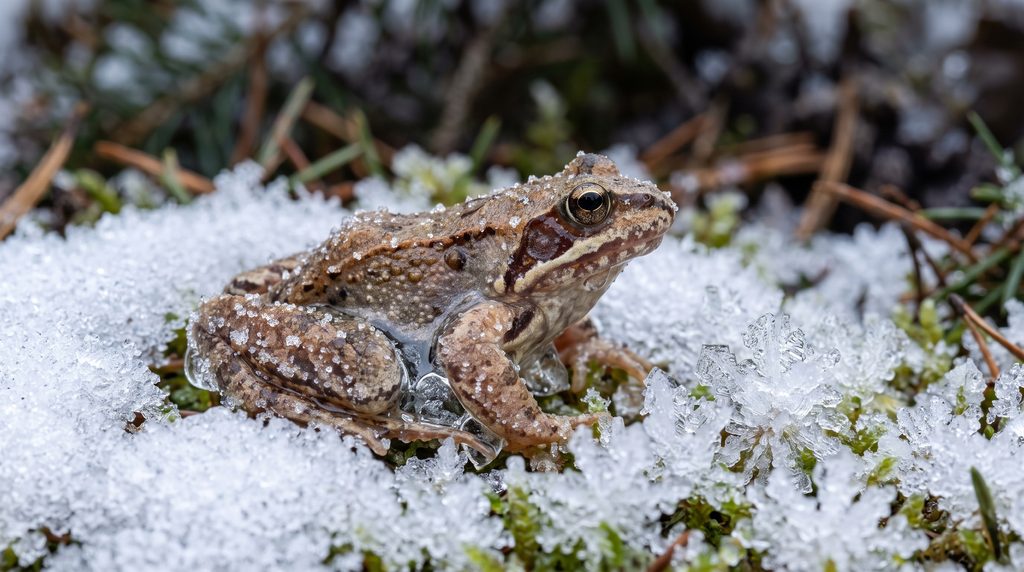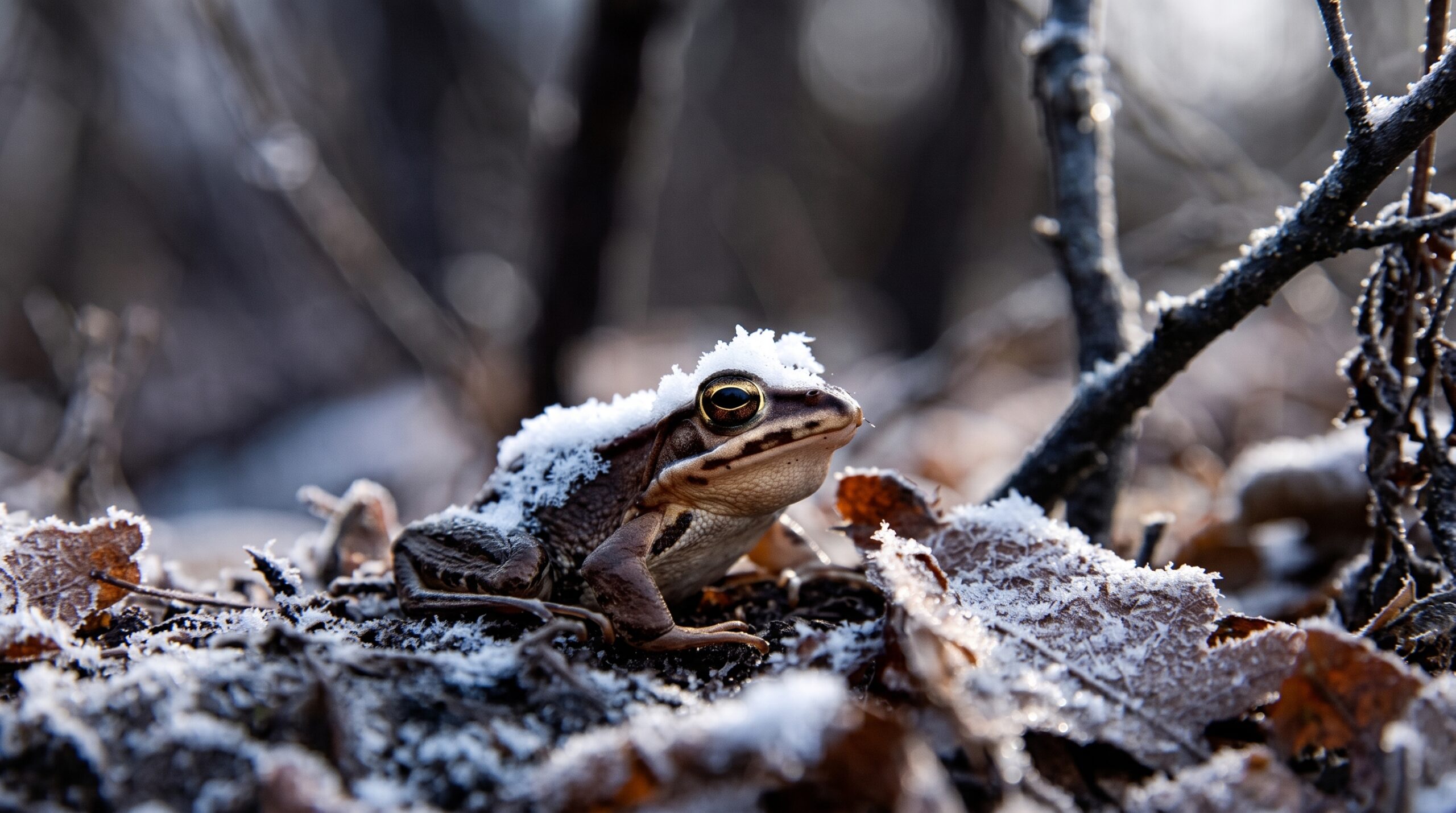
Deep beneath the fallen leaves of North America’s winter forests, a small amphibian survives something that would be fatal to most vertebrates. The wood frog can endure extensive freezing, stop breathing, and temporarily lose its heartbeat before recovering when temperatures rise. This extraordinary process, known as wood frog freezing, is one of the most remarkable examples of cold adaptation in the animal kingdom.
Scientists have discovered that wood frogs survive through controlled ice formation, protective chemicals such as glucose, and profound changes in metabolism. Their bodies do not simply resist the cold. Instead, they tolerate freezing in ways that protect living cells from otherwise devastating damage.
Table of Contents
- Meet the Wood Frog
- Why Wood Frogs Freeze During Winter
- Wood Frog Freezing: What Happens Inside the Body
- Glucose: The Frog’s Natural Cryoprotectant
- How Much of a Wood Frog’s Body Actually Freezes?
- Why Ice Does Not Destroy Its Cells
- What Happens to the Heart, Brain, and Lungs?
- How Wood Frogs Thaw and Recover in Spring
- Why Alaskan Wood Frogs Survive Extreme Cold
- How Repeated Freezing Changes Their Protection
- Where Wood Frogs Live in North America
- Why Wood Frogs Breed So Early
- What Scientists Can Learn From Wood Frogs
- Threats to Wood Frogs and Their Winter Habitat
- Frequently Asked Questions
- Conclusion
1. Meet the Wood Frog
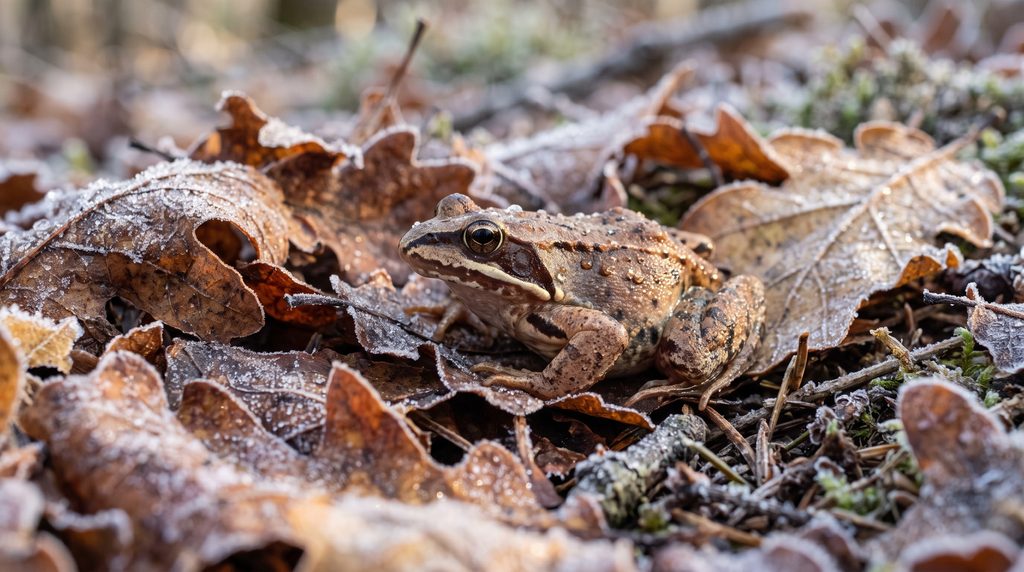
The wood frog (Lithobates sylvaticus, also known as Rana sylvatica) is a small North American amphibian recognized by the dark mask extending through each eye. Its body color varies from tan and reddish brown to darker shades, helping it blend into the forest floor.
Wood frogs inhabit moist forests, woodland edges, and areas near seasonal wetlands. They spend much of their adult lives on land, feeding on small invertebrates and seeking shelter beneath vegetation.
Unlike many aquatic frogs, wood frogs generally overwinter in shallow terrestrial shelters rather than remaining underwater. This behavior exposes them to freezing temperatures that would be dangerous for most other amphibians.
Their ability to tolerate ice formation allows them to survive in environments extending from temperate American forests to subarctic Alaska.
2. Why Wood Frogs Freeze During Winter
Most frogs avoid freezing by seeking environments where their body temperatures remain above the point at which damaging ice forms.
Some overwinter in aquatic habitats, while others shelter underground. Wood frogs often remain close to the soil surface, protected by leaves, vegetation, and sometimes snow.
These shelters reduce exposure to wind and temperature fluctuations, but they do not always prevent freezing.
When temperatures fall sufficiently, ice can begin forming within the frog’s body fluids. Instead of immediately dying, the wood frog activates physiological responses that make extensive freezing survivable.
This adaptation is called freeze tolerance.
Importantly, wood frogs do not freeze because freezing is inherently beneficial. They survive freezing because their protective mechanisms allow them to endure conditions that their overwintering habitat cannot always prevent.
3. Wood Frog Freezing: What Happens Inside the Body
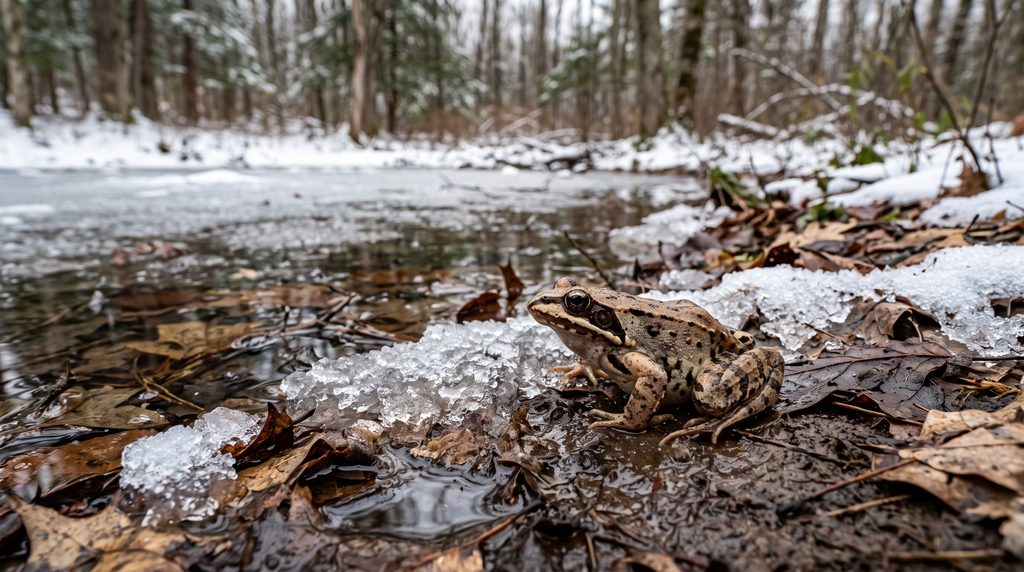
Wood frog freezing begins when ice forms in body fluids, typically outside the cells.
This distinction is critical. Ice forming inside cells can damage membranes and internal structures, while controlled extracellular freezing can be tolerated by animals with suitable physiological adaptations.
As ice develops, liquid water moves out of cells toward the extracellular ice. The cells become dehydrated, and dissolved substances inside them become more concentrated.
These changes would normally be extremely dangerous.
Wood frogs survive because they rapidly mobilize protective compounds and regulate their physiological responses to freezing.
The freezing process
As the frog cools, several linked events occur:
- Ice begins forming in extracellular body fluids.
- The liver releases large amounts of glucose into the bloodstream.
- Glucose reaches tissues while circulation remains active.
- Water shifts from cells toward growing extracellular ice.
- Metabolism and physiological activity decline dramatically.
- Heartbeat and breathing eventually cease during extensive freezing.
This process does not mean that every cell becomes a solid block of ice.
The survival of the animal depends on preserving living cellular structures despite extensive freezing elsewhere in the body.
4. Glucose: The Frog’s Natural Cryoprotectant
One of the most important discoveries in wood frog freezing research involves glucose, the simple sugar used by many organisms as an energy source.
In wood frogs, glucose also functions as a cryoprotectant: a substance that helps protect biological tissues against freezing-related damage.
How the liver releases glucose
Before winter, wood frogs accumulate glycogen, a stored form of carbohydrate, in their livers.
When freezing begins, physiological signals stimulate the breakdown of glycogen into glucose. The glucose enters the bloodstream and is distributed to other tissues before circulation stops.
As glucose accumulates, it helps reduce cellular dehydration stress and contributes to the protection of proteins, membranes, and other structures.
Glucose does not simply prevent the frog from freezing. Instead, it helps living cells survive while ice forms in surrounding fluids.
Why glucose alone is not enough
Wood frogs also accumulate urea, another compound that contributes to their tolerance of freezing and dehydration.
Urea levels can rise during preparation for winter, providing protection before freezing begins. Glucose production responds strongly to the onset of freezing itself.
These compounds work alongside changes in metabolism, water balance, and other cellular processes.
Research published in PLOS ONE on cryoprotectants and extreme freeze tolerance in wood frogs demonstrates how glucose and urea contribute to the exceptional cold tolerance of subarctic populations.
PLOS One
5. How Much of a Wood Frog’s Body Actually Freezes?
One of the most surprising findings in wood frog biology is the proportion of body water that can freeze without killing the animal.
Research has documented that wood frogs can survive when approximately 65–70% of their total body water becomes ice under suitable conditions.
This figure refers to the proportion of water that freezes, not the percentage of the entire frog’s body mass that turns into ice.
PMC
Why the distinction matters
Wood frogs contain water, proteins, fats, minerals, and other biological materials.
When scientists measure freezing, they are concerned with the water converted into ice and the consequences for remaining liquid compartments.
The water that freezes is primarily extracellular, while intracellular ice formation is generally avoided.
The amount of ice formed depends on temperature, hydration, cryoprotectant concentrations, and other physiological conditions.
Therefore, 70% should not be treated as an exact value reached by every frog during every winter.
Can wood frogs survive being completely frozen?
The expression “frozen solid” describes the frog’s rigid, motionless appearance, but it is not literally accurate at the cellular level.
A frozen wood frog retains unfrozen water and living cellular components.
If all cellular water froze, the resulting damage would generally be incompatible with survival.
The remarkable feature of wood frog freezing is not that every part of the animal turns into ice. It is that the frog survives extensive ice formation while preserving the structures necessary for recovery.
6. Why Ice Does Not Destroy Its Cells
Ice formation presents two major challenges for living tissues: mechanical damage and changes in water balance.
As extracellular ice grows, water moves out of cells. This dehydration increases the concentration of dissolved substances and can disrupt cellular membranes and proteins.
Wood frogs possess physiological adaptations that help reduce these effects.
Protecting cellular membranes
Glucose and other protective solutes help stabilize cellular conditions during freezing.
Their presence can reduce damaging changes associated with dehydration and the concentration of dissolved substances.
Cells also alter their metabolism as oxygen delivery declines and energy becomes limited.
These responses allow tissues to remain viable during prolonged periods of greatly reduced physiological activity.
Controlled ice formation
The location and rate of ice formation matter enormously.
Extracellular ice is less directly destructive than uncontrolled intracellular freezing, but it still creates serious physiological stress.
Research has also identified antifreeze-associated glycolipids in tissues of naturally frozen Alaskan wood frogs. Their precise contribution to survival remains an area of investigation.
The Company of Biologists
The frog’s resistance is therefore the result of several interacting adaptations rather than one chemical acting as a perfect antifreeze.
7. What Happens to the Heart, Brain, and Lungs?
During extensive wood frog freezing, normal breathing and heartbeat cease.
Circulation stops, and the animal becomes unresponsive and rigid.
To an observer unfamiliar with freeze-tolerant amphibians, a frozen wood frog may appear dead.
However, its tissues have entered a state of profound metabolic suppression rather than undergoing irreversible biological death.
Surviving without normal circulation
When the heart stops, oxygen delivery through the bloodstream also stops.
Wood frog tissues tolerate this interruption by reducing metabolic demands and relying on physiological mechanisms that support survival during oxygen deprivation.
Their cells still require protection from chemical imbalances and energy depletion.
The brain and other organs must remain sufficiently intact to resume coordinated function after thawing.
This is why freeze tolerance cannot be explained simply as an animal “turning itself off.” It requires extensive biochemical preparation and highly specialized cellular responses.
8. How Wood Frogs Thaw and Recover in Spring
When temperatures rise, the ice within a frozen wood frog begins to melt.
As liquid water becomes available again, tissues gradually rehydrate, and physiological functions start returning.
The heart resumes beating, circulation becomes established, and breathing returns.
Recovery is a biological process
Thawing does not instantly restore every organ to normal function.
Different tissues recover at different rates, and the timing depends on freezing severity, temperature, and the condition of the frog.
The animal must restore water balance, redistribute dissolved substances, and recover normal metabolic activity.
Experimental studies demonstrate that wood frogs can survive freezing and subsequently regain movement and normal physiological functions.
However, recovery is not guaranteed after every freezing event. Excessive cold, inappropriate freezing rates, or other stressful conditions can exceed the animal’s tolerance.
Does the frog actually come back to life?
The phrase “come back to life” describes the dramatic appearance of recovery, but it is not literal resurrection.
A successfully frozen wood frog remains biologically alive throughout the freezing period, even though its heartbeat and breathing may temporarily stop.
Its cells retain the capacity to recover once suitable temperatures return.
That distinction makes the process scientifically remarkable without suggesting that the animal has reversed irreversible death.
9. Why Alaskan Wood Frogs Survive Extreme Cold
Not all wood frog populations possess identical freezing tolerance.
Researchers have found important differences between frogs from relatively temperate regions and those living in Interior Alaska.
In experimental research, Alaskan wood frogs survived freezing to approximately −16°C (3°F), while studied populations from the upper Midwest and southern Canada generally tolerated substantially less severe freezing.
These findings demonstrate that cold tolerance varies geographically.
Evidence from natural winter conditions
A 2014 study followed wood frogs overwintering in Interior Alaska.
The researchers documented animals remaining frozen for an average of 193 days, with some overwintering sites reaching temperatures below −18°C (approximately 0°F).
All 18 tracked frogs in that study survived until spring.
These results represent a particular study population under documented environmental conditions, not a universal survival guarantee for every Alaskan wood frog.
What makes northern frogs different?
Alaskan wood frogs can accumulate particularly high concentrations of protective compounds.
Research has documented differences in liver glycogen reserves, urea accumulation, and glucose responses compared with frogs from more temperate populations.
These adaptations help explain why northern frogs can tolerate colder temperatures and longer freezing periods.
The evidence also demonstrates why scientists should avoid assigning one universal freezing limit to the entire species.
10. How Repeated Freezing Changes Their Protection
Wood frogs may experience several freezing and thawing events during autumn before remaining frozen for much of winter.
Research suggests that these repeated events can influence the accumulation and distribution of protective glucose.
In controlled experiments, successive freezing and thawing cycles increased glucose concentrations in measured tissues.
The results help explain how frogs in natural Alaskan environments may develop stronger cryoprotective responses than frogs subjected to a single laboratory freezing event.
However, repeated freezing should not be interpreted as universally harmless or automatically beneficial.
The effects depend on the severity and duration of freezing, the frog’s physiological condition, and its capacity to recover between events.
These findings highlight how closely wood frog freezing is connected to the environmental conditions experienced before and during winter.
11. Where Wood Frogs Live in North America
Wood frogs have one of the broadest geographic distributions of any North American amphibian.
Their range extends across much of Canada and Alaska, through the northeastern United States and Great Lakes region, and southward into parts of the Appalachian Mountains.
They are associated primarily with forests containing suitable moist terrestrial habitat and seasonal breeding wetlands.
Their broad distribution provides scientists with opportunities to compare populations exposed to very different winter conditions.
The contrast between temperate and subarctic populations is especially valuable for understanding how wood frog freezing tolerance varies across environments.
12. Why Wood Frogs Breed So Early
Wood frogs are among the earliest amphibians to begin breeding in many northern forests.
As temperatures rise and seasonal pools become available, adults travel toward temporary woodland wetlands, often called vernal pools.
These habitats frequently lack established populations of fish, reducing one important source of predation on eggs and tadpoles.
Males produce distinctive duck-like calls during the breeding period, while females deposit gelatinous egg masses in shallow water.
Successful winter survival allows adult frogs to take advantage of these early seasonal breeding opportunities.
For readers interested in creating suitable amphibian habitat, our guide to building a small wildlife pond explains how freshwater features can support frogs and other wildlife. A garden pond is not necessarily a substitute for the seasonal, fish-free wetlands used by breeding wood frogs.
green garden
13. What Scientists Can Learn From Wood Frogs
Wood frog freezing research provides important insights into how living tissues survive extreme physiological stress.
Scientists are particularly interested in the protection of cell membranes, responses to dehydration, and survival during prolonged interruptions in normal oxygen delivery.
These processes have potential relevance to cryobiology, the study of biological systems at low temperatures.
Understanding natural cryoprotectants may help researchers investigate problems associated with preserving cells and tissues.
However, the ability of wood frogs to survive freezing does not mean that their adaptations can be directly transferred to human organs.
Human tissues have different physiological limitations, and whole-organ freezing presents complex challenges that remain unresolved.
Wood frogs provide a valuable biological model, not a proven medical solution.
14. Threats to Wood Frogs and Their Winter Habitat
Despite their exceptional cold tolerance, wood frogs remain vulnerable to environmental changes.
Forest fragmentation, wetland destruction, road mortality, and changes in local moisture conditions can affect their survival and reproduction.
Their life cycle depends on connections between terrestrial forests and aquatic breeding habitats.
Why leaf litter matters
Fallen leaves provide shelter and help influence temperature and moisture conditions near the forest floor.
For wood frogs that overwinter in shallow terrestrial shelters, these microhabitats are especially important.
Removing natural ground cover can change the conditions available to overwintering amphibians.
Our article on why fallen leaves matter for wildlife explores how leaf litter contributes to shelter and ecological processes in woodland and garden environments.
green garden
Protecting forest floors, maintaining suitable wetlands, and preserving connections between habitats are practical conservation priorities.
15. Frequently Asked Questions
Can a wood frog survive being frozen completely solid?
Wood frogs can survive extensive freezing, but not the freezing of every cell. Research documents survival when approximately 65–70% of body water freezes under suitable conditions.
How cold can wood frogs survive?
Freezing tolerance varies among populations. Experimental studies have documented survival at approximately −16°C in Alaskan wood frogs, while studied temperate populations generally tolerate less severe freezing.
How long can a wood frog stay frozen?
A field study in Interior Alaska documented wood frogs remaining frozen for an average of 193 consecutive days. The duration possible depends on population characteristics and environmental conditions.
Why does glucose protect wood frogs?
Glucose acts as a cryoprotectant, helping cells tolerate dehydration and other stresses associated with extracellular ice formation. It works alongside urea and additional physiological adaptations.
Are wood frogs dead when their hearts stop?
No. During successful freeze tolerance, normal heartbeat and breathing temporarily cease, but tissues remain viable and can resume functioning after thawing.
Can other frogs survive freezing?
Yes. Freeze tolerance occurs in several amphibian species, although the degree of tolerance and protective mechanisms vary. Wood frogs are among the best-studied examples.
16. Conclusion
Wood frog freezing demonstrates one of nature’s most extraordinary solutions to winter survival.
By producing protective glucose, accumulating other cryoprotectants, and tolerating controlled ice formation outside their cells, wood frogs can survive conditions that would kill most vertebrates.
Research has shown that substantial portions of their body water can freeze, their heartbeat and breathing can temporarily stop, and their physiological functions can recover when temperatures rise.
Their survival also varies geographically, with some Alaskan populations demonstrating particularly impressive tolerance of extreme cold.
The wood frog does not literally die and return from death. Instead, it remains alive through a highly specialized physiological state that allows it to withstand extensive freezing.
Each spring, the return of these small amphibians to woodland pools provides a striking example of how evolution has shaped life to survive environments that appear almost impossible to endure.