
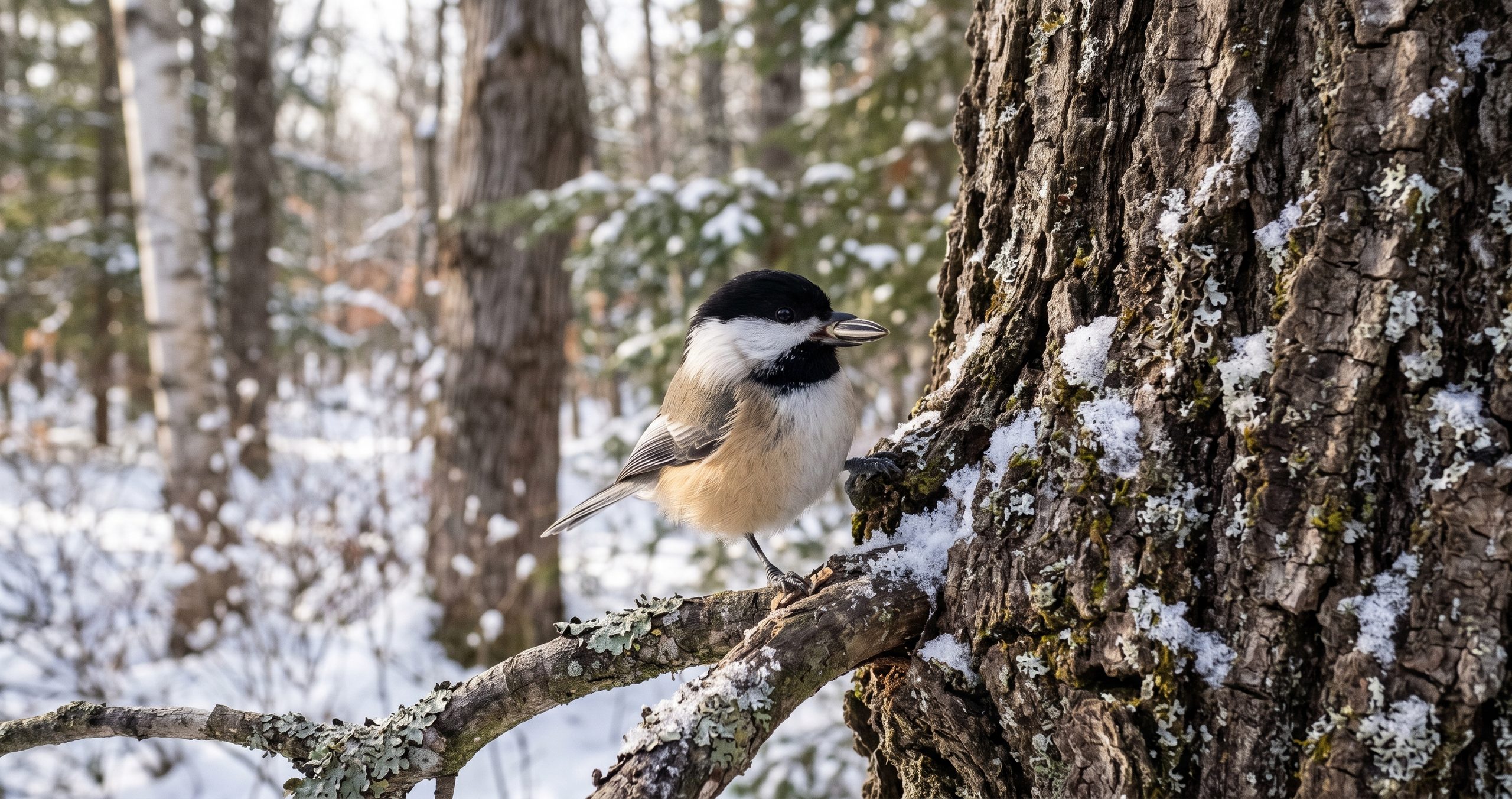
As temperatures fall across North America, black-capped chickadees begin relying on an extraordinary survival strategy: hiding food and remembering where to find it. The science of chickadee winter food memory reveals how these small songbirds use spatial learning, specialized brain structures, and environmental information to survive periods when food becomes scarce.
Their remarkable abilities have attracted neuroscientists and wildlife biologists for decades. By studying how chickadees store and retrieve food, researchers are uncovering connections between memory, seasonal environmental challenges, and the ways animal brains adapt to their surroundings.
Table of Contents
- Meet the Black-Capped Chickadee
- Why Chickadees Hide Food for Winter
- How Food Caching Works
- Chickadee Winter Food Memory: How Birds Find Their Caches
- The Hippocampus and Spatial Memory
- What Seasonal Research Reveals
- How Many Food Caches Can Chickadees Remember?
- Regional Differences Across North America
- What Happens When a Cache Disappears?
- How Chickadees Adapt to Changing Winter Conditions
- Supporting Chickadees in Your Backyard
- Why Chickadee Memory Matters to Science
- Frequently Asked Questions
- Conclusion
1. Meet the Black-Capped Chickadee
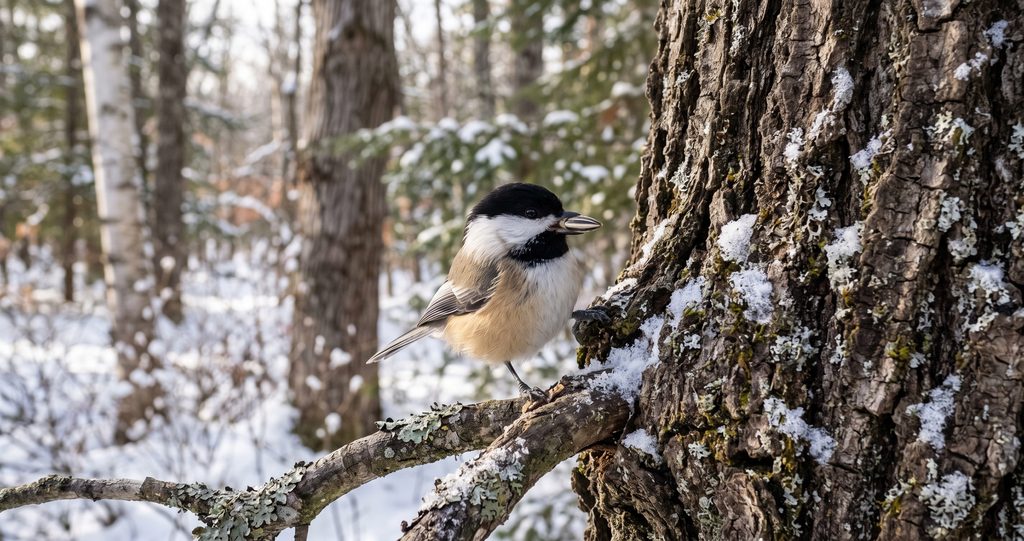
The black-capped chickadee (Poecile atricapillus) is one of North America’s most recognizable backyard birds. Its black cap and throat, white cheeks, gray back, and pale underside make it relatively easy to identify throughout much of its range.
These energetic birds inhabit deciduous and mixed forests, woodland edges, parks, and residential neighborhoods. They remain active throughout winter in many northern regions, where freezing temperatures and snow can make finding food difficult.
Unlike migratory birds that escape harsh northern winters, black-capped chickadees generally remain in their territories year-round. Their survival depends on several adaptations, including insulating plumage, flexible foraging behavior, and the ability to locate previously stored food.
A chickadee’s brain may be small, but its memory system is remarkably well suited to the challenges of winter.
2. Why Chickadees Hide Food for Winter
Winter presents a serious energy challenge for small birds. Cold temperatures increase the energy needed to maintain body temperature, while shorter daylight hours reduce the time available for feeding.
Black-capped chickadees respond partly by storing food during periods of abundance. This behavior, known as food caching, allows them to save edible resources for later use.
Their natural diet includes insects, spiders, insect eggs, seeds, and other small food items. The proportions vary with the season, with animal prey particularly important during warmer months.
During fall and winter, seeds and cached foods become valuable components of their diet. A chickadee may collect a seed, carry it away, and conceal it in a protected location.
Food caching is not the bird’s only winter survival strategy. Chickadees also seek sheltered roosting sites, adjust their activity, and can lower their body temperature during nighttime periods to conserve energy.
Together, these behaviors help them cope with unpredictable winter conditions.
3. How Food Caching Works
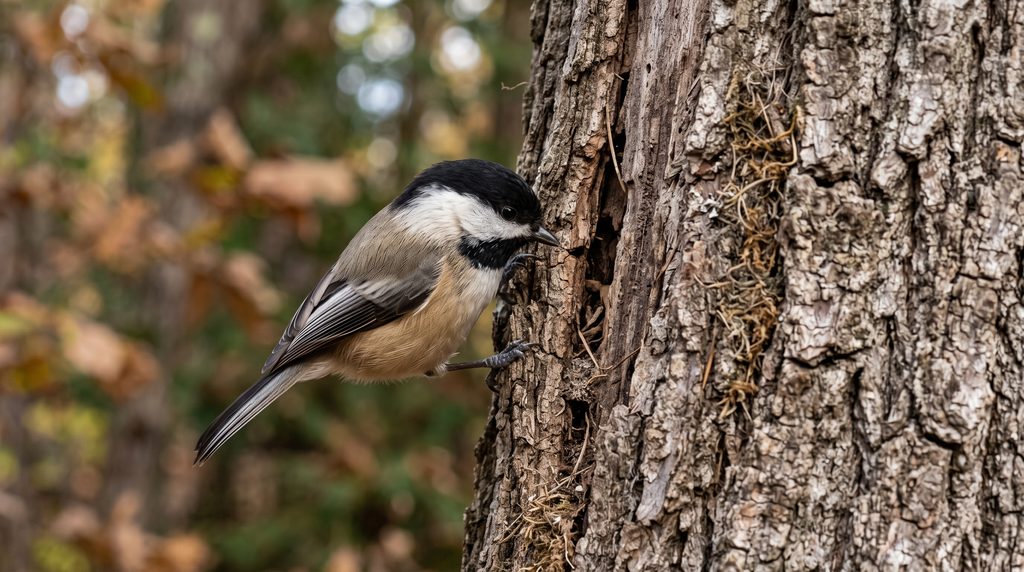
Black-capped chickadees are scatter-hoarders. Instead of gathering their entire food supply in one central location, they distribute food among many separate hiding places.
A chickadee may conceal a seed beneath loose bark, inside a narrow tree crevice, among clusters of needles, or within other protected spaces. The exact location depends on the available habitat and the bird’s behavior.
The caching process
A typical caching event involves several actions:
- The bird collects a suitable food item.
- It transports the item to a potential storage location.
- It places the food inside a crevice or other concealed space.
- It may adjust or cover the item before leaving.
- It later searches for and retrieves stored food when needed.
Individual food items are often stored separately, reducing the risk that one discovery will eliminate a large portion of the bird’s reserves.
Scatter-hoarding also spreads resources across the bird’s familiar environment. However, this strategy creates a demanding memory problem: remembering numerous locations that may look similar.
Unlike a human marking storage locations on a map, the chickadee must rely on information acquired while moving through its habitat.
4. Chickadee Winter Food Memory: How Birds Find Their Caches
The central feature of chickadee winter food memory is the ability to remember locations in physical space.
This capacity is called spatial memory. It allows an animal to retain information about where objects, resources, or important places are located relative to the surrounding environment.
When a chickadee hides food, it can encode spatial information associated with the cache site. Later, it uses that information to guide its search.
Landmarks and environmental cues
Trees, branches, bark patterns, and other stable environmental features can provide useful positional information.
For example, a bird might store food in a bark crevice on a particular side of a familiar tree. Its subsequent search can be guided by the tree’s position and the spatial relationship between the cache and nearby features.
Controlled experiments have demonstrated that food-storing chickadees can use remembered spatial information to recover hidden food. Their retrieval behavior cannot be explained entirely by detecting food through smell or randomly searching every possible location.
Nevertheless, memory does not guarantee perfect recovery. Environmental changes, interference, and the passage of time can affect whether a particular cache is successfully located.
Remembering places rather than following a fixed route
Chickadees do not need to repeat the precise route they traveled when hiding food.
Spatial memory can help them approach a previously visited location from different directions. This flexibility is particularly valuable in forests where the most convenient flight path changes with weather, obstacles, or predators.
Research also indicates that food-storing birds can distinguish relevant cache locations from other familiar sites. This makes spatial memory more useful than simply recognizing an individual tree.
The full set of cues used by wild chickadees under natural winter conditions remains an active area of research.
5. The Hippocampus and Spatial Memory
One of the most important brain regions involved in chickadee winter food memory is the hippocampus.
The hippocampus is associated with learning and remembering spatial relationships in birds and many other vertebrates. In food-caching species, it plays a particularly important role in remembering where resources have been stored.
Why the hippocampus matters
Research comparing food-storing and non-food-storing birds has revealed relationships between caching behavior and hippocampal anatomy.
Experiments involving hippocampal damage have also demonstrated that this region is important for accurate cache retrieval. Birds with impaired hippocampal function can experience difficulties remembering storage locations.
These findings support the conclusion that successful caching relies on specialized neural mechanisms rather than a simple instinct to search familiar hiding places.
However, the hippocampus does not operate independently. Vision, attention, motivation, and other memory-related processes also contribute to the bird’s behavior.
Brain structure and environmental demands
The relationship between caching and hippocampal development has become an important example in research on animal cognition.
Scientists have investigated whether populations exposed to more demanding winter environments show differences in hippocampal structure or memory performance.
Some studies have found associations between harsher environments, stronger spatial memory performance, and aspects of hippocampal anatomy.
These patterns are scientifically significant, but they do not mean that cold weather automatically produces a larger hippocampus in every chickadee. Development, experience, population history, and other biological factors can influence the results.
6. What Seasonal Research Reveals
Seasonal changes in chickadee winter food memory have been investigated through behavioral experiments and studies of brain anatomy.
Food caching can increase during fall, when birds prepare for periods of reduced food availability. Researchers have therefore examined whether changes in caching activity are associated with changes in memory performance or hippocampal characteristics.
Seasonal changes in the brain
Some studies of food-storing birds have reported seasonal differences in hippocampal measures, including volume or cellular characteristics.
However, the evidence is not uniform across studies, species, populations, or measurement methods. Findings from one food-storing bird species should not automatically be applied to black-capped chickadees.
The hippocampus also participates in broader neural processes involving learning and experience. Researchers continue to investigate how seasonal behavior, new neurons, and environmental conditions interact.
It would be misleading to claim that every chickadee’s hippocampus grows by a fixed percentage each fall. Such a universal seasonal change has not been established.
Research in controlled environments
Scientists study chickadee memory using controlled caching and retrieval experiments.
Birds may be allowed to hide food in an environment containing multiple potential storage sites. Researchers then examine which sites the birds revisit after a delay.
By changing the available visual information or comparing caching and retrieval conditions, scientists can investigate the cues used during memory-guided searches.
These experiments help isolate particular cognitive abilities. Nevertheless, laboratory performance does not necessarily represent every aspect of caching in a complex natural forest.
7. How Many Food Caches Can Chickadees Remember?
One of the most frequently repeated claims about chickadees is that they can remember thousands of hidden food locations.
The broader scientific evidence supports an impressive ability to store and retrieve food from numerous separate sites. However, precise numerical claims require careful interpretation.
Why cache counts are difficult to establish
Researchers must distinguish among several different measurements:
- The number of food items stored during a particular observation period.
- The number of unique locations used for caching.
- The number of locations remembered simultaneously.
- The number of caches successfully retrieved after a delay.
- The total number of caching events across an entire season.
These measurements are not interchangeable.
A bird might use the same location more than once, retrieve food soon after storing it, or lose a cache to another animal. Counting caching events therefore does not directly reveal the number of locations held in memory at any one moment.
Estimates are not universal limits
Statements that chickadees remember a particular number of caches are often presented without explaining how the estimate was obtained.
An observed caching rate cannot simply be multiplied by the number of days in winter to establish a bird’s memory capacity. Such calculations ignore retrieval, repeated use of sites, food loss, and changes in caching activity.
Similarly, success in a laboratory task with a limited number of storage sites does not establish an absolute upper limit on memory in the wild.
The scientifically defensible conclusion is that chickadees possess highly effective spatial memory suited to scatter-hoarding, while the precise number of simultaneously remembered caches remains difficult to quantify.
This distinction is essential when interpreting popular descriptions of chickadee intelligence.
8. Regional Differences Across North America
Black-capped chickadees occupy a broad geographic range that includes the northern United States, parts of the Rocky Mountain region, and much of southern Canada.
Winter conditions differ considerably across this range. A chickadee living in northern Minnesota may experience prolonged freezing temperatures, while one in a milder part of the Pacific Northwest may encounter a different combination of rain, snow, and food availability.
These environmental differences can influence the demands placed on food caching and memory.
Northern forests and severe winters
In colder continental regions, stored food may provide an important resource when natural foraging opportunities become limited.
Researchers have examined geographic differences in spatial cognition and hippocampal characteristics in relation to winter severity. Some findings suggest that birds from harsher environments may perform better on certain spatial memory tasks.
However, differences between populations can reflect multiple influences, including inherited characteristics, development, experience, and local ecology.
Milder winter environments
In regions with relatively mild winters, chickadees may have access to more consistent natural food supplies during certain periods.
That does not mean these birds lack strong spatial memory or abandon caching behavior. Food availability can fluctuate substantially even in comparatively mild climates.
Furthermore, not every small chickadee encountered in the western United States is a black-capped chickadee. Mountain chickadees and other related species have their own distributions and ecological adaptations.
Research findings involving mountain chickadees should be identified by species rather than automatically presented as evidence about black-capped chickadees.
9. What Happens When a Cache Disappears?
Not every hidden seed remains available until its owner returns.
Caches may be discovered by other birds, removed by small mammals, damaged by moisture, or otherwise become unusable.
Black-capped chickadees therefore face more than the challenge of remembering where food was hidden. They must also respond to changing information about individual storage sites.
A classic experimental study, Food Storage by Black-Capped Chickadees: Memory for the Location and Contents of Caches, investigated whether these birds remember more than simple cache positions.
The researchers found evidence that chickadees can retain information about cache contents and distinguish sites associated with different retrieval experiences.
ScienceDirect
This suggests that their caching memory can include information about the status of individual food stores.
If a chickadee discovers that a previously occupied cache is empty, remembering that experience can help it avoid unnecessary repeated searches.
The precise persistence of these memories under different natural conditions remains difficult to measure.
10. How Chickadees Adapt to Changing Winter Conditions
The value of chickadee winter food memory becomes especially apparent when environmental conditions change.
Snowfall can alter the appearance of familiar surroundings, while storms may damage branches or cover potential storage locations.
Chickadees must continue navigating despite these changes. Remembered spatial relationships can remain useful even when individual visual details become less obvious.
Memory and behavioral flexibility
A chickadee does not depend exclusively on cached food. It continues searching for insects, seeds, and other available resources throughout winter.
This flexible approach reduces dependence on any single food source.
Birds may also adjust their caching behavior according to current food availability and energetic demands. When resources are plentiful, storing food can provide opportunities for future use.
When food is scarce, immediate consumption may become more important.
The importance of familiar habitat
Stable woodland features can provide useful spatial information for birds that repeatedly forage and cache within a familiar area.
Mature trees, natural cavities, and varied vegetation also offer opportunities for finding insects and concealing food.
Maintaining structurally diverse habitat can therefore support both the physical resources and environmental features associated with chickadee survival.
11. Supporting Chickadees in Your Backyard

Homeowners across the northern United States can help chickadees by providing suitable food, shelter, and natural habitat.
Black oil sunflower seeds are a popular feeder food for chickadees. Birds may carry individual seeds away from feeders, sometimes eating them immediately and sometimes storing them elsewhere.
Suet can also provide a useful supplemental food source during cold weather.
Creating a chickadee-friendly yard
Native trees and shrubs provide natural foraging opportunities, including insects and seeds. Where safe, retaining some dead wood and standing snags can preserve cavities and bark crevices used by wildlife.
Dense vegetation can offer shelter from wind and predators, while a clean source of unfrozen water may help birds during winter.
Feeders should be cleaned regularly, and spoiled or moldy food should be discarded. If sick birds are observed, follow local wildlife agency guidance on temporarily removing feeders.
For additional background on the species and its natural history, the Cornell Lab of Ornithology’s black-capped chickadee guide provides identification information and descriptions of caching behavior.
All About Birds
Supporting chickadees does not require creating artificial caching sites or attempting to train their memory. A healthy, diverse yard allows these birds to carry out their natural behaviors.
12. Why Chickadee Memory Matters to Science
Research on chickadee winter food memory extends beyond understanding how a small bird survives winter.
Food-storing birds provide a valuable opportunity to investigate how ecological demands relate to learning, brain structure, and memory.
Their caching behavior produces measurable outcomes. Scientists can observe where food is hidden, how long it remains stored, and whether birds return to the correct locations.
This makes chickadees useful subjects for studying spatial cognition.
Memory and brain plasticity
Research into hippocampal neurogenesis—the recruitment of new neurons—has contributed to discussions about how adult brains change with experience and seasonal demands.
A scientific review of seasonal hippocampal plasticity emphasizes that relationships among caching activity, hippocampal size, and neuronal recruitment are complex. The timing and magnitude of observed changes differ among studies.
PMC
These findings help scientists investigate how memory-related brain systems respond to ecological challenges.
However, chickadee research does not establish that humans can improve their memories simply by imitating food-caching behavior. The relevant brain mechanisms share some broad principles, but important differences exist between species.
13. Frequently Asked Questions
Do black-capped chickadees remember every seed they hide?
There is no evidence that every individual cache is remembered and successfully retrieved. Chickadees demonstrate effective spatial memory, but some stored food is lost, stolen, or never recovered.
Do chickadees use smell to find hidden food?
Research supports an important role for spatial memory in cache retrieval. Other sensory cues may contribute to searching, but chickadees do not rely solely on smelling hidden seeds.
Does a chickadee’s brain grow every fall?
Some studies have identified seasonal differences in hippocampal volume or neuronal recruitment, while others have not found consistent changes in overall hippocampal size. The results depend on the population, study design, and brain measure examined.
Can chickadees remember thousands of hiding places?
Cornell Lab of Ornithology describes black-capped chickadees as capable of remembering thousands of hiding places. However, this general description should not be interpreted as a precisely established, universal number of simultaneously remembered caches.
All About Birds
Do chickadees remember food locations under snow?
Chickadees can use spatial information to locate cached food despite changing environmental conditions. However, snow and other habitat changes may complicate retrieval, and success is not guaranteed.
14. Conclusion
Black-capped chickadees demonstrate how memory can become an essential survival tool in challenging environments.
Their ability to distribute food among separate locations and later retrieve it depends on sophisticated spatial learning and the hippocampus, a brain region closely associated with memory.
Research has revealed important relationships among caching behavior, environmental conditions, and neural plasticity. At the same time, uncertainties remain about seasonal brain changes and the exact number of caches an individual bird can remember.
Understanding chickadee winter food memory offers a valuable perspective on animal intelligence and the adaptations that allow small birds to survive North America’s coldest seasons.
The next time a chickadee carries a sunflower seed away from a backyard feeder, it may be doing more than finding its next meal. It may be storing a resource whose location will become important later in winter.Suggested image placement: Immediately after Section 4, showing a black-capped chickadee concealing a sunflower seed in a tree-bark crevice. Alt text: chickadee winter food memory shown by a black-capped chickadee hiding a seed in tree bark.
For the published article, add this natural internal-link sentence at the end of Section 11:
A wildlife-friendly yard also benefits from natural ground cover. Our guide to keeping fallen leaves for wildlife explains how leaf litter supports insects, spiders, and other organisms that contribute to backyard food webs.
This target was verified as an existing article.
green garden
SEO & Metadata
SEO Title — Rank Math
Chickadee Winter Food Memory: 7 Amazing Secrets of Winter SurvivalFocus keyword near the beginning; number 7; power word Amazing; positive sentiment Survival.
Meta Description
Discover how chickadee winter food memory works, from hidden seed caches and spatial landmarks to hippocampus research and surprising winter survival skills.156 characters.
Focus Keyword
chickadee winter food memory
5 Related Keywords
- Black-capped chickadee memory
- How chickadees remember food
- Chickadee food caching behavior
- Chickadee hippocampus research
- Winter survival adaptations in birds
URL Slug
chickadee-winter-food-memory
Suggested Category
Uncategorized — recommend creating Wildlife for more precise categorization.
Tags
Nature, Wildlife, Ecology
2 Verified Internal Link Suggestions
- Fallen Leaves for Wildlife: Why You Should Keep Some — Best for Section 11, where the article discusses supporting backyard birds and natural food webs.
green garden
- Why Arctic Foxes Bury Food: Inside Their Remarkable Caching Strategy — Best for Section 12 as a related reading suggestion comparing food-storage adaptations across animal species.
3 Authoritative External Dofollow Sources
1. Cornell Lab of Ornithology — Black-capped Chickadee Overview
Black-capped Chickadee Species Guide
Supports identification, food caching, and general natural history.
All About Birds
2. Smulders, Sasson & DeVoogd (1995) — Seasonal Variation in Hippocampal Volume
Research publication on PubMed
Documents the relationship between October caching activity and hippocampal volume in an upstate New York population.
PubMed
3. Hoshooley and colleagues — Annual Cycle of Food-Storing and the Hippocampus
Research publication on PubMed
Provides important contrasting evidence: seasonal caching differences occurred without significant seasonal change in overall hippocampal size in that study.
PubMedSEO implementation: Use ordinary editorial hyperlinks without rel="nofollow" or rel="sponsored" for these references. Dofollow behavior depends on the final WordPress link settings.
Editorial verification: The internal links above were located on the website, and the scientific sources support the main claims. The article deliberately avoids presenting a precise number of simultaneously remembered caches as established fact, and distinguishes inconsistent seasonal hippocampal findings rather than generalizing from one study.