
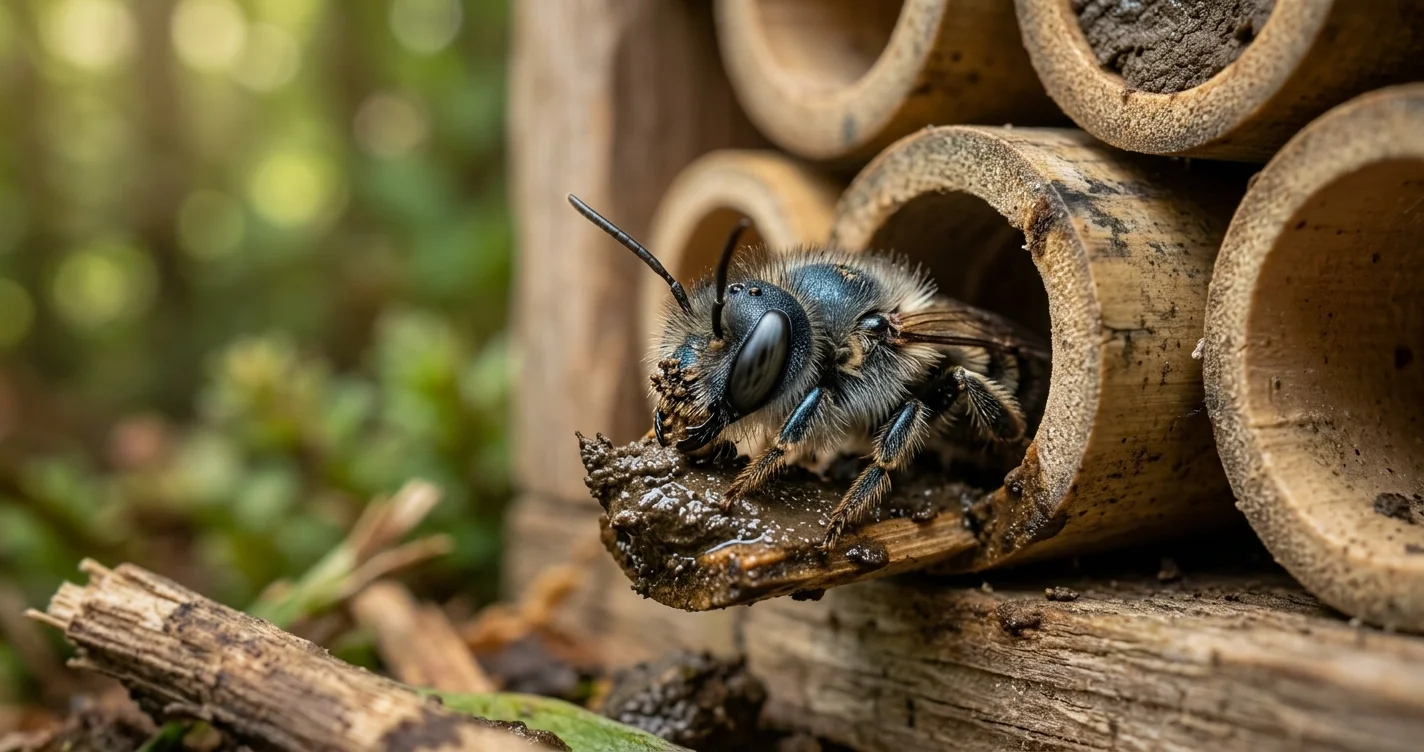
A small metallic-blue bee lands beside a hollow stem, disappears inside, and returns carrying a tiny ball of mud. Over the next several days, she repeats this journey, quietly constructing a nursery for the next generation.
Inside a mason bee nest, something remarkable happens. A solitary female builds individual chambers, supplies each one with pollen and nectar, lays an egg, and seals it behind a carefully constructed mud wall. When her work is complete, the developing bees remain protected inside until they are ready to emerge.
Unlike honeybees, mason bees do not maintain large colonies or produce harvestable honey. Instead, they are important native pollinators that can help fruit trees, flowering shrubs, and spring gardens reproduce.
Understanding their nesting behavior also reveals how gardeners can provide useful habitat without accidentally creating conditions that encourage parasites, disease, or overcrowding.
Table of Contents
- What Makes Mason Bees Different From Honeybees?
- Mason Bee Nest Construction: Seven Steps
- How Mason Bee Larvae Develop
- When Adult Mason Bees Emerge
- Why Mason Bees Are Effective Spring Pollinators
- How to Set Up a Safe Bee Hotel
- How to Clean and Maintain a Bee Hotel
- Best Plants for Mason Bees
- Common Myths About Mason Bees
- Frequently Asked Questions
- Conclusion
What Makes Mason Bees Different From Honeybees?
Mason bees belong primarily to the genus Osmia, a diverse group of solitary bees found across much of the world.
Many species have dark, metallic-blue, greenish, or bronze coloration, although appearance varies considerably.
Their name comes from their habit of using mud or other materials to construct partitions inside nesting cavities.
Solitary Bees Instead of Colonies
Honeybees live in highly organized colonies containing a queen, workers, and male drones.
Mason bees follow a different reproductive strategy.
Each female generally builds and provisions her own nest rather than relying on a large colony of workers.
Several females may nest close together when suitable cavities are available, but they do not form a cooperative honeybee-style society.
Different Ways of Carrying Pollen
Honeybees transport pollen in specialized structures on their hind legs.
Female mason bees carry pollen on dense hairs beneath their abdomens, called the scopa.
This difference matters because the pollen often remains relatively loose and can be transferred between flowers during visits.
Do Mason Bees Sting?
Female mason bees possess stingers, but they are generally nonaggressive and rarely sting unless trapped, squeezed, or directly handled.
Because they do not defend large communal stores of honey, they usually show little interest in confronting people.
Nevertheless, anyone with a history of severe insect-sting reactions should avoid handling bees directly.
Mason Bee Nest Construction: Seven Steps
The nesting process of a mason bee is a carefully organized sequence of construction, food gathering, egg laying, and sealing.
Most cavity-nesting Osmia species do not excavate their own tunnels in solid wood. Instead, they occupy existing holes, hollow stems, or similar protected spaces.
Step 1: Finding a Suitable Nesting Cavity
A female begins by searching for an appropriate cavity.
Natural nesting sites may include hollow plant stems, beetle tunnels in dead wood, and other narrow openings.
The cavity must provide enough room for developing offspring while offering protection from weather and predators.
Different mason bee species prefer different tunnel diameters and lengths.
Step 2: Inspecting and Preparing the Tunnel
After selecting a cavity, the female explores its interior.
She may remove loose debris or examine the space before beginning construction.
Some species create a mud partition at the back of the cavity to establish the first brood chamber.
The exact arrangement depends on the species and the structure of the nesting site.
Step 3: Collecting Pollen and Nectar
The female visits flowers to gather food for her future offspring.
She carries pollen on the underside of her abdomen and transports nectar internally.
Returning to the cavity, she deposits these materials into the developing brood chamber.
Repeated trips gradually produce a food provision containing enough nutrients for one larva.
Step 4: Laying a Single Egg
Once the food provision is complete, the female lays an egg in the chamber.
The egg is positioned so that the emerging larva can access the stored food.
Unlike honeybee larvae, mason bee larvae do not receive repeated feeding visits from adult workers.
Their food supply is prepared before they hatch.
Step 5: Building a Mud Partition
After laying the egg, the female collects moist soil or mud.
She uses her mandibles to shape the material into a partition that closes the chamber.
The partition separates the developing offspring from the next chamber.
This mud-based construction gives mason bees their common name.
Step 6: Repeating the Process
The female repeats the sequence farther toward the tunnel entrance.
Each new chamber receives its own pollen and nectar provision, egg, and protective partition.
A single tunnel may contain several offspring arranged in a row.
In some species, female offspring are more often placed in deeper chambers, while males develop closer to the entrance.
This arrangement can influence the order in which adults emerge.
Step 7: Sealing the Entrance
After completing the final brood chamber, the female closes the tunnel entrance.
The outer seal helps protect the developing offspring from environmental exposure and some natural enemies.
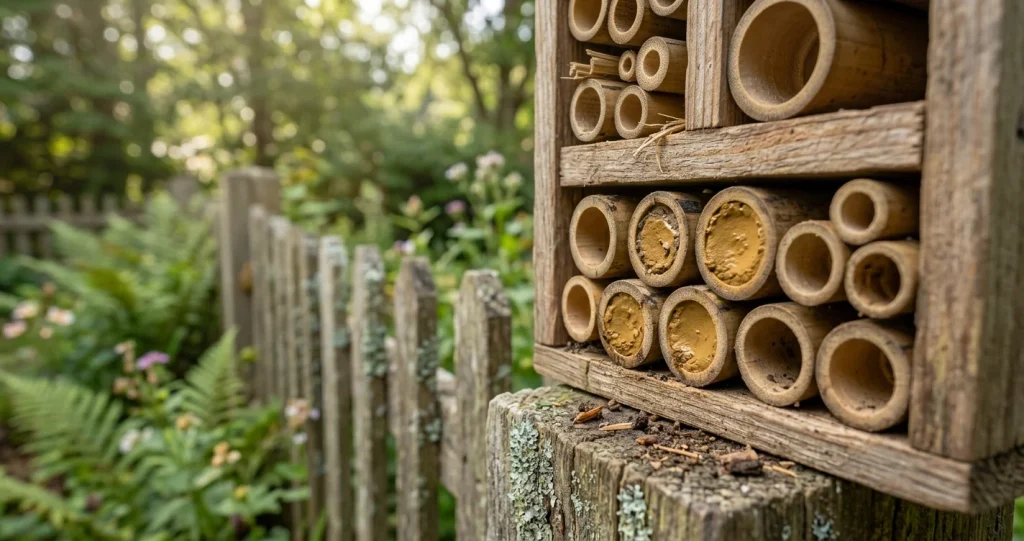
A completed nest may appear as a small circular mud plug at the end of a hollow stem or nesting tube.
The female then searches for another suitable cavity if she has time and sufficient resources to continue nesting.
How Mason Bee Larvae Develop
After the eggs are laid, development continues inside the sealed chambers.
The female does not remain inside the nest to care for the larvae.
From Egg to Feeding Larva
The egg hatches into a small larva that begins consuming the stored pollen and nectar.
As the larva grows, it molts several times.
Its development depends on adequate food, suitable temperature, and protection from excessive moisture and natural enemies.
Spinning a Cocoon
Many mason bee species eventually spin protective cocoons.
Inside these structures, they undergo further development and metamorphosis.
In commonly managed spring-flying species such as the blue orchard bee (Osmia lignaria), the insect generally develops into an adult before winter.
The adult remains inside its cocoon during the cold season.
Overwintering
The sheltered adult enters a dormant state that allows it to survive until conditions become favorable.
Cold-season temperature patterns influence successful overwintering and subsequent emergence.
Different species have different developmental schedules, so these details should not be applied identically to every mason bee.
When Adult Mason Bees Emerge
Many familiar orchard mason bees emerge during early spring, often around the time fruit trees begin flowering.
Males commonly emerge before females, a pattern known as protandry.
Why Males Emerge First
Males may wait near nesting areas for females to appear.
After mating, females begin searching for cavities and gathering pollen.
The active adult nesting season is often relatively short compared with the lifespan of an entire honeybee colony.
Weather Influences Emergence
Temperature and local climate affect when mason bees become active.
Warm spring conditions can encourage emergence, while prolonged cold may delay it.
However, unusually early warmth can create problems if bees emerge before sufficient flowers are available.
Why Mason Bees Are Effective Spring Pollinators
Mason bees can be particularly valuable pollinators of spring-flowering fruit trees.
Their effectiveness comes from a combination of body structure, foraging behavior, and seasonal timing.
Loose Pollen Transfer
Because female mason bees carry pollen beneath their abdomens, pollen can readily contact floral reproductive structures.
Their movements between flowers may transfer pollen efficiently.
However, pollination effectiveness varies by plant species and environmental conditions.
Visiting Fruit Blossoms
Some orchard mason bees forage readily on apple, pear, cherry, and other spring blossoms.
Their emergence often overlaps with flowering periods in temperate orchards.
This timing makes them useful contributors to fruit-tree pollination.
Working in Cool Spring Conditions
Certain mason bee species can forage under relatively cool conditions when some other pollinators are less active.
This can be especially useful during variable spring weather.
Still, they do not replace the ecological importance of honeybees, bumblebees, flies, butterflies, and other pollinating insects.
Healthy gardens benefit from diverse pollinator communities.
How to Set Up a Safe Bee Hotel
A bee hotel can provide nesting opportunities for cavity-nesting bees, but design and maintenance are important.
Poorly managed hotels can concentrate parasites, encourage mold, and create unsuitable nesting conditions.
Choose the Right Location
Place the nesting structure in a sheltered area with morning sunlight.
An east- or southeast-facing position often works well in temperate North American gardens.
Protect the structure from persistent rain and strong wind.
The entrance should remain unobstructed so bees can approach and leave easily.
Select Appropriate Nesting Materials
Use untreated natural materials such as hollow reeds, suitable plant stems, or properly constructed removable nesting inserts.
Tunnel diameters should vary to accommodate different local species.
For commonly managed orchard mason bees, openings around 5/16 inch are often used, although requirements differ among species.
Avoid rough, splintered interiors that could damage delicate wings.
Avoid Oversized Hotels
A large structure packed with hundreds of cavities may appear attractive, but it can concentrate nesting insects and their parasites.
Several smaller nesting sites distributed across a garden may be preferable.
Natural habitat, including standing dead stems and suitable dead wood, can also support native cavity-nesting bees.
Provide Mud Nearby
Many mason bees require access to moist soil for building partitions.
A small area of exposed, damp soil can provide construction material.
Avoid creating stagnant water or permanently saturated conditions.
How to Clean and Maintain a Bee Hotel
Bee hotels should not be treated as permanent decorations that require no attention.
Maintenance helps reduce the buildup of parasites, pathogens, and damaged nesting materials.
Inspect the Structure
Check the exterior for water damage, mold, and deterioration.
Do not open occupied nests during active development.
Disturbing brood chambers can injure developing bees.
Replace Disposable Materials
Some paper liners and natural nesting materials are intended for single-season use.
Replace them according to species-specific management guidance after the bees have completed their life cycle.
Do not reuse heavily contaminated or damaged nesting materials.
Use Removable Systems Carefully
Removable trays or liners can allow inspection and management.
However, opening nests or extracting cocoons requires knowledge of the species and developmental stage.
For unmanaged native bee hotels, minimizing disturbance and replacing old materials at appropriate times may be safer than routinely handling cocoons.
Avoid Harsh Chemicals
Do not spray occupied nesting cavities with insecticides, disinfectants, or household cleaning products.
If a nesting component becomes unsuitable, replace it rather than exposing developing bees to potentially harmful chemicals.
The best approach combines careful placement, weather protection, modest nesting density, and appropriate seasonal maintenance.
Best Plants for Mason Bees
Mason bees need accessible flowers throughout their active foraging period.
Plant selection should reflect local climate and native bee species.
Spring-Flowering Trees
Apple, cherry, plum, and other fruit trees can provide abundant spring pollen and nectar.
Native flowering trees may also be valuable, depending on the region.
Flowering Shrubs
Willows, serviceberries, and other early-flowering shrubs can support bees when food is otherwise limited.
Native species are particularly useful when they match the needs of local pollinators.
Early Garden Flowers
Spring-blooming plants such as native violets and suitable early perennials can supplement woody plant blossoms.
Choose species that grow well in your region and avoid invasive ornamentals.
Avoid Pesticide Exposure
Reduce unnecessary pesticide use, particularly when plants are flowering.
If treatment is unavoidable, follow the product label and choose methods that minimize exposure to pollinators.
Providing flowers, nesting habitat, and clean water or damp soil is often more beneficial than installing a bee hotel alone.
Common Myths About Mason Bees
Myth 1: Mason Bees Live in Large Colonies
Mason bees are solitary.
Females construct and provision their own nests, although several may use nearby cavities.
Myth 2: Mason Bees Produce Honey
Mason bees do not maintain honey-producing colonies.
They gather pollen and nectar primarily to provision their offspring.
Myth 3: Mason Bees Cannot Sting
Female mason bees can sting, but they are generally reluctant to do so.
They should still be observed without unnecessary handling.
Myth 4: Any Bee Hotel Helps Pollinators
Poorly designed or neglected hotels may encourage parasites, disease, or unsuitable nesting conditions.
A small, well-maintained structure is generally preferable to a large, poorly managed one.
Myth 5: Mason Bees Need Artificial Hotels to Survive
Mason bees naturally use hollow stems, beetle tunnels, and other cavities.
Preserving suitable natural nesting habitat can be just as important as installing artificial structures.
Frequently Asked Questions
How long does it take a mason bee to build a nest?
A female may spend several days constructing and provisioning a complete nest, depending on weather, food availability, and the number of brood chambers.
Do mason bees return to the same nest?
Individual females may use suitable nesting areas repeatedly during their active season, but their offspring generally emerge the following year and seek appropriate nesting cavities.
When should a mason bee hotel be installed?
For spring-flying species, install nesting materials before local adult emergence, often in late winter or early spring.
How deep should mason bee nesting tubes be?
Many managed orchard mason bee systems use cavities approximately 6–8 inches deep, although suitable dimensions vary among species.
Can mason bees pollinate vegetables?
Some mason bees visit vegetable flowers, but their importance varies by crop and season. Many spring-flying species are especially valuable for fruit trees.
Should I clean a bee hotel every year?
Seasonal inspection and appropriate replacement of used nesting materials are recommended. The exact maintenance method depends on the nesting system and bee species.
Are mason bees native to North America?
Many mason bee species are native to North America, including the blue orchard bee. However, some species present in North America have been introduced from other regions.
Conclusion
Mason bees are remarkable examples of how solitary insects can contribute to healthy gardens and natural ecosystems.
A female builds her nest one chamber at a time, gathering pollen and nectar, laying eggs, and sealing each developing offspring behind a protective mud partition.
The young grow inside these chambers, and many spring-flying species emerge the following year when flowers begin to bloom.
By providing suitable nesting cavities, maintaining bee hotels responsibly, planting diverse flowers, and reducing pesticide exposure, gardeners can support these valuable pollinators.
The most effective approach is not simply to install more bee hotels, but to create a balanced habitat where mason bees and other native pollinators can thrive.
External Sources
1. Oregon State University Extension — Nurturing Mason Bees in Your Backyard in Western Oregon: Research-based information about mason bee nesting, life cycles, emergence, nesting materials, and management. Oregon State University: Mason Bee Management Guide
2. USDA Forest Service — Pollinators: Educational resources about native pollinators, their ecological importance, habitat requirements, and conservation. USDA Forest Service: Pollinator Resources
3. Xerces Society for Invertebrate Conservation — Pollinator Conservation: Conservation guidance about supporting native bees, creating nesting habitat, selecting beneficial plants, and reducing threats to pollinators. Xerces Society: Pollinator Conservation