
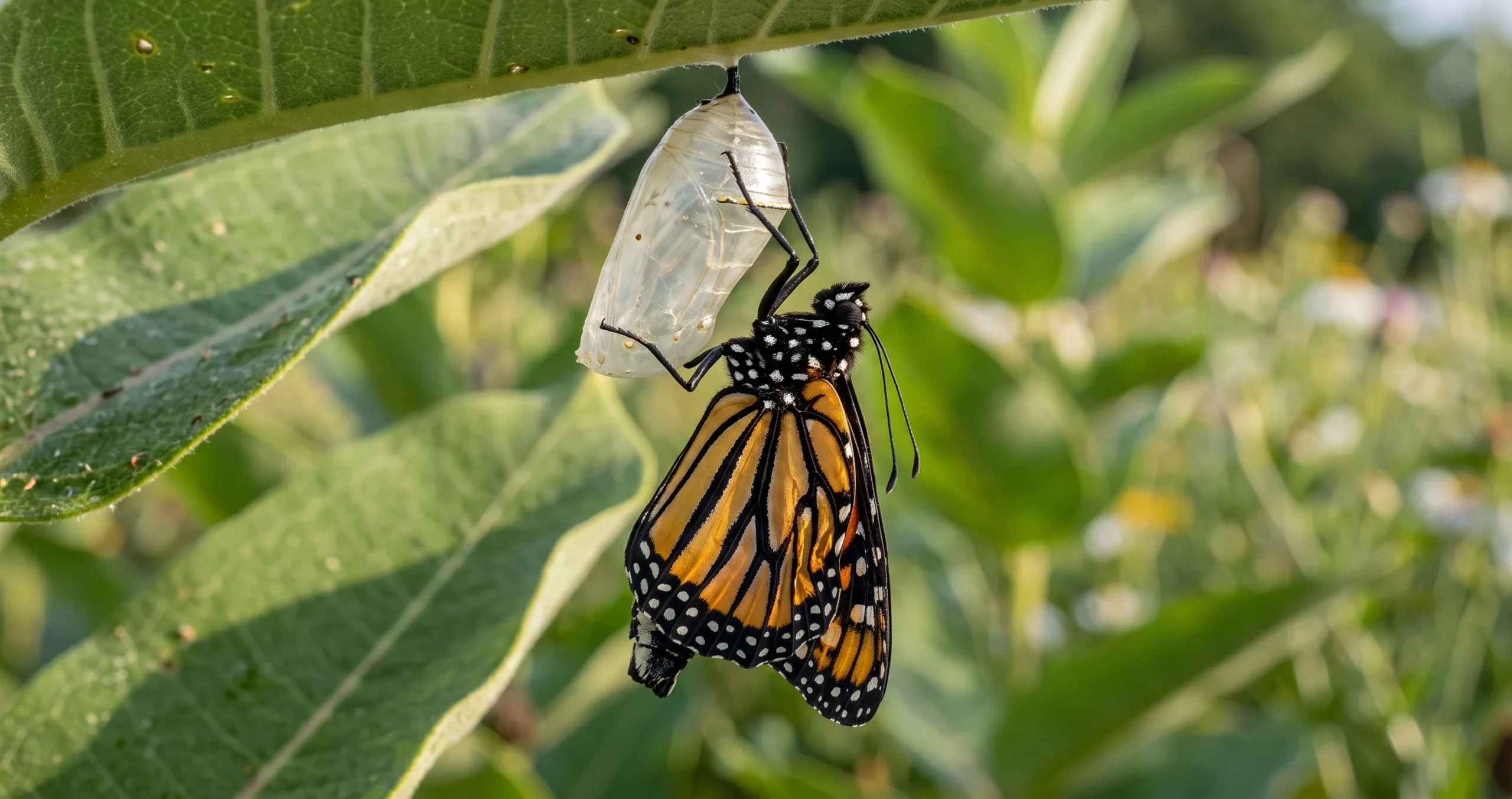
Inside a monarch butterfly chrysalis, an extraordinary biological transformation turns a milkweed-eating caterpillar into a beautiful orange-and-black butterfly. Although the green chrysalis appears motionless, complex changes are taking place beneath its protective covering.
What happens inside a monarch butterfly chrysalis is far more fascinating than the common belief that a caterpillar simply dissolves into liquid. During monarch butterfly metamorphosis, certain larval tissues break down, others reorganize, and specialized developing tissues form adult structures such as wings, antennae, legs, and reproductive organs.
This remarkable butterfly transformation is controlled by hormones and carefully coordinated cellular processes. Over approximately 8–15 days under typical summer conditions, the developing monarch completes its pupal stage before emerging as an adult butterfly.
Discover the science inside a monarch butterfly chrysalis, including the stages of development, how butterfly wings form, and the remarkable process of emergence.
Table of Contents
- What Happens Inside a Monarch Butterfly Chrysalis?
- The Four Stages of the Monarch Butterfly Life Cycle
- Inside a Monarch Butterfly Chrysalis: The Biological Transformation
- Monarch Chrysalis Stages: A Developmental Timeline
- How Hormones Control Monarch Metamorphosis
- Signs a Monarch Butterfly Is Ready to Emerge
- How Monarch Butterfly Wings Expand After Emergence
- Why Monarch Metamorphosis Matters
- Common Myths About Monarch Chrysalises
- Frequently Asked Questions
- Conclusion
What Happens Inside a Monarch Butterfly Chrysalis?
Inside a monarch butterfly chrysalis, a living pupa undergoes extensive biological changes that transform a caterpillar into an adult butterfly. Certain larval tissues break down, others are remodeled, and specialized developing tissues form adult structures such as wings, antennae, and reproductive organs. Hormones coordinate these changes until the fully developed butterfly is ready to emerge.
This extraordinary transformation is known as complete metamorphosis.
A monarch chrysalis may look like a small, motionless green ornament hanging beneath a leaf. Its smooth surface and delicate metallic-gold markings conceal a remarkably active developmental process.
The caterpillar that entered this stage was built for crawling and eating milkweed leaves. The adult butterfly that emerges will have wings, compound eyes, and the ability to travel between flowers.
These changes do not happen through a mysterious process in which the caterpillar completely dissolves and rebuilds itself from nothing.
Instead, metamorphosis involves coordinated changes to tissues and organs, many of which began developing before the chrysalis formed.
Understanding what happens inside a monarch butterfly chrysalis reveals one of the most fascinating examples of animal development.
The Four Stages of the Monarch Butterfly Life Cycle
The monarch butterfly (Danaus plexippus) undergoes four distinct developmental stages: egg, larva, pupa, and adult.
Each stage has a different function in the insect’s growth and survival.
Stage 1: The Monarch Egg
The life cycle begins when a female monarch lays a small egg on a milkweed plant.
Milkweed is essential because monarch caterpillars depend on it as their larval host plant.
Inside the egg, an embryo develops until the tiny caterpillar is ready to hatch.
Under favorable conditions, this stage generally lasts approximately three to five days.
Stage 2: The Monarch Caterpillar
After hatching, the caterpillar begins feeding on milkweed.
As it grows, it passes through five developmental stages called instars.
Between these stages, it sheds its external cuticle because the existing covering cannot accommodate unlimited growth.
During this period, the caterpillar accumulates nutrients that support both its current development and its eventual transformation.
The familiar black, yellow, and white bands become increasingly prominent as it matures.
Stage 3: The Monarch Chrysalis
When the caterpillar finishes growing, it stops feeding and searches for a suitable place to pupate.
It attaches itself to a silk pad using a specialized structure called the cremaster and hangs in a characteristic J-shaped posture.
The final larval cuticle is then shed, revealing the pupa.
The newly exposed chrysalis hardens and develops its recognizable green appearance.
This is the stage during which extensive internal remodeling produces the adult butterfly.
Stage 4: The Adult Monarch Butterfly
After pupal development is complete, the butterfly emerges from its chrysalis.
Its wings are initially soft, folded, and unable to support flight.
The adult must expand and dry them before flying.
Once ready, it begins its adult life, feeding primarily on flower nectar and eventually participating in reproduction.
Inside a Monarch Butterfly Chrysalis: The Biological Transformation
The most remarkable changes in monarch development occur during the pupal stage.
Although the chrysalis appears motionless, the tissues inside remain biologically active.
The Chrysalis Is Not an Empty Shell
A chrysalis is the pupal stage of a butterfly, enclosed by its pupal cuticle.
It is not a separate hollow container, nor is it a silk cocoon.
The pupa continues to respire and carry out essential metabolic processes while its anatomy changes.
Beneath the protective outer covering, developing adult structures become increasingly organized.
What Happens to the Caterpillar’s Body?
One common misconception is that a caterpillar completely turns into liquid inside its chrysalis.
The reality is more complex.
Certain larval tissues undergo controlled breakdown through processes that include programmed cell death.
Other tissues survive and are extensively reorganized.
Materials from tissues that are broken down can be reused during development.
At the same time, specialized groups of cells grow and differentiate into adult structures.
The transformation is therefore a combination of tissue breakdown, preservation, remodeling, and new growth.
How Adult Body Parts Develop
Many adult insect structures originate from developmental tissues established during larval life.
These include imaginal tissues associated with the formation of wings and other adult appendages.
During metamorphosis, these tissues undergo substantial growth and differentiation.
The developing butterfly acquires functional adult legs, antennae, wing structures, and reproductive anatomy.
Some organs are remodeled from existing larval tissues rather than being constructed entirely from new cell populations.
This coordinated development produces an adult with a body plan very different from that of the caterpillar.
How Monarch Butterfly Wings Form
Butterfly wing development begins before the adult emerges.
Within the developing pupa, wing tissues grow and become organized into folded structures.
Wing veins form, scales develop, and the characteristic monarch wing pattern becomes established.
The familiar orange coloration results primarily from pigments within the wing scales, while black and white markings create the species’ distinctive appearance.
Before emergence, the wings remain compactly folded inside the pupal covering.
They are already developed structures, but they have not yet expanded into their final shape.
Monarch Chrysalis Stages: A Developmental Timeline
The stages inside a monarch chrysalis are best understood as a continuous biological process rather than a series of identical daily events.
The following timeline illustrates typical changes under favorable summer conditions.
| Approximate period | What happens |
|---|---|
| Day 1 | The newly formed pupal cuticle hardens; adult development continues |
| Days 2–4 | Tissue remodeling and development of adult structures progress |
| Days 5–8 | Wings, flight muscles, and other adult tissues continue maturing |
| Days 9–12 | In some individuals, wing pigmentation becomes visible as emergence approaches |
| Days 13–15 | Slower-developing individuals may complete maturation and emerge |
This is an illustrative timeline, not a fixed day-by-day schedule. Monarchs may emerge earlier or later, and developmental processes overlap. Monarch Joint Venture reports that the pupal stage generally lasts 8–15 days under normal summer conditions.
How Long Does the Entire Monarch Life Cycle Take?
Typical development time by life stage
Illustrative midpoints of reported ranges, in days. Actual timing varies with temperature and conditions.
0 days4 days8 days12 days16 daysEggCaterpillarChrysalis
The complete journey from egg to adult often takes approximately three to five weeks under suitable conditions. Temperature can change the pace considerably.
How Hormones Control Monarch Metamorphosis
Metamorphosis depends on chemical signals that coordinate growth, molting, and changes in tissue identity.
Juvenile Hormone and the Caterpillar Stage
Juvenile hormone helps maintain larval development during earlier molts.
As its activity changes toward the end of larval life, the insect becomes capable of progressing toward pupation.
This helps ensure that the caterpillar does not begin adult development before it has reached the appropriate developmental stage.
Ecdysteroids and Tissue Remodeling
Ecdysteroids are hormones involved in regulating insect molts and developmental transitions.
The active hormone 20-hydroxyecdysone influences gene expression and cellular processes associated with metamorphosis.
Its effects depend on developmental timing and interactions with other signals.
These hormonal mechanisms have been extensively investigated in insect developmental biology, although many molecular details come from model insects rather than monarch-specific experiments.
Signs a Monarch Butterfly Is Ready to Emerge
One of the most exciting moments in the monarch butterfly life cycle occurs shortly before the adult leaves its chrysalis.
The Chrysalis Changes Color
A newly formed monarch chrysalis is typically green with small metallic-looking markings.
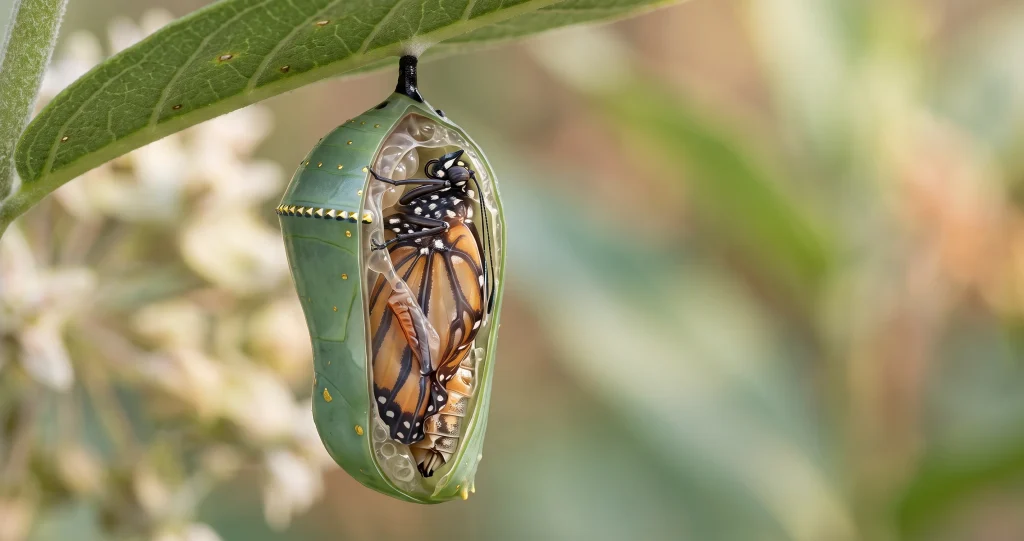
As development approaches completion, the adult wing pattern becomes visible through the pupal covering.
The orange, black, and white colors become increasingly apparent because pigmentation develops in the wing scales.
The covering does not need to become newly transparent for this change to occur.
The Butterfly Emerges
When development is complete, the adult splits the pupal covering and pulls itself free.
This process is called eclosion.
The newly emerged butterfly usually hangs beneath the empty chrysalis or another secure support.
At first, its wings are small, folded, and soft.
Although the adult body has formed, the wings still require expansion and drying before flight becomes possible.
How Monarch Butterfly Wings Expand After Emergence
After emerging, the butterfly pumps hemolymph, the fluid circulating through its body, into the veins of its wings.
This pressure helps unfold and expand the wings to their functional shape.
The wings then dry and become sufficiently rigid to support flight.
During this period, the monarch remains vulnerable because it cannot immediately escape by flying.
Under suitable conditions, several hours may pass before the butterfly is ready for its first flight.
The wings do not grow from nothing after emergence. They are already formed within the pupa and are simply expanding into their final shape.
Why Monarch Metamorphosis Matters
Complete metamorphosis allows the caterpillar and adult butterfly to perform different ecological roles.
The caterpillar specializes in consuming milkweed foliage and accumulating nutrients.
The adult primarily feeds on nectar, using its elongated proboscis to obtain liquid food from flowers.
This division allows the two life stages to exploit different resources.
For monarch conservation, both stages matter.
Milkweed plants provide essential breeding habitat and food for caterpillars. Nectar-producing flowers provide energy for adults, including butterflies preparing for migration.
Protecting native milkweed and suitable flowering plants helps support the entire monarch life cycle.
Common Myths About Monarch Chrysalises
Several misconceptions surround butterfly metamorphosis because the most dramatic changes occur out of sight.
Myth 1: The Caterpillar Completely Turns Into Liquid
This is incorrect. Some tissues break down, but others survive, reorganize, and continue developing. Many adult structures begin forming during the caterpillar stage.
Myth 2: A Chrysalis Is a Silk Cocoon
A chrysalis is the butterfly’s pupa, enclosed by its own pupal cuticle. A cocoon is an additional protective covering, usually made of silk, produced by certain insects, including many moths.
Myth 3: Butterfly Wings Develop Only After Emergence
Monarch wings develop before emergence. The adult expands its folded wings afterward using hemolymph pressure.
Myth 4: Nothing Happens Inside a Motionless Chrysalis
Although the pupa may appear inactive, cellular development, tissue remodeling, and other physiological processes continue inside.
Myth 5: Every Monarch Emerges After Exactly 10 Days
Development varies with temperature and environmental conditions. A fixed ten-day schedule does not apply to every individual.
Frequently Asked Questions
1. What happens inside a monarch butterfly chrysalis?
Inside a monarch butterfly chrysalis, larval tissues undergo remodeling while adult structures develop. Wings, antennae, legs, flight muscles, and other organs mature through carefully coordinated biological processes.
2. Does a monarch caterpillar turn into liquid?
No. Some larval tissues break down, but many structures remain organized. Metamorphosis involves tissue remodeling, growth, and cellular differentiation rather than complete liquefaction.
3. How long does a monarch stay in its chrysalis?
A monarch generally spends approximately 8–15 days in its chrysalis under normal summer conditions. Temperature and environmental factors can influence this period.
4. Can you see a butterfly developing inside its chrysalis?
Most internal changes cannot be observed directly. Shortly before emergence, however, the monarch’s orange, black, and white wing patterns become visible through the pupal covering.
5. How do monarch butterfly wings develop?
Wing development begins during larval life and continues during the pupal stage. Wing tissues grow, veins and scales develop, and pigmentation forms. The folded wings expand after the butterfly emerges.
6. Why does a monarch chrysalis turn dark before hatching?
Near emergence, the adult’s pigmented wings become visible through the pupal covering. This makes the chrysalis appear darker. However, unusual darkening without normal development may indicate a problem.
7. Can a monarch butterfly fly immediately after emerging?
No. A newly emerged monarch must expand, dry, and strengthen its wings. This process generally takes several hours under suitable conditions.
8. What is the difference between a chrysalis and a cocoon?
A chrysalis is the pupal stage of a butterfly. A cocoon is a separate protective covering, commonly made of silk, that surrounds the pupa of certain insects.
Conclusion
Inside a monarch butterfly chrysalis, one of nature’s most sophisticated developmental transformations unfolds.
The caterpillar does not simply disappear. Its tissues undergo carefully regulated changes, while developing adult structures mature into the anatomy of a butterfly.
Hormonal signals coordinate the transition, wings develop inside the pupa, and the adult eventually emerges with a completely different appearance and lifestyle.
The entire process demonstrates how an organism can transform its body while maintaining the continuity of life.
By protecting milkweed, nectar-producing flowers, and suitable natural habitats, we can help future generations of monarch butterflies complete this remarkable journey.
The next time you encounter a green monarch chrysalis hanging beneath a leaf, remember that its stillness conceals an extraordinary process of biological transformation.
External sources:
1. Monarch Joint Venture — Life Cycle. Egg development, larval instars, chrysalis duration, and adult emergence. Read source.
2. Monarch Joint Venture — Growth and Development. Imaginal tissues, organ development, and changes during metamorphosis. Read source.
3. University of Maryland Extension — Metamorphosis: The Life Stages of a Monarch Butterfly on Milkweed in North East, Maryland. Doris Behnke, updated October 23, 2024. Read source.
4. Truman, J. W., and Riddiford, L. M. (2002). Endocrine Insights into the Evolution of Metamorphosis in Insects. Annual Review of Entomology, 47, 467–500. Read research.
5. University of Houston — Life Cycle. Educational overview of monarch development and approximate life-stage durations. Read source.