
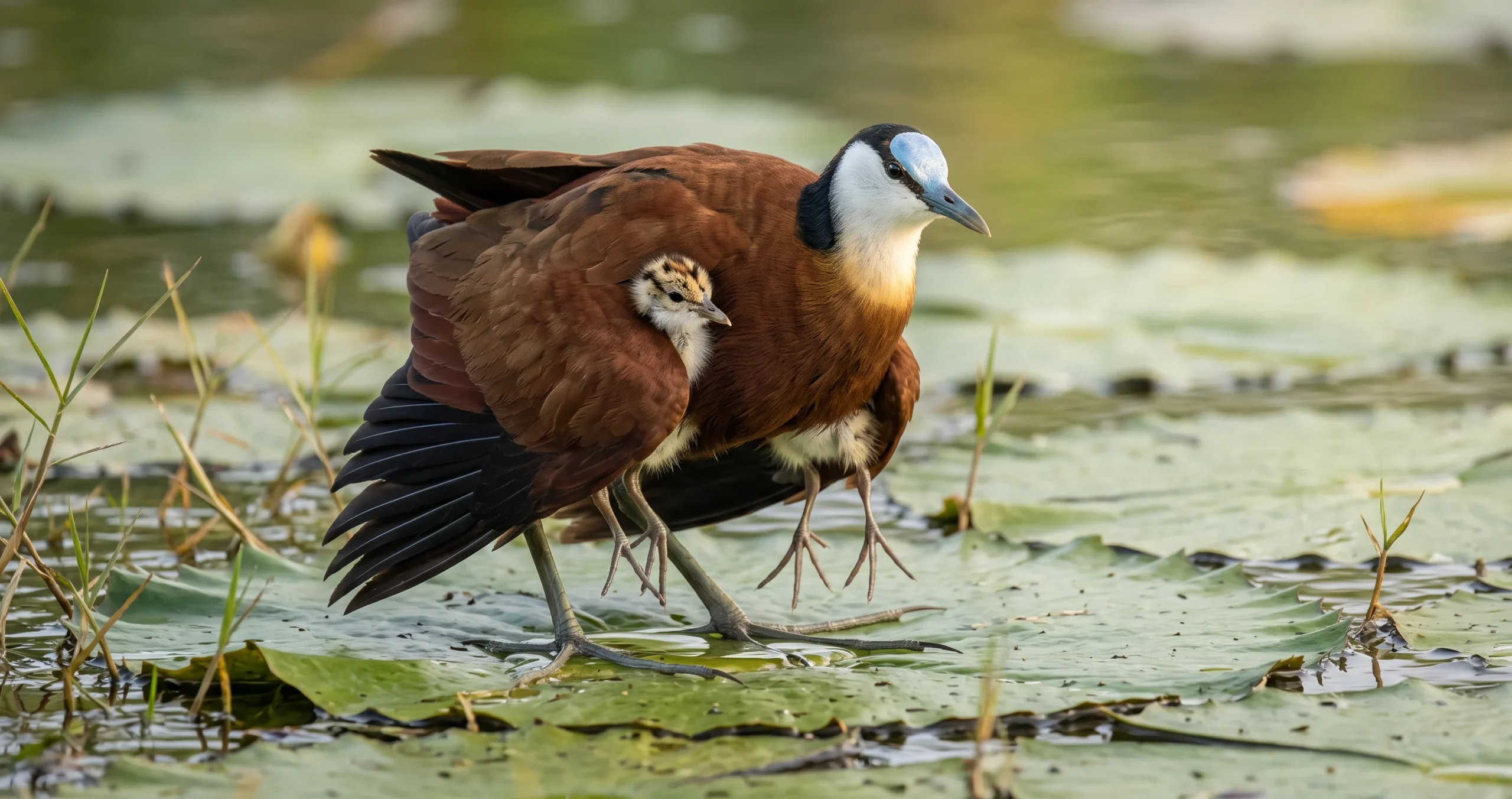
Imagine watching a bird walk across a floating carpet of lily pads. Its slender body, chestnut-brown feathers, and remarkably long toes make it an unusual sight. But suddenly, something even stranger catches your attention.
Several tiny legs appear to be dangling from beneath its body.
For a moment, the bird seems to have six or even eight legs.
The explanation is far more fascinating than an anatomical mystery. Those extra legs belong to baby birds hidden beneath their father’s wings.
The African jacana (Actophilornis africanus) is known for its remarkable parental behavior. Unlike many familiar bird species, in which females perform much of the incubation and chick care, male African jacanas take primary responsibility for raising their offspring.
One of their most extraordinary abilities is carrying chicks beneath their wings, sometimes with the youngsters’ tiny legs hanging visibly below.
This unusual behavior explains the photographs of a bird that looks like it has extra legs. More importantly, it reveals an impressive survival strategy in the wetlands of Africa.
Table of Contents
- Meet the African Jacana
- How Male Jacanas Carry Their Chicks ?
- The Remarkable Parenting Role of Male Jacanas
- Why Jacana Chicks Need Protection ?
- Other Unusual Adaptations of Jacanas
- Do Other Birds Carry Their Babies?
- Frequently Asked Questions
- Conclusion
Meet the African Jacana
The African jacana belongs to the family Jacanidae, a group of tropical waterbirds famous for their exceptionally long toes and claws.
African jacanas inhabit freshwater wetlands across much of sub-Saharan Africa. They are commonly found around shallow lakes, marshes, ponds, and slow-moving waterways where floating vegetation provides feeding and nesting opportunities.
Adult birds have striking chestnut-brown upperparts, a dark head and neck, contrasting white facial and throat markings, and a distinctive blue frontal shield above the bill.
Females are generally larger than males, an unusual characteristic associated with the species’ reproductive system.
However, the African jacana’s most recognizable physical adaptation is found at the ends of its legs.
The Bird That Appears to Walk on Water
Jacanas are sometimes called lily-trotters because they move across floating aquatic vegetation with remarkable ease.
Their extraordinarily long toes spread their weight across a relatively large surface area, allowing them to step on lily pads and other floating plants without immediately sinking through them.
This creates the illusion that they are walking directly on water.
In reality, their feet are supported by vegetation beneath them. Jacanas can also swim, but their specialized toes make floating plants particularly useful as pathways through wetland habitats.
These adaptations allow jacanas to explore areas that would be difficult for many other birds to navigate.
The floating vegetation also provides access to insects, aquatic invertebrates, and suitable nesting locations.
How Male Jacanas Carry Their Chicks
Among the African jacana’s most extraordinary behaviors is the way males protect their young.
Male jacanas can gather small chicks beneath their wings, concealing much of their bodies among the adult’s feathers.
Under certain circumstances, the male can even transport the chicks while moving away from danger.
The Chicks Hide Beneath the Wings
When young jacanas need protection or warmth, they can shelter beneath their father’s body and wings.
The adult lowers his wings around the chicks, forming a protective covering of feathers.
The chicks are small enough to fit close against his body, particularly during their earliest days after hatching.
This behavior is important because newly hatched jacanas are vulnerable despite being relatively mobile.
Their downy feathers provide some insulation, but they still benefit from the warmth and protection of a parent.
The adult’s wings help conceal their bodies from view while providing shelter from exposure.
The Strange Extra-Legs Illusion
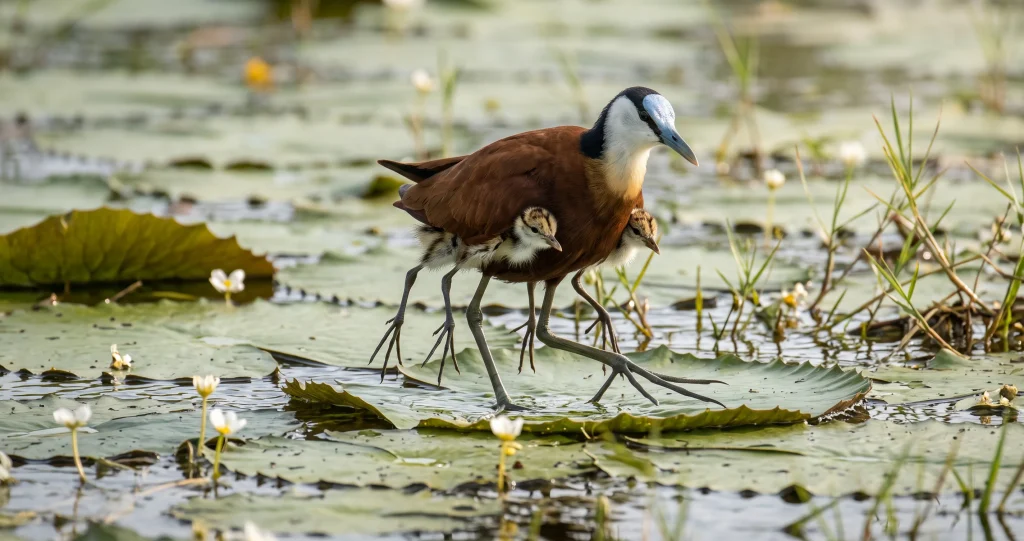
The famous extra-legs appearance occurs when chicks are carried beneath the male’s wings.
Most of each chick’s body remains hidden against the adult, but its long, slender legs may hang visibly below the feathers.
Because several chicks can be concealed simultaneously, the adult may appear to possess far more than two legs.
The effect can be especially dramatic when the bird is photographed from the side.
A viewer sees the adult’s normal legs alongside several smaller pairs, apparently emerging from the same body.
However, the additional limbs are not part of the adult’s anatomy. They belong to the chicks being transported.
This unusual appearance has made jacanas a favorite subject among wildlife photographers and bird enthusiasts.
Carrying Chicks Away From Danger
Wing-carrying is more than an unusual visual phenomenon. It can serve an important protective function.
When disturbed, a male jacana may gather chicks beneath his wings and move them away from a threatening situation.
The chicks remain tucked against his body while their legs hang below.
This allows the adult to transport young that might otherwise struggle to keep up or remain exposed.
It is important to distinguish carrying from ordinary brooding.
During brooding, the adult covers chicks primarily to provide warmth and shelter, often while remaining relatively stationary.
During transport, the adult moves with the chicks held beneath his wings.
Both behaviors involve close contact between parent and offspring, but they serve somewhat different immediate purposes.
Not every photograph showing chicks beneath an adult’s wings necessarily documents active transport.
The Remarkable Parenting Role of Male Jacanas
In many familiar bird species, females incubate eggs while males help defend territories, gather food, or protect the nest.
African jacanas follow a different reproductive arrangement.
Fathers Take Responsibility for the Young
Male African jacanas perform the essential work of incubating eggs and caring for chicks.
After a female lays eggs in a nest, the male generally assumes responsibility for incubation. Once the chicks hatch, he continues to guard, brood, and guide them.
Rather than placing food directly into their mouths, the male leads the chicks through suitable feeding areas where they can find small prey themselves.
His responsibilities also include detecting potential danger and responding to disturbances.
This parental role is especially important during the chicks’ vulnerable early development.
An Unusual Mating System
African jacanas exhibit sex-role reversal, and their breeding system can involve polyandry, in which one female mates with multiple males.
Females are generally larger than males and may defend territories containing the nesting areas of more than one mate.
Each breeding male can incubate his own clutch and subsequently care for the chicks.
This arrangement differs from the familiar image of a bird family consisting of one male and one female sharing parental responsibilities equally.
However, female jacanas are not necessarily uninvolved in reproduction or territorial defense. Their roles simply differ substantially from those of males.
Research on other jacana species, including the wattled jacana and pheasant-tailed jacana, also demonstrates strong male investment in parental care, although the details vary among species.
Chicks That Can Move Soon After Hatching
African jacana chicks are precocial.
This means they hatch in a relatively advanced state, with downy feathers, open eyes, and the ability to move around soon after emerging from their eggs.
Unlike helpless nestlings that depend on adults to deliver every meal, jacana chicks can begin exploring and finding food early in life.
Nevertheless, being mobile does not mean they are fully independent.
Their small size makes them vulnerable to predators, weather, and disturbances in their wetland habitat.
Their father’s protection remains important until they develop greater strength and independence.
Why Jacana Chicks Need Protection
Wetlands provide abundant food and shelter, but they also contain numerous hazards for young birds.
Predators in the Wetland
Young jacanas may be threatened by predatory birds and other animals that hunt in or around freshwater habitats.
Herons, for example, are among the potential threats that can prompt protective behavior in adult jacanas.
A chick moving openly across floating vegetation may be more exposed than one concealed beneath a parent’s wings.
When danger is detected, an adult may call, lead chicks toward cover, or gather them beneath his wings.
Wing-carrying offers an additional means of moving vulnerable young away from immediate danger. This behavior has been documented in African jacanas in both wildlife photography and field observations.
Camouflage and Hidden Movement
Jacana chicks have patterned down that helps them blend into their surroundings.
Their brown and pale markings can make them difficult to distinguish among floating leaves, wetland plants, and natural debris.
This camouflage is especially useful when chicks remain motionless or seek cover.
The father’s behavior complements their natural coloration. He remains alert while the young explore and can respond when circumstances become threatening.
Protection From Weather
Predators are not the only concern.
Small chicks can lose body heat more rapidly than adults, particularly during cool or wet conditions.
Brooding beneath a parent’s feathers helps reduce exposure and provides warmth.
In African jacanas, the male’s wings therefore have more than one protective function: they can cover chicks while resting and help carry them when movement becomes necessary.
These behaviors demonstrate how parental care can compensate for the vulnerability of young birds even when they are capable of walking and feeding independently.
Other Unusual Adaptations of Jacanas
Although the extra-legs illusion attracts considerable attention, African jacanas possess several other remarkable characteristics.
Extremely Long Toes
Their elongated toes are among the family’s most distinctive features.
By spreading their weight across floating vegetation, jacanas can move over surfaces that would offer insufficient support to birds with shorter toes.
This ability allows them to explore aquatic habitats efficiently and reach food hidden among leaves and stems.
Specialized Wetland Feeding
African jacanas feed primarily on small invertebrates, including insects and other creatures associated with aquatic vegetation.
They search around floating leaves, plant stems, and shallow water, picking up suitable food with their bills.
Their feeding behavior helps explain why wetlands rich in floating plants are important habitats for the species.
The vegetation provides both a physical platform and access to prey.
Differences Between Adults and Chicks
Adult African jacanas possess the distinctive coloration and facial shield associated with mature birds.
Young chicks look very different.
They are covered in patterned down that provides camouflage, and they lack the fully developed appearance of adults.
Despite their small size, their legs and toes already reflect the adaptations associated with jacana life.
As they mature, their plumage changes and their ability to move and forage improves.
Do Other Birds Carry Their Babies?
African jacanas are not the only birds that transport their young, although different species use different methods.
Jacanas Carry Chicks Beneath Their Wings
The most distinctive feature of jacana transport is the position of the chicks.
They are held beneath the adult’s wings, close to the body. Their dangling legs produce the famous appearance of extra limbs.
This behavior has also been documented in the Australian comb-crested jacana (Irediparra gallinacea), demonstrating that wing-carrying is not exclusive to African jacanas.
Grebes Carry Chicks on Their Backs
Grebes provide another fascinating example of parental transport.
In several grebe species, newly hatched chicks climb onto an adult’s back and rest among the feathers.
The parent can swim while the young remain above the water.
This arrangement differs from jacana wing-carrying because the chicks ride on the adult’s back rather than hanging beneath its wings.
Swans and Other Waterbirds
Some swans also allow small cygnets to ride on their backs.
This behavior can help young birds rest and remain close to their parents while traveling across water.
Although both jacanas and these waterbirds transport their offspring, their methods are not anatomically identical.
The jacana’s dangling chick legs create a particularly striking visual illusion that is rarely matched by other birds.
Frequently Asked Questions
1. Which bird looks like it has extra legs?
The African jacana (Actophilornis africanus) is one bird known for this unusual appearance. When a male carries chicks beneath his wings, their dangling legs can create the illusion that the adult has several extra limbs. The Australian comb-crested jacana also displays this behavior.
2. Do male jacanas really carry their chicks?
Yes. Male African jacanas have been observed carrying chicks beneath their wings, particularly when responding to potential danger. The chicks are held close to the adult’s body, sometimes with their legs hanging visibly below.
3. Why do jacana chicks hide beneath their father’s wings?
Chicks shelter beneath their father’s wings for protection and warmth. When threatened, they may also be transported this way to a safer location. The behavior helps protect young birds during a vulnerable stage of development.
4. Can jacana chicks walk and swim?
Yes. Jacana chicks are precocial and can walk soon after hatching. They can also swim, although they still depend on parental protection. Their early mobility allows them to explore floating vegetation and begin finding food.
5. Do female jacanas care for their chicks?
Male African jacanas provide most direct incubation and chick care. Females generally concentrate more on territorial activities and reproduction. The precise division of parental responsibilities varies among jacana species.
6. Where do African jacanas live?
African jacanas occur across much of sub-Saharan Africa. They inhabit freshwater wetlands, marshes, lakes, ponds, and waterways with floating aquatic vegetation. These environments provide feeding opportunities, nesting sites, and shelter for chicks.
Conclusion
The African jacana demonstrates that some of the most extraordinary wildlife behaviors are hidden in everyday acts of survival.
At first glance, a bird that looks like it has extra legs seems almost impossible. Yet the explanation is beautifully simple: a devoted father is carrying his chicks beneath his wings.
Those dangling legs belong to young birds seeking protection in a wetland filled with challenges.
The behavior is only one part of a remarkable parenting system in which males incubate eggs, guard offspring, and guide chicks through their early development.
Combined with their exceptionally long toes, specialized wetland lifestyle, and unusual breeding roles, African jacanas represent one of the bird world’s most fascinating examples of adaptation.
What appears to be an impossible bird with too many legs is actually a father keeping his family safe.
External sources:
1. BirdLife South Africa — African Jacana. Species identification, habitat, diet, and breeding biology.
2. African BirdLife — How the Male African Jacana Protects Its Chicks. Video documentation and explanation of chick-carrying behavior.
3. W. R. Tarboton — Incubation Behaviour of the African Jacana. South African Journal of Zoology, 1993. Peer-reviewed research on male incubation.
4. Division of Labour in Parental Care Behaviour of a Sex-Role-Reversed Shorebird, the Wattled Jacana. Animal Behaviour. Research on parental responsibilities in a related jacana species.
5. ABC News — Comb-Crested Jacana Carrying Chicks to Safety. Photographic evidence of similar wing-carrying behavior in an Australian jacana.