
A snake’s tail might appear to be little more than the final section of its long, flexible body. Yet in some species, this seemingly simple structure has evolved into a remarkable survival tool. From producing warning sounds to attracting unsuspecting prey, snake tail adaptations reveal just how inventive evolution can be.
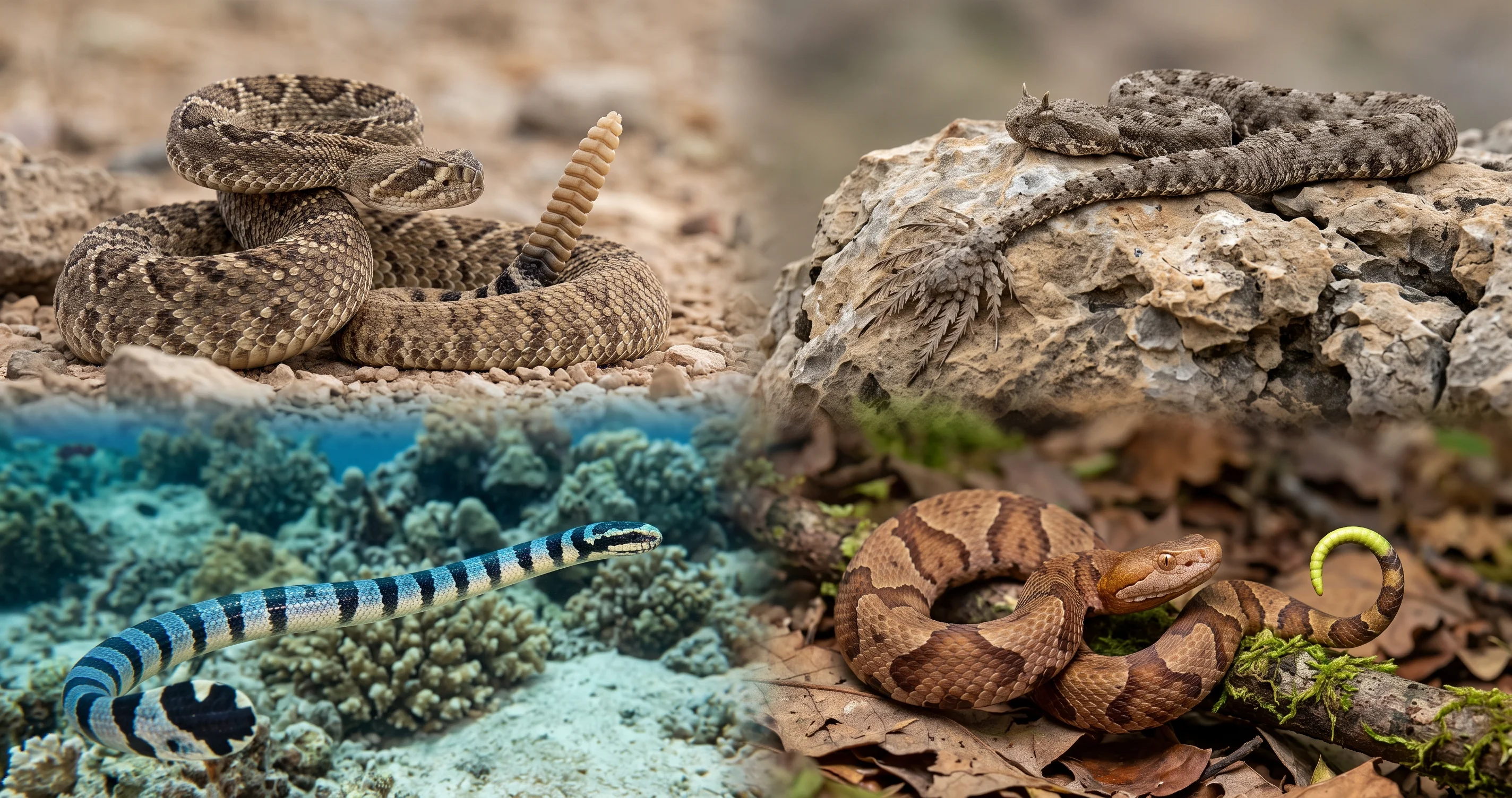
Some rattlesnakes use their tails to warn approaching animals. A rare Iranian viper moves its tail like a spider to attract birds. Sea kraits rely on flattened tails for swimming, while young copperheads display brightly colored tail tips that can help lure small prey.
These extraordinary adaptations demonstrate how natural selection can modify similar anatomical structures for very different purposes. Each example offers a fascinating glimpse into the relationship between anatomy, behavior, and survival.
Table of Contents
- Understanding Snake Tail Adaptations
- Rattlesnakes: The Tail That Produces a Warning Sound
- Spider-Tailed Horned Viper: The Tail That Mimics a Spider
- Sea Kraits: The Tail That Works Like a Swimming Paddle
- Juvenile Copperheads: The Colorful Tail That Attracts Prey
- Comparing Four Remarkable Tail Adaptations
- How Scientists Study Snake Tail Behavior
- Common Myths About Snake Tails
- Frequently Asked Questions
- Conclusion
Understanding Snake Tail Adaptations
One Body Structure, Several Evolutionary Functions
Most snakes possess a tail that begins behind the cloaca, the opening used for waste elimination and reproduction. Although the tail represents only part of the animal’s total length, its structure varies considerably among species.
In many snakes, the tail contributes to balance, movement, or defensive behavior. In others, evolution has produced specialized features that serve much more unusual purposes.
These differences reflect the ecological pressures experienced by each species over many generations.
For example, a snake that frequently swims may benefit from a flattened tail that helps push against water. A terrestrial ambush predator may instead benefit from tail movements that attract prey within striking distance.
What Is Caudal Luring?
Caudal luring is a hunting behavior in which an animal moves its tail in a way that attracts potential prey.
Among certain snakes, the tail resembles a worm, insect, or another small creature. The snake remains relatively motionless while the moving tail attracts attention.
If a prey animal approaches, the snake may strike.
Caudal luring is particularly interesting because it combines physical appearance with carefully coordinated behavior. The tail’s effectiveness depends not only on its shape or color but also on how the snake moves it.
Rattlesnakes: The Tail That Produces a Warning Sound
Scientific group: Crotalus and Sistrurus — North and South America
How the Rattlesnake’s Rattle Works
Among the most recognizable snake tail adaptations is the rattlesnake’s extraordinary warning mechanism.
At the end of its tail, a rattlesnake possesses a series of hollow, loosely connected keratin segments. Keratin is the same general type of structural protein found in human fingernails and hair.
When the snake rapidly vibrates its tail, these segments strike against one another, producing the familiar buzzing or rattling sound.
The sound does not come from loose stones or seeds inside the rattle. It results from the repeated contact between the hardened keratin segments.
Specialized Muscles Create Rapid Vibrations
Rattlesnakes possess specialized muscles that allow the tail to vibrate extremely quickly.
These muscles are adapted for rapid, repeated contractions. Their activity causes the rattle to move back and forth, generating an audible warning that can be heard by nearby animals.
The vibration rate varies with species, temperature, and the snake’s physiological condition.
This mechanism allows the snake to communicate a warning without immediately resorting to biting.
Why Rattlesnakes Warn Instead of Attacking
Venom is valuable for capturing prey, and a defensive encounter with a much larger animal can be dangerous.
Rattling may encourage a potential threat to move away before physical contact occurs.
Large mammals, including humans, can recognize the distinctive sound and avoid approaching the snake.
However, rattlesnakes do not always rattle before striking. Some remain silent, especially when attempting to avoid detection.
The Myth of Counting Rattle Segments
A young rattlesnake begins life with a small keratin button at the tail tip. Additional segments can develop as the snake sheds its skin.
Because snakes may shed several times within a year, the number of rattle segments does not correspond directly to age.
Segments can also break off through normal activity.
Consequently, counting the rings on a rattlesnake’s tail is not a reliable way to determine how old it is.
Spider-Tailed Horned Viper: The Tail That Mimics a Spider
Scientific name: Pseudocerastes urarachnoides — Iran
An Extraordinary Snake From Iran
The spider-tailed horned viper is among the most unusual examples of specialized snake anatomy.
This venomous species inhabits rocky environments in western Iran, where its patterned scales help it blend into the surrounding landscape.
Its most distinctive feature is found at the very end of its tail.
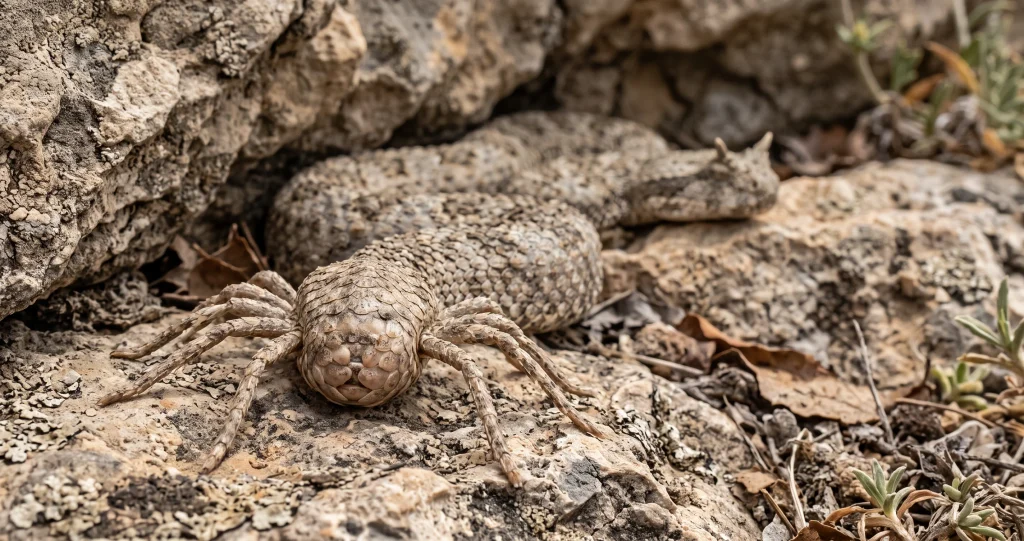
Unlike the relatively simple tapering tail of many snakes, this viper possesses a bulbous tip surrounded by elongated scale projections.
Together, these structures create an appearance remarkably similar to a spider.
A Tail That Appears to Move Like Prey
The spider-like appearance becomes particularly striking when the snake moves its tail.
By manipulating the tip against the rocky surface, the viper produces movements resembling those of a small arthropod.
Birds searching for food may approach the moving object, apparently interpreting it as potential prey.
The snake remains concealed while its tail draws attention away from its head.
This hunting strategy is an especially dramatic example of caudal luring.
Scientific Observations of Bird Hunting
Researchers have documented spider-tailed horned vipers using their unusual tails during encounters with birds.
Published observations include birds approaching the moving lure and being captured by the waiting snake.
These observations provide strong evidence that the tail functions in prey attraction.
However, scientists must distinguish the demonstrated hunting behavior from broader evolutionary explanations. Exactly how the elaborate structure developed over evolutionary time remains a subject for investigation.
Camouflage Makes the Lure More Effective
The spider-tailed horned viper’s hunting strategy depends on more than its tail.
Its body coloration resembles the surrounding rocks, helping the snake remain difficult to detect.
This concealment allows the moving tail to become the most noticeable part of the animal.
The combination of camouflage, specialized anatomy, and controlled movement creates an effective ambush-hunting system.
The spider-tailed horned viper demonstrates how snake tail adaptations can become highly specialized for a particular ecological role.
Sea Kraits: The Tail That Works Like a Swimming Paddle
Scientific genus: Laticauda — Indo-Pacific region
A Snake Adapted to Two Environments
Sea kraits are venomous marine reptiles that spend substantial time hunting in coastal waters but also return to land.
Unlike fully aquatic sea snakes, sea kraits retain important adaptations for terrestrial movement.
They may rest, digest food, shed their skin, and reproduce on land while obtaining much of their food underwater.
This amphibious lifestyle requires a body capable of functioning in two very different environments.
One of their most important aquatic adaptations is their distinctive tail.
How the Paddle-Shaped Tail Improves Swimming
Sea kraits possess laterally compressed tails that form a broad, paddle-like surface.
As the snake moves its body from side to side, waves of motion travel along its length toward the tail.
The flattened tail interacts with the surrounding water, contributing to propulsion.
Its broad surface provides an advantage over a narrow, rounded tail during aquatic movement.
This design helps sea kraits maneuver while searching for prey in reef-associated habitats.
Sea Kraits Versus Fully Marine Sea Snakes
Both sea kraits and many fully marine sea snakes possess flattened tails, but their lifestyles differ.
Sea kraits regularly return to land and lay eggs there. Fully marine sea snakes generally spend their lives in water, with many species giving birth to live young.
Sea kraits also retain ventral scales that assist movement on land.
These differences illustrate how closely related ecological challenges can produce similar swimming adaptations while other anatomical features remain distinct.
Why Efficient Swimming Matters
Many sea kraits hunt fish, particularly eels, among reefs and rocky crevices.
Underwater hunting requires maneuverability, controlled movement, and the ability to return to the surface to breathe.
Their flattened tails contribute to locomotion in this demanding environment.
The sea krait paddle tail is therefore an example of an anatomical adaptation associated with the transition between terrestrial and aquatic habitats.
Juvenile Copperheads: The Colorful Tail That Attracts Prey
Scientific name: Agkistrodon contortrix — Eastern and central United States
A Bright Tail on a Camouflaged Snake
Adult copperheads are recognized for their copper-colored heads and distinctive hourglass-shaped body markings.
Young copperheads often possess another noticeable feature: a bright yellow or yellow-green tail tip.
This coloration contrasts with the brown and tan patterns covering the rest of the body.
The contrast is particularly striking when the snake remains motionless among leaves or forest debris.
How Juvenile Copperheads Use Their Tails
Juvenile copperheads may move their brightly colored tail tips in a wriggling motion.
The movement can resemble a small worm or caterpillar, potentially attracting animals that feed on such prey.
Small frogs and lizards are among the prey associated with juvenile copperhead diets.
The snake may remain concealed while the moving tail attracts attention nearby.
This behavior is another example of caudal luring, although its effectiveness can depend on the prey species and environmental conditions.
Why the Bright Color Fades With Age
As copperheads mature, the vivid coloration of the tail tip generally becomes less conspicuous.
In many adults, the tail blends more closely with the surrounding body coloration.
This change occurs alongside broader developmental changes in body size, hunting behavior, and diet.
Researchers have proposed that conspicuous juvenile tail coloration is especially useful when young snakes target relatively small prey.
However, the relationship between color change, prey preferences, and hunting success should not be treated as identical in every individual or population.
A Specialized Strategy During Early Life
Young snakes face different challenges from adults.
Their smaller body size limits the prey they can capture, and their hunting strategies may differ accordingly.
A conspicuous moving tail could help bring appropriately sized prey closer without requiring the snake to pursue it.
The juvenile copperhead yellow tail demonstrates how an adaptation can be especially prominent during one stage of an animal’s life.
Comparing Four Remarkable Snake Tail Adaptations
Although all four adaptations involve the tail, their biological functions differ considerably.
| Snake | Specialized tail structure | Primary function | Ecological advantage |
|---|---|---|---|
| Rattlesnake | Interlocking keratin rattle | Defensive warning | May discourage approaching threats |
| Spider-tailed horned viper | Spider-like bulbous tip and scales | Prey attraction | Helps lure birds toward an ambush |
| Sea krait | Flattened paddle-shaped tail | Swimming propulsion | Improves aquatic locomotion |
| Juvenile copperhead | Brightly colored tail tip | Prey attraction | May attract small prey within striking range |
These examples highlight three major evolutionary functions: defense, locomotion, and hunting.
The rattlesnake produces a sound that may prevent conflict. The spider-tailed viper and juvenile copperhead use visual movement to attract prey, while sea kraits rely on tail shape to improve movement through water.
Rather than representing a single evolutionary solution, these features demonstrate how similar body structures can become adapted to different environmental challenges.
How Scientists Study Snake Tail Behavior
Field Observations and Wildlife Photography
Understanding unusual snake behavior requires careful observation in natural environments.
Researchers may document how snakes position their bodies, move their tails, and respond to nearby animals. Video recordings are particularly valuable because rapid movements can be reviewed repeatedly.
For species such as the spider-tailed horned viper, recorded hunting encounters help establish whether prey actually responds to the moving tail.
However, a single successful encounter does not reveal how frequently a behavior succeeds across an entire population.
Controlled Experiments and Comparative Anatomy
Scientists can also investigate how tail coloration, shape, and movement influence animal responses.
Controlled experiments may compare reactions to different visual stimuli, while anatomical studies reveal structural differences among related species.
High-speed video and movement analysis can help researchers examine the mechanics of rattling or swimming.
Together, these approaches allow scientists to connect physical adaptations with behavior while recognizing the limitations of individual observations.
Common Myths About Snake Tails
Myth: Every Rattlesnake Rattles Before Striking
Rattlesnakes can strike without producing an audible warning.
Rattling is one defensive behavior, not a mandatory step before a bite. Depending on the situation, a snake may remain still, attempt to escape, or respond defensively.
For this reason, people should never rely on hearing a rattle to determine whether a nearby snake presents a danger.
Myth: A Rattlesnake’s Age Equals Its Number of Rattle Segments
Rattle segments accumulate through shedding rather than annual growth.
Because shedding frequency varies and segments can break off, the number of visible sections cannot provide an accurate age.
Myth: Every Snake With a Bright Tail Is Venomous
Bright tail coloration is not exclusive to venomous snakes.
Coloration varies among species and can serve different functions. Identifying a snake’s potential danger requires reliable species identification rather than relying on one feature.
Myth: Sea Kraits Cannot Move on Land
Sea kraits are adapted for both aquatic and terrestrial environments.
Their flattened tails assist swimming, but their bodies retain features that allow them to move across rocks, beaches, and other coastal surfaces.
Frequently Asked Questions
What Is the Main Purpose of a Rattlesnake’s Rattle?
The rattle primarily functions as a defensive warning signal. Its sound may discourage large animals from approaching, reducing the likelihood of a dangerous encounter.
Does the Spider-Tailed Horned Viper Really Catch Birds With Its Tail?
The snake does not physically capture birds using its tail. Instead, documented hunting behavior shows it moving its spider-like tail lure to attract birds within striking distance, where it captures them using its mouth and venomous bite.
Are Sea Kraits Dangerous to Humans?
Sea kraits are venomous and should be treated with caution. Although they generally do not seek confrontation with humans, bites can be medically serious.
They should never be handled or deliberately disturbed.
Why Do Baby Copperheads Have Yellow Tails?
The conspicuous tail coloration is associated with caudal luring, a behavior in which the snake moves its tail to attract potential prey.
The bright color generally fades as the snake matures.
Do All Snakes Use Their Tails to Hunt?
No. Although several species exhibit caudal luring, many snakes use their tails primarily for movement, balance, or other functions.
Some species also employ tail vibrations defensively without possessing a specialized rattle.
Can Snake Tails Grow Back After Being Lost?
Unlike certain lizards, snakes generally cannot regenerate a complete tail after losing it.
A serious tail injury may heal, but the missing structure does not normally regrow into a functional replacement.
Conclusion
The extraordinary diversity of snake tail adaptations demonstrates how evolution can transform one basic anatomical structure into remarkably different biological tools.
Rattlesnakes use specialized keratin segments to produce defensive warnings. Spider-tailed horned vipers employ elaborate tail movements to attract birds, while sea kraits possess flattened tails that assist swimming.
Juvenile copperheads reveal another evolutionary strategy, using conspicuous tail coloration and movement associated with attracting small prey.
Together, these examples illustrate the close relationship between anatomy, environment, and animal behavior.
They also remind us that even the smallest anatomical features can reveal fascinating stories about how wildlife survives.
Understanding these adaptations encourages a deeper appreciation of snakes, not simply as predators, but as highly specialized animals shaped by millions of years of evolutionary change.