
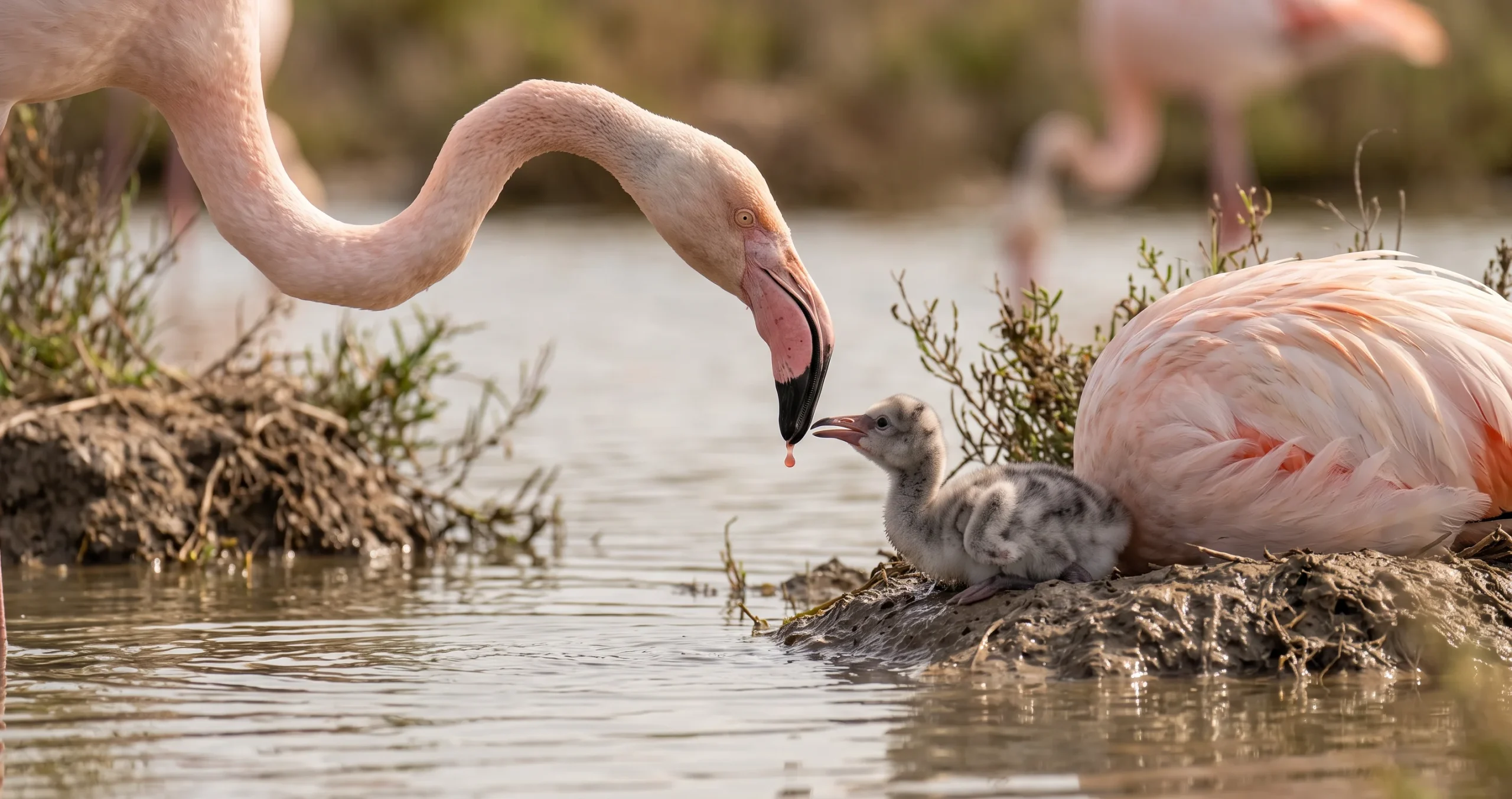
Flamingos are famous for their elegant necks, long legs, and brilliant pink feathers. Yet one of their most extraordinary biological adaptations has nothing to do with their appearance. It involves the unusual way they nourish their young.
Both male and female flamingos produce a specialized, nutrient-rich secretion called flamingo crop milk. This reddish substance provides essential nourishment to chicks during their earliest stages of development.
Unlike mammalian milk, it is not produced by mammary glands. Instead, it originates from specialized tissues in the upper digestive tract and is delivered directly to hungry chicks through regurgitation.
This remarkable adaptation reveals a fascinating connection between bird anatomy, parental cooperation, nutrition, and evolution.
Table of Contents
- Both Flamingo Parents Produce Crop Milk
- The Biological Origin of Flamingo Crop Milk
- The Surprising Red Color of Flamingo Crop Milk
- How Gray Flamingo Chicks Develop Into Pink Adults
- The Importance of Crop Milk for Flamingo Survival
- Flamingo Crop Milk Compared With Mammalian Milk
- Flamingos and Pigeons: An Unusual Feeding Similarity
- The Connection Between Diet and Pink Feathers
- Common Myths About Flamingo Parenting
- Frequently Asked Questions
- Conclusion
Both Flamingo Parents Produce Crop Milk
An Unusual Form of Parental Care
Among birds, feeding offspring is common, but producing a specialized milk-like secretion is relatively rare.
Many species deliver insects, fish, seeds, or partially digested food to their young. Flamingos follow a different strategy during early chick development.
Both parents can produce crop milk, a concentrated nutritional substance that supports chicks before they become capable of obtaining enough food independently.
This shared responsibility is especially important because flamingo chicks cannot immediately use the specialized filter-feeding technique of adults.
Fathers Participate in Milk Production
One of the most remarkable aspects of flamingo reproduction is that fathers participate directly in producing crop milk.
Male flamingos possess the physiological ability to generate this secretion, just as females do.
This is different from mammalian lactation, where milk production is primarily associated with specialized mammary glands in females.
Flamingo parents deliver the secretion through their bills, allowing chicks to receive nourishment without needing to capture or filter food.
Parental Cooperation in Breeding Colonies
Flamingos typically breed in large colonies, often nesting close to many other pairs.
Both parents contribute to incubation and chick care. After hatching, they coordinate feeding and protection as their offspring develop.
This cooperation helps distribute the demands of reproduction between the two adults.
Although individual feeding patterns vary, the ability of both parents to produce crop milk is an important component of flamingo reproductive biology.
The Biological Origin of Flamingo Crop Milk
Specialized Cells in the Digestive Tract
Flamingo crop milk is not true milk in the mammalian anatomical sense.
It is a specialized secretion associated with the lining of the upper digestive tract, including the esophageal region.
Changes in epithelial tissues allow nutrient-rich material to become available for feeding chicks.
The secretion is subsequently delivered through regurgitation.
This process differs from simply bringing up an ordinary meal because the nourishing material includes substances produced by the parent’s own tissues.
Proteins and Fats Support Chick Growth
Growing flamingo chicks require considerable energy and nutrients to develop their muscles, organs, feathers, and skeletal structures.
Crop milk provides concentrated nourishment, particularly proteins and lipids.
Proteins supply amino acids needed for tissue development, while fats provide an energy-rich nutritional resource.
The composition of the secretion can vary, and its biological properties should not be assumed to be identical across all flamingo species or developmental stages.
The Hormonal Role of Prolactin
Prolactin is a hormone involved in reproductive and parental processes in many birds.
In pigeons, its role in stimulating crop milk production has been extensively studied.
Flamingo crop milk production is also associated with reproductive hormonal changes, with prolactin considered an important part of its regulation.
However, the detailed cellular mechanisms in flamingos are not as thoroughly characterized as those in domestic pigeons.
Understanding this distinction prevents conclusions from one bird species from being automatically applied to another.
A Specialized Evolutionary Adaptation
The ability to nourish chicks with a secretion produced by digestive tissues demonstrates how different animal groups can evolve solutions to similar developmental challenges.
Mammals use mammary glands, while flamingos rely on specialized digestive-tract tissues.
The underlying anatomy differs, but both systems provide nutritional support to dependent young.
This similarity in function illustrates an important principle of evolutionary biology: different structures can evolve to perform comparable tasks.
The Surprising Red Color of Flamingo Crop Milk
The Origin of Its Reddish Appearance
One of the most striking characteristics of flamingo crop milk is its reddish or pinkish coloration.
The secretion contains nutrients and biological components that contribute to its appearance.
Carotenoid pigments, which flamingos obtain through their diet, are associated with the species’ distinctive coloration and may contribute to the color of the secretion.
However, the visible color should not be attributed exclusively to carotenoids.
Flamingo crop milk has also been described as containing blood cells, making its composition more complex than a simple mixture of fat, protein, and pigment.
The Misleading Blood-Feeding Myth
Photographs of flamingos feeding chicks sometimes create the impression that adults are deliberately bleeding into their offspring’s mouths.
This interpretation is misleading.
The reddish substance involved in normal chick feeding is a naturally produced nutritional secretion, not the result of parents intentionally injuring themselves.
Although blood cells may occur within crop milk, this does not mean flamingos feed their chicks by opening wounds or sacrificing blood through injury.
Understanding the difference is essential for accurately interpreting this unusual behavior.
Carotenoids and Biological Pigmentation
Carotenoids are naturally occurring pigments found in many organisms.
Flamingos acquire these compounds through their food, either directly from pigment-containing organisms or indirectly through aquatic food chains.
These pigments are processed and deposited in tissues, contributing to pink, orange, and reddish coloration.
Their relationship with flamingo crop milk is interesting, but adult feather color and the composition of parental feeding secretions are separate biological processes.
A pink adult does not necessarily produce crop milk of a particular shade.
How Gray Flamingo Chicks Develop Into Pink Adults
Flamingos Are Not Born Pink
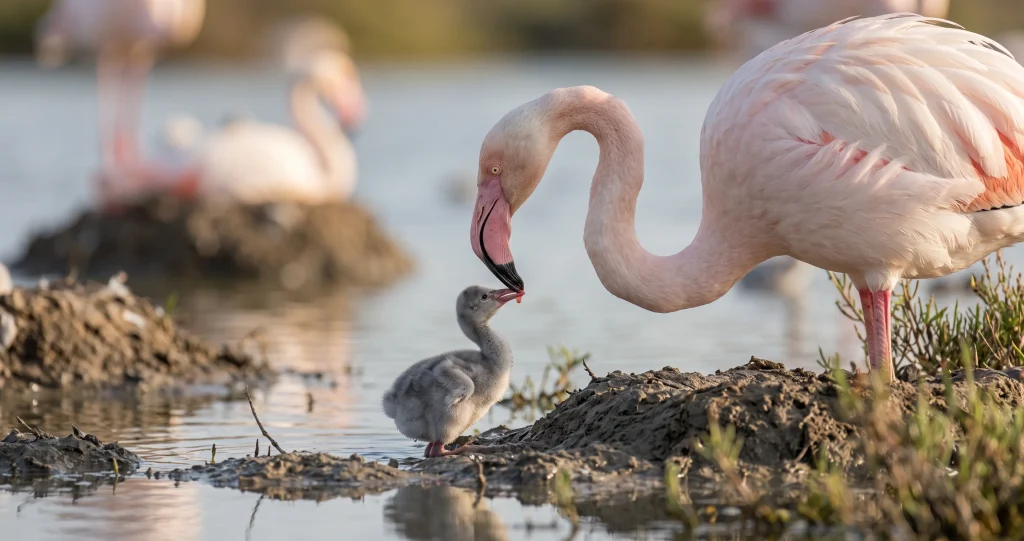
Despite the brilliant colors of mature flamingos, newly hatched chicks generally have pale gray or whitish down.
Their appearance is quite different from that of adults.
Young flamingos also have relatively straight bills, rather than the strongly downward-curved structures associated with adult filter feeding.
As they develop, their bills gradually acquire the characteristic shape needed to collect food from water and sediment.
The Transition Toward Independent Feeding
During early life, chicks depend heavily on crop milk supplied by their parents.
As they grow, their feeding anatomy and behavior develop, gradually allowing them to exploit natural food resources.
The transition is not instantaneous.
Young flamingos may continue receiving parental nourishment while beginning to practice feeding behaviors.
The duration of this period varies among species and environmental conditions, so a single feeding timeline should not be applied to every flamingo population.
The Slow Development of Pink Plumage
The familiar pink coloration of adult flamingos develops gradually.
Juvenile birds typically retain grayish or brownish plumage before acquiring more extensive pink tones.
Dietary carotenoids contribute to feather coloration as birds mature and replace their plumage.
The exact intensity of pink depends on several factors, including diet, species, age, and physiological condition.
This is why flamingos are not uniformly bright pink throughout their lives.
The Importance of Crop Milk for Flamingo Survival
Meeting the Needs of Growing Chicks
Flamingo chicks face a difficult nutritional challenge.
Their developing bills are not immediately suited to the efficient filter feeding practiced by adults.
Crop milk helps bridge this developmental gap by providing concentrated nourishment directly from the parents.
The secretion supplies important nutrients during a period of rapid growth and physiological change.
Without appropriate parental feeding, young chicks would struggle to meet their nutritional requirements.
Life in Large Flamingo Colonies
Flamingos often nest in extensive colonies near shallow saline or alkaline wetlands.
Adults construct nesting mounds from mud or other available material, creating elevated places for eggs and newly hatched chicks.
These breeding environments can contain many neighboring nests.
Such colonies offer opportunities for synchronized breeding, but they also create challenges involving space, environmental conditions, and locating offspring.
Recognizing Chicks Among Thousands
As chicks become more mobile, they may gather in large groups commonly called crèches.
These gatherings can contain numerous young flamingos, sometimes making it difficult for an observer to distinguish individual chicks.
Parents nevertheless locate and recognize their own offspring, with vocal recognition playing an important role.
Adults and chicks use characteristic calls that help maintain contact within the colony.
A crèche is not a communal feeding system in which every adult automatically feeds any chick. Parental feeding generally remains directed toward an adult’s own offspring.
Environmental Conditions and Breeding Success
Successful flamingo reproduction depends on suitable nesting and feeding habitats.
Changes in water levels, food availability, salinity, and human disturbance can influence breeding conditions.
Extreme environmental changes may affect nest stability or the availability of suitable feeding areas for adults.
Because chicks depend on parental nourishment, disruptions to adult feeding opportunities can have consequences for developing offspring.
Protecting wetland habitats is therefore important for maintaining healthy flamingo populations.
Flamingo Crop Milk Compared With Mammalian Milk
Flamingo crop milk and mammalian milk share a broad nutritional purpose, but their biological origins differ.
Mammalian milk is produced by mammary glands and delivered through specialized structures associated with lactation.
Flamingo crop milk originates from specialized digestive-tract tissues and is delivered through regurgitation.
Both contain nutrients that support early development, but their cellular composition and physiological production mechanisms are not identical.
The term crop milk describes a functional resemblance rather than an exact anatomical equivalent.
Flamingos and Pigeons: An Unusual Feeding Similarity
Flamingos are not the only birds capable of producing a milk-like secretion.
Pigeons and doves also produce crop milk, which is derived from specialized cells lining the crop.
In pigeons, prolactin stimulates changes in the crop epithelium, allowing nutrient-rich cells to accumulate and become available to chicks.
Flamingos produce a comparable nutritional secretion, although the anatomical details and composition differ.
Some penguin species, notably emperor penguins, can also produce a specialized esophageal secretion under particular breeding circumstances.
These examples show that milk-like parental feeding has evolved in more than one bird lineage.
The Connection Between Diet and Pink Feathers
Flamingos obtain their characteristic coloration from carotenoid pigments in their food.
Depending on the species and habitat, their diets can include algae, small crustaceans, aquatic invertebrates, and other organisms.
Carotenoid compounds are processed and incorporated into growing feathers and other tissues.
This explains why diet influences the intensity of flamingo coloration.
However, pink feathers are not produced simply by drinking crop milk as a chick. Adult coloration develops through dietary pigment acquisition and subsequent feather growth.
The relationship between food, physiology, and plumage is a separate but equally fascinating aspect of flamingo biology.
Common Myths About Flamingo Parenting
Myth: Flamingos deliberately feed their chicks blood.
Normal flamingo feeding involves a specialized nutritional secretion. Its reddish appearance does not indicate intentional injury.
Myth: Only female flamingos produce crop milk.
Both male and female flamingos can produce the secretion and participate in feeding their young.
Myth: Flamingos are born bright pink.
Chicks generally hatch with pale down and develop adult coloration gradually.
Myth: Crop milk is identical to mammalian milk.
The substances have comparable nutritional functions but arise from different anatomical tissues.
Myth: All birds produce crop milk.
Only certain bird groups possess specialized milk-like feeding adaptations.
Frequently Asked Questions
What is flamingo crop milk made of?
Flamingo crop milk is a nutrient-rich secretion containing proteins, fats, and other biological components. It may also contain carotenoid pigments and blood cells, contributing to its distinctive appearance.
Do male flamingos produce crop milk?
Yes. Both male and female flamingos can produce crop milk and feed their chicks, making parental nourishment a shared responsibility.
Is flamingo crop milk actually blood?
No. It is a specialized nutritional secretion produced by the upper digestive tract. Although blood cells may be present, normal crop milk feeding does not require parents to injure themselves.
Why are baby flamingos gray instead of pink?
Flamingo chicks hatch with pale down and have not yet developed the adult plumage that incorporates substantial dietary carotenoid pigments. Their coloration changes gradually as they mature.
How long do flamingo chicks drink crop milk?
The duration varies among flamingo species and individual breeding circumstances. Chicks gradually transition toward independent feeding as their bills and feeding abilities develop.
Do pigeons produce the same kind of milk?
Pigeons produce a similar nutrient-rich secretion from their crop lining. However, pigeon crop milk and flamingo crop milk differ in their anatomical production processes and composition.
Can flamingos raise chicks without crop milk?
Crop milk is an important component of normal early chick nourishment. Its role is especially significant before young flamingos can efficiently obtain food through their developing filter-feeding structures.
Conclusion
Flamingo crop milk is one of the most unusual examples of parental nourishment in the bird world.
The ability of both parents to produce a reddish, nutrient-rich secretion demonstrates how specialized anatomy and reproductive physiology can work together to support developing offspring.
From the transformation of gray chicks into pink adults to the coordination of feeding within enormous breeding colonies, flamingo parenting involves far more biological complexity than their elegant appearance suggests.
Understanding these adaptations provides a deeper appreciation of flamingos and the remarkable diversity of reproductive strategies found throughout nature.
External Sources :
1. Smithsonian’s National Zoo — Practical Tips for Anyone Currently Raising Nine Flamingo Chicks at the Same Time. Explains crop milk production, its red coloration, parental feeding, and chick recognition. Smithsonian National Zoo — Flamingo Chick Feeding
2. San Diego Zoo — Flamingo. Covers chick appearance, crop milk, parental care, and crèche behavior: San Diego Zoo — Flamingo Biology
3. Peer-reviewed research — Metabolic Fractionation, Storage and Display of Carotenoid Pigments by Flamingoes. Examines the relationship between dietary carotenoids and flamingo pigmentation: Scientific Research — Flamingo Carotenoid Pigmentation.