
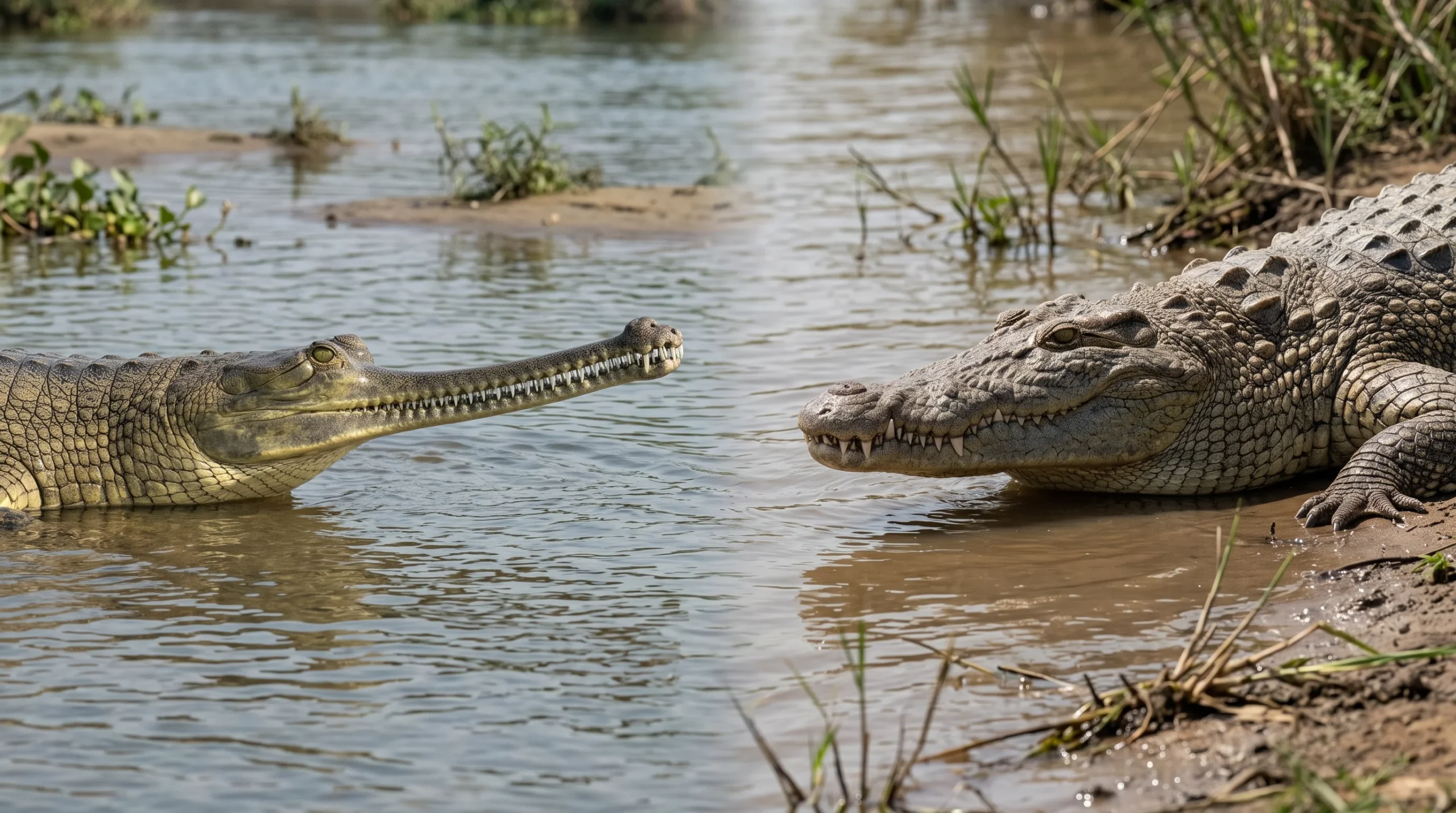
The gharial (Gavialis gangeticus) is one of the most unusual living crocodilians. Its extraordinarily long, narrow snout, lined with sharp, interlocking teeth, looks almost impossible beside the broad jaws of familiar crocodiles. Yet this remarkable feature is precisely what makes the gharial such an effective fish hunter.
Native to the great rivers of the northern Indian subcontinent, the gharial has evolved a highly specialized way of life. Its streamlined body, powerful tail, and slender jaws allow it to pursue aquatic prey while spending most of its time in water.
Unlike many crocodiles, the gharial is not built to overpower large land animals. Its anatomy reflects a different evolutionary strategy, one shaped by river currents, slippery fish, and the demands of aquatic hunting.
Today, this extraordinary reptile is also among the world’s most threatened crocodilians, making its survival closely connected to the future of the rivers it inhabits.
Table of Contents
- The Gharial Is One of the World’s Most Unusual Crocodilians
- The Gharial’s Extraordinary Snout Is Built for Catching Fish
- The Gharial’s Teeth Form a Specialized Fish Trap
- Gharials Are Highly Adapted to Life in Water
- The Ghara Makes Adult Male Gharials Distinctive
- Gharials Reproduce Along Sandy Riverbanks
- The Gharial’s Evolution Reveals an Ancient Reptile Lineage
- Gharials Are Critically Endangered
- Gharials Play an Important Role in River Ecosystems
- Frequently Asked Questions About Gharials
- Gharial vs Crocodile: Two Different Hunting Adaptations
- Conclusion
The Gharial Is One of the World’s Most Unusual Crocodilians
The gharial belongs to the order Crocodylia, which also includes true crocodiles, alligators, caimans, and the false gharial. Its scientific name is Gavialis gangeticus, and it is a member of the family Gavialidae.
Although its body resembles that of other crocodilians, its head immediately distinguishes it. The snout is exceptionally long and narrow, particularly in mature animals.
Adult males can reach lengths of around 5 meters or more, although exceptionally large individuals are uncommon today. Females are generally smaller, and both sexes have heavily armored skin and powerful tails.
Gharials are strongly associated with large freshwater rivers. Unlike crocodilians that regularly move across land, mature gharials are comparatively awkward on solid ground because of their body proportions and limb mechanics.
Their unusual appearance is not an evolutionary accident. Nearly every major feature of their anatomy reflects their specialized aquatic lifestyle.
The Gharial’s Extraordinary Snout Is Built for Catching Fish
The gharial’s most striking adaptation is its extremely elongated snout.
In many crocodiles, the jaws are relatively broad and robust, allowing them to handle a variety of prey. The gharial’s jaws, by contrast, are narrow and streamlined.
A Narrow Snout Reduces Resistance in Water
Water creates resistance whenever an animal moves through it. A wide object moving sideways generally encounters greater resistance than a narrow object under similar conditions.
The gharial’s slender snout helps reduce this resistance during rapid lateral movements.
This is especially useful when targeting fish, which can change direction quickly and escape through small openings in the water.
The narrow snout allows the gharial to strike toward prey without pushing as much water aside as a broader jaw would.
However, the same structure is less resistant to the bending and twisting forces associated with restraining large, struggling animals.
Specialized Anatomy Creates Hunting Advantages
The gharial’s skull illustrates an important principle of evolution: specialization can improve performance in one activity while limiting versatility in another.
Its narrow jaws are particularly suited to capturing aquatic prey, but they are not designed for the same feeding demands as the heavy skulls of large, broad-snouted crocodiles.
This does not make the gharial an inferior predator.
Instead, it demonstrates how natural selection can produce highly effective anatomical solutions for particular environments and prey types.
The Gharial’s Teeth Form a Specialized Fish Trap
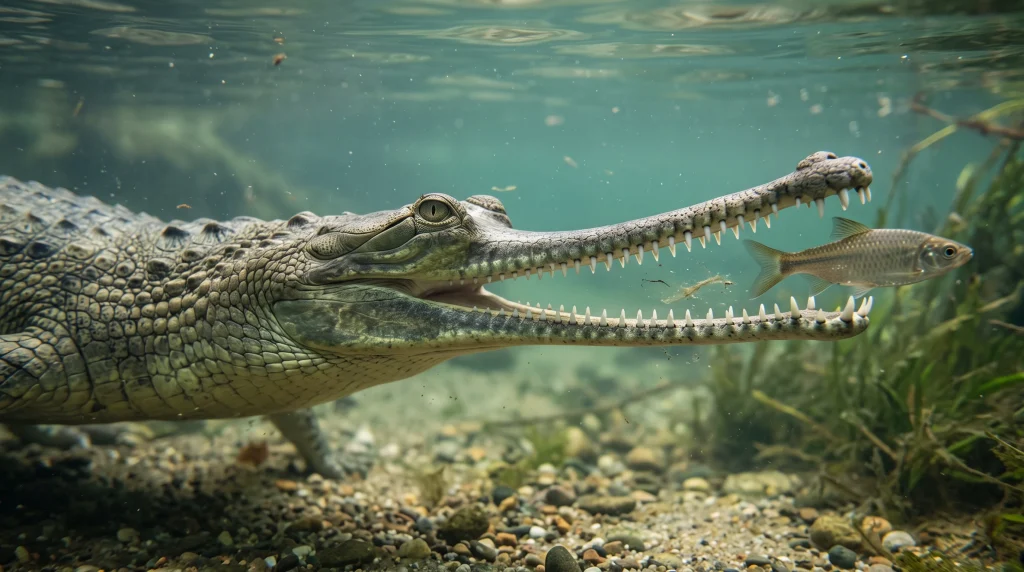
The gharial’s jaws contain numerous long, slender, sharply pointed teeth.
These teeth interlock when the mouth closes, creating an effective gripping structure for slippery prey.
Interlocking Teeth Secure Moving Fish
Fish have smooth, flexible bodies that can be difficult to restrain.
The gharial’s pointed teeth help prevent captured fish from escaping once the jaws close.
Unlike mammals with specialized chewing teeth, crocodilians generally seize prey and swallow manageable pieces rather than chewing food into small fragments.
The gharial’s teeth are therefore designed primarily for gripping and holding rather than grinding.
Young and Adult Gharials Have Different Diets
Young gharials consume small aquatic animals, including insects, crustaceans, and other invertebrates.
As they grow, fish become increasingly important in their diet.
Adult gharials are predominantly fish-eating predators.
Their feeding specialization is closely connected to the rivers they inhabit, where fish populations provide their principal source of food.
Gharials Are Highly Adapted to Life in Water
Gharials spend most of their time in freshwater habitats, especially large rivers with deep channels and suitable basking areas.
Their elongated bodies and muscular tails support efficient movement through water.
Powerful Tails Provide Propulsion
Like other crocodilians, gharials use lateral movements of their tails to swim.
The tail generates propulsion while the limbs assist with positioning and maneuvering.
Their eyes and nostrils are positioned high on the head, allowing them to remain mostly submerged while observing their surroundings and breathing.
These adaptations help gharials navigate river environments while minimizing unnecessary exposure.
Movement on Land Is More Limited
Mature gharials are less capable of the elevated walking movements associated with some other crocodilians.
Their relatively weakly developed limb support for terrestrial movement makes them particularly dependent on aquatic habitats.
They still leave the water to bask and nest, but their body structure is best suited to swimming.
This dependence on rivers makes habitat changes especially significant for their survival.
The Ghara Makes Adult Male Gharials Distinctive
One of the most unusual features of the gharial appears only in mature males.
Adult males develop a bulbous structure near the tip of the snout, known as the ghara.
The name comes from its resemblance to a traditional Indian earthenware pot.
The Ghara Is Associated With Communication
The ghara surrounds the nostril region and is associated with distinctive sounds and visual displays.
During reproductive activity, males may produce buzzing or other vocal signals.
The structure is believed to play a role in communication and sexual signaling.
Females do not develop the same prominent nasal growth.
This difference between males and females is an example of sexual dimorphism, where individuals of the same species develop different physical characteristics according to sex.
Gharials Reproduce Along Sandy Riverbanks
Although gharials spend most of their lives in water, reproduction requires suitable land habitats.
Females lay their eggs in nests excavated in sandy riverbanks.
Sandy Banks Provide Nesting Habitat
Female gharials select suitable exposed banks and dig nesting cavities in the sand.
The eggs develop underground, where temperature and moisture conditions influence incubation.
After hatching, the young must reach the water and begin surviving in a river environment filled with potential predators.
Gharials display parental behavior, including guarding nesting areas and remaining associated with young. However, their narrow jaws limit their ability to transport hatchlings in the same way documented for some broader-snouted crocodilians.
River Changes Can Disrupt Reproduction
The availability of suitable nesting banks depends on natural river processes.
Seasonal changes in water levels, sediment deposition, and river flow help shape these habitats.
Dams, sand extraction, and altered water management can reduce nesting opportunities.
For a species that depends on particular river conditions, even localized habitat changes can affect reproductive success.
The Gharial’s Evolution Reveals an Ancient Reptile Lineage
Gharials belong to a crocodilian evolutionary lineage with deep roots in prehistoric ecosystems.
Ancient crocodilian relatives occupied a remarkable variety of habitats and developed different skull shapes and feeding strategies.
Some possessed broad jaws suited to large prey, while others evolved elongated snouts associated with aquatic hunting.
The Gharial Is Not a Primitive Crocodile
The gharial’s unusual appearance sometimes creates the impression that it is a primitive survivor unchanged from prehistoric times.
This interpretation is misleading.
Modern gharials are living species shaped by evolutionary processes, just like modern crocodiles and alligators.
Their specialized snouts represent adaptations rather than evidence of evolutionary inferiority.
The False Gharial Is a Close Relative
The false gharial (Tomistoma schlegelii) is another long-snouted crocodilian, found in Southeast Asia.
Although it was historically classified separately based on anatomical characteristics, molecular research supports a close relationship between the false gharial and the true gharial.
This discovery demonstrates how genetic evidence can clarify relationships that are difficult to determine from appearance alone.
Gharials Are Critically Endangered
Despite their remarkable adaptations, gharials face serious conservation challenges.
The species is classified as Critically Endangered on the IUCN Red List.
Its remaining wild populations are concentrated primarily in India and Nepal.
River Modification Threatens Gharial Habitat
Dams, water extraction, sand mining, and other river modifications can alter the environments gharials need.
Changes in water depth and flow may affect fish availability, movement between habitats, and access to nesting banks.
Fragmentation can also isolate populations and reduce opportunities for natural dispersal.
Fishing Activities Create Additional Risks
Gharials may become entangled in fishing nets, leading to injuries or drowning.
Because their jaws are narrow and contain numerous teeth, entanglement can be particularly dangerous.
Fishing pressure may also influence the availability of aquatic prey in some habitats.
Protecting gharials therefore requires cooperation between conservation organizations, local communities, and river-management authorities.
Conservation Programs Support Recovery
Conservation initiatives include habitat protection, population monitoring, nesting-site management, and carefully planned breeding or release programs.
However, releasing young animals alone cannot guarantee long-term recovery.
Gharials need connected, functioning river systems with suitable prey and nesting habitats.
The survival of this species ultimately depends on maintaining the ecological conditions that support its entire life cycle.
Gharials Play an Important Role in River Ecosystems
As specialized fish predators, gharials form part of the complex food webs of South Asian rivers.
Their feeding behavior connects them directly to fish populations and the broader aquatic community.
They also interact with other animals through competition, scavenging, and shared habitat use.
The disappearance of a large native predator can alter ecological relationships, although the precise consequences depend on the characteristics of each river ecosystem.
Protecting gharials can benefit other wildlife by encouraging the conservation of river channels, sandbanks, and surrounding habitats.
Their presence also highlights the ecological importance of large freshwater systems, which support fish, turtles, birds, mammals, and countless smaller organisms.
Frequently Asked Questions About Gharials
Why does the gharial have such a long snout?
The gharial’s long, narrow snout is specialized for catching fish. Its streamlined shape reduces resistance during sideways movements through water, while sharp interlocking teeth help grip slippery prey. This adaptation makes the gharial highly effective at aquatic hunting, although its jaws are less suited to restraining large, strongly struggling animals.
Do gharials eat humans?
Gharials are not generally considered predators of humans. Their feeding anatomy is specialized for fish rather than large mammals. However, they remain large wild reptiles with sharp teeth and should never be approached or handled. Their specialized diet does not mean that close contact is safe.
How large can a gharial grow?
Adult male gharials can reach lengths of approximately 5 meters or more, although very large individuals are uncommon today. Females are generally smaller. Their elongated snouts contribute to their distinctive appearance, while their overall body proportions are adapted primarily for swimming.
What is the purpose of the ghara?
The ghara is a bulbous structure that develops near the tip of the snout in mature male gharials. It is associated with vocal communication and reproductive displays. The structure also makes adult males visually distinctive from females, which lack the prominent nasal growth.
Where do gharials live?
Gharials inhabit large freshwater rivers of the northern Indian subcontinent. Their surviving wild populations are concentrated mainly in India and Nepal. They depend on deep river channels, accessible fish populations, and suitable sandy banks for basking and nesting.
Are gharials related to crocodiles?
Yes. Gharials and true crocodiles belong to the order Crocodylia, which also includes alligators and caimans. Gharials belong to the family Gavialidae, while true crocodiles belong to Crocodylidae. They share ancient ancestry but have developed different skull shapes and feeding specializations.
Why are gharials critically endangered?
Gharials are threatened by river modification, fishing-net entanglement, sand extraction, habitat fragmentation, and disturbance of nesting sites. Their strong dependence on large river systems makes them especially vulnerable to environmental changes. Conservation efforts focus on protecting suitable habitats, supporting reproduction, and maintaining viable wild populations.
Gharial vs Crocodile: Two Different Hunting Adaptations
The most striking difference between a gharial and a typical broad-snouted crocodile is the shape of their jaws.
The gharial has an exceptionally long, narrow snout with numerous slender teeth. This design reduces resistance during sideways movements through water and helps the animal capture fish.
A Nile crocodile, by comparison, possesses a broader, more robust skull with powerful jaws suited to gripping and restraining a wider range of prey, including fish, reptiles, birds, and mammals.
Gharials are highly specialized aquatic hunters, while many crocodiles are more versatile predators.
However, not all crocodile species have equally broad snouts. Some also possess elongated jaws associated with fish-catching behavior.
These differences illustrate how closely related predators can develop distinct adaptations without one being universally superior to the other.
Conclusion
The gharial is one of nature’s most remarkable examples of evolutionary specialization.
Its extraordinary snout, slender teeth, powerful swimming tail, and dependence on large rivers reveal an animal shaped by the demands of aquatic hunting.
Unlike the broader jaws of many crocodiles, the gharial’s narrow snout is designed primarily for capturing fish. This distinctive adaptation has allowed it to occupy a specialized ecological role for generations.
Yet the same dependence on particular river habitats makes the gharial vulnerable to environmental disruption.
Protecting this Critically Endangered reptile requires more than preserving individual animals. It means maintaining healthy rivers, suitable nesting banks, and thriving aquatic ecosystems.
The gharial’s unusual appearance is not simply a curiosity of nature. It is a reminder of the extraordinary diversity that evolution has produced—and how easily that diversity can be threatened.
External Sources :
1. Smithsonian’s National Zoo — Gharial