
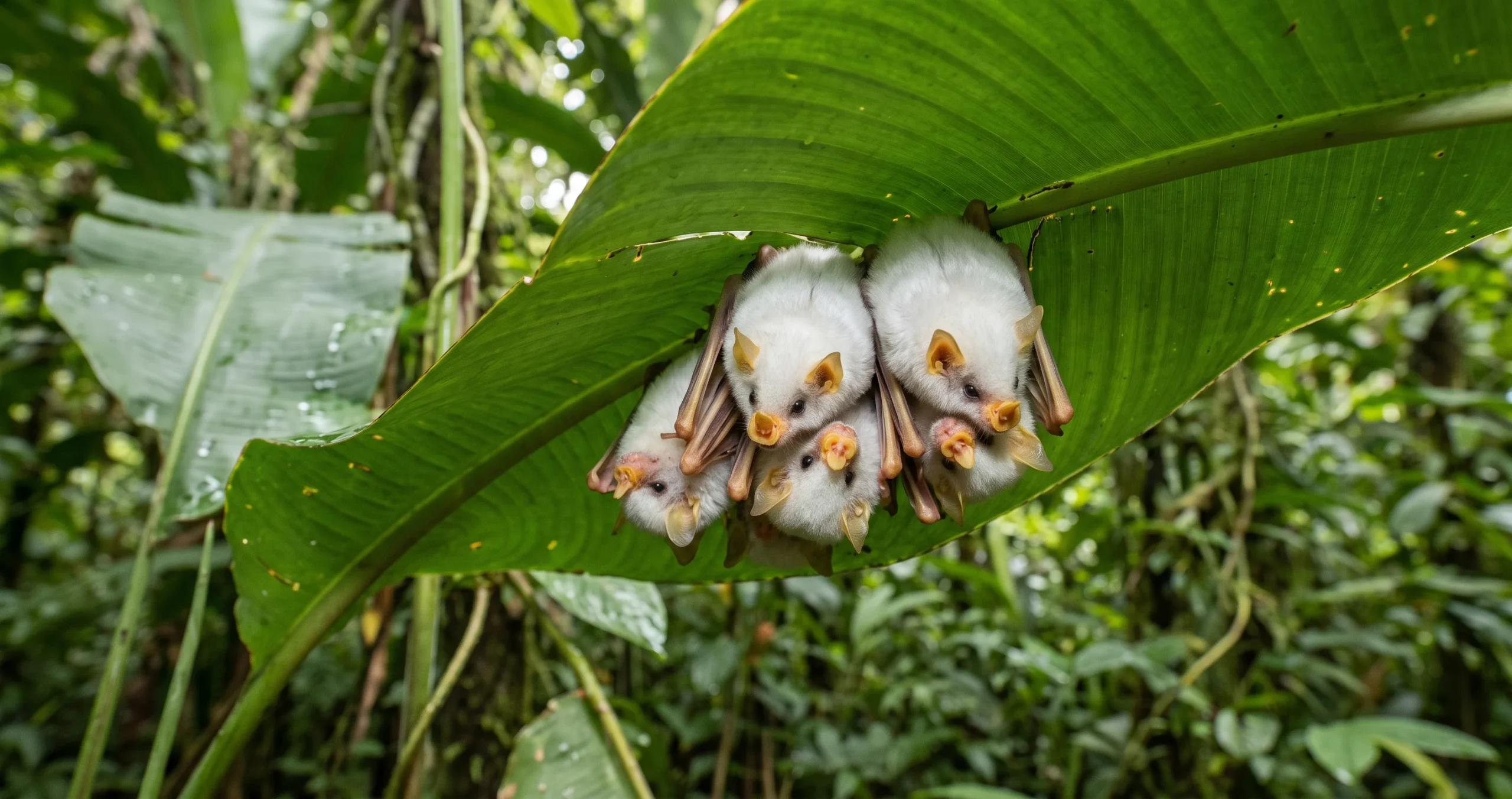
Deep inside Central America’s tropical rainforests, one tiny mammal has developed an extraordinary way to find shelter. Instead of hiding in dark caves or hollow trees, Honduran white bats transform living leaves into protective daytime roosts.
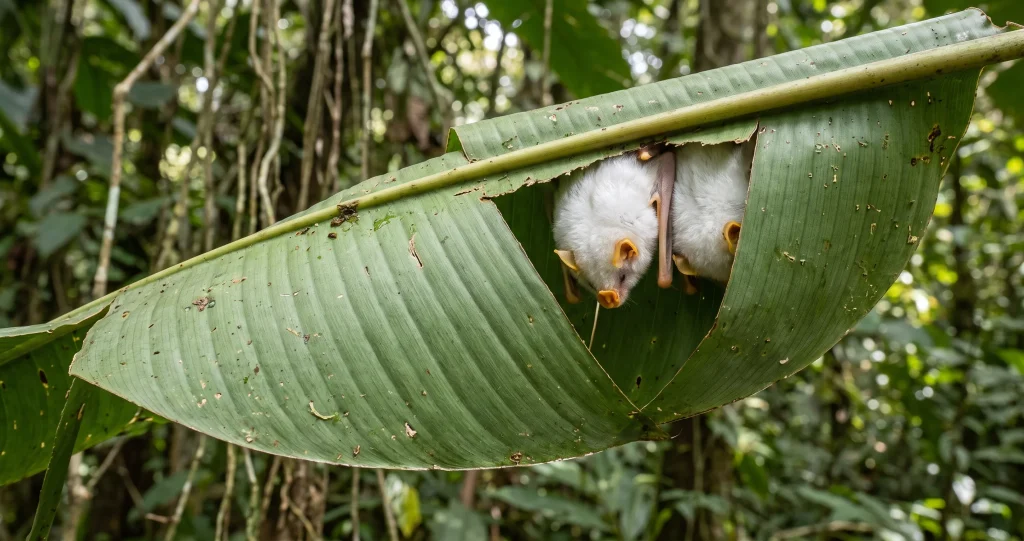
A Honduran white bat leaf tent is created when these small mammals make carefully positioned cuts in a broad leaf, causing it to fold downward like a natural roof. Several bats can then hang beneath the shelter, partially concealed by the surrounding vegetation.
Known scientifically as Ectophylla alba, Honduran white bats are also remarkable for their snowy white fur, yellow ears, and specialized fruit-based diet.
Their unusual lifestyle reveals a fascinating relationship between tropical plants and the animals that depend on them.
Table of Contents
- What Makes Honduran White Bats Unique
- How Honduran White Bats Build Leaf Tents
- How Leaf Tents Provide Shelter
- The Mystery of Their White Fur
- Where Honduran White Bats Live
- Social Behavior and Daily Life
- What Honduran White Bats Eat
- Natural Predators and Survival
- Leaf-Tent Bats Compared With Cave Bats
- Conservation and Rainforest Protection
- Frequently Asked Questions
- Conclusion
What Makes Honduran White Bats Unique?
The Honduran white bat is a small, fruit-eating bat belonging to the family Phyllostomidae, commonly known as New World leaf-nosed bats.
Adults typically measure approximately 3.7–4.7 centimeters (1.5–1.9 inches) in body length and weigh only a few grams.
Their appearance is distinctive. Most of the body is covered in pale white fur, while the ears and noseleaf have a striking yellow-orange coloration.
The noseleaf is a specialized structure surrounding the nose that is associated with echolocation in many leaf-nosed bats.
Unlike the dark brown or gray coloration familiar in many other bat species, the Honduran white bat’s unusual appearance stands out in photographs.
Yet these animals are surprisingly difficult to notice in their natural environment.
Their small size, preference for dense vegetation, and habit of resting beneath folded leaves all contribute to their secretive lifestyle.
How Honduran White Bats Build Leaf Tents
The construction of a Honduran white bat leaf tent is one of the most fascinating examples of shelter modification among tropical mammals.
These bats do not collect fallen leaves or assemble nests from separate materials. Instead, they alter the structure of leaves that remain attached to living plants.
Step 1: Selecting a Suitable Leaf
Honduran white bats use broad leaves from tropical understory plants, particularly certain species of Heliconia.
These plants produce large, elongated leaves with prominent central midribs and flexible leaf blades.
A suitable leaf must have the physical characteristics needed to form a shelter when modified.
Researchers have documented the use of particular plant species, but the exact factors governing every leaf-selection decision are not fully understood.
Leaf shape, size, structural condition, and surrounding vegetation may influence suitability.
Step 2: Making Cuts Near the Midrib
After selecting a leaf, the bats create cuts in the leaf blade near its central midrib.
The midrib is the prominent central vein that supports the leaf.
By damaging specific sections of the leaf tissue, the bats alter how the leaf supports its own weight.
The cuts allow portions of the leaf to bend downward, creating a folded structure.
This behavior is sometimes described as tent-making because the resulting shape resembles a simple roof.
Importantly, the bats do not completely detach the leaf from the plant.
Step 3: Allowing the Leaf to Fold
Once the supporting tissue has been modified, gravity helps pull the leaf into a downward-folding shape.
The central portion remains supported while the sides form a sheltered space underneath.
The resulting structure provides a natural roof above the roosting animals.
The precise appearance varies according to the plant species, leaf structure, and location of the cuts.
This is not the same as a human-made tent. It is a living leaf whose shape has been changed through animal behavior.
Step 4: Hanging Beneath the Shelter
After a suitable tent has formed, the bats rest beneath the folded leaf.
Like other bats, Honduran white bats can hang upside down using their feet.
Their gripping toes and claws allow them to remain suspended while resting.
Several individuals may occupy the same shelter, often hanging close together beneath the green roof.
From above, the leaf may appear relatively ordinary, making the animals beneath it less obvious.
Step 5: Using and Changing Roosts
Honduran white bats can use suitable leaf tents as daytime shelters and move between roosting locations.
Because living leaves eventually age, become damaged, or change position, these structures are not permanent homes.
Roost switching is an important part of the species’ behavior.
Researchers have also studied how social relationships influence the use of different shelters.
The Honduran white bat leaf tent demonstrates how a relatively small modification to a plant can create a useful resting place without requiring a permanent cavity or constructed nest.
How Leaf Tents Provide Shelter
A folded leaf offers several potential advantages in the humid tropical forest.
First, it creates overhead cover. Rainfall reaching the upper leaf surface may be diverted away from the animals resting underneath, although a leaf tent is not completely waterproof.
Second, the green roof can reduce direct visual exposure to predators moving through the vegetation.
Third, a leaf tent provides a resting location within the forest understory, where suitable food plants and other vegetation may be nearby.
However, researchers should not assume that every possible benefit has been experimentally demonstrated.
The effectiveness of these shelters depends on the leaf’s condition, surrounding vegetation, weather, and the behavior of nearby animals.
A Honduran white bat leaf tent provides concealment and overhead cover, not guaranteed protection from danger.
The Mystery of Their White Fur
White fur might seem like an unusual characteristic for an animal living in a green rainforest.
Many tropical bats have darker coloration, making the Honduran white bat particularly distinctive.
One scientific explanation involves the appearance of white fur beneath green leaves.
When sunlight passes through vegetation, the light reaching the animals may take on a greenish tint.
Under certain lighting conditions, the bats’ pale fur may reflect this filtered light and become less conspicuous.
This has led researchers to investigate whether their coloration contributes to camouflage.
Nevertheless, the evolutionary explanation for their white fur is not completely settled.
Their yellow ears and noseleaf are also distinctive. Research has investigated the pigments responsible for this coloration, including carotenoid-related compounds.
The existence of these pigments does not, by itself, prove that the yellow features evolved specifically for camouflage.
The safest scientific interpretation is that their coloration may have visual or other biological functions that require careful investigation.
Where Honduran White Bats Live
Despite their name, Honduran white bats are not restricted to Honduras.
Their documented range includes tropical regions of Central America, particularly Honduras, Nicaragua, Costa Rica, and Panama.
They are associated with humid lowland forests containing suitable roosting vegetation and fruit-producing plants.
The Importance of Heliconia Plants
Heliconia plants are important components of many tropical forest understories.
Their broad leaves provide suitable material for tent construction, while their dense growth can create sheltered areas beneath the forest canopy.
Not every Heliconia leaf is suitable for use as a bat tent.
The availability of appropriately shaped and positioned leaves helps determine where the bats can establish daytime roosts.
This illustrates an important ecological principle: protecting an animal’s habitat also means protecting the plants and structural features that support its behavior.
Social Behavior and Daily Life
Honduran white bats are social animals that may rest in small groups beneath the same leaf.
These groups can include several individuals, although the number and composition vary.
Their social organization has attracted scientific attention because individuals can share roosts while also moving among different shelters.
A group of bats hanging closely together is visually striking, but it should not automatically be described as a family.
Determining relationships among individuals requires behavioral observation and, in some studies, genetic evidence.
What Happens During the Day?
During daylight hours, the bats generally remain beneath their leaf shelters.
They hang upside down, conserving energy while avoiding unnecessary exposure.
Their folded wings rest close to their bodies.
If disturbed, they may leave the roost, but repeated disturbance can interfere with normal resting behavior.
Wildlife observers should maintain distance and avoid touching, lifting, or manipulating occupied leaves.
What Happens at Night?
Honduran white bats are nocturnal.
After darkness falls, they leave their daytime shelters to search for food.
Like other bats, they possess specialized sensory abilities that help them navigate their surroundings.
Their nightly activity connects their roosting habitat with fruit-producing plants elsewhere in the forest.
What Honduran White Bats Eat
Honduran white bats are specialized fruit-eating bats.
Research has documented a particularly important relationship with figs, including Ficus colubrinae.
These fruits provide food for the bats and connect them to the reproductive ecology of tropical plants.
Unlike insect-eating bats that capture flying prey, Honduran white bats obtain much of their nutrition from fruit.
Their feeding habits also make them potential contributors to seed dispersal.
Their Role in Forest Regeneration
Fruit-eating bats can transport seeds away from parent plants.
When viable seeds are deposited in suitable locations, they may contribute to the establishment of new vegetation.
The exact seed-dispersal contribution of Honduran white bats depends on their feeding behavior, the fruits consumed, and the fate of transported seeds.
Their relationship with fruiting plants demonstrates that even very small mammals can participate in important ecological processes.
Natural Predators and Survival
Life beneath a leaf does not eliminate the risks of living in a tropical rainforest.
Potential threats to small roosting bats include predators capable of searching vegetation, such as certain snakes, birds, and arboreal mammals.
However, detailed records identifying the main predators of Honduran white bats are limited.
It would be misleading to claim that one particular predator is their primary enemy without species-specific evidence.
The leaf tent may reduce visibility from certain angles, but it cannot prevent every attack.
The bats’ small size, ability to fly, concealed roosting locations, and nocturnal activity are all relevant to understanding their survival.
Leaf-Tent Bats Compared With Cave Bats
Many familiar bat species use caves, rock crevices, buildings, or hollow trees as daytime shelters.
These locations often provide relatively stable structures that may remain available for years.
Honduran white bats follow a different strategy.
Instead of relying on an existing cavity, they modify flexible living leaves to create temporary shelters.
| Feature | Honduran White Bat | Typical Cave-Roosting Bat |
|---|---|---|
| Daytime shelter | Modified living leaf | Cave or rock cavity |
| Shelter structure | Temporary and plant-based | Often long-lasting |
| Roost location | Tropical understory | Underground or rocky habitat |
| Group size | Often small groups | Varies greatly by species |
| Main food | Primarily fruit | Depends on species |
| Shelter modification | Cuts living leaves | Usually uses existing spaces |
This comparison highlights different roosting strategies rather than suggesting that one is universally superior.
Both strategies reflect the ecological conditions and evolutionary histories of the animals involved.
Conservation and Rainforest Protection
Honduran white bats depend on tropical forest environments that provide suitable leaves for roosting and appropriate fruit resources.
Habitat loss and fragmentation can reduce the availability of both.
Deforestation may separate feeding areas from suitable shelter locations, while changes in forest vegetation can affect the plants used for tent construction.
The species has been assessed as Near Threatened by the IUCN Red List, although its latest assessment and population trend should be checked against the current IUCN species record before publication.
Near Threatened does not mean that a species is already classified as Endangered. It indicates that conservation concerns exist and that the species may approach a threatened category under relevant assessment criteria.
Protecting rainforest habitat, maintaining native vegetation, and supporting responsible land management are important conservation measures.
The survival of these bats depends on more than individual trees. It relies on functioning forest ecosystems.
Frequently Asked Questions About Honduran White Bats
Are Honduran white bats real?
Yes. Honduran white bats are a scientifically recognized species called Ectophylla alba. They occur naturally in Central American tropical forests and are known for their pale fur, yellow facial features, and unusual habit of roosting beneath modified living leaves.
How big is a Honduran white bat?
Adults are approximately 3.7–4.7 centimeters long, or about 1.5–1.9 inches. They weigh only a few grams, making them small enough for several individuals to rest beneath a single suitable leaf.
How do Honduran white bats build leaf tents?
They make cuts in selected portions of a living leaf near its central midrib. These modifications allow the leaf to fold downward, forming a roof-like shelter. The bats then hang beneath the leaf using their feet.
Why are Honduran white bats white?
Their white coloration may influence how visible they are beneath green leaves, particularly when light filters through vegetation. However, the complete evolutionary explanation for their unusual fur coloration remains an area of scientific investigation.
What do Honduran white bats eat?
They primarily eat fruit, with research documenting a strong association with particular fig species. Their feeding behavior connects them to tropical forest plants and may contribute to seed dispersal.
Do Honduran white bats live in caves?
They are primarily known for roosting beneath modified leaves rather than occupying caves. Their tent-making behavior distinguishes them from many bat species that rely on rock cavities, hollow trees, or other permanent shelters.
Where can Honduran white bats be found?
They occur in parts of Central America, including Honduras, Nicaragua, Costa Rica, and Panama. They are associated with humid tropical forests containing suitable roosting plants and fruit resources.
Are Honduran white bats rare?
They are specialized forest bats that can be difficult to observe because of their small size and concealed daytime roosts. Their conservation assessment reflects concerns about habitat availability, but rarity should not be confused with a precise population estimate.
How long do Honduran white bats live?
Reliable species-specific lifespan information is limited. Although some other small bats can live for many years, those figures should not automatically be applied to Honduran white bats without supporting research.
Are Honduran white bats endangered?
The species has been classified as Near Threatened in IUCN assessments. This is different from the Endangered category. The latest official assessment should be consulted for its current conservation status.
Conclusion
The Honduran white bat demonstrates how closely animal behavior can be connected to the structure of living plants.
By making carefully positioned cuts in broad tropical leaves, these tiny mammals create temporary shelters that support their daytime roosting behavior.
Their pale fur, social groups, specialized fruit diet, and dependence on rainforest vegetation make them an extraordinary example of tropical biodiversity.
The Honduran white bat leaf tent is more than an unusual resting place. It represents a remarkable ecological relationship between a small mammal and the plants that help sustain its life.
Protecting these animals ultimately means preserving the forests, food sources, and living leaves that make their unusual lifestyle possible.
External Sources:
- IUCN Red List — https://www.iucnredlist.org/
- Bat Conservation International — https://www.batcon.org/
- Animal Diversity Web, University of Michigan — https://animaldiversity.org/