
Saffron may be famous as one of the world’s most valuable spices, but you don’t need a commercial field or Mediterranean climate to try producing a small harvest yourself. With healthy corms, excellent drainage, plenty of sun, and careful harvesting, growing saffron crocus can be a surprisingly approachable home-garden project.
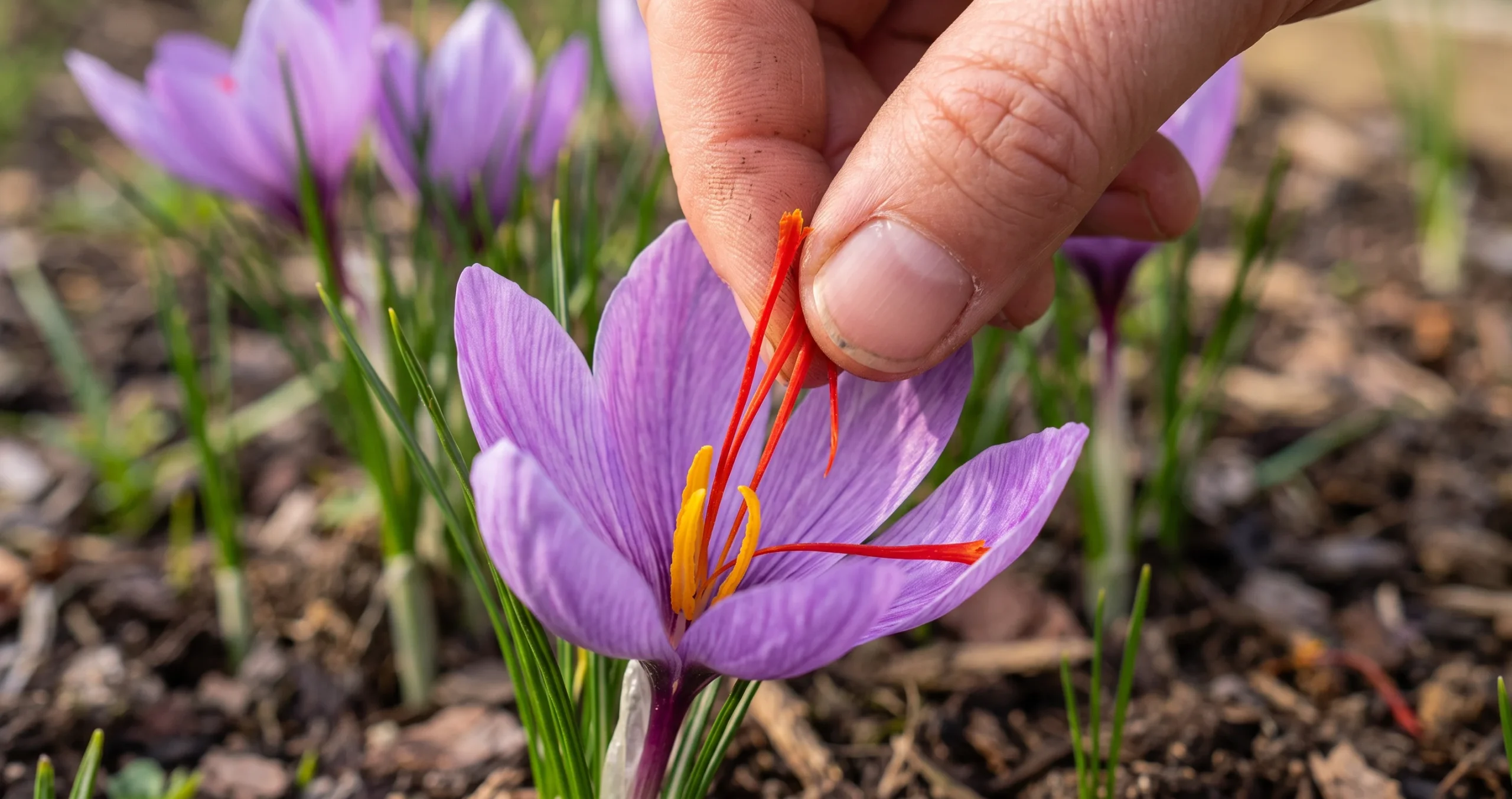
The plant that produces culinary saffron is Crocus sativus, a small fall-blooming crocus with lavender-purple flowers. Each flower contains just three vivid red stigmas—the threads that become saffron after harvesting and drying. That tiny yield explains both the spice’s value and the satisfaction of producing even a small jar at home.
Unlike familiar spring crocuses, saffron crocus follows a different seasonal rhythm. Corms are generally planted in late summer or early fall, flowers appear in fall, foliage continues growing afterward, and the plant eventually enters summer dormancy.
Table of Contents
- What Is Saffron Crocus?
- Growing Saffron Crocus: The Right Conditions
- When to Plant Saffron Corms
- How to Plant Saffron Crocus
- When Does Saffron Crocus Bloom?
- How to Harvest Saffron by Hand
- Why So Many Flowers Produce So Little Saffron
- How to Dry Fresh Saffron
- How to Store Homegrown Saffron
- Caring for Saffron After Harvest
- Common Saffron-Growing Mistakes
- Growing Saffron in Containers
- FAQ
- Conclusion
What Is Saffron Crocus?
Saffron comes from Crocus sativus, a perennial member of the iris family, Iridaceae.
Although gardeners often call the underground structures “saffron bulbs,” botanically they are corms. A corm is a solid underground stem that stores energy, whereas a true bulb consists largely of layered modified leaves.
This distinction does not greatly change how a home gardener handles the plant, but buying genuine Crocus sativus corms matters.
Saffron crocus is sterile and does not reproduce through viable seed. Instead, established corms produce daughter corms, allowing a planting to gradually expand. University of Vermont guidance describes saffron as a perennial crop that can remain planted for several years while secondary corms develop.
Most importantly, do not confuse culinary saffron crocus with plants commonly called autumn crocus or meadow saffron in the genus Colchicum. They are different plants, and Colchicum contains toxic compounds. Penn State Extension specifically notes the potential confusion created by these common names.
For edible saffron, grow correctly identified Crocus sativus from a reputable source.
Growing Saffron Crocus: The Right Conditions
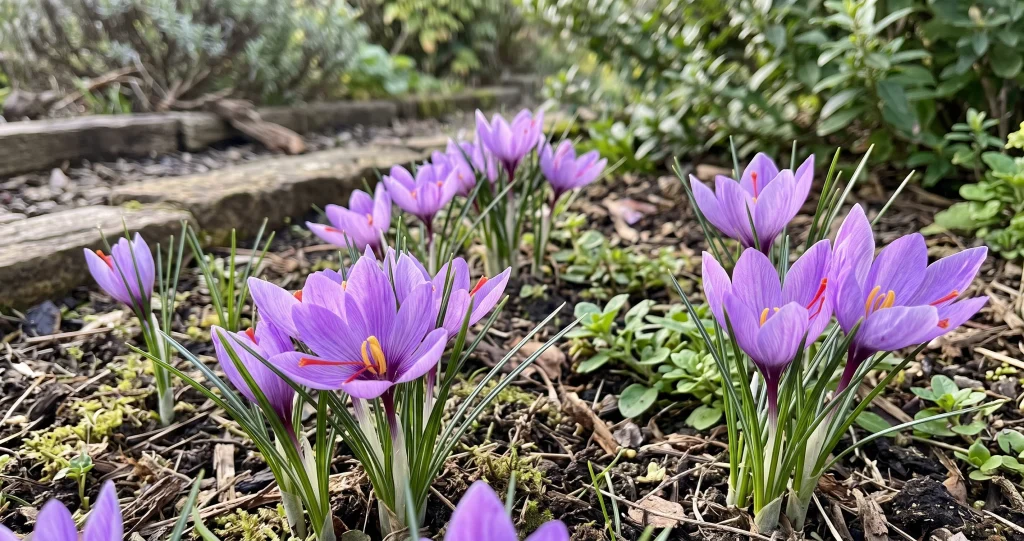
Success with growing saffron crocus starts underground.
The plant needs a location with full sun and excellent drainage. Poorly drained soil is one of the biggest risks because corms can rot when they remain excessively wet.
A sandy or loamy soil that drains freely is preferable to heavy, waterlogged clay. If your garden stays wet after rain, consider a raised bed or container instead of planting directly into the ground.
Penn State recommends full sun, well-drained soil, and planting corms approximately 3 to 4 inches deep and 3 to 4 inches apart.
Avoid choosing a location based only on how it looks while the flowers are blooming. Remember that the narrow, grasslike foliage remains important after flowering.
Those leaves are producing and storing energy that supports the corms and future flowers.
When to Plant Saffron Corms
Timing matters because saffron is a fall-blooming crocus.
Corms are generally purchased and planted in late summer to early fall so they can establish before their autumn flowering period. Regional conditions influence the exact calendar.
University of Vermont Extension notes that corms are generally available in late summer and that foliage can emerge in September or October, followed by flowers later in fall.
Penn State gives September through October as a planting period in its guidance, with flowers potentially following several weeks later.
Rather than treating one calendar date as universal across the United States, use reputable corm suppliers and local Extension guidance to adjust planting time for your region.
When your corms arrive, inspect them before planting.
Choose firm, plump corms. Discard specimens that are soft, badly shriveled, moldy, or visibly diseased.
How to Plant Saffron Crocus
Planting saffron is straightforward once you have chosen the right site.
Loosen the soil and improve drainage before planting. Organic matter can improve poor soil structure, but the goal is not a rich, moisture-retentive bed. Saffron needs water to grow, yet persistent saturation around the corm is undesirable.
Plant each corm with its pointed growing end facing upward.
A practical home-garden guideline is approximately 3 to 4 inches deep and 3 to 4 inches apart, consistent with Penn State recommendations.
After planting, cover the corms with soil and water them in.
Avoid turning the bed into a constantly moist area afterward. Natural rainfall may supply much of the moisture required in many climates.
Rodents can also become a problem. Squirrels, mice, voles, and other animals may dig up underground corms. University of Vermont Extension suggests physical barriers such as hardware cloth where animal damage is a concern.
For more ideas on protecting bulbs and other underground crops naturally, see our guide to protecting garden plants from wildlife.
When Does Saffron Crocus Bloom?
One of the pleasures of growing saffron crocus is its unusual flowering season.
While many crocuses announce spring, Crocus sativus flowers in fall.
University of Vermont reports that saffron generally flowers during October and November in its growing conditions, although exact timing depends on climate. Its harvest guidance notes that the flowering season can extend for several weeks.
The flowers are lavender to purple, with brilliant red stigmas extending from their centers.
Do not be discouraged if the first year’s display seems modest. Corms can multiply over time, potentially producing a larger planting and more flowers in subsequent seasons when conditions are suitable.
During peak flowering, inspect the bed frequently. Individual flowers are short-lived, and saffron production rewards timely harvesting.
How to Harvest Saffron by Hand
This is where you discover why saffron commands such a high price.
There is no fruit to pick and no large seed head to collect.
You want just three red stigmas from each flower.
University of Vermont’s North American Center for Saffron Research and Development recommends harvesting flowers when they are fully elongated and just beginning to open. Waiting until flowers wilt can make harvesting more difficult and allow the stigmas to deteriorate or become dirty.
Morning is generally a good harvesting period, but wet flowers should be allowed to dry first.
Pick the flower gently. Indoors, open it carefully and identify the three red stigmas.
Separate the red stigmas from the yellow stamens and purple petals using clean fingers or tweezers.
The distinction is important: the red stigmas are the culinary saffron.
During the peak flowering period, check your plants daily if possible. The process is repetitive but simple:
Harvest the flowers, separate the stigmas, and prepare the threads for drying.
Once you do this yourself, the economics of saffron begin to make sense.
Why So Many Flowers Produce So Little Saffron
A single saffron flower gives you only three stigmas.
Those stigmas are delicate and weigh very little after drying.
University of Vermont Extension estimates that approximately 150 to 170 flowers are needed to produce just one gram of saffron. It takes roughly 4,000 flowers to make an ounce.
That means a small backyard planting is unlikely to fill large spice jars.
But it doesn’t need to.
Saffron is normally used in tiny quantities. A modest home harvest can still provide enough threads to flavor several dishes.
The low yield also explains why genuine saffron is expensive. Every flower must be harvested, and its three valuable stigmas have to be separated.
Mechanizing such delicate work is difficult.
You’re not paying for a plant that is impossible to grow. Much of saffron’s value reflects the enormous amount of flower material and careful labor required to create a small quantity of finished spice.
How to Dry Fresh Saffron
Harvesting is only half the process.
Fresh stigmas contain substantial moisture and must be dried properly to create a stable culinary spice.
Drying also influences saffron’s characteristic color, aroma, and flavor. Important compounds associated with saffron quality include crocin, picrocrocin, and safranal.
University of Vermont researchers have evaluated different drying temperatures for culinary saffron. Their trials compared approximately 130°F for 60 minutes, 170°F for 25 minutes, and 210°F for 7–10 minutes. In their testing, the higher-temperature treatment produced higher levels of some important quality compounds, including safranal and crocins.
For a home gardener, the essential principle is controlled dehydration rather than scorching the threads.
Spread the stigmas in a single layer and use a reliable drying method. If using heat, accurate temperature control matters because such a tiny quantity of material can overheat quickly.
UVM notes that properly dried saffron needs to lose more than 80% of its water content.
After drying, the threads should be dry rather than damp or soft.
Never seal obviously moist saffron into a storage container. Remaining moisture can compromise quality and storage life.
How to Store Homegrown Saffron
Once your saffron is completely dry, protect it from its main storage enemies: moisture, light, heat, and air exposure.
Transfer the dried threads into a clean, airtight container.
A small glass jar with a tight-fitting lid works well. Because a home harvest may occupy very little space, choose a container appropriately sized for the amount you have rather than repeatedly opening a large jar.
Keep the container in a cool, dark, dry location.
University of Vermont Extension specifically recommends storing saffron in an airtight container away from direct sunlight and heat to preserve its flavor.
Label the container with the harvest year.
Also keep your saffron as whole threads rather than immediately grinding the entire harvest. Whole threads make it easier to control quantities during cooking and reduce unnecessary exposure of the spice to air.
Caring for Saffron After Harvest
Do not assume the plant has finished its work once the flowers disappear.
Its leaves matter.
Allow the foliage to remain naturally until it yellows and dies back. During this period, the plant is supporting the underground corms.
Eventually, saffron enters summer dormancy.
Over the years, the original corms produce daughter corms. A successful planting can therefore become increasingly crowded.
UVM describes perennial systems in which corms are left to reproduce for four to five years, while Penn State recommends periodic division to prevent overcrowding.
When division becomes necessary, lift the corms during dormancy, separate healthy daughter corms, and replant them at appropriate spacing.
This natural multiplication is one of the rewards of growing saffron crocus as a perennial crop.
Common Saffron-Growing Mistakes
The most serious mistake is poor drainage.
A sunny location will not compensate for soil that remains saturated around the corms.
Another common problem is buying the wrong plant. Crocus sativus is the source of culinary saffron; plants casually sold or described as “autumn crocus” may belong to completely different genera.
Planting too late can also reduce the opportunity for normal establishment and flowering.
During harvest, confusing the red stigmas with other floral structures reduces the quality of your finished product. Remember that each Crocus sativus flower produces only three saffron-bearing red stigmas.
Finally, don’t remove healthy foliage simply because flowering has finished. The leaves continue playing an important role in the plant’s annual growth cycle.
Growing Saffron in Containers
Gardeners without suitable ground can still experiment with growing saffron crocus.
Containers can be particularly useful where native soil is heavy or drainage is unreliable.
Choose a container with drainage holes and enough depth for the corms and root system. Penn State notes that saffron can be grown in containers and recommends sufficient container depth for proper development.
Use a free-draining growing medium and place the container where it receives plenty of direct sunlight.
The main challenge is moisture management.
Containers can dry rapidly, but they can also remain dangerously wet if drainage holes become blocked or saucers hold standing water.
The goal is not permanent dryness. It is avoiding prolonged saturation around the corms.
Climate also matters. A container exposes underground plant parts to temperature fluctuations differently from garden soil, so gardeners in very cold regions should consult local Extension recommendations for overwintering.
FAQ About Growing Saffron Crocus
Is saffron difficult to grow at home?
The basic cultivation is relatively straightforward if you can provide full sun and excellent drainage. Harvesting and separating the stigmas require more patience than ordinary garden crops.
Is saffron grown from seeds?
No. Crocus sativus is sterile and is propagated vegetatively through corms and the daughter corms they produce.
When should saffron corms be planted?
They are typically planted in late summer or early fall, with regional timing varying according to climate and the source of the corms.
Does saffron bloom in its first year?
Healthy corms can flower during the first fall after planting, although performance varies with corm size, planting time, and growing conditions.
How many saffron threads come from one flower?
Each flower produces three red stigmas that become culinary saffron.
How many flowers are needed for one gram of saffron?
University of Vermont Extension estimates approximately 150–170 flowers per gram.
Can saffron crocus grow in pots?
Yes. Containers can work well when they provide sufficient depth, full sun, and excellent drainage.
Should saffron be harvested wet?
Ideally, no. UVM recommends allowing wet or dew-covered flowers to dry before harvesting.
How should homegrown saffron be stored?
Once thoroughly dried, keep the threads in an airtight container protected from direct sunlight, moisture, and heat.
Conclusion
Growing saffron crocus changes the way you look at a jar of saffron.
The plant itself is small and relatively uncomplicated. Give Crocus sativus plenty of sunlight, excellent drainage, appropriate planting depth, and time to establish, and it can reward you with delicate purple flowers in fall.
The work comes at harvest.
Every flower provides only three red stigmas. Each must be collected by hand, separated carefully, dried correctly, and protected during storage. With roughly 150–170 flowers required for a single gram, even a tiny amount represents a remarkable concentration of plants and labor.
For a home gardener, however, quantity isn’t necessarily the goal.
A few precious batches of saffron harvested from your own garden can turn a small fall-flowering bed into one of the most unusual edible crops you grow.
External Sources :
- University of Vermont Extension — Saffron: World’s Most Expensive Spice. UVM is especially relevant because its North American Center for Saffron Research and Development has conducted saffron cultivation, harvesting, and post-harvest research in North America.