
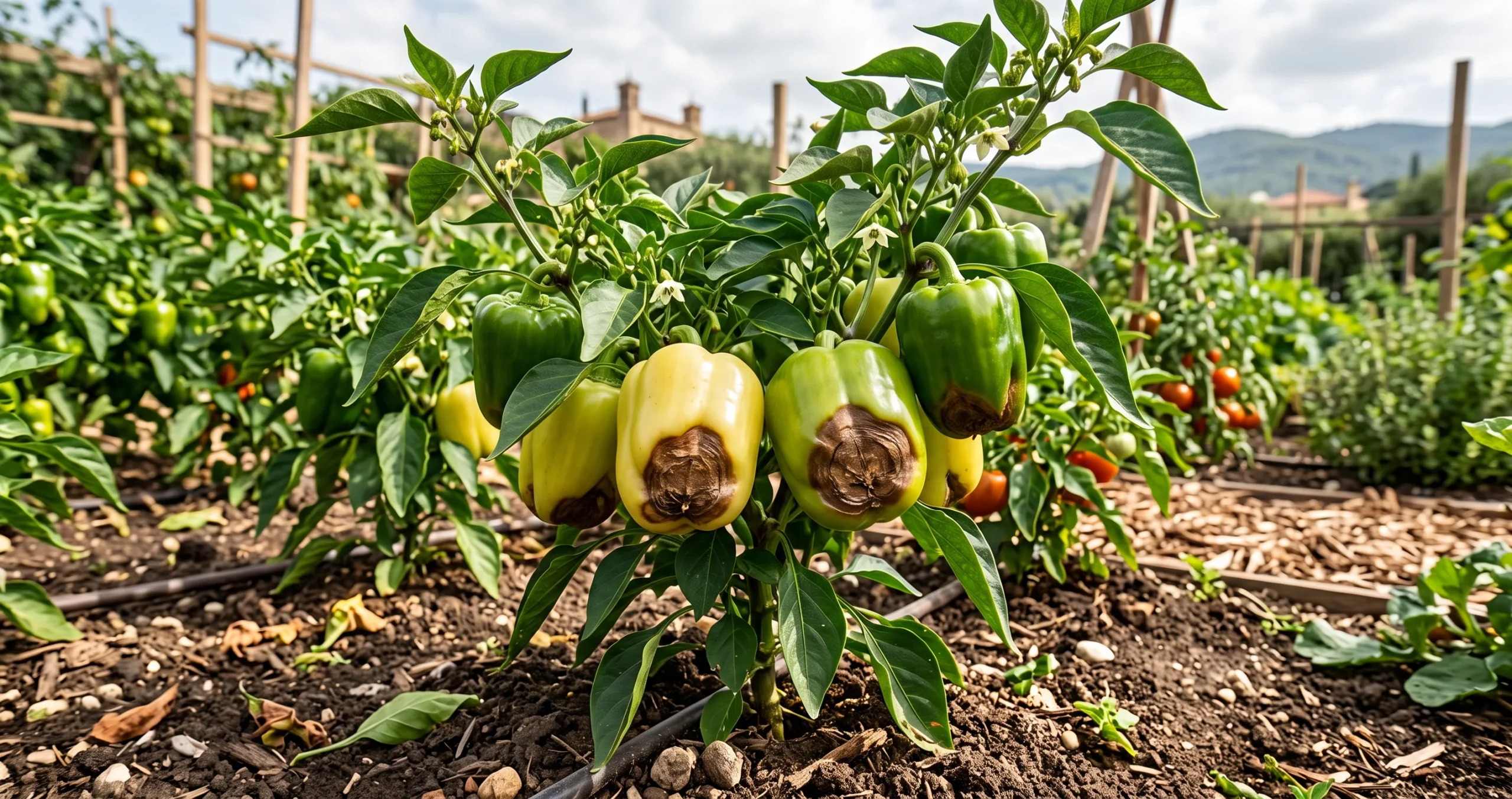
A pepper can look perfectly healthy until a pale, sunken patch appears at the bottom of the fruit. Within days, that spot may become dark, leathery, and impossible to ignore. Blossom end rot peppers develop when growing fruit does not receive enough calcium where it is needed—but in most garden soils, the real problem is not a shortage of calcium in the ground. It is usually a problem with calcium uptake and movement, commonly triggered by inconsistent soil moisture.
That distinction matters. Adding eggshells, lime, or calcium sprays will not solve the underlying problem when pepper roots already have access to sufficient calcium. More consistent watering and steadier soil moisture are usually much more effective.
Table of Contents
- What Blossom End Rot Looks Like on Peppers
- What Really Causes Blossom End Rot
- Why Watering Controls Calcium Movement
- How to Water Peppers Correctly
- Why Mulch Makes Such a Difference
- Container Peppers Need Extra Attention
- When Calcium Amendments Are Actually Needed
- Why Eggshells Usually Do Not Fix the Problem
- Other Factors That Increase Blossom End Rot
- What to Do With Damaged Peppers
- A Simple Prevention Plan
- FAQ
- Conclusion
What Blossom End Rot Looks Like on Peppers
Blossom end rot normally begins at or near the blossom end of the pepper—the end opposite the stem.
Early damage may look pale tan, slightly soft, or water-soaked. As the affected tissue collapses, the lesion becomes larger, darker, sunken, and often leathery.
University of Minnesota Extension describes affected pepper fruit as developing tan, soft areas that eventually become black and sunken. Fruit can also remain stunted or develop an abnormal shape.
The appearance can easily make gardeners suspect a fungal disease.
Blossom end rot, however, is primarily a physiological disorder, not an infectious disease.
Secondary fungi or bacteria may later colonize damaged tissue, but they are taking advantage of fruit that was already injured.
That distinction changes how the problem should be treated.
Fungicides do not correct the underlying cause.
The Real Cause of Blossom End Rot Peppers
The damaged portion of a pepper affected by blossom end rot is deficient in calcium.
That statement sometimes leads to an incorrect conclusion:
Low calcium in fruit does not automatically mean low calcium in soil.
In many garden soils, plenty of calcium is already present.
University of Illinois Extension specifically notes that blossom end rot in peppers is associated with drought, uneven water availability, or root damage. Although calcium is deficient in the affected fruit tissue, adding calcium to the soil seldom changes the condition because the underlying problem is commonly calcium mobility within the plant.
Calcium cannot simply jump from soil particles into a developing pepper.
It enters primarily through roots with water and moves through the plant in the transpiration stream.
Anything that disrupts water uptake can therefore interfere with calcium delivery.
Common triggers include:
- Drought
- Repeated wet-to-dry cycles
- Waterlogged soil
- Root damage
- Excessive nitrogen-driven growth
- Cold soil
- High salt concentrations around roots
- Irregular irrigation
The practical lesson is simple.
Blossom end rot peppers usually need better moisture management before they need more calcium.
Why Inconsistent Watering Disrupts Calcium Transport
Calcium movement is closely connected to water movement.
Roots absorb water from the soil, and dissolved minerals move into and through the plant as part of that process.
Calcium is relatively immobile once deposited in plant tissues. Developing fruit therefore depends on a continuing supply while its cells are rapidly expanding.
Now imagine pepper plants growing through this cycle:
Moist soil → several hot dry days → severe drying → heavy watering → drying again
The soil may contain adequate calcium throughout the entire period.
But the plant’s ability to continuously deliver calcium to rapidly developing fruit has been disrupted.
The result can be localized calcium deficiency in the fruit.
This explains why blossom end rot often appears during periods of rapidly changing moisture.
Penn State Extension identifies wide fluctuations in available water as a common cause because they interfere with the plant’s ability to absorb calcium from the soil.
Keeping the root zone reasonably consistent is therefore the foundation of prevention.
How to Water Peppers to Prevent Blossom End Rot
There is no universal watering calendar that works in every garden.
A pepper growing in sandy soil during 95°F weather may need water much sooner than one growing in moisture-retentive soil during a cool week.
Instead of blindly watering every Monday and Thursday, manage the soil moisture.
Water Deeply
Frequent light sprinkling wets only the surface.
That can encourage shallow root development and leave deeper soil dry.
University of Minnesota Extension recommends thoroughly soaking pepper soil when plants have not received approximately one inch of rain during the week, while noting that sandy soils may require more frequent irrigation.
Deep watering encourages roots to explore a larger volume of soil.
Avoid Severe Drying
Do not repeatedly wait for pepper plants to wilt before watering.
Visible wilting means the plant is already experiencing water stress.
During fruit development, repeated stress increases the risk of blossom end rot.
Avoid the Flood-and-Drought Cycle
Giving severely dry soil an enormous amount of water does not compensate for days of stress.
The goal is not simply to deliver a certain total number of gallons each month.
The goal is consistent moisture availability.
Adjust for Weather
Hot, windy weather increases water loss.
Check soil more frequently during heat waves.
After significant rainfall, irrigation may not be necessary at all.
Adjust for Soil Type
Sandy soils drain quickly and may require more frequent irrigation.
Clay-rich soils retain water much longer.
Gardeners should therefore use soil conditions—not a rigid calendar—as the final guide.
Mulch Is One of the Best Defenses
Mulch does not supply calcium directly.
It solves another part of the problem.
Bare soil exposed to summer sun can lose moisture rapidly from the surface. Soil temperatures also fluctuate more dramatically.
Organic mulch creates a protective layer between the soil and the atmosphere.
Suitable materials include:
- Shredded leaves
- Clean straw
- Untreated grass clippings applied appropriately
- Other suitable organic garden mulches
Mulch slows evaporation and helps the root zone remain evenly moist for longer periods.
That is exactly what pepper plants need.
Penn State Extension recommends both regular irrigation and mulch for blossom end rot prevention because mulch helps preserve soil moisture.
Apply mulch after the soil has warmed adequately in spring. Keep it from being packed tightly against the pepper stem.
Think of mulch as a moisture buffer.
Without mulch:
Water → rapid evaporation → dry soil → watering → rapid evaporation
With mulch:
Water → slower evaporation → steadier root-zone moisture
The second pattern provides more stable conditions for calcium transport.
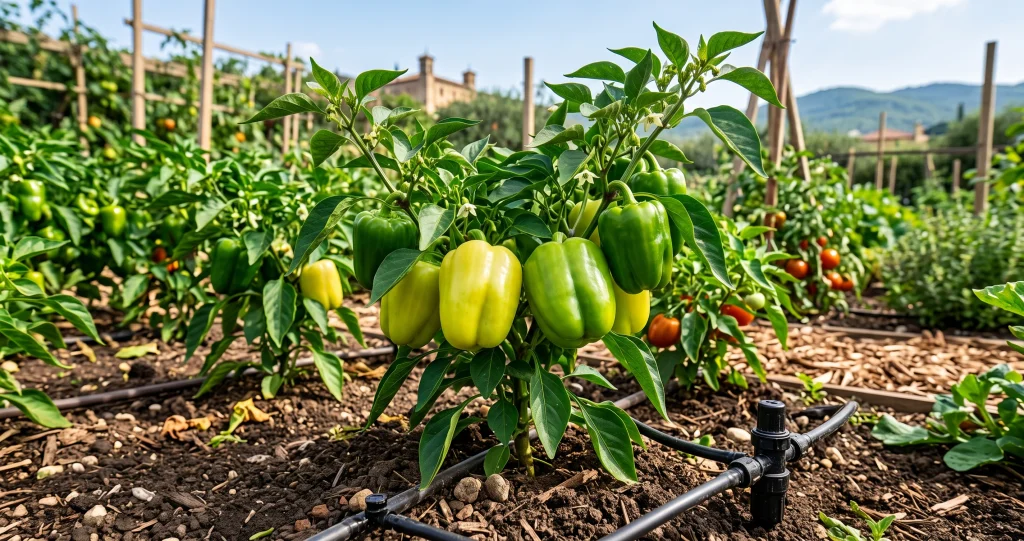
Container Peppers Need Extra Attention
Blossom end rot can become especially frustrating when peppers are grown in containers.
The reason is straightforward.
Containers contain a limited volume of growing medium, and that medium can dry much faster than garden soil.
A pepper plant in a large pot may be adequately hydrated in the morning but substantially drier by late afternoon during hot weather.
Repeated cycles like this can increase stress.
Check container peppers frequently during warm weather.
Some pots may need daily watering during hot, dry periods, while larger containers or cooler conditions may require much less.
Container size matters too.
A tiny pot provides very little moisture reserve for a mature pepper plant.
Larger containers generally buffer changes in soil moisture more effectively.
Good drainage remains essential. Consistent moisture does not mean permanently saturated roots.
When Calcium Amendments Are Actually Needed
Calcium amendments are not useless.
They are simply overused as a universal response to blossom end rot.
There are situations where soil genuinely contains insufficient available calcium or where soil chemistry creates a legitimate need for amendment.
The correct way to determine this is through a soil test.
A laboratory soil test can provide information about soil pH and nutrient status and help determine whether calcium-containing amendments are appropriate.
University of Illinois Extension specifically recommends soil testing when gardeners suspect low calcium.
If testing confirms a deficiency, follow the recommendations provided with the test.
Depending on soil conditions, an appropriate amendment might contain calcium.
But adding lime automatically is a poor strategy.
Agricultural lime changes soil pH as well as supplying calcium. If soil pH is already appropriate or high, unnecessary liming can create additional nutrient problems.
Gypsum supplies calcium without raising pH as strongly as limestone, but it should still be used for an identified reason rather than as a reflex treatment for every damaged pepper.
Test first. Amend second.
That approach is cheaper and more scientifically sound.
Why Eggshells Usually Do Not Fix Blossom End Rot
Eggshells contain calcium.
That fact is true.
The problem is timing and availability.
Eggshell calcium does not instantly become available to pepper roots simply because shells are placed around a plant.
Shells can decompose slowly, particularly when pieces are large.
More importantly, adding calcium cannot solve a transport problem when the soil already contains sufficient calcium.
A pepper experiencing repeated drought stress may continue developing blossom end rot even while sitting in calcium-rich soil.
The better first response is:
Check moisture → stabilize watering → add mulch → evaluate fertilization → soil-test if deficiency is suspected
Eggshells can still be composted as part of a long-term soil-management program.
They simply should not be treated as emergency medicine for a pepper already showing blossom end rot.
Calcium Sprays Are Usually Not the Solution
Another common recommendation is spraying calcium directly onto pepper leaves.
The logic sounds appealing.
If the fruit lacks calcium, spray more calcium onto the plant.
Unfortunately, plant physiology makes the situation more complicated.
Calcium has limited mobility within plant tissues, and foliar applications do not reliably redirect enough calcium into developing fruit to solve a moisture-driven blossom end rot problem.
University of Illinois Extension notes that foliar calcium applications generally provide little benefit because calcium is poorly moved into fruit.
Again, moisture management addresses the more common underlying issue.
Excess Fertilizer Can Make the Problem Worse
Water is not the only factor influencing blossom end rot.
Excessive fertilizer can contribute.
Heavy nitrogen applications can stimulate rapid vegetative growth. A plant suddenly producing large amounts of leaves and stems creates additional competition for resources.
Certain nutrient imbalances can also interfere with calcium uptake.
University of Illinois Extension notes that high concentrations of ammonium, potassium, and magnesium may interfere with calcium uptake.
More fertilizer is therefore not always better.
Feed peppers according to actual soil fertility and plant needs.
Avoid trying to force rapid growth with excessive nitrogen, particularly once fruit development is underway.
Healthy pepper plants need balanced growth, not maximum foliage production.
Root Damage Can Trigger Blossom End Rot
Healthy roots are essential for water and nutrient uptake.
Deep hoeing or aggressive cultivation near pepper plants can damage roots.
Once roots are injured, the plant’s ability to absorb water can temporarily decline.
That can interfere with calcium transport even when the soil is moist and fertile.
Control weeds carefully around established peppers.
Mulch provides another advantage here because it suppresses many weeds and reduces the need for repeated cultivation around roots.
What to Do With Peppers Already Showing Damage
Unfortunately, the damaged tissue will not repair itself.
Once cells at the blossom end collapse, watering or calcium treatments cannot rebuild that portion of the fruit.
Remove badly affected peppers.
This allows the plant to direct resources toward new fruit.
Then correct the growing conditions so subsequent peppers have a better chance of developing normally.
Do not panic if the first few peppers show blossom end rot.
A plant can produce healthy fruit later once moisture conditions stabilize.
The plant itself is not necessarily diseased.
A Simple Prevention Plan
Preventing blossom end rot peppers is mostly about consistency.
1. Start With Good Soil
Grow peppers in well-drained soil with adequate organic matter.
Avoid sites that remain waterlogged.
2. Water Deeply
Encourage a substantial root system instead of repeatedly wetting only the soil surface.
3. Keep Moisture Consistent
Avoid alternating severe drought with heavy irrigation.
4. Add Mulch
Use organic mulch to reduce evaporation and buffer moisture fluctuations.
5. Protect Roots
Avoid deep cultivation around established pepper plants.
6. Avoid Excessive Nitrogen
Rapid leafy growth can increase the plant’s demand for calcium and water.
7. Test Before Adding Calcium
Do not automatically reach for lime, gypsum, eggshells, or calcium products.
Confirm an actual soil problem first.
Common Myths About Blossom End Rot
Myth: Blossom end rot is a fungal disease
It is a physiological disorder.
Fungi or bacteria can colonize damaged fruit later, but they are not usually responsible for initiating blossom end rot.
Myth: Every affected pepper means the soil lacks calcium
No.
Affected fruit does experience localized calcium deficiency, but garden soil frequently contains adequate calcium. Water stress can prevent enough of that calcium from reaching developing fruit.
Myth: Adding eggshells provides an immediate cure
Eggshells release calcium slowly and cannot repair fruit already damaged by blossom end rot.
Myth: More watering always solves the problem
Consistency matters more than simply pouring on more water.
Waterlogged roots can also interfere with nutrient uptake.
Myth: Calcium spray repairs damaged peppers
Existing damage is permanent. Foliar calcium also does not reliably solve moisture-related calcium transport problems.
FAQ
What causes blossom end rot peppers?
Blossom end rot develops when cells in the developing fruit fail to receive sufficient calcium. In many gardens, inconsistent moisture, drought, waterlogging, or root stress interferes with calcium uptake and transport even though the soil contains enough calcium.
How often should peppers be watered?
Water according to soil, weather, plant size, and rainfall rather than a fixed schedule. University of Minnesota Extension recommends thoroughly soaking pepper soil if plants do not receive about one inch of rain weekly, with more frequent watering potentially necessary in sandy soil.
Does mulch prevent blossom end rot?
Mulch can significantly reduce one of the major risk factors by slowing evaporation and keeping soil moisture more consistent.
Should I add calcium when my peppers have blossom end rot?
Only when there is evidence that the soil actually needs it. A soil test is the best way to determine whether a calcium amendment is appropriate.
Will Epsom salt stop blossom end rot?
No. Epsom salt is magnesium sulfate, not a calcium fertilizer. Excess magnesium can also interfere with calcium uptake under some conditions.
Can damaged peppers recover?
The existing damaged tissue cannot recover. Correcting moisture conditions can, however, help later fruit develop normally.
Are blossom end rot peppers caused by overwatering?
Excessively wet soil can contribute because poorly functioning roots have difficulty taking up nutrients. Both drought and waterlogging can disrupt calcium delivery.
Conclusion
The most important lesson about blossom end rot peppers is that calcium in the fruit and calcium in the soil are not the same issue.
The damaged fruit is calcium-deficient, but that does not mean your garden automatically needs more calcium.
Pepper roots need consistent access to moisture to absorb and transport calcium effectively. Drought, repeated wet-dry cycles, waterlogged soil, root injury, and excessive fertilization can all disrupt that process.
For most gardeners, the first solution should therefore be simple:
Water deeply. Keep moisture consistent. Mulch the soil. Protect the roots. Avoid excessive fertilizer.
Only add calcium when a soil test indicates that an amendment is actually appropriate.
That approach does more than reduce blossom end rot. It creates the stable root environment peppers need to produce healthy fruit throughout the growing season.