
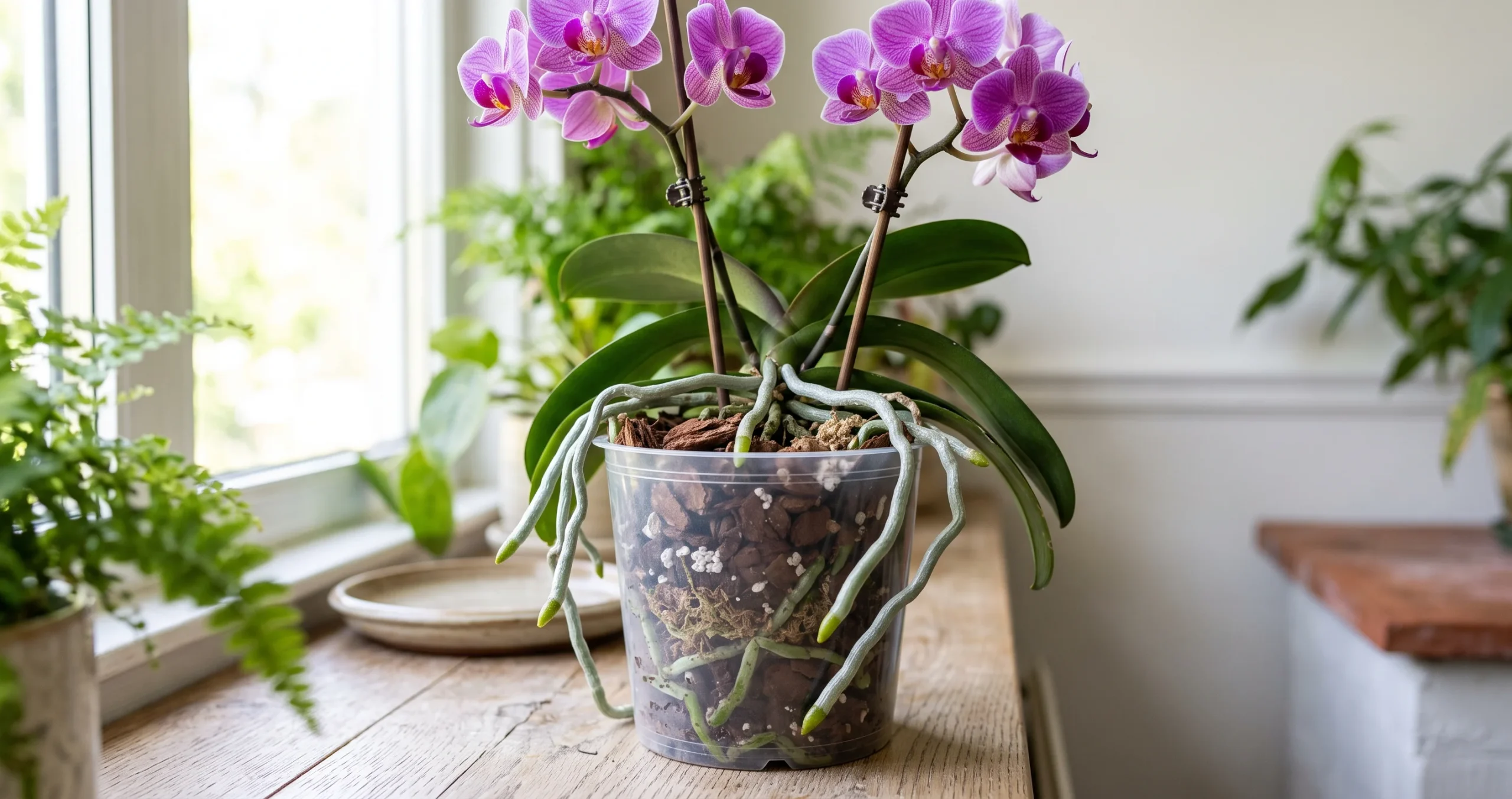
One of the easiest ways to struggle with an indoor orchid is to treat it like an ordinary houseplant. For many commonly grown orchids, especially Phalaenopsis, the roots are adapted to conditions very different from those found in a pot of dense houseplant soil. Choosing the right orchid bark potting medium can therefore make the difference between firm, functioning roots and a root system that slowly deteriorates.
The important detail is that bark itself is not magical. What matters is the root environment it creates: drainage, moisture, and plenty of air.
That also means the popular advice that “all orchids need bark, not soil” needs some context. The orchid family is enormously diverse, and terrestrial orchids do exist. This guide focuses primarily on the epiphytic orchids commonly grown as houseplants.
Table of Contents
- Why Many Orchids Don’t Naturally Grow in Soil
- What Makes Orchid Roots Different
- Why Regular Potting Soil Can Cause Problems
- How Orchid Bark Potting Medium Works
- Choosing the Right Orchid Mix
- How to Repot an Orchid Into Bark
- Signs Your Orchid Needs Better Potting Medium
- Common Orchid Potting Myths
- Frequently Asked Questions
- Conclusion
Why Many Orchids Don’t Naturally Grow in Soil
Walk through the natural habitat of many tropical orchids and you would not necessarily find their roots buried underground.
Many popular orchids are epiphytes. An epiphyte grows attached to another plant, usually a tree, without parasitizing that plant. Smithsonian Gardens explains that epiphytic orchids use their roots to anchor themselves to plants such as trees and obtain moisture from sources including rain and mist.
Dendrobiums, for example, include many epiphytic orchids that naturally grow on tree trunks and branches. Smithsonian Gardens recommends a bark mixture for many commonly cultivated Dendrobiums.
This natural lifestyle gives us an important clue about orchid care.
An orchid root attached to bark may repeatedly become wet during rain and then receive abundant oxygen as the water drains and evaporates. Putting that same type of root into dense, continuously wet potting soil creates a very different environment.
That is why successful orchid growing is less about simply giving the plant water and more about maintaining a healthy balance between water and air around the roots.
What Makes Orchid Roots Different?
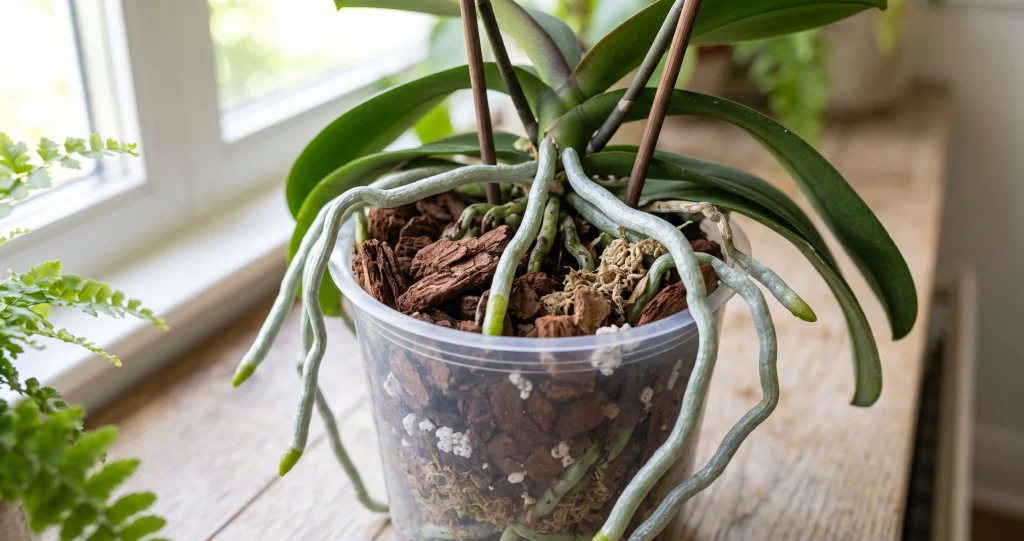
Many epiphytic orchids develop thick roots that may look silver-gray when dry and greener when wet.
Their roots are adapted to absorbing moisture while remaining exposed to an airy environment.
The American Orchid Society notes that root health is especially important in orchid cultivation and explains that restricting airflow around orchid roots can stress and eventually kill root cells.
This helps explain something that often confuses new growers.
An orchid can suffer from root problems even when its owner is carefully watering it.
The problem may not simply be how much water is being applied. It can also be how long the root environment remains saturated and how much oxygen remains available after watering.
Air Is Part of the Root Environment
Imagine the difference between chunky pieces of bark and fine potting soil.
Large bark particles create irregular gaps throughout the pot. Water can pass through those spaces while air can return around the roots.
Fine organic material can behave differently. As it becomes saturated or compressed, the spaces between particles become smaller.
That distinction is central to choosing an appropriate orchid bark potting medium.
Why Regular Potting Soil Can Cause Problems
Ordinary houseplant potting mix is designed for plants whose roots are adapted to growing in a soil-like environment.
For many epiphytic orchids, it can retain too much moisture while providing insufficient aeration.
The American Orchid Society warns that if water cannot flow rapidly through an orchid pot, the medium may be too dense and the roots can be deprived of air.
This does not mean that touching soil instantly kills an orchid. The problem develops when the medium creates unsuitable root conditions.
What Happens Inside the Pot
After watering, fine potting mix may stay wet for considerably longer than coarse bark.
If the root zone repeatedly remains saturated, oxygen availability can decline. Root tissues become stressed, damaged roots stop functioning efficiently, and decay can follow.
The visible symptoms above the pot may appear much later.
Leaves can become limp or wrinkled even though the pot contains plenty of moisture.
This seems contradictory until you inspect the roots. A plant with badly damaged roots may be surrounded by water but have too little healthy root tissue left to absorb it effectively.
This is one reason adding more water to a struggling orchid can sometimes make the situation worse.
How Orchid Bark Potting Medium Works
A good orchid medium does more than physically hold the plant upright.
It creates a particular balance of moisture retention, drainage, and aeration.
The American Orchid Society describes fresh, fast-draining but sufficiently moisture-retentive media as important for healthy orchid roots. It notes that orchids can be successfully cultivated in several kinds of media, including bark-based, peat-based, and inorganic systems.
So bark is not the only possible orchid medium.
It is simply one of the most practical choices for many commonly grown epiphytic orchids.
Bark Creates Air Spaces
Chunky bark pieces don’t fit tightly together.
The gaps between them allow excess water to drain while maintaining spaces containing air.
This structure resembles aspects of the naturally exposed root environment of epiphytic orchids much more closely than compact garden soil does.
Bark can also retain some moisture on and within its surfaces, preventing the root environment from becoming instantly bone-dry after watering.
The goal is therefore not maximum drainage or maximum moisture retention.
It is balance.
Choosing the Right Orchid Bark Potting Medium
Walk into a garden center and you may find several products labeled “orchid mix.”
They are not necessarily identical.
Commercial mixes can contain fir or other bark, sphagnum moss, perlite, charcoal, or other materials. The ideal combination depends on the orchid, pot size, growing environment, and your watering habits.
The American Orchid Society advises matching the medium to both the orchid and the grower’s conditions. A coarser medium may suit situations where plants receive frequent watering, while more moisture-retentive components may be useful under drier indoor conditions.
Coarse Bark
Large bark pieces create larger air spaces and generally dry faster.
They can work particularly well for larger orchids, humid environments, or growers who water frequently.
Finer Bark
Smaller bark particles hold moisture more evenly and generally dry more slowly.
They can be useful for smaller plants or environments where pots dry quickly.
Bark With Sphagnum
Adding some sphagnum moss increases moisture retention.
This can help in dry indoor environments, but heavily packed moss can remain wet for a long time. It should therefore be used according to the moisture requirements of the orchid and growing conditions rather than as a universal solution.
For more indoor growing guidance, readers can also explore the houseplant resources at Secrets of the Green Garden.
How to Repot an Orchid Into Bark
Repotting can look intimidating because orchid roots are thick and sometimes tightly intertwined.
The process is easier when approached slowly.
Start with fresh orchid bark potting medium appropriate for your orchid. Use a pot with good drainage; clear orchid pots can also make it easier to monitor roots and moisture.
Gently remove the orchid from its old container.
Carefully loosen and remove deteriorated old medium without unnecessarily stripping or damaging healthy roots.
Inspect the root system. Healthy roots are generally firm, while dead or badly rotted roots may be brown or black, soft, hollow, or mushy.
Using clean cutting tools, remove clearly dead root material while preserving healthy tissue.
Position the orchid in its new pot and work fresh bark gently around the roots. Avoid crushing the bark into the pot as tightly as ordinary potting soil.
Those spaces between bark pieces are intentional.
The American Orchid Society recommends fresh medium when repotting and notes that orchids commonly need repotting when the medium deteriorates or when the plant has outgrown its container.
Timing Matters
When possible, repot around the beginning of new root growth.
New roots can establish themselves directly in the new environment. The American Orchid Society specifically notes that repotting as new roots begin emerging can reduce growth setbacks.
However, a severely deteriorated, waterlogged medium should not necessarily be left untouched simply because the calendar isn’t perfect.
Protecting the remaining healthy root system can be more important.
Signs Your Orchid Needs Repotting Into Better Medium
You don’t need to wait until an orchid collapses.
The root zone often provides earlier clues.
A bark mix that once consisted of recognizable chunks gradually decomposes into smaller particles. As this happens, it can become more compact and retain more water.
The American Orchid Society identifies deteriorating medium and dead roots as important reasons for repotting.
Another warning sign is unusually slow drainage.
Water should be able to move readily through an appropriate orchid medium. Fine material resembling coffee grounds washing from drainage holes can indicate that bark has substantially broken down.
Watch for combinations of:
- Soft, dark, or hollow roots
- Bark breaking into fine particles
- Medium staying wet much longer than it once did
- Poor drainage
- An unpleasant decomposing smell
- Roots badly crowding the container
- Declining leaves accompanied by damaged roots
One symptom alone does not always prove that the medium is responsible. Light, temperature, pests, disease, watering, and nutrition can also affect orchid health.
Inspect the roots before assuming the cause.
Common Orchid Potting Myths
Myth: Every Orchid Must Grow in Bark
No.
The orchid family includes epiphytic, terrestrial, and lithophytic plants. Smithsonian Gardens maintains orchids representing all three growth habits.
Some orchids naturally grow terrestrially, while others may perform well in sphagnum, specialized mixtures, mounted culture, or inorganic systems.
The advice to use bark applies especially well to many common epiphytic houseplant orchids.
Myth: Bark Means You Can Water Constantly
Bark improves aeration, but it does not make overwatering impossible.
Watering frequency still depends on temperature, humidity, airflow, pot size, bark grade, and the orchid itself.
Check the medium rather than watering automatically according to a rigid calendar.
Myth: Orchid Bark Never Needs Replacing
Bark is organic material.
It gradually decomposes.
As particles become smaller, the physical structure of the pot changes. Air spaces decrease and moisture behavior changes.
Replacing deteriorating medium before it becomes heavily compacted helps preserve a more stable root environment.
Myth: A Bigger Pot Is Always Better
Orchids do not necessarily benefit from a large volume of unused medium around their roots.
Oversized containers can remain wet longer, particularly toward the center.
Choose a container based primarily on the root system rather than the size of the flowers and leaves.
Frequently Asked Questions
Can I use regular potting soil for a Phalaenopsis orchid?
For typical epiphytic Phalaenopsis orchids, ordinary dense houseplant soil is generally unsuitable because it can retain too much water and restrict aeration around the roots.
A coarse, well-draining orchid medium is usually more appropriate.
Does an orchid bark potting medium contain actual bark?
Usually, yes.
Commercial bark-based orchid mixes commonly contain pieces of bark and may also contain materials such as sphagnum, perlite, or horticultural charcoal. Formulations vary, so read the package rather than relying only on the words “orchid mix.”
Should orchid bark stay wet?
It should not remain continuously saturated for orchids that require drying between waterings.
A healthy bark medium typically becomes wet during watering and then gradually loses moisture while maintaining air spaces around the roots.
How often should orchid bark be replaced?
There is no universal schedule.
The American Orchid Society discusses repotting approximately yearly or every other year as needed, but the actual interval depends on how rapidly the medium decomposes and the requirements of the plant.
Judge the physical condition of the medium and roots rather than relying only on time.
Can I reuse old orchid bark?
Fresh medium is preferable.
Old bark may already be decomposing and its structure may no longer provide the drainage and aeration you are trying to restore.
Are aerial orchid roots supposed to be buried?
Not necessarily.
Epiphytic orchids naturally produce exposed roots. Healthy aerial roots do not need to be forced into the pot simply to make the plant look tidier.
Why are my orchid’s roots green after watering?
Many commonly grown epiphytic orchids have roots that visibly change appearance as they become hydrated.
That color change can be useful when observing the plant, but watering decisions should also account for the condition of the medium, pot weight, environment, and species.
Conclusion
The lesson behind orchid potting is more useful than the simple slogan “bark, not soil.”
Many popular houseplant orchids evolved with roots exposed to remarkably airy environments. Those roots need moisture, but they also need oxygen and drainage.
A suitable orchid bark potting medium helps recreate that balance inside a container. The spaces between bark pieces allow drainage and airflow while the material retains enough moisture to support the roots between waterings.
Regular potting soil can upset that balance for epiphytic orchids by creating a dense, persistently wet root environment. As the roots deteriorate, the leaves and flowers eventually reveal the consequences.
Choose the medium according to the orchid, your environment, and your watering habits. Inspect the roots regularly, replace deteriorating bark before it becomes heavily compacted, and remember that healthy orchid care begins below the leaves.
The flowers may get the attention, but the roots determine whether there will be more flowers to enjoy.
External Sources:
- American Orchid Society — Best Potting Media
AOS: What Is the Best Potting Media? - American Orchid Society — Repotting Orchids
AOS: Repotting - Smithsonian Gardens — Orchid Growing Habits
Smithsonian Gardens: Where Do Orchids Grow?