
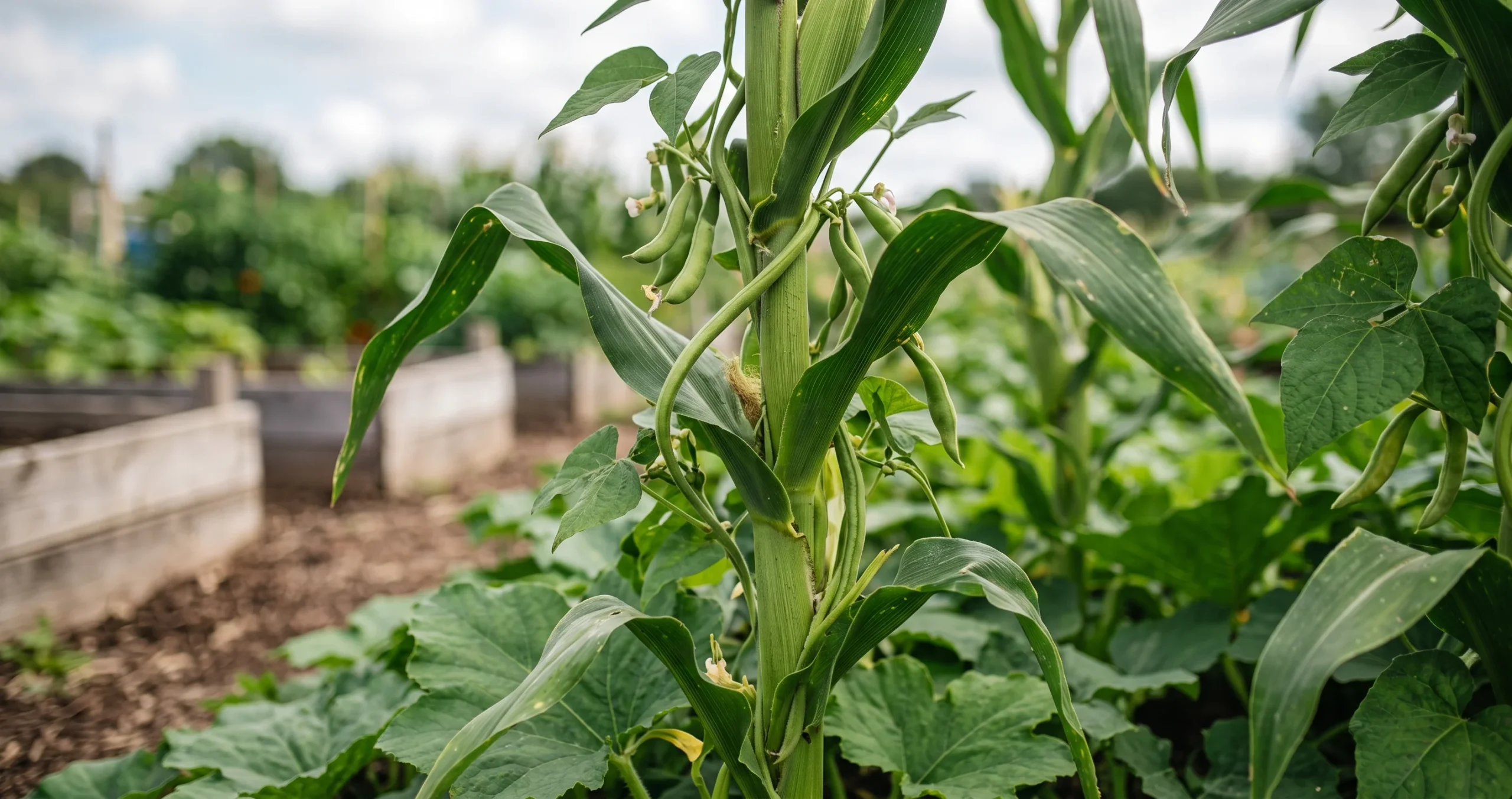
Long before companion planting became a popular gardening term, Indigenous peoples across parts of North America developed sophisticated agricultural systems based on generations of observation and experience. One of the best-known examples brings corn, beans, and squash together in the same growing space.
Today, Three Sisters companion planting is often presented as a simple garden trick, but it is better understood as a traditional Indigenous agricultural practice with cultural, historical, and ecological significance. Corn can provide climbing support, beans associate with nitrogen-fixing bacteria, and sprawling squash leaves shade the soil.
For home gardeners, understanding how those relationships actually work—and where popular explanations oversimplify them—is the key to growing a successful Three Sisters garden.
Table of Contents
- What Is the Three Sisters Method?
- Indigenous Origins of the Three Sisters
- How Corn, Beans, and Squash Work Together
- Does the Three Sisters Method Really Improve the Soil?
- Choosing the Right Varieties
- Three Sisters Companion Planting: Step-by-Step
- Timing and Spacing
- Watering, Feeding, and Maintenance
- Common Mistakes
- Common Myths
- Frequently Asked Questions
- Conclusion
What Is the Three Sisters Method?
The Three Sisters method grows corn, climbing beans, and squash in a shared planting system rather than treating them as three isolated crops.
The basic relationship is easy to visualize. Corn grows vertically, beans climb upward, and squash spreads horizontally across the soil.
This creates several layers of vegetation within a relatively small area.
The National Park Service describes the Three Sisters as a traditional system in which corn supports climbing beans while squash shades the ground, helping reduce moisture loss and weed growth.
The plants also complement one another as foods. Corn supplies substantial carbohydrates, beans provide protein and other nutrients, and squash contributes fiber, vitamins, minerals, seeds, and edible flesh, depending on the variety and how it is used.
But the Three Sisters are more than a convenient list of compatible vegetables.
Indigenous Origins of the Three Sisters
The Three Sisters method belongs to Indigenous agricultural traditions of the Americas, and its history should not be reduced to a modern companion-planting “hack.”
Different Indigenous nations developed agricultural systems adapted to their own climates, soils, crop varieties, and cultural practices. Corn, beans, and squash became especially important across many regions.
The National Park Service documents the Three Sisters among Ancestral Pueblo agricultural crops and describes corn, beans, and squash as central foods in Frijoles Canyon in what is now New Mexico.
In the Northeast, the crops were also important to Indigenous agriculture. The National Park Service notes that Narragansett and Wampanoag farmers around Narragansett Bay cultivated corn, beans, and squash together before European settlement.
The Three Sisters are particularly associated with Haudenosaunee traditions. A National Park Service history of the Finger Lakes region describes Haudenosaunee agriculture as relying on corn, beans, and squash grown together through mutually beneficial growing processes.
Because practices varied among nations and environments, there was never a single universal Three Sisters layout that every Indigenous community followed.
That distinction matters. The modern backyard version described below is an adaptation for home vegetable gardens, not a claim to reproduce every traditional Indigenous agricultural system.
How Corn, Beans, and Squash Work Together
The appeal of Three Sisters companion planting comes from the different growth habits of the crops.
Corn Provides Vertical Support
Corn is the tallest sister.
Once established, its strong upright stalk gives climbing or pole beans something to wind around. That can reduce the need for a separate bean trellis.
Timing is critical, however.
Beans grow quickly. If vigorous pole beans are planted at the same moment as young corn, they can overwhelm corn seedlings before the stalks are strong enough to support them.
The corn therefore needs a head start.
Beans Climb and Fix Nitrogen
Beans are legumes. Their roots can form a symbiotic relationship with rhizobia bacteria, which convert atmospheric nitrogen into forms incorporated into the plant-soil system.
This is where one of the biggest Three Sisters myths appears.
Beans do not continuously pump large amounts of immediately available nitrogen directly into neighboring corn plants.
Much of the biologically fixed nitrogen is incorporated into the bean plant itself. Some nitrogen can eventually enter the surrounding system through root turnover, residues, decomposition, and nutrient cycling.
That means a Three Sisters bed should not be treated as magically self-fertilizing.
The nitrogen-fixing relationship remains agriculturally important, but gardeners should not assume that planting beans beside severely nitrogen-deficient corn will instantly correct the problem.
Squash Creates Living Ground Cover
Squash occupies the lowest layer.
Its broad leaves spread over exposed ground, intercepting sunlight that might otherwise reach weed seedlings. The resulting shade can also reduce evaporation from the soil surface.
The National Park Service describes squash in traditional Three Sisters plantings as helping shade soil, conserve moisture, and reduce weed growth.
Squash stems and leaves can also make the interior of a mature planting physically dense, although claims that this provides complete pest protection are exaggerated.
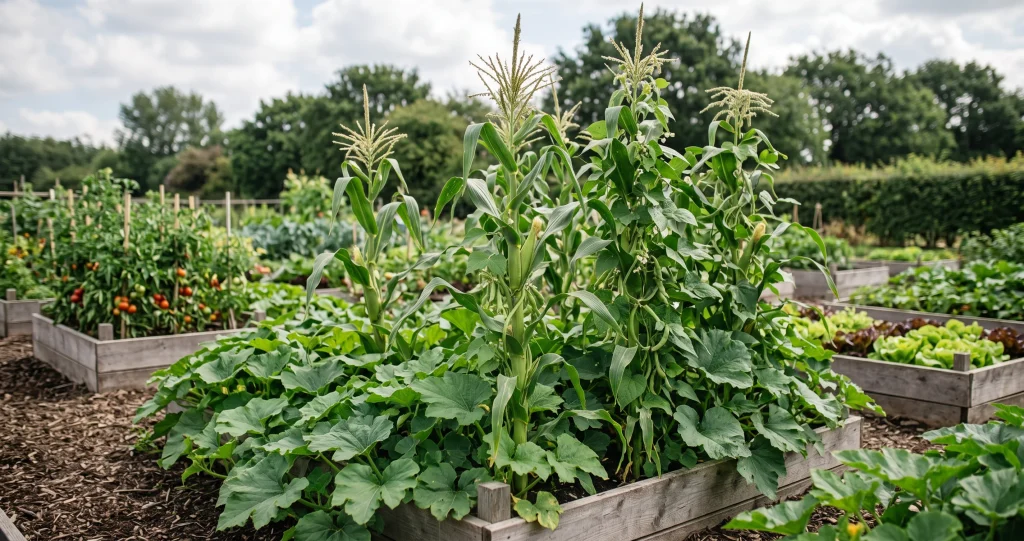
Together, the crops create a vertical structure: squash near the soil, beans climbing through the middle, and corn reaching above both.
Does the Three Sisters Method Really Improve the Soil?
The answer is more nuanced than many gardening graphics suggest.
Legumes and their associated bacteria perform biological nitrogen fixation, but not all that nitrogen immediately becomes available to neighboring plants. A large portion remains within living bean tissues during the growing season.
Squash provides a more immediate soil-surface benefit. By creating shade, its foliage can slow surface moisture loss and suppress some weeds.
Dense vegetation also protects more soil from direct sun compared with completely bare ground.
Still, the system does not eliminate ordinary soil management. A poor, compacted, nutrient-deficient site does not automatically become fertile simply because three compatible crops are planted together.
Before planting, improve garden soil when necessary with finished compost or other appropriate organic matter. Our gardening resources at Secrets of the Green Garden provide additional guidance for building healthier garden soil and maintaining vegetable beds.
Choosing the Right Varieties
Variety selection can determine whether Three Sisters companion planting works beautifully or becomes an overcrowded tangle.
Start with corn that grows tall and sturdy enough to support beans. Traditional flour, dent, or flint corn varieties may be particularly well suited to this style of planting, although gardeners sometimes experiment with sweet corn.
For beans, choose a climbing or pole variety.
Bush beans defeat one of the main structural relationships because they do not climb the corn. Extremely aggressive pole varieties, however, can become heavy enough to pull on weak stalks.
For the third sister, select a vining squash rather than a compact bush type if you want substantial living ground cover.
Winter squash and pumpkins can work particularly well where sufficient space is available. Remember that a single vigorous vine can travel many feet beyond its original planting spot.
Three Sisters Companion Planting: Step-by-Step
Step 1: Choose a Sunny Location
Corn, beans, and squash are warm-season crops that perform best with abundant sunlight.
Choose a location receiving at least six hours of direct sunlight, with more generally preferable for strong vegetable production.
The bed also needs good drainage. Avoid low areas where water remains pooled after rain.
Step 2: Prepare the Soil
Remove perennial weeds before planting.
Work finished compost into the bed if the soil would benefit from additional organic matter. If you regularly garden in the same area, a soil test is the most reliable way to determine whether nutrient or pH adjustments are actually necessary.
Avoid automatically applying excessive nitrogen fertilizer.
Too much nitrogen can produce lush vegetative growth at the expense of balanced crop development, and unnecessary fertilizer can create environmental problems.
Step 3: Create the Planting Area
Many contemporary home-garden versions use broad, low mounds or hills.
Historical arrangements varied. For example, the National Park Service describes Native American farming in New England using mounds approximately three feet across and spaced about three feet apart on center.
For a modern garden, think of the mound as a broad planting zone rather than a steep pile of soil.
Allow generous space between planting centers. Squash needs room to travel, and packing numerous Three Sisters groups into a tiny raised bed usually creates more competition than cooperation.
Step 4: Plant the Corn First
Corn should establish before the beans begin climbing it.
Plant corn after the danger of frost has passed and the soil has warmed sufficiently for the variety you are growing.
Rather than growing one isolated stalk, plant several corn plants together. Corn is wind-pollinated, so groups or blocks generally provide better opportunities for pollen to reach the silks than a single lonely plant.
Follow the seed packet’s planting-depth recommendations.
Step 5: Give the Corn a Head Start
Wait until the corn is several inches tall and growing strongly before introducing climbing beans.
Historical descriptions from Carolina Algonquian agriculture similarly indicate corn was established first, followed by beans and then squash.
A useful backyard guideline is to wait until corn is roughly 6 inches tall before adding the beans, though growth conditions and varieties can alter the ideal timing.
This delay prevents vigorous bean vines from smothering tiny corn seedlings.
Step 6: Plant the Pole Beans
Sow pole beans around the established corn, leaving enough distance that the plants are not emerging directly on top of the corn roots.
As the vines lengthen, guide them gently toward the stalks if necessary.
There is no need to tightly tie bean vines to corn. Climbing beans naturally twine around suitable supports.
Step 7: Add Squash
Plant squash after the corn has become established and around the time the beans are getting underway.
Position squash toward the outer portion of the planting area so its vines can travel outward rather than completely smothering the central corn.
Once vines begin running, gently redirect them when necessary.
Do not repeatedly lift or rearrange mature vines. Squash stems can crack surprisingly easily.
Timing and Spacing Matter More Than Perfect Symmetry
A common mistake is searching for one supposedly authentic spacing formula and applying it everywhere.
Traditional systems varied, and modern varieties vary dramatically in vigor and mature size.
A tall flour corn with a moderate climbing bean and sprawling winter squash behaves differently from short sweet corn combined with an aggressive pole bean and giant pumpkin.
For a backyard adaptation, give each planting group roughly 3 to 4 feet of growing space and leave room for squash vines to spread beyond it.
More important than an exact number is preventing overcrowding.
If foliage becomes so dense that air barely moves through the plants, disease pressure can increase and harvesting becomes difficult.
Watering, Feeding, and Maintenance
Young Three Sisters beds do not initially have the dense canopy seen in finished photographs.
During establishment, weeds still need to be controlled manually. Once squash expands, its foliage can suppress some new weeds, but it will not eliminate every unwanted plant.
Water deeply enough to moisten the root zone rather than repeatedly sprinkling only the soil surface.
As the canopy develops, check soil moisture beneath the squash leaves instead of assuming shaded soil is automatically wet.
Monitor all three crops for pests and diseases individually.
Corn may encounter earworms and other pests, beans can develop beetle or disease problems, and squash is vulnerable to issues such as squash vine borers, squash bugs, and powdery mildew in areas where those problems occur.
Companion planting does not make any crop immune.
Common Mistakes
Planting everything simultaneously is probably the easiest mistake to make. Fast-growing beans can climb corn before its stalks are ready.
Using bush beans eliminates the natural climbing relationship. Pole beans are the better fit when corn is intended to act as living support.
Using weak corn as a trellis can also cause trouble. A vigorous bean vine becomes surprisingly heavy.
Planting too densely creates competition for sunlight, water, nutrients, and physical space.
Another mistake is assuming squash removes the need for weeding. It suppresses some weed germination once its canopy develops, but early-season weeds still compete strongly with young crops.
Finally, do not expect the beans to eliminate all fertilizer needs. Good soil management remains important.
Common Myths About the Three Sisters
Myth: Beans Directly Feed Corn All Season
This description is too simplistic.
Beans participate in nitrogen fixation through their association with bacteria, but much of that nitrogen is used by the bean plant itself while it is actively growing. The longer-term system can benefit from nutrient cycling, particularly when plant residues return to the soil.
Myth: Any Corn, Bean, and Squash Combination Works
Plant architecture matters.
Bush beans will not climb corn, extremely vigorous vines can overwhelm smaller plants, and compact squash does not create the same spreading ground cover as a vining cultivar.
Myth: Squash Completely Prevents Weeds
Squash foliage shades the ground and can suppress weeds, but it is not a perfect weed barrier.
Gardeners still need to manage weeds, especially while the plants are young.
Myth: Three Sisters Gardens Never Need Fertility Management
These are productive crops with real nutrient requirements.
The method can use space and biological relationships effectively, but it does not create nutrients from nothing. Soil testing, compost, crop residues, and responsible fertility management remain valuable.
Myth: There Is One Authentic Three Sisters Layout
Indigenous agriculture across North America was—and remains—diverse.
Different communities used crops, planting arrangements, varieties, and management practices adapted to local conditions. A single internet diagram should not be presented as representing every Indigenous Three Sisters tradition.
Frequently Asked Questions
Can I use sweet corn in a Three Sisters garden?
Yes, but choose a reasonably sturdy variety and avoid pairing it with excessively vigorous beans. Traditional agricultural systems often involved corn types selected for purposes and growing conditions different from modern sweet corn.
Do I need to inoculate the beans?
Not always. Compatible rhizobia may already be present in soil where beans have previously grown.
In soils without appropriate bacteria, a bean-specific inoculant can support effective nodulation. Follow product instructions and avoid assuming that any microbial product will work with every legume.
How far apart should Three Sisters plantings be?
Spacing depends on the varieties and layout. A practical home garden often needs approximately 3 to 4 feet around planting groups, with additional room for squash vines.
Traditional spacing differed among communities and growing regions.
Should beans and corn be planted on the same day?
Usually not in a small home Three Sisters garden.
Allow corn to become several inches tall before sowing pole beans so the stalk has time to establish before supporting vines.
Can I grow the Three Sisters in a raised bed?
Yes, provided the bed is large enough.
A small raised bed can become crowded quickly, especially once squash vines mature. Allow vines to trail over the bed’s edge when practical.
Does Three Sisters companion planting eliminate fertilizer?
No.
Beans can fix atmospheric nitrogen through symbiotic bacteria, but that does not mean all their fixed nitrogen becomes immediately available to corn and squash. Base fertility decisions on your soil and the crops’ condition.
Does squash really conserve water?
Its broad leaves shade the soil, which can reduce direct solar heating and surface evaporation. The plants still require adequate irrigation or rainfall, especially during hot weather and fruit development.
Is the Three Sisters method just companion planting?
It can be described horticulturally as intercropping or companion planting, but that description is incomplete.
The Three Sisters have deep Indigenous agricultural and cultural histories. Treating the system only as a modern gardening technique overlooks where this knowledge originated.
Conclusion
Three Sisters companion planting demonstrates how plants with very different growth habits can share the same space effectively.
Corn creates vertical structure for climbing beans. Beans participate in biological nitrogen fixation through their relationship with soil bacteria. Squash spreads across the ground, shading soil and helping suppress weeds and reduce surface moisture loss.
The system works best when gardeners respect timing rather than simply dropping three kinds of seeds into one hole. Establish the corn first, introduce climbing beans after the stalks are strong enough to support them, and give squash enough room to spread.
Just as importantly, the Three Sisters should be understood within their proper history. Indigenous peoples developed sophisticated agricultural systems long before modern companion-planting terminology existed, and practices varied across nations, regions, climates, and generations.
A home Three Sisters bed is therefore both a practical lesson in plant relationships and an opportunity to recognize the agricultural knowledge behind one of North America’s most enduring growing traditions.