
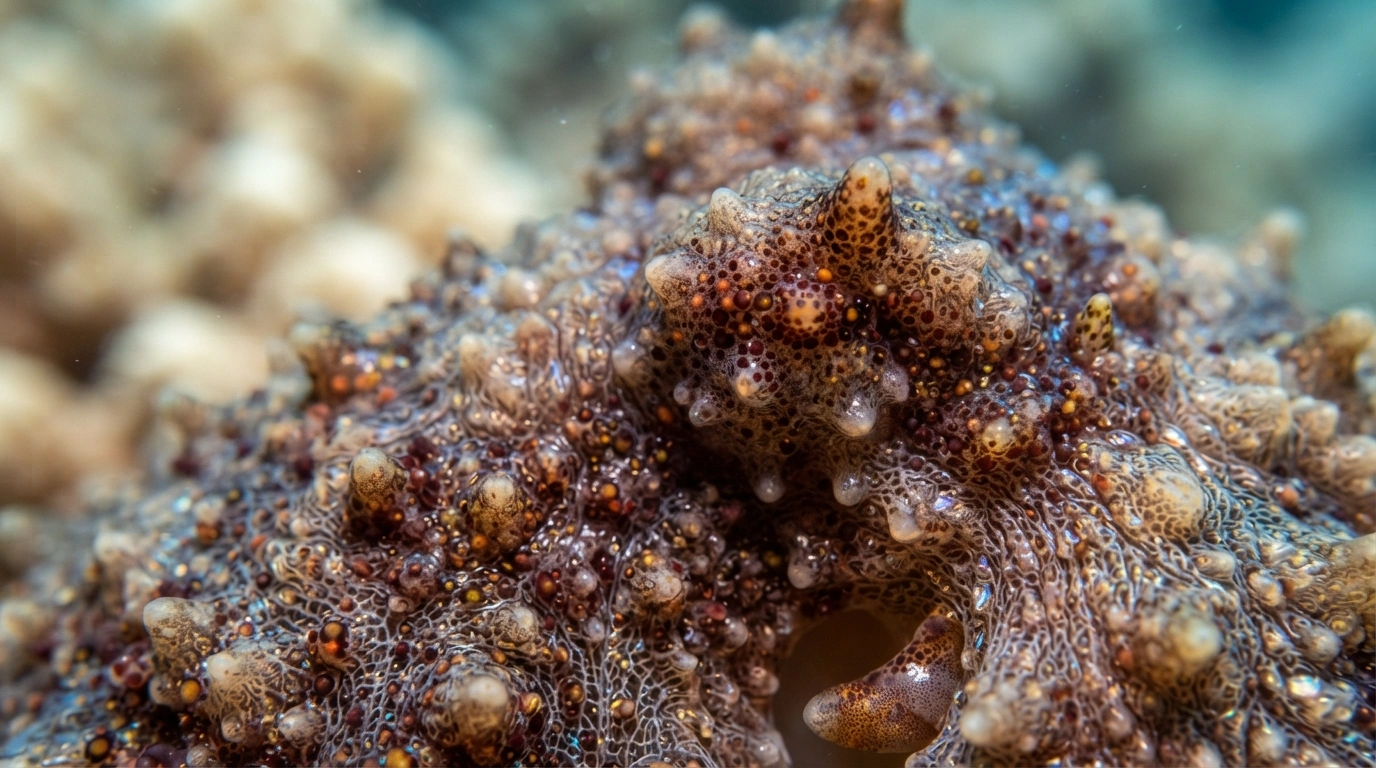
An octopus can rest against a pale patch of sand, move toward a reef, and suddenly appear mottled with browns, creams, and dark patches. This extraordinary octopus camouflage is not a slow change in pigmentation like tanning or seasonal coloration. It is an active visual system controlled by the nervous system and capable of reorganizing the animal’s appearance in fractions of a second.
The effect can seem almost instantaneous to a human observer. Thousands of specialized structures in the skin expand, contract, reflect, and scatter light while the octopus simultaneously changes posture and, in many species, skin texture.
Understanding this transformation reveals something remarkable: an octopus does not simply possess colorful skin. Its skin functions more like a living biological display connected directly to its brain.
Table of Contents
- Why Octopus Color Change Looks Instantaneous
- The Biology Behind Octopus Camouflage
- Chromatophores: Thousands of Living Color Units
- How the Nervous System Controls the Display
- Iridophores and the Colors Pigments Cannot Produce
- Leucophores and Environmental Light
- Changing Texture as Well as Color
- How an Octopus Chooses the Right Pattern
- The Color-Blindness Paradox
- Camouflage for Hunting and Defense
- Color Change as Communication
- Why Humans Struggle to Follow the Transformation
- What Octopus Skin Is Teaching Engineers
- Frequently Asked Questions
- Conclusion
Why Octopus Color Change Looks Instantaneous
Most animal color changes are comparatively slow because they depend on pigment being produced, destroyed, or transported inside cells. Octopus camouflage works differently.
Octopuses possess specialized pigment organs called chromatophores. Each can rapidly alter how much pigment is exposed at the skin surface, allowing large areas of the animal to change appearance almost simultaneously.
According to the Smithsonian Ocean Portal, cephalopods such as octopuses, squid, and cuttlefish can change their skin coloration extremely rapidly through thousands of these specialized structures.
Rather than waiting for new pigment to form, the animal essentially rearranges an optical system that is already present.
That distinction explains much of its astonishing speed.
The Biology Behind Octopus Camouflage
The skin responsible for octopus camouflage is not a single layer of pigment. It contains several optical components that interact with incoming light.
The most important include chromatophores containing pigments and deeper reflective structures such as iridophores and leucophores. Different octopus species possess different arrangements and densities of these structures.
Working together, these components can alter color, brightness, contrast, and pattern.
This layered organization is one reason an octopus can produce far more sophisticated appearances than would be possible with a simple collection of colored spots.
Chromatophores: Thousands of Living Color Units
Chromatophores are among the most important components of octopus camouflage.
Each chromatophore contains an elastic pigment-filled sac surrounded by radial muscles. Depending on the species, the pigments may produce yellow, orange, red, brown, or dark tones.
When the muscles contract, they pull outward on the pigment sac.
The sac becomes broader and more visible, almost like a tiny colored disc opening across the skin. When those muscles relax, the elastic sac retracts and becomes much less conspicuous.
Research on cephalopod coloration has shown that this expansion and retraction can occur in less than a second. Because enormous numbers of chromatophores can be controlled across the body, the overall transformation can be extraordinarily rapid.
Individual chromatophores therefore behave somewhat like biological pixels, although the comparison is imperfect.
Unlike electronic pixels, they are muscular organs under neural control.
How the Nervous System Controls the Display
The extraordinary speed of octopus camouflage depends heavily on direct neural control.
Chromatophore muscles receive signals associated with the cephalopod nervous system. Instead of relying primarily on slow hormonal changes, the animal can rapidly activate different groups of chromatophores.
This makes complex patterns possible.
One group may expand while another contracts. Neighboring areas can become light, dark, spotted, or strongly contrasting as the octopus processes visual information from its surroundings.
The nervous system coordinates this activity across a soft body that can bend, stretch, squeeze, and rotate.
The result is not simply a color response. It is coordinated control of the animal’s visible surface.
Iridophores Add Structural Color
Pigments cannot explain every color visible in cephalopod skin.
Beneath or among the chromatophores are structures known as iridophores. Instead of producing color primarily through pigments, iridophores manipulate light through microscopic reflective structures.
They can generate shimmering or metallic appearances including blues, greens, silvers, and golds.
This phenomenon is called structural coloration.
Rather than a molecule simply absorbing certain wavelengths and reflecting others, microscopic structures influence how light is reflected. The resulting appearance may change with viewing angle and illumination.
Chromatophores positioned above reflective layers can also modify the light traveling through them.
That interaction dramatically expands the visual possibilities available for octopus camouflage and signaling.
Leucophores Help Match Environmental Light
Another useful component is the leucophore.
Leucophores scatter broadband light and can appear white under white illumination. Because they reflect ambient wavelengths, their appearance can be influenced naturally by the surrounding light environment.
This provides another layer of optical flexibility.
An octopus therefore does not need a separate pigment for every possible underwater color. Its skin combines selective pigments with structures that reflect and scatter available light.
The result is a remarkably efficient biological camouflage system.
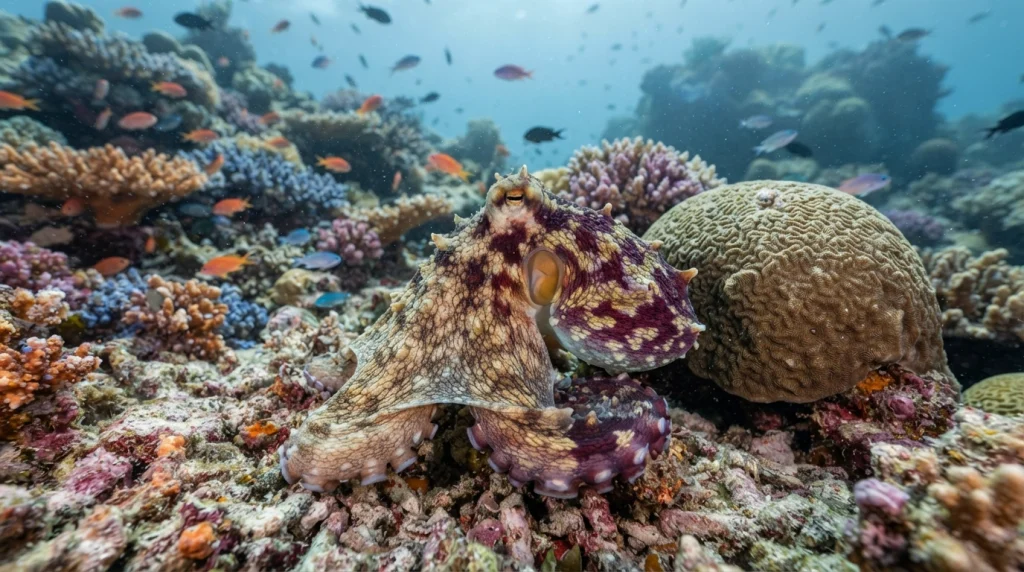
Octopus Camouflage Includes Texture
Color alone would not make an octopus disappear against a complicated reef.
A smooth animal sitting on rough coral would still produce an obvious outline even if its colors were nearly perfect.
Many octopuses solve this problem using muscular structures in the skin called papillae. These structures can alter the surface from relatively smooth to raised, rough, or pointed.
An octopus resting beside algae or coral can therefore change both its pigmentation and its apparent texture.
The combination is especially powerful because predators often detect prey through edges, shadows, outlines, and surface irregularities rather than color alone.
Effective octopus camouflage attacks several of those visual clues simultaneously.
How an Octopus Chooses the Right Pattern
An octopus does not necessarily reproduce every tiny feature of the surrounding environment.
Research on cephalopod camouflage suggests that these animals respond to important visual characteristics such as contrast, edges, spatial scale, and prominent objects.
Scientists commonly describe cephalopod camouflage patterns using broad categories such as uniform, mottled, and disruptive appearances.
Uniform patterns can work well against relatively consistent backgrounds.
Mottled patterns introduce patches of different brightness, helping the animal merge with visually irregular environments.
Disruptive patterns take another approach.
Strong contrasting patches can cross the apparent boundaries of the body, making the outline harder to recognize. Instead of making every square centimeter match the reef, the pattern interferes with an observer’s ability to identify the octopus as a coherent object.
For another example of an ocean animal using extraordinary visual biology, see Why the Colossal Squid Has the Largest Eyes of Any Animal Alive.
The Strange Color-Blindness Paradox
One of the most intriguing mysteries surrounding octopus camouflage is that many studied cephalopods appear to have limited conventional color vision.
Their eyes are exceptionally sophisticated, yet most studied species have only one main visual pigment rather than the multiple photoreceptor types humans use to distinguish colors.
This creates an apparent paradox.
How can an animal produce such convincing color matches while apparently lacking human-like color vision?
Scientists continue to investigate the question.
Brightness, contrast, polarization, spectral properties of the environment, and other visual cues may all contribute. Researchers have also explored hypotheses involving light-sensitive molecules outside the eyes, although these possibilities do not mean that octopus skin simply “sees” color in the same way a human eye does.
The safest conclusion is that excellent camouflage does not require the same visual system humans use.
Evolution can reach similar functional outcomes through very different sensory mechanisms.
Camouflage for Defense
Octopuses are soft-bodied animals without the heavy shells that protected many ancestral mollusks.
Remaining unseen is therefore enormously valuable.
A well-camouflaged octopus can avoid attracting the attention of fish, marine mammals, and other predators. Remaining motionless while displaying an appropriate pattern can make the animal surprisingly difficult to distinguish from the seafloor.
When concealment fails, the strategy can change rapidly.
Some octopuses suddenly become darker, paler, or more contrasting. Others combine visual displays with rapid movement, ink release, or escape into narrow crevices.
Octopus camouflage is therefore part of a broader defensive toolkit rather than an isolated ability.
Camouflage Also Helps Octopuses Hunt
The same system that hides an octopus from predators can hide it from prey.
Many octopuses hunt crustaceans, mollusks, fish, and other marine animals. Approaching without being recognized allows a predator to reduce the distance before attacking.
This makes camouflage both defensive and offensive.
A reef octopus moving through a complex environment may repeatedly modify its appearance as the visual background changes beneath it.
A pale sandy area may demand one pattern, while rocks, coral rubble, algae, and shadows require completely different combinations.
The animal can transition among these visual environments without carrying a fixed camouflage pattern.
That flexibility is one of its greatest advantages.
Color Change Can Also Become a Signal
Not every dramatic color transformation is intended to make an octopus invisible.
Cephalopods also use body patterns during interactions with predators, prey, rivals, and potential mates.
A sudden high-contrast display can make an animal conspicuous rather than hidden.
Blue-ringed octopuses provide a famous example. When disturbed, their characteristic blue markings become dramatically visible, functioning as a warning associated with an animal possessing powerful venom.
Other visual changes may occur during aggression, courtship, hunting, or defensive behavior.
The same biological equipment underlying octopus camouflage can therefore serve multiple purposes depending on context.
Why the Human Eye Struggles to Follow the Change
The title “faster than the human eye can track” describes the experience well, but it should not be interpreted as a single scientifically defined speed threshold.
Human visual perception does not operate like a camera with one universal frame rate.
What makes octopus transformation difficult to follow is the combination of speed and complexity.
Thousands of chromatophores can change while reflective structures alter the optical appearance and muscles reposition the body. Texture, posture, contrast, and pattern may all shift during the same brief event.
To a diver, one moment may reveal an obvious octopus.
A moment later, the same animal appears to have dissolved into rock and coral.
High-speed video allows researchers to slow these transformations down and examine individual components that are difficult to appreciate during real-time observation.
The Importance of Body Shape
A perfectly colored octopus could still be detected if its silhouette remained unmistakably octopus-shaped.
Fortunately for the animal, its body is extraordinarily flexible.
With no rigid external skeleton, an octopus can flatten itself, raise portions of its mantle, curl or extend its arms, and squeeze into irregular spaces.
Behavior completes the illusion.
An octopus mimicking an uneven patch of reef may arrange its arms so they no longer resemble eight obvious appendages. Some species can position themselves among algae while moving in ways that complement their coloration.
Successful octopus camouflage is therefore produced by skin, nervous system, posture, texture, and behavior acting together.
Mimicry Takes the System Even Further
Some octopuses do more than disappear.
The mimic octopus, Thaumoctopus mimicus, is famous for combining body pattern, posture, and movement in displays resembling other marine organisms.
This is different from straightforward background matching.
Instead of visually becoming part of the habitat, the animal can produce an appearance that resembles something predators may hesitate to approach.
Mimicry demonstrates the flexibility of the same basic biological machinery.
The skin is not programmed to create only one disguise. It is part of a behavioral system capable of producing dramatically different visual outcomes.
A Living Display Without a Screen
Thinking of octopus camouflage as a biological display helps explain why it fascinates scientists and engineers.
A conventional screen contains large numbers of independently controlled pixels. Octopus skin similarly contains enormous numbers of small controllable units, but those units are embedded in flexible living tissue.
They operate while the surface stretches, folds, swims, and changes three-dimensional shape.
That is a major engineering challenge.
Human-made displays usually perform best on rigid or carefully manufactured surfaces. An octopus achieves dynamic visual control over a body that is almost continuously deforming.
What Octopus Skin Is Teaching Engineers
Researchers studying cephalopods have helped inspire experimental adaptive materials.
Engineers are interested in surfaces capable of changing color, reflectance, texture, or shape in response to signals.
Potential applications extend beyond literal camouflage.
Cephalopod-inspired research may contribute to flexible displays, responsive materials, soft robotics, optical technologies, and surfaces that regulate how they interact with light.
Biology provides the inspiration rather than a ready-made blueprint.
An artificial material does not need to reproduce an octopus exactly. Instead, researchers can study principles such as expandable pigment structures, multilayer reflectors, distributed control, and reversible texture change.
Millions of years of evolution have already demonstrated that dynamic surfaces are possible.
Frequently Asked Questions
How fast can an octopus change color?
Many visible changes can occur in less than a second, although the exact timing depends on the species, behavior, pattern, and structures involved.
Rapid neural control of chromatophores allows these transformations to happen much faster than pigment-production mechanisms found in many other animals.
Do octopuses change color only for camouflage?
No.
Although octopus camouflage is one of the best-known functions, changes in appearance can also occur during communication, courtship, hunting, aggression, warning displays, and defensive encounters.
Are chromatophores cells?
In cephalopods, the visible chromatophore system is more accurately described as a chromatophore organ involving a central pigment sac, radial muscles, nerves, and associated tissues.
This organization helps explain the speed of the response.
Can octopuses change skin texture?
Many species can.
Muscular papillae can alter the three-dimensional surface of the skin, helping the octopus resemble rough coral, rocks, algae, or other structures.
Can an octopus become any color?
No.
Its visual range is constrained by its pigments, reflective structures, anatomy, illumination, and species-specific biology. The impressive result comes from combining these mechanisms rather than possessing an unlimited palette.
Conclusion
Octopus camouflage is one of the most sophisticated examples of dynamic appearance change in the animal kingdom.
Thousands of neurally controlled chromatophores expose and conceal pigments while reflective structures manipulate incoming light. At the same time, muscles can alter skin texture, posture, and the overall outline of the animal.
The transformation is so effective because an octopus does not depend on color alone.
It can manipulate contrast, brightness, pattern, texture, body shape, and behavior as parts of one coordinated system.
What appears to a diver as an almost magical disappearance is actually the result of specialized anatomy and exceptionally fast neural control.
An octopus resting on a reef is therefore carrying something extraordinary across every centimeter of its body: a flexible biological display capable of changing its visual identity almost instantly.
Internal Link Suggestions:
- Why the Colossal Squid Has the Largest Eyes of Any Animal Alive — https://secretsofthegreengarden.com/colossal-squid-eyes/
- At Night, Coral Reefs Come Alive: The Hidden World of Coral Polyps — https://secretsofthegreengarden.com/coral-polyps-night-feeding/
External Dofollow Authoritative Sources:
- Smithsonian Ocean — How Octopuses and Squids Change Color
https://ocean.si.edu/ocean-life/invertebrates/how-octopuses-and-squids-change-color - Marine Biological Laboratory — Roger Hanlon, Cephalopod Camouflage Research
https://www.mbl.edu/research/faculty-directory/Roger%20Hanlon - PubMed Central / Royal Society — Mechanisms and Behavioural Functions of Structural Coloration in Cephalopods
https://pmc.ncbi.nlm.nih.gov/articles/PMC2706477/