
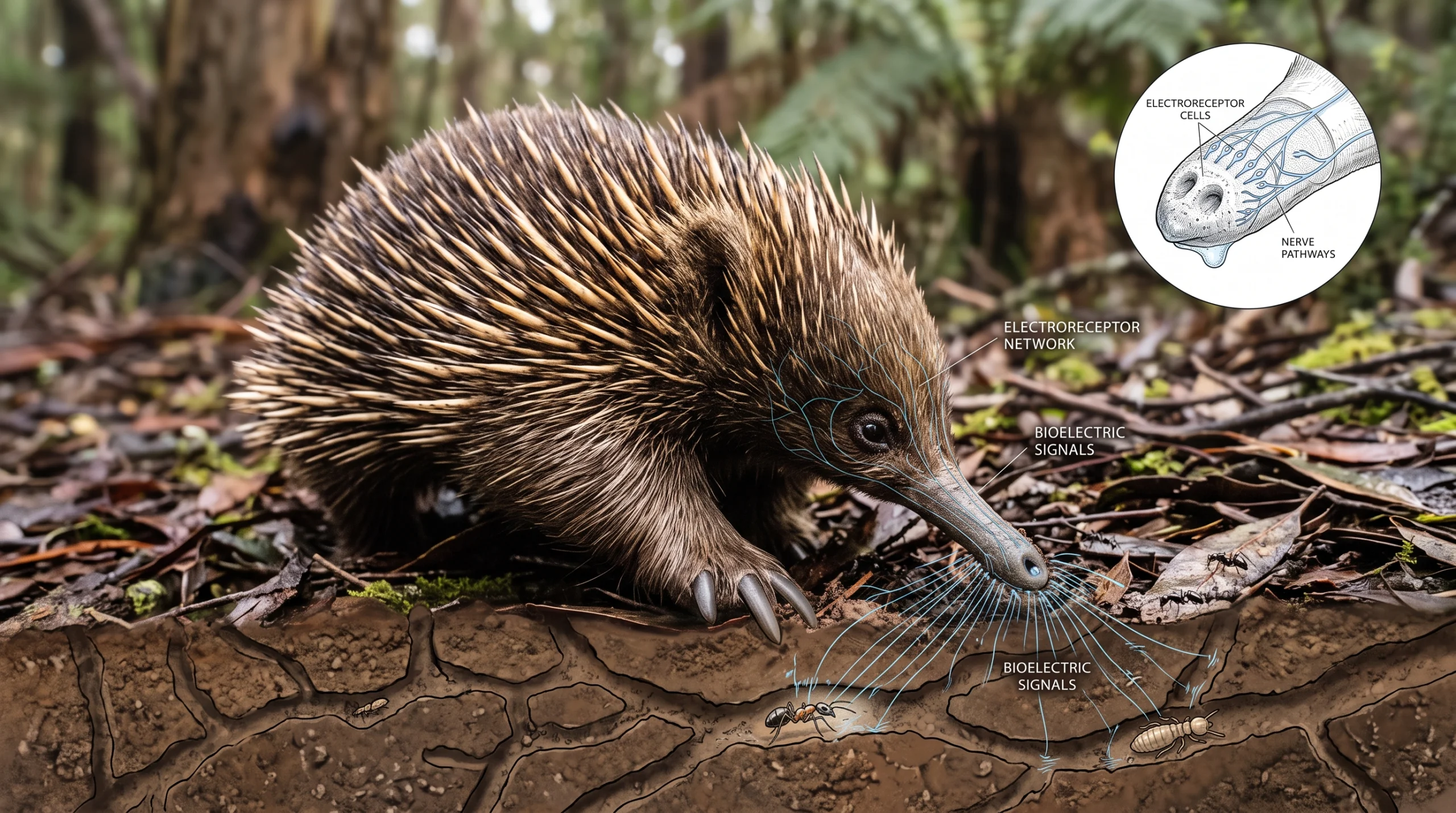
An echidna moving across an Australian forest floor can look almost methodical. Its head stays low as it noses through leaf litter, investigates rotting wood and presses its long, narrow snout against patches of soil. When it finds a promising feeding site, powerful claws take over, opening ant nests, termite galleries and other places where small invertebrates are hidden.
Much of this search depends on familiar senses, especially smell and touch. Yet the echidna’s snout also carries a much less familiar sensory system. Specialized structures in its skin are capable of responding to weak electrical stimuli, giving echidnas a form of electroreception.
The ability is real, but it is easy to exaggerate. An echidna does not scan underground prey from a distance with biological radar. Its electroreception is substantially less developed than that of its close relative, the platypus, and researchers are still investigating exactly how important it is during natural foraging.
Instead, the evidence points toward something more subtle and biologically interesting. The echidna’s snout is a multisensory probe in which touch, mechanical information, smell and a limited electrical sense can potentially contribute information as the animal searches for food.
The Echidna’s Snout Is a Specialized Sensory Tool
The short-beaked echidna, Tachyglossus aculeatus, has an elongated snout that is particularly well suited to close investigation of its surroundings.
During foraging, the animal moves its snout over and into substrates such as loose soil, leaf litter, decaying vegetation and fallen timber. It may investigate cracks and small openings before using its strong forelimbs and claws to expose insect colonies.
The snout is therefore much more than a structure surrounding the nose and mouth. Its skin contains specialized sensory structures connected to the nervous system.
A highly sensitive tactile surface
Mechanical information is particularly important at such close range.
When the tip of the snout touches soil, bark or an insect gallery, deformation and vibration in the surface can provide information about what the echidna is encountering. Specialized mechanosensory structures in monotreme snout and bill skin include structures commonly called push rods.
Push rods contain specialized cellular and nerve arrangements capable of responding to mechanical deformation. Associated sensory endings include structures that can contribute information about pressure, touch and vibration.
This makes sense for an animal that often searches where vision provides little useful information. A snout inserted into leaf litter or pressed against soil is already in direct physical contact with the environment, allowing mechanical cues to become especially informative.
Electroreception adds another potential channel to this sensory stream.
What Electroreception Actually Means
Electroreception is the ability of an animal to detect electrical fields or electrical changes in its surroundings.
It should not be confused with the production of powerful electricity by animals such as electric eels. Electroreceptive animals do not necessarily generate a specialized electric field themselves. Instead, receptors in their bodies respond to electrical stimuli originating in the environment.
Living animals naturally produce extremely weak electrical activity. Nerve impulses depend on movements of charged ions across cell membranes, while muscle contractions involve electrical activity associated with activation of muscle fibers.
Under suitable conditions, biological electrical activity can create weak electric fields in the surrounding medium.
Water conducts electrical signals far more effectively than air, which helps explain why electroreception is particularly common among aquatic and semi-aquatic vertebrates, including several groups of fishes.
Detecting comparable signals on land is considerably more difficult.
That environmental limitation makes echidnas scientifically unusual. They are fully terrestrial mammals, yet physiological experiments have demonstrated electroreceptive structures in their snouts.
Electroreceptors in the Echidna’s Snout
Some of the clearest physiological evidence for echidna electroreception came from experiments published in The Journal of Physiology in 1989.
Researchers recorded activity from sensory nerve fibers supplying the upper jaw of short-beaked echidnas. They identified individual sensory units that responded to weak electrical stimulation applied to moist areas of the snout.
The responsive areas were concentrated around the snout tip.
These experiments provided direct physiological evidence that the echidna possesses receptors capable of responding to electrical stimuli rather than merely reacting to pressure or vibration.
Sensory structures derived from glands
Anatomical work on monotremes has linked electroreception to specialized structures generally described as sensory mucous glands.
These structures are thought to represent modified glandular systems that have acquired a sensory function. They possess specialized epidermal regions supplied by sensory nerve fibers.
In both echidnas and platypuses, electrical stimulation of these structures can produce activity in sensory nerves.
Their distribution is important. Electroreceptive structures occur alongside mechanosensory structures, meaning the snout can potentially supply the nervous system with several different categories of information at approximately the same time.
The arrangement is much more elaborate in the platypus bill than in the echidna snout.
Finding Food Beneath Leaves and Soil
Short-beaked echidnas feed heavily on ants and termites, although their diet can include other small invertebrates depending on habitat and availability.
Finding these animals requires several stages.
First, an echidna must locate a promising feeding area. Odors can provide valuable information at this stage. Echidnas have a well-developed olfactory system, and comparative genomic research has also highlighted the importance of olfactory receptor genes in the echidna lineage.
Once the animal reaches a likely feeding site, close-range investigation becomes increasingly important.
The snout can probe loose material and openings. Mechanical receptors can register contact, texture and movement. Smell can continue providing chemical information. If conditions permit, electroreceptors may contribute additional information from weak electrical fields associated with living organisms.
The critical word is may.
The presence and physiological function of electroreceptors in echidnas are well established. Their exact contribution to everyday prey detection in natural environments is less firmly resolved.
It is therefore inaccurate to describe an echidna simply detecting an ant several centimeters underground and digging directly toward it solely because of the ant’s electrical field.
A more defensible interpretation is that electroreception can provide an additional short-range cue under favorable conditions as part of a much broader sensory system.
Moisture Makes Electrical Detection More Useful
The difference between water and dry air is central to understanding echidna electroreception.
Electrical currents associated with biological activity require a conductive medium if they are to produce detectable fields beyond the body. Water containing dissolved ions provides such a medium far more effectively than dry air.
Moist soil can also provide conductive pathways that dry, loose substrate cannot provide as effectively.
This creates an important ecological constraint for echidnas.
Their electroreceptors are located at the end of a snout that frequently contacts soil, litter and other surfaces. When those surfaces are damp, electrical coupling between the environment and the sensory structures is much more favorable.
Under very dry conditions, the usefulness of the system should be considerably reduced.
Laboratory experiments demonstrating echidna electroreception have consequently involved moist skin and conductive conditions. Reviews of animal electroreception emphasize that the echidna should not be interpreted as possessing an electrical sense that operates efficiently through dry air.
This moisture dependence also offers a plausible explanation for why a terrestrial mammal can retain a sensory system more commonly associated with aquatic animals.
An echidna pressing its snout into damp substrate temporarily creates conditions far more favorable to electrical detection than an animal attempting to sense the same field through air.
Echidna Versus Platypus
The contrast between echidnas and platypuses demonstrates how dramatically ecology can influence the usefulness of a sensory system.
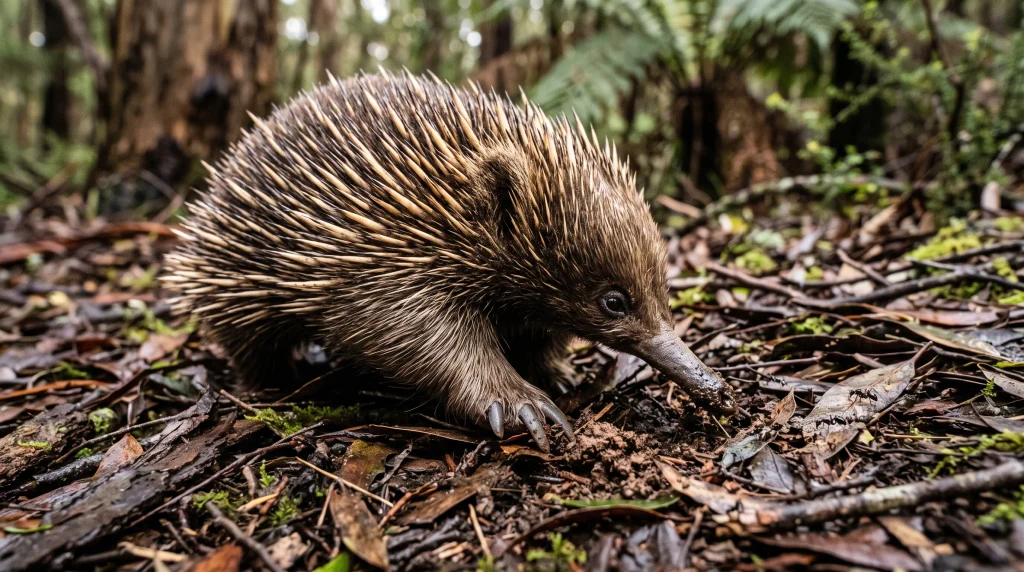
Both animals are monotremes, the egg-laying branch of living mammals. Both possess electroreceptive structures associated with specialized skin on the snout or bill.
The similarities largely end there.
The platypus is a semi-aquatic predator that searches underwater for animals such as aquatic insect larvae, worms and crustaceans. When submerged, it closes its eyes, ears and nostrils. Sensory information from the bill becomes crucial.
The platypus bill contains an extraordinarily elaborate combination of mechanoreceptors and electroreceptors. Experiments have shown that platypuses can respond behaviorally to weak electric fields, while neurophysiological research has demonstrated extensive processing of electrosensory and mechanical information.
Researchers have proposed that integrating these signals helps platypuses locate moving prey underwater.
The echidna has a much more limited electroreceptive apparatus. Its terrestrial environment also provides much poorer conditions for electrical signals to propagate.
For an echidna, smell and tactile investigation remain major components of food searching. Electroreception appears to be an additional specialized capability rather than the dominant sensory system seen in underwater platypus foraging.
That difference makes the echidna especially interesting. It shows that an electroreceptive system can persist in a mammal that has become thoroughly adapted to life on land.
An Ancient Monotreme Sensory Legacy
Monotremes occupy one of the major surviving branches of the mammalian evolutionary tree.
Living monotremes consist of the platypus and echidnas. They share several distinctive reproductive features, most famously egg laying, while also possessing the defining mammalian characteristics of hair and milk production.
Their unusual combination of characteristics has sometimes led to misleading descriptions of monotremes as primitive mammals or living fossils.
Modern echidnas are neither primitive nor unchanged remnants of the distant past. They are specialized animals produced by their own long evolutionary history.
Electroreception nevertheless raises an intriguing evolutionary issue.
Because electroreceptive structures occur in both living platypus and echidna lineages, researchers have proposed that some form of electroreception may have been present in their shared monotreme ancestry. Comparative anatomical and fossil evidence has been used to explore how this sensory system may subsequently have changed as platypus ancestors became increasingly specialized for aquatic feeding and echidna ancestors adapted to terrestrial insectivory.
The precise evolutionary sequence remains a subject of interpretation.
What is clear from living animals is that electroreception has followed very different trajectories within monotremes. In the platypus it became an exceptionally important component of an aquatic sensory system. In echidnas, it is far more restricted.
Some researchers have even discussed whether the relatively reduced electroreceptive system of modern echidnas could represent a sensory capability that has become less important during adaptation to terrestrial environments.
That remains an evolutionary interpretation rather than proof that the sense has no useful modern function.
A Multisensory Foraging System
Thinking of echidna electroreception as an isolated super-sense misses one of the most important principles of animal sensory biology.
Animals routinely combine information from different sensory channels.
An echidna approaching a termite colony does not need one sense to perform every stage of the search. Odor may indicate a promising location. Touch can reveal the texture of the substrate. Vibrations or other mechanical disturbances may provide additional clues. Electrical information may potentially contribute when the snout is close to living prey in suitably moist material.
The brain can then use overlapping sensory information to guide behavior.
This is known broadly as multisensory integration, in which information from different sensory systems contributes to perception and decision-making.
Such integration can be especially valuable when individual signals are unreliable.
An odor can disperse. A vibration can originate from several sources. An electrical signal can become difficult to detect as conductivity decreases. Combining sensory channels gives an animal more information than relying exclusively on one cue.
The echidna’s snout is particularly well positioned for this task because several sensory systems converge on the same small region that the animal actively presses against potential feeding sites.
What Scientists Still Do Not Know
Electroreception in echidnas provides an important example of the difference between demonstrating a sensory capability and understanding its full ecological role.
Physiological experiments establish that receptors in the echidna snout respond to electrical stimulation. Anatomical studies identify specialized sensory structures associated with those responses.
Those findings do not automatically tell researchers how frequently echidnas depend on electrical information while foraging in the wild.
Natural environments are much more complicated than controlled experiments.
Soil moisture varies dramatically. Substrate composition affects conductivity. Prey differs in size, depth and activity. Odor and mechanical cues may sometimes provide much stronger information than electrical fields.
The relative importance of electroreception could therefore change according to local conditions.
Further field experiments could help determine how echidnas weigh electrical cues against odor and mechanical information, how substrate moisture influences their behavior, and whether electroreception becomes particularly valuable when other sensory signals are weak or ambiguous.
Comparisons among different echidna species could also help scientists understand how electroreceptive systems have changed during monotreme evolution.
For now, the most scientifically secure conclusion is carefully bounded. Echidnas possess genuine electroreceptors, but the degree to which these receptors contribute to prey localization under different natural conditions remains less completely understood than electroreception in the platypus.
A Remarkably Sophisticated Snout
An echidna pushing its narrow snout into damp leaf litter may appear to be performing a simple search for insects.
At the sensory level, the process is considerably more sophisticated.
The snout is simultaneously a physical probe, a sensitive tactile surface and part of an olfactory search system. Embedded within its specialized skin are also receptors capable of responding to weak electrical stimuli.
Electroreception does not turn an echidna into a living underground radar system. Its range and ecological importance should not be exaggerated, particularly when compared with the extraordinarily developed electrical sense of the platypus.
Instead, its significance lies in how it complements other information.
Smell helps identify promising places. Touch and mechanoreception provide immediate information about surfaces and movement. Under suitably moist conditions, electroreception may add another clue associated with nearby living organisms.
The result is a remarkable example of multisensory evolution. Beneath the echidna’s seemingly simple habit of pressing its snout against the ground lies an unusually diverse collection of sensory adaptations, allowing an animal with modest eyesight and a highly specialized diet to investigate a complex world hidden beneath leaves, bark and soil.
Sources and Further Reading
Gregory, J. E., Iggo, A., McIntyre, A. K., & Proske, U. — 1989. “Responses of electroreceptors in the snout of the echidna.” The Journal of Physiology, 414, 521–538. This experimental study provides direct electrophysiological evidence for electroreceptors in the short-beaked echidna.
Proske, U., Gregory, J. E., & Iggo, A. — 1998. “Sensory receptors in monotremes.” Philosophical Transactions of the Royal Society B: Biological Sciences, 353. A review of mechanosensory and electroreceptive structures in the platypus and echidna.
Pettigrew, J. D. — 1999. “Electroreception in monotremes.” Journal of Experimental Biology, 202, 1447–1454. A review comparing electroreception and sensory processing among monotremes.
Scheich, H., Langner, G., Tidemann, C., Coles, R. B., & Guppy, A. — 1986. “Electroreception and electrolocation in platypus.” Nature, 319, 401–402. Classic experimental evidence demonstrating electroreception in the platypus.
Pettigrew, J. D., Manger, P. R., & Fine, S. L. B. — 1998. “The sensory world of the platypus.” Philosophical Transactions of the Royal Society B: Biological Sciences, 353. A detailed examination of sensory processing and the integration of mechanical and electrical information in the platypus.
England, S. J., & Robert, D. — 2022. “The ecology of electricity and electroreception.” Biological Reviews. A modern review examining biological electric fields, electroreception and the physical environments in which electrical sensing operates.
Australian Museum. “What is a monotreme.” Background information on living monotremes, including the platypus and echidnas.