
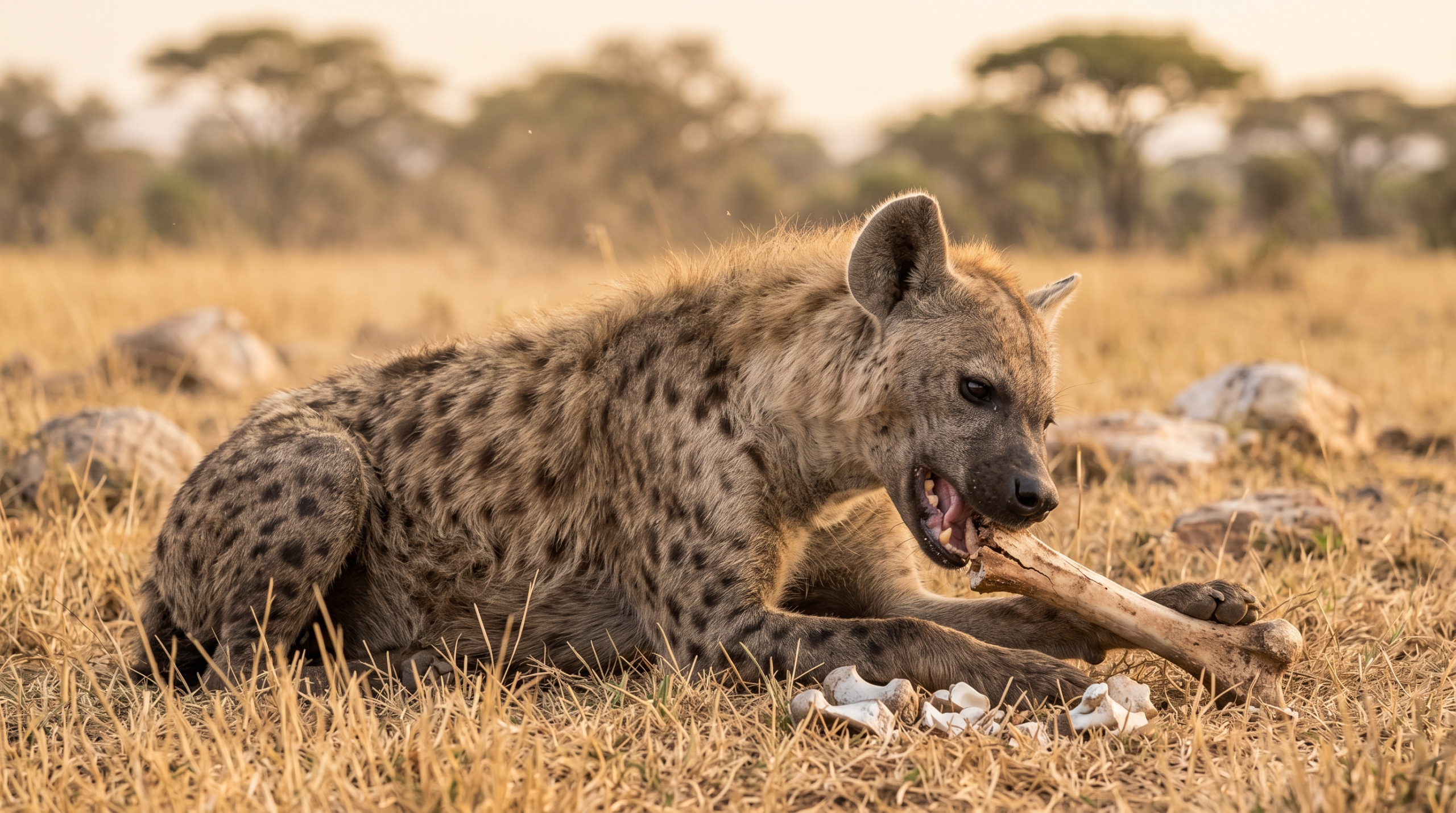
A spotted hyena approaches the remains of an ungulate carcass. Much of the obvious meat may already be gone, but the carcass is far from nutritionally irrelevant. Skin, connective tissue, marrow and substantial portions of the skeleton can still represent usable food.
For Crocuta crocuta, hard skeletal material is not simply an obstacle.
Spotted hyenas possess an integrated combination of robust skull architecture, powerful jaw muscles, specialized teeth and digestive physiology that allows them to fracture, swallow and process bone to an extent unusual among large mammalian carnivores.
This ability has helped create one of the most persistent misconceptions about the species: that hyenas are scavengers surviving mainly on scraps abandoned by more impressive predators.
They are not.
Spotted hyenas are accomplished hunters in their own right. Bone processing complements that predatory ability by allowing them to exploit carcasses unusually thoroughly.
Understanding spotted hyena bone crushing therefore requires looking at the complete feeding system—from obtaining a carcass and selecting hard tissues to mechanically breaking bone, chemically processing swallowed fragments and eventually excreting material that was not absorbed.
A Predator That Leaves Surprisingly Little Behind
Large herbivore carcasses contain far more potential nutrition than exposed muscle.
Once the easiest flesh has been removed, substantial resources can remain in organs, connective tissues, skin, marrow and mineralized skeletal tissues.
Spotted hyenas are unusually well equipped to exploit many of these resources.
At a carcass, a hyena can tear soft tissue using the slicing portions of its dentition while also processing much harder material with robust teeth farther forward in the cheek-tooth row.
This does not mean every carcass is stripped of literally everything.
Teeth, hair, portions of hooves and other resistant material may remain or pass through the digestive system incompletely processed. Carcass use also varies with hunger, competition, prey size and the amount of food available.
What makes the spotted hyena exceptional is the range of tissues it can use—not an imaginary ability to make every trace of a carcass disappear.
First, Hyenas Are Not Just Scavengers
The stereotype of the hyena waiting for a lion to finish eating is biologically inaccurate.
Spotted hyenas regularly kill their own prey.
They can hunt alone, particularly when pursuing smaller animals, and cooperate when tackling larger or more challenging prey. Their social system allows multiple clan members to participate in hunts, although group size and hunting tactics vary considerably.
The balance between hunting and scavenging is not identical everywhere.
Prey availability, competitor abundance, habitat, season and local ecological conditions can all influence how food is obtained. For that reason, a percentage measured in one population should never be presented as the universal proportion of food hunted by the species.
Hyenas also scavenge whenever doing so is profitable—which is exactly what an adaptable carnivore should do.
And food theft goes both ways.
Lions can appropriate kills made by spotted hyenas just as hyenas can exploit carcasses killed by lions or other predators. The outcome depends heavily on the animals present and the circumstances surrounding the carcass.
The scientific picture is therefore more interesting than the stereotype: spotted hyenas are predators, scavengers and competitors whose strategy changes with opportunity.
What Makes a Spotted Hyena’s Skull So Powerful?
A spotted hyena’s ability to process bone cannot be attributed to one spectacular anatomical feature.
The entire feeding apparatus matters.
The skull is robust and provides extensive areas for attachment of powerful jaw-closing muscles. The jaws, tooth row and cranial architecture work together to withstand substantial mechanical loading during feeding.
Large muscles generate force around the jaw joint. That force is transmitted through the mandible and concentrated at the teeth contacting the food.
Where along the tooth row the animal bites matters because the jaw functions mechanically as a lever.
A bite delivered farther back in the mouth can have different mechanical properties from one delivered at the front.
The geometry and strength of the skull also help it tolerate the stresses produced when hard material resists the bite.
Calling this arrangement a “biological hydraulic press” would be misleading. No hydraulic system is involved.
The impressive performance emerges from bones, muscles, joints, teeth and behavior functioning as one mechanical system.
The Teeth Built for Processing Bone
Hyena dentition is frequently misrepresented in popular illustrations.
The dramatic canine teeth attract attention, but they are not the primary bone-crushing tools.
Incisors
The smaller front teeth help with tasks such as gripping and removing tissue from food.
Canines
Large canines are useful for gripping prey and food and play important roles during predation and social interactions.
They are formidable teeth—but their appearance should not lead us to assign them every feeding function.
Premolars
The enlarged, robust premolars are especially important for processing hard material.
These teeth can contact bone over relatively concentrated areas while tolerating high loads. Their shape and position make them well suited to cracking hard skeletal tissues.
This is the key correction to the common claim that hyenas simply “crush bones with their fangs.”
Carnassials
Like other carnivorans, spotted hyenas also possess specialized carnassial teeth adapted for shearing.
These help slice flesh and other tissues.
The hyena’s dentition is therefore multifunctional. Different teeth contribute differently to gripping, cutting, tearing and hard-object processing.
How Does a Hyena Actually Crack a Bone?
Bone is strong, but it is not unbreakable.
When a hyena processes a hard skeletal element, it positions the material between appropriate teeth and applies force with the jaw-closing muscles.
The teeth concentrate that load onto a relatively small region.
If stresses within the bone exceed its structural resistance, cracks form and propagate until part of the bone fails.
The process is influenced by several factors.
A thin bone is mechanically different from a thick limb bone. Hollow geometry behaves differently from dense compact material. The location and orientation of the bite matter, as do the bone’s age, condition and existing damage.
Hyenas can also reposition difficult pieces and bite repeatedly.
The result should not be imagined as every bone exploding instantly after one effortless bite.
Spotted hyena bone crushing is skilled mechanical processing of a variable biological material.
Some bones and bone regions are considerably more difficult to fracture than others.
How Strong Is a Hyena’s Bite?
This is where scientific discussions are often replaced by viral rankings.
Claims such as “Animal X has a bite of exactly Y PSI” look authoritative but are frequently difficult to compare.
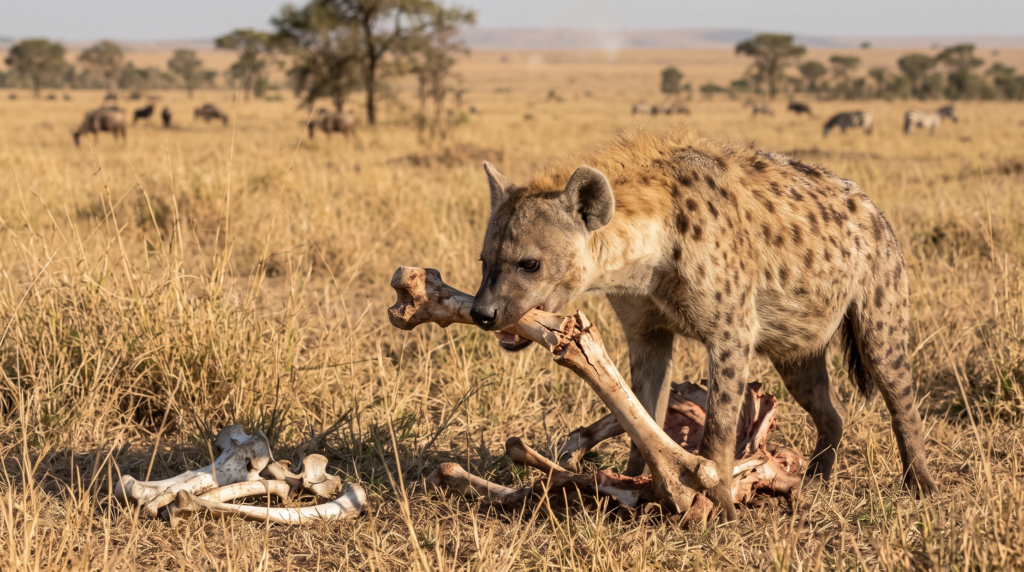
Bite force can be measured directly in living animals under particular conditions, estimated from skull and muscle anatomy, modeled biomechanically, or inferred using other methods.
Those approaches do not necessarily produce directly interchangeable numbers.
Bite position matters too.
Force delivered at the canine teeth is not equivalent to force at a posterior tooth closer to the jaw joint.
Body size creates another issue. Researchers may be interested in absolute bite force, whereas another comparison might examine force relative to body mass or skull dimensions.
Consequently, saying that one species simply has “the strongest bite” on the basis of an internet PSI table is scientifically weak.
For spotted hyenas, the more meaningful observation is that their cranial and dental system is highly specialized for generating and tolerating the forces required during hard-food processing.
Their actual ability to break bones provides stronger biological evidence than a sensational ranking.
Why Eat Bone at All?
Bone is not nutritionally equivalent to muscle, but neither is it useless rock.
Living bone is a composite biological tissue.
Its mineralized component contains large quantities of calcium and phosphorus, principally associated with calcium-phosphate minerals.
Bone also contains an organic matrix dominated by proteins such as collagen.
And some skeletal elements contain marrow within internal cavities.
This distinction matters because hyenas are sometimes described as cracking bones solely to obtain marrow.
They certainly can gain access to marrow by fracturing bones.
But spotted hyenas can also consume and digest substantial amounts of the bone tissue itself.
The behavior therefore extracts value from more than the material hidden inside a bone.
That gives hyenas access to resources that many competing carnivores exploit less completely.
From Crushed Bone to Swallowed Fragments
Mechanical processing comes first.
Large skeletal elements must be reduced to pieces that can be handled and swallowed.
A hyena grips and repositions the bone while repeatedly loading it with the premolars. Fractures create smaller pieces, and continued processing reduces difficult material into manageable fragments.
Chewing accomplishes more than making the food physically small enough to swallow.
Breaking bone increases the surface area exposed to digestive fluids.
That becomes important once the fragments enter the gastrointestinal tract.
Mechanical fragmentation and chemical digestion therefore complement one another:
teeth reduce the bone physically → digestion attacks the resulting fragments chemically.
The animal does not need to swallow an enormous intact limb bone to demonstrate impressive bone consumption.
Its specialization lies precisely in its ability to process hard material before and after swallowing.
What Happens Inside the Stomach?
Once swallowed bone enters the stomach, mechanical force is replaced by chemical processing.
Spotted hyenas possess a digestive system capable of handling diets containing substantial animal tissue and skeletal material.
The acidic gastric environment contributes to breaking down food and can promote dissolution of mineralized bone components.
Meanwhile, digestive enzymes act on accessible organic material.
Bone fragments already fractured by the teeth present more exposed surface to gastric contents than a large intact skeletal element would.
The stomach should not be portrayed as a container of magical acid capable of instantly dissolving anything placed inside it.
Different tissues resist digestion differently.
Some material continues into the intestine, where further digestion and absorption occur, while less digestible components eventually leave the body.
The remarkable feature is not limitless acidity.
It is the coordination between powerful mechanical processing and an effective carnivore digestive system.
Can Hyenas Really Digest Calcium From Bone?
Bone mineral is rich in calcium and phosphorus.
Acidic conditions can promote chemical dissolution of mineral components, making some of their constituents available for subsequent absorption.
But several biological processes must be distinguished.
Chemical dissolution changes mineralized material in the digestive tract.
Digestion breaks suitable organic molecules into forms that can be processed further.
Absorption transfers usable substances across the intestinal wall into the body.
Excretion removes material that remains unabsorbed.
These stages are not interchangeable.
A mineral entering a hyena’s stomach is not automatically absorbed in its entirety.
The accurate conclusion is that bone consumption provides access to mineral nutrients and organic material, and the hyena’s digestive physiology allows it to obtain nutritional value from skeletal tissues.
There is no need to claim 100% extraction to make the adaptation impressive.
Why Is Hyena Dung Sometimes White?
One conspicuous consequence of bone-rich feeding can appear after digestion is finished.
Hyena feces are sometimes pale, grayish or chalky-looking.
Heavy consumption of mineralized skeletal tissue can contribute substantial calcium-rich material to digestive residues, influencing the appearance of droppings.
This does not mean every spotted hyena scat is bright white.
Diet matters.
An animal consuming different proportions of flesh, organs, hair and bone can produce feces with different appearances. Environmental exposure after deposition can also alter how scat looks as it dries and weathers.
Pale, chalky feces are therefore a useful clue associated with substantial bone consumption, not a mandatory identifying feature of every hyena dropping.
What Parts of a Carcass Can Hyenas Consume?
Spotted hyenas have unusually broad feeding capabilities.
Depending on the carcass and circumstances, usable material can include:
- muscle;
- internal organs;
- skin;
- connective tissues;
- marrow;
- cartilage;
- substantial portions of bone.
This broad utilization is especially valuable when several carnivore species compete for the same carcass.
But phrases such as “hyenas eat absolutely everything” should be avoided.
Hair and highly resistant structures can be poorly digested. Teeth, portions of hooves and other hard material may remain, be discarded or pass through differently.
Carcass use also depends on how hungry the animals are and what alternative food is available.
Efficiency does not mean complete consumption under every circumstance.
Hyenas and Lions — Who Steals From Whom?
Popular culture often presents a simple sequence:
lion kills → lion eats → hyena steals leftovers.
Real interactions are far more dynamic.
Spotted hyenas can kill large prey themselves, and lions can subsequently take possession of those carcasses.
Hyenas can likewise displace other predators or exploit carcasses they did not kill.
The balance of power can depend on group composition.
Numbers of hyenas matter. Numbers of lions matter. The presence of adult male lions can alter the risk dramatically. Carcass size, location and how strongly each group is motivated to defend the food also influence the outcome.
This interaction is an example of kleptoparasitism—obtaining food captured by another animal.
Neither species permanently occupies the role of thief or victim.
Their relationship includes competition, carcass theft, direct aggression and simultaneous use of overlapping prey resources.
A Hunter With an Exceptional Digestive Toolkit
The combination is what makes spotted hyena feeding ecology so effective.
If Crocuta crocuta were merely able to digest bone but incapable of securing carcasses, the specialization would be less useful.
If it were an excellent hunter but unable to exploit hard remains, it would leave more potential food inaccessible.
Instead, spotted hyenas combine sophisticated hunting behavior with highly effective carcass processing.
They can pursue and kill prey.
They can scavenge opportunistically.
They can compete with other large carnivores.
And once they gain access to a carcass, they can exploit tissues ranging from soft organs and muscle to hard skeletal material.
That flexibility is particularly valuable in ecosystems where access to food changes from one day to the next.
Does Bone Crushing Damage Their Teeth?
Specialization does not make teeth indestructible.
Bone is mechanically demanding food.
Repeated contact with hard skeletal material produces wear, and teeth can become damaged or fractured.
Adult mammalian permanent teeth do not simply regrow every time they break.
The spotted hyena’s robust premolars and cranial adaptations reduce the risks associated with processing hard foods, but they cannot eliminate basic mechanical limits.
This creates an evolutionary tradeoff.
Teeth need shapes capable of concentrating enough force to fracture hard material while remaining resistant enough to survive repeated loading.
Age-related wear can also alter feeding performance.
A hyena capable of crushing bone is therefore not immune to the consequences of doing so.
Its anatomy is adapted to manage those stresses.
Why Don’t Lions Process Bones the Same Way?
Lions can chew and consume bone.
They should not be described as incapable of breaking skeletal material.
But lions and spotted hyenas differ in the degree to which their skulls and teeth are specialized for hard-object processing.
Spotted hyenas are particularly well adapted for durophagy.
Durophagy means feeding on hard materials. Depending on the animal, that can involve bones, shells or other mechanically resistant foods.
In spotted hyenas, enlarged robust premolars, cranial architecture and powerful jaw musculature form a feeding system capable of repeated bone processing.
Lions possess a different balance of feeding specializations associated with capturing large prey and processing flesh.
The distinction is therefore relative, not absolute.
Both can interact with bone.
Spotted hyenas are simply much more specialized for making substantial skeletal material a routine part of feeding.
Other Bone-Crushing Hyenas
The spotted hyena is one member of the family Hyaenidae.
Living hyaenids also include the brown hyena, striped hyena and aardwolf.
Brown and striped hyenas are capable scavengers and can process hard carcass material, but their ecology is not identical to that of spotted hyenas.
The aardwolf provides the most dramatic contrast.
Rather than specializing in large carcasses and skeletal tissues, the aardwolf feeds predominantly on insects—especially termites.
Its skull and dentition reflect this radically different diet.
This diversity demonstrates why statements about “hyenas” should not automatically be applied equally to every living hyaenid.
They share evolutionary ancestry.
They do not share identical feeding strategies.
The Ecological Value of Efficient Carcass Use
A large carcass is a temporary concentration of nutrients.
Once an animal dies, those nutrients can move through multiple ecological pathways.
Large carnivores consume flesh.
Vultures remove exposed soft tissues.
Hyenas can process soft and hard tissues.
Smaller scavengers exploit remaining fragments.
Invertebrates, fungi and microorganisms participate in decomposition.
Nutrients eventually return to soils, plants and broader food webs.
Spotted hyenas contribute to this process by accessing parts of carcasses that many other large carnivores use less extensively.
Their movement also redistributes nutrients. Material consumed at one location can later be excreted elsewhere.
This does not make hyenas the ecosystem’s “garbage disposal.”
That phrase understates both their role as predators and the complexity of decomposition.
They are better understood as large carnivores whose unusual feeding adaptations influence how energy and nutrients move through African ecosystems.
Common Misconceptions About Hyena Bone Crushing
“Spotted hyenas survive mainly on leftovers.”
No. They are capable predators and frequently kill their own prey. Hunting and scavenging contributions vary among populations and circumstances.
“Their canine teeth do all the bone crushing.”
No. Enlarged, robust premolars are particularly important in processing hard skeletal material.
“Hyenas crack bones only to get the marrow.”
Marrow is valuable, but spotted hyenas also consume substantial portions of the mineralized bone itself.
“A hyena can crush absolutely any bone.”
No biological feeding system is unlimited. Bone dimensions, structure, condition and bite placement influence whether and how it fractures.
“Every mineral swallowed from bone is absorbed.”
No. Dissolution, digestion, absorption and excretion are separate processes, and not all swallowed material is retained.
“Hyena stomach acid can dissolve anything.”
Their digestive system is highly effective at processing animal tissues and bone, but it is not chemically unlimited.
“Bone crushing never damages hyena teeth.”
Hard-object feeding produces mechanical wear and carries a risk of tooth damage.
“Lions always make kills and hyenas always steal them.”
Both species hunt, scavenge and can appropriate carcasses obtained by the other.
“All hyenas are specialized bone crushers.”
No. Feeding ecology differs substantially across Hyaenidae, with the termite-eating aardwolf providing an extreme example.
Frequently Asked Questions
Can spotted hyenas really crush bones?
Yes. Crocuta crocuta is highly specialized for durophagy and can fracture and consume substantial skeletal material. Bone-processing ability depends on the type, dimensions and condition of the bone as well as how it is positioned during biting.
Which hyena teeth are used to break bones?
The enlarged, robust premolars are particularly important for cracking hard material. The canines are prominent and powerful but should not be described as the principal bone-crushing teeth.
Do hyenas eat the bone itself or only the marrow?
Both can be valuable. Hyenas can expose and consume marrow, but they also swallow and digest substantial portions of bone tissue itself.
How can a hyena digest bone?
Mechanical crushing first breaks bone into smaller fragments. Acidic gastric conditions then help process organic tissues and dissolve mineralized material, after which usable nutrients can be absorbed farther along the digestive tract.
Why is hyena poop sometimes white?
Heavy bone consumption can leave feces rich in pale mineral residues, producing a chalky or whitish appearance. Not all hyena feces look this way because diet and weathering vary.
Are spotted hyenas hunters or scavengers?
Both. They are accomplished predators that can obtain substantial food through hunting while also scavenging whenever opportunities make doing so profitable.
Conclusion
The spotted hyena’s ability to turn a hard skeletal element into usable nutrition is not the product of one extraordinary tooth or a mythical stomach acid.
It is a system.
A robust skull provides the structural framework. Powerful jaw muscles generate force. Specialized premolars concentrate that force onto resistant material. Repeated mechanical loading fractures bone into manageable pieces.
The digestive system then takes over.
Acidic gastric conditions and digestive processes act on the crushed fragments, allowing the animal to obtain value from marrow, organic bone matrix and mineralized tissue before less digestible material is eventually excreted.
But spotted hyena bone crushing becomes truly significant only when viewed alongside the rest of the animal’s ecology.
Crocuta crocuta is not a passive scavenger built to survive on leftovers. It is an intelligent, social and highly capable predator that can also exploit carrion and process carcasses more extensively than many competing large carnivores.
That combination—predatory ability, behavioral flexibility, specialized teeth, powerful jaws and effective digestion—allows the spotted hyena to occupy a distinctive position in African food webs.
The bones other predators use less completely are not simply waste.
For a spotted hyena, they can still be food.
Internal-linking opportunities
- Link African carnivore competition to an article explaining interactions among lions, hyenas, leopards and other predators.
- Link durophagy to an article about animals specialized for eating mechanically hard foods.
- Link scavenger ecology to an article explaining how vertebrates, insects and microorganisms process animal carcasses.
- Link hyena social behavior to an article about spotted hyena clans, rank, cooperation and communication.
Authoritative external sources
- Holekamp Lab, Michigan State University — Long-term research on spotted hyena behavioral ecology, hunting, social organization and competition with other carnivores.
- Smithsonian’s National Zoo & Conservation Biology Institute — Species-level background on spotted hyena biology, feeding and ecology.
- IUCN Red List — Crocuta crocuta — Authoritative information on distribution, ecology, population status and conservation.
- Peer-reviewed research in the Journal of Zoology and Journal of Anatomy — Comparative work on hyaenid skull morphology, dentition, feeding mechanics and durophagous adaptations.
- Peer-reviewed carnivore biomechanics literature — Comparative research on bite mechanics, cranial performance and the limitations of using single bite-force values to rank carnivores.