

As daylight fades over a Southeast Asian rainforest, an orangutan moving through the canopy begins looking for somewhere to spend the night.
There is no permanent bedroom waiting.
Instead, the ape can stop in a suitable tree and create one.
Using powerful arms, hands, feet, and the branches immediately around it, an orangutan pulls vegetation inward, bends and partly breaks supporting branches, and adds smaller leafy material until a broad resting platform takes shape high above the forest floor.
These orangutan sleeping nests are among the most characteristic structures produced by wild great apes.
The popular description that an orangutan “builds a new bed every night” captures something real: adult wild orangutans frequently construct fresh night nests. But the rule is not absolute. Existing nests can sometimes be reused, and orangutans may also make less elaborate structures for daytime resting. Nesting behavior varies among individuals, populations, habitats, and circumstances.
Understanding how these nests are built reveals much more than a curious bedtime routine. It offers insight into orangutan cognition, physical skill, childhood learning, canopy life—and even how scientists estimate wild orangutan populations.
Every Evening, the Canopy Becomes a Bedroom
The word “nest” can be misleading if it makes us imagine a bird’s nest used for eggs and chicks.
An orangutan nest is primarily a resting and sleeping platform.
Wild orangutans—including Bornean orangutans (Pongo pygmaeus), Sumatran orangutans (Pongo abelii), and the closely related Tapanuli orangutan (Pongo tapanuliensis)—live much of their lives in trees. Building a stable resting structure allows a large-bodied ape to settle among branches instead of attempting to sleep directly on a narrow support.
Nest construction is deeply integrated into the orangutan daily cycle. Researchers studying wild animals commonly use departure from the morning nest and entry into the evening nest to define the beginning and end of an observation day.
The nest is temporary architecture, built from living vegetation already present in the tree.
Do Orangutans Really Build a New Nest Every Night?
Frequently, yes.
But not invariably.
Adult orangutans commonly build fresh night nests, while also constructing occasional daytime nests for rest. Modern work on the development of nest building describes night-nest construction as a regular daily skill in wild adults.
Yet nest reuse is also known.
Whether an animal constructs a completely new platform can depend on its movements, the presence of an older usable nest, local vegetation, weather, and individual behavior.
That distinction matters when scientists survey orangutan populations. If every visible nest were assumed to represent one different orangutan, estimates would be wildly misleading.
In fact, field population models must incorporate the average nest production rate, because an individual can produce more than one detectable nest over time. Surveys in Sabah have used observed daily nest-production values slightly above one nest per nest-building orangutan per day for particular Bornean populations.
So “a new bed almost every night” is a good shorthand.
“Exactly one new nest per orangutan every day” is not.
Choosing the Right Tree
An orangutan cannot build an effective sleeping platform just anywhere.
The arrangement of branches matters.
A useful location needs supports capable of bearing a large ape while also providing branches that can be bent, pulled, or broken into the structure.
Studies of orangutan nesting indicate that nests may be supported by a substantial single branch, groups of stable branches, or branching forks.
Tree architecture can therefore influence where an orangutan decides to stop.
Suitable construction material also needs to be within reach. An animal building from fresh branches benefits from having both relatively strong supporting elements and smaller, more flexible leafy branches available around the chosen position.
Researchers should be cautious when using human engineering language here.
There is no evidence that orangutans calculate loads, angles, or structural equations.
What the evidence does show is that their branch choices are not random.
Step One — Building the Foundation
The first major task is creating a structure capable of supporting body weight.
An orangutan typically pulls relatively substantial branches inward toward a central resting area. Branches may be bent and partially broken while remaining attached to the tree.
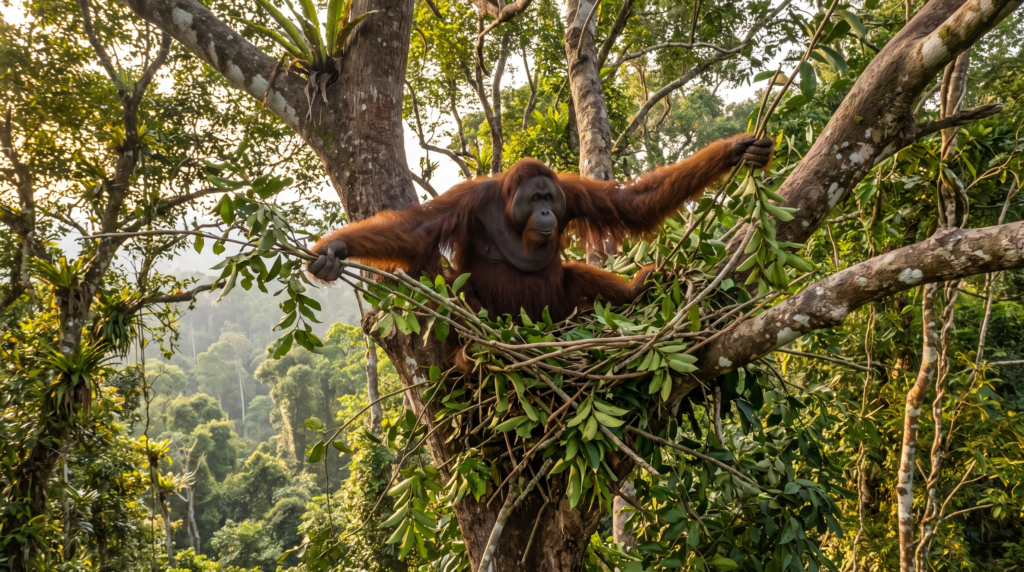
A biomechanical study of Sumatran orangutan nests found an especially interesting construction technique.
Large structural branches were often subjected to what engineers call greenstick fracture: the branch breaks only partly across instead of snapping completely free. Because part of the branch remains intact, it can be bent and incorporated into the nest while retaining attachment to the tree.
Researchers found that the branches used in the main structural portion of nests were thicker, stronger, and more rigid than material used for lining.
That provides unusually direct evidence that orangutans distinguish, behaviorally, between materials suited to different functions.
Step Two — Adding Smaller Branches
Once the principal support is established, smaller branches can be drawn into the center.
These increase the density of the platform and reduce large gaps.
The 2012 biomechanical study found that orangutans treated thinner branches differently from the heavier structural material. Rather than leaving all branches partly attached, they could follow a partial break with twisting movements that detached thinner material for use in the nest’s interior.
This produces a functional difference between parts of the structure.
Larger branches form much of the load-bearing base.
Smaller material helps create the surface on which the animal will actually rest.
The authors of the study described this as evidence of technical sophistication because the apes appeared to select materials according to relevant mechanical properties.
That does not mean an orangutan conceptualizes “structural engineering” in human terms.
It means its behavior is sensitive to what different branches can physically do.
Step Three — Making the Nest Comfortable
A sleeping platform must do more than prevent an orangutan from falling.
It also needs to provide a usable resting surface.
Smaller leafy twigs can be placed into the middle of the nest, creating a more compliant center. Biomechanical measurements found that orangutan nests were softer toward the central area than at the edges, a property the researchers suggested could contribute to both comfort and safety.
Descriptions of orangutan nest building sometimes use human words such as “mattress,” “pillow,” or “blanket.”
These can be helpful functional analogies, but they should not be taken literally.
An orangutan is not producing manufactured bedding. It is modifying vegetation so that different parts of the structure serve different resting functions.
Recent research on learning even distinguishes ordinary nests from nests with additional “comfort elements,” showing that young orangutans pay particular attention to more complex nest-building actions.
Do Orangutans Build Roofs?
Sometimes orangutans make additional modifications using leafy branches above or around the resting position.
Such structures are sometimes described as “roofs.”
The word can again exaggerate the similarity to human architecture.
An overhead arrangement of foliage may provide some shielding from rain or other environmental exposure, but it should not be imagined as a sealed, waterproof hut.
There is also behavioral variation among orangutan populations in the use of leaves during nest construction. Research has documented site-specific behaviors such as carrying leafy material to nest locations, contributing to broader evidence that orangutan nesting traditions can vary culturally.
Not every nest contains the same additional features.
How Strong Is an Orangutan Nest?
Strong enough to support a large arboreal ape—but not because every branch is maximally rigid.
A successful nest requires a combination of properties.
Structural branches need sufficient strength to carry body mass.
Yet some flexibility is useful because branches must be bent and incorporated into the structure without simply snapping away.
The van Casteren study experimentally tested branches from nests and found systematic differences between materials used for support and for lining. Orangutans selected thicker, mechanically stronger branches for the main structure and thinner material for other components.
This is one of the strongest pieces of evidence that orangutan construction involves functional material selection.
It is reasonable to call that technically sophisticated.
It is not necessary to claim that orangutans understand formal mechanics.
How Long Does It Take to Build One?
Orangutans can build a functional sleeping platform quickly, but there is no single construction time that applies to every nest.
Time varies according to the complexity of the structure, branch availability, whether an existing nest is being modified, and individual behavior.
Because the most reliable scientific observations come from particular animals and field sites, one recorded build duration should not be transformed into a universal species value.
The striking point is not a specific stopwatch number.
It is that orangutans repeatedly perform a multi-stage construction task during ordinary daily life, selecting a site, assembling supports, manipulating branches, and modifying the resting surface within a relatively short period.
Night Nests and Day Nests Are Not Always the Same
Orangutans sometimes build during the day as well.
Day nests can provide temporary resting places during pauses in feeding and travel.
They are not necessarily identical to night nests.
Recent research on immature orangutans found that young animals paid greater observational attention to more complex nesting behaviors, including night-nest construction and the addition of comfort elements, than to simpler day-nest behaviors.
That pattern is consistent with the idea that full night nests can require more elaborate construction.
A temporary daytime platform may be sufficient for a short rest.
A nest used for hours of nighttime sleep places different demands on stability and comfort.
Why Sleep Above the Ground?
For a primarily arboreal ape, remaining in the canopy avoids the need to descend every evening and climb back up the next morning.
A constructed platform also provides a broader and more stable sleeping surface than a bare branch.
Researchers have proposed several possible benefits of great-ape nests, including improved comfort, reduced heat loss, protection from some parasites or disturbances, and increased safety.
These functions are difficult to separate cleanly in the wild.
Predator avoidance may contribute in some environments, but it should not be presented as the sole reason orangutans sleep above ground.
For an animal already adapted to moving, feeding, and resting in trees, an elevated sleeping platform may offer several advantages simultaneously.
Does a Leafy Nest Keep an Orangutan Dry?
Foliage can reduce direct exposure, especially when leaves are positioned above or around an animal.
But an orangutan nest is not completely waterproof.
Rainfall in tropical forests can be intense, and nest protection depends on canopy cover, wind, leaf arrangement, nest location, and the amount of additional vegetation used.
Orangutans are also known to manipulate leaves in other rain-related contexts, illustrating their ability to use vegetation as immediate protection from weather.
Still, descriptions of “rainproof orangutan houses” go too far.
The better interpretation is that nest placement and leafy modifications can influence exposure without creating a sealed shelter.
What About Mosquitoes and Other Insects?
Claims that orangutans deliberately build nests from special “mosquito-repellent plants” require strong evidence.
At present, nest construction itself should not automatically be described as deliberate chemical pest control.
A leafy platform may physically change an animal’s exposure to insects, and different plant species certainly contain different chemical compounds. Orangutans are also capable of sophisticated plant use in other contexts.
But those facts do not prove that nest-building orangutans routinely select foliage because they understand its insect-repellent chemistry.
Physical shelter, botanical chemistry, and intentional medicinal or repellent use are separate hypotheses.
They should not be merged without experimental evidence.
Young Orangutans Have to Develop the Skill
A newborn orangutan does not immediately construct an adult-quality nest.
Youngsters spend years with their mothers, giving them extraordinary opportunities to observe how experienced orangutans move, feed, select plants, and build sleeping platforms.
A 2025 study of wild immature orangutans found strong evidence that observation contributes to nest-skill acquisition.
Young animals frequently watched—or “peered at”—others building nests. Peering was associated with increased nest-building practice, and youngsters paid particular attention to complicated, multi-step elements of construction.
Before independence, mothers were the principal individuals observed.
As immature orangutans aged, they increasingly watched other potential models as well.
This makes nest building difficult to classify as either purely instinctive or entirely taught.
Development appears to involve biological predispositions, practice, maturation, and substantial social learning.
A Young Orangutan’s Long Apprenticeship
Orangutan childhood is exceptionally long.
Sumatran orangutan mothers, for example, can provide care for offspring for roughly six to nine years, and the species has an unusually long interval between births.
During those years, young orangutans acquire a huge body of ecological knowledge.
They must learn how to travel through complex forest canopies, recognize hundreds of potential food items, process difficult foods, and eventually construct their own resting structures.
Nest building therefore belongs to a much broader apprenticeship.
It is one of many skills required before a young ape can function independently in a three-dimensional rainforest environment.
Do Orangutans Sleep Alone?
Orangutans are often described as semi-solitary, particularly compared with chimpanzees or gorillas.
But “solitary” does not mean every individual is always alone.
Mothers and dependent offspring maintain extremely close relationships. Youngsters can share maternal nests during early life, and later juveniles may construct their own nests nearby as independence increases.
Maternal care includes carrying, proximity, nest sharing, and providing opportunities for young orangutans to observe adult skills.
Independent adults generally construct and occupy their own resting sites, but orangutan social organization is more flexible than the stereotype of completely isolated apes suggests.
Orangutan Nests Are Valuable to Scientists
In dense tropical forest, seeing an orangutan directly can be difficult.
Seeing its abandoned nest may be easier.
Because orangutans regularly construct conspicuous canopy platforms that remain visible after the ape leaves, researchers can use nests as indirect evidence of orangutan presence and abundance.
Field teams may walk transects and record nests from the ground. In some regions, researchers have also conducted aerial surveys from helicopters, and newer work is exploring drone imagery and automated nest detection.
The basic logic sounds simple:
orangutans build nests → nests persist temporarily → scientists count them → nest density is modeled to estimate orangutan density.
The actual mathematics is considerably more complicated.
Why Counting Nests Is More Complicated Than It Sounds
One hundred nests do not mean one hundred orangutans.
To translate nests into population estimates, researchers must account for several variables.
One is nest production rate: how frequently individuals build detectable nests.
Another is the proportion of the population that actually builds nests. Very young dependent infants, for example, may share with their mothers rather than produce independent night nests.
Then there is nest decay.
Some nests remain visible for months, and persistence varies with forest type, climate, vegetation, and local conditions. Surveys in Borneo have reported markedly different average decay times between study areas and habitat types.
Detection probability also matters. Observers may miss nests because of canopy structure, viewing angle, nest age, or survey method.
Population researchers therefore use models incorporating nest density, production, decay, and detectability rather than simply treating every nest as one ape.
This link between ordinary sleeping behavior and conservation science is one of the most fascinating aspects of orangutan nests.
Common Misconceptions About Orangutan Sleeping Nests
“Every orangutan builds exactly one brand-new nest every night.”
Fresh night nests are common, but nests may sometimes be reused and additional day nests can also be constructed.
“The nest is just a random heap of branches.”
Biomechanical research shows systematic differences between branches selected for structural support and those used in the nest lining.
“Orangutans engineer nests exactly like humans build houses.”
Their construction is technically sophisticated, but there is no evidence that they use formal calculations or human engineering concepts.
“Every nest has a roof, pillow, and blanket.”
Additional features vary among nests and individuals.
“Orangutans are born already knowing how to build perfect nests.”
Youngsters practice for years and use observational social learning, especially from their mothers.
“One nest equals one orangutan.”
Population estimation requires correction for production rates, decay, reuse, detectability, and the proportion of nest-building individuals.
Frequently Asked Questions
Why do orangutans build sleeping nests?
They create broad, stable resting platforms in the canopy. The structures likely contribute to safe, comfortable sleep and may also influence exposure to weather and other disturbances.
Do orangutans make a new nest every night?
They frequently construct fresh night nests, but reuse occurs and nesting frequency varies. Orangutans can also build separate daytime resting nests.
What are orangutan nests made from?
They are made mainly from branches, twigs, leaves, and other vegetation available at the construction site.
How do orangutans keep the nest from collapsing?
They select and manipulate supporting branches, often bending partly fractured branches toward a central structure. Research shows that stronger and thicker branches are preferentially used for major structural components.
Do baby orangutans build nests?
Young orangutans practice nest construction while still dependent on their mothers. Their competence develops gradually through maturation, repeated practice, and observation of experienced individuals.
Why do scientists count orangutan nests?
Nests can remain visible after the orangutans have moved away. Carefully designed nest surveys therefore provide an indirect method for estimating orangutan distribution and population density.
Conclusion
When an orangutan settles into the canopy at the end of the day, it does much more than choose a branch and lie down.
It builds.
Large, strong branches can be bent into a supporting foundation. Smaller material thickens the platform. Leafy twigs create a more compliant resting surface, and additional modifications can sometimes provide further comfort or shelter.
Research shows that these orangutan sleeping nests are structurally organized rather than randomly assembled. The apes select branches with different physical properties for different parts of the nest, while young orangutans spend years observing and practicing before mastering the skill themselves.
The behavior also has an unexpected second life after the orangutan leaves.
Abandoned nests become data.
By recording their abundance, persistence, construction rates, and detectability, conservation scientists can infer where orangutans remain and estimate population size—even when the apes themselves are hidden deep within the rainforest canopy.
A temporary bed made from branches therefore connects biomechanics, cognition, childhood learning, forest ecology, and endangered-species conservation.
For an orangutan, it is simply where the night begins.
Image ALT-text suggestions
- “Bornean orangutan constructing a sleeping nest from leafy branches high in the rainforest canopy”
- “Orangutan bending strong branches inward to create the foundation of an arboreal sleeping nest”
- “Young Sumatran orangutan observing its mother building a sleeping platform in a rainforest tree”
Internal-linking opportunities
- Link orangutan social learning to an article about how young orangutans learn feeding and tool-use skills from their mothers.
- Link great ape intelligence to an article comparing construction, tool use, and problem solving among apes.
- Link Bornean rainforest ecology to a guide explaining canopy structure and arboreal wildlife.
- Link orangutan conservation to an article about habitat fragmentation, forest connectivity, and population monitoring.
Key Scientific Sources
- van Casteren et al. — Nest-building orangutans demonstrate engineering know-how to produce safe, comfortable beds, Proceedings of the National Academy of Sciences. The study documented differences in branch mechanics and construction methods between supporting and lining components of orangutan nests.
- Permana et al. — research on the acquisition of nest-building skills in wild immature orangutans, providing evidence for observational social learning and selective attention to complex construction behaviors.
- Ancrenaz et al. — Aerial Surveys Give New Estimates for Orangutans in Sabah, Malaysia, documenting the use of nest-production rates, decay estimates, detection models, and aerial surveys in population assessment.
- van Casteren et al. and subsequent mammalian nest-construction reviews — evidence that orangutan nests rely on stable supporting branches and structurally differentiated plant materials.