
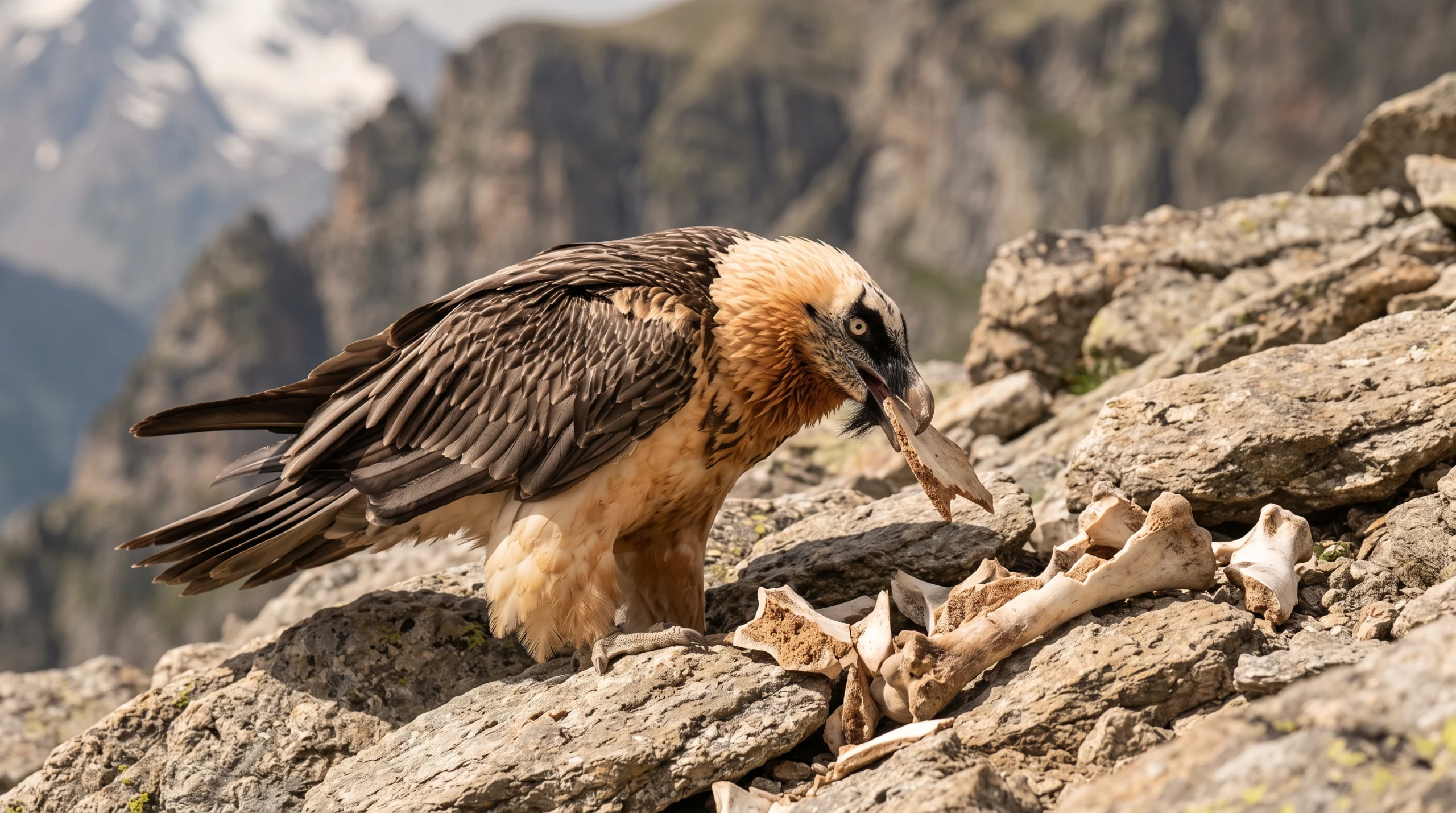
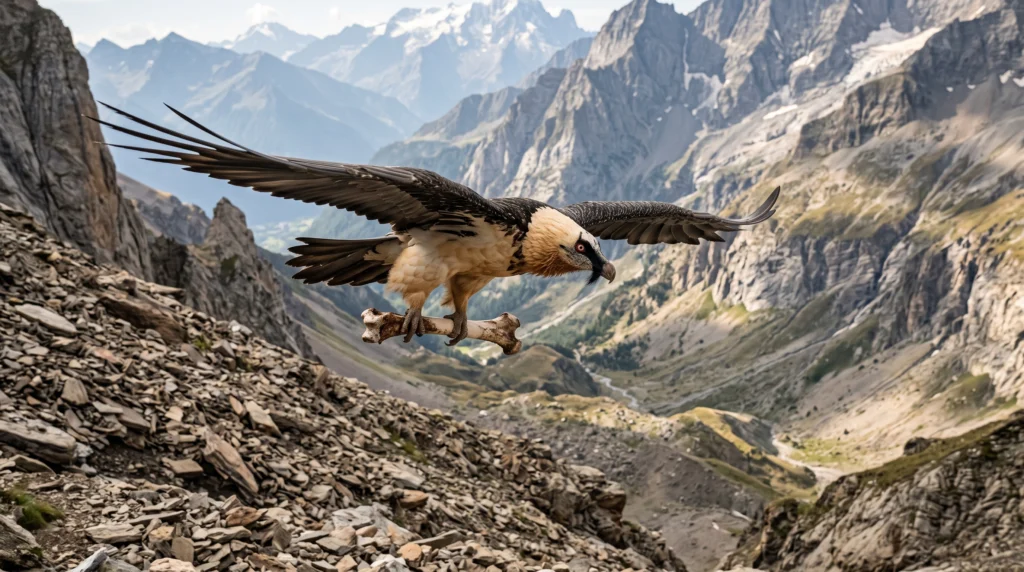
High above a rocky mountain slope, a bearded vulture circles with something unusual clutched beneath it: a large bone. The bird releases its cargo, the bone crashes against exposed rock, and the vulture descends to inspect the result. If the piece is still too large, it may carry it upward and try again.
This remarkable behavior, known as bearded vulture bone dropping, is not simply a trick for cracking open bones to reach the marrow. The bearded vulture (Gypaetus barbatus) is an extraordinary example of dietary specialization because it can consume and digest substantial amounts of bone itself.
The spectacular aerial drop is therefore only one stage in a much larger feeding system: finding skeletal remains, selecting useful bones, transporting them, breaking oversized pieces when necessary, swallowing the fragments, and chemically digesting a food source most scavenging birds use far less extensively.
The Vulture That Eats What Other Scavengers Leave Behind
A carcass is not consumed by one animal all at once. Different scavengers specialize in different portions and stages of decomposition.
Large scavengers may remove muscle, organs, skin, and other soft tissues. Invertebrates and microorganisms continue the process. Eventually, much of the obvious food can disappear while the skeleton remains.
For most animals, those bones are difficult to exploit efficiently.
For the bearded vulture, they are food.
Scientific research confirms that the species has an exceptionally bone-centered diet. Studies of bearded vulture feeding ecology have found that skeletal material can dominate what the birds consume, making Gypaetus barbatus an extreme dietary specialist among vertebrates.
This specialization gives the bird access to a resource that can remain after many other scavengers have already fed.
Bearded Vultures Really Do Eat Bones
The scientific term for feeding on bone is osteophagy.
Many animals occasionally chew, gnaw, or consume bones, often to obtain minerals or remaining tissue. Bearded vultures take osteophagy much further. Bone is a central component of their feeding ecology rather than an occasional supplement.
This corrects one of the most persistent misconceptions about the species.
You may see the bone-dropping behavior described as if the bird were simply smashing a hard container to expose the marrow inside. Marrow certainly has nutritional value, particularly in relatively fresh bones, but the bearded vulture can ingest and digest the mineralized bone material as well.
Bones are also more nutritionally useful than their dry appearance suggests. Research comparing old and fresh skeletal material found that bones can retain substantial nutritional value even as they age. Dry bones lose fat as they weather, but significant protein remains within them.
For an animal equipped to digest this resource, a skeleton is far from nutritionally empty.
Not Every Bone Needs to Be Dropped
The famous aerial behavior can create another misconception: that every bone a bearded vulture finds must first be smashed against a mountain.
It does not.
If a bone or fragment is already manageable, the vulture can swallow it directly. Research on bearded vulture remains and feeding ecology documents the ingestion of surprisingly substantial skeletal pieces.
The bird therefore faces a practical problem when feeding: not simply “How do I get inside this bone?” but “Can I swallow this item in its present form?”
Smaller pieces can proceed directly to ingestion.
Oversized or awkward pieces require processing.
That is where bone dropping becomes useful.
What Happens When the Bone Is Too Large?
When a desirable bone cannot conveniently be swallowed, a bearded vulture can turn gravity and the mountain itself into processing tools.
The precise behavior varies, but the general sequence is straightforward.
The bird obtains a bone from a carcass or feeding area and transports it in flight. It moves toward suitable exposed rocky terrain and releases the bone above the surface.
Impact does the mechanical work.
If the bone fractures into useful pieces, the bird can descend, recover manageable fragments, and eat them. If the result is inadequate, the bone may be transported and dropped again.
Research describes bearded vultures deliberately dropping skeletal remains onto rocky surfaces to fragment bones that are too large to swallow.
The important point is that dropping is food processing.
It converts an otherwise awkward skeletal element into pieces that the bird’s remarkable digestive system can handle.
What Is a Bearded Vulture Ossuary?
Certain rocky areas used for breaking bones are known as ossuaries, or bone-breaking sites.
An ossuary is not a structure constructed by the bird. It is a suitable natural area where bones can be dropped against hard terrain.
Research on bearded vulture ossuaries shows that these sites can serve multiple functions. They are used to break and prepare skeletal remains, and bones can also accumulate or remain there for extended periods. Studies suggest that both the nutritional value of particular skeletal elements and their handling characteristics influence which remains are consumed and which are left behind.
An effective dropping area needs the right physical characteristics. Exposed hard rock provides an impact surface, while sufficiently open terrain allows the bird to approach, release its load, and return to retrieve fragments.
Repeated use of favorable locations turns parts of the mountain landscape into recognizable food-processing sites.
How Accurate Does the Drop Need to Be?
Carrying a bone through mountain air is not the same as dropping an identical object in a laboratory.
The object can vary in length, mass, shape, and aerodynamics. Wind conditions change. Terrain is uneven. The vulture also needs the bone to land where the impact is useful and where the fragments remain accessible.
That makes the behavior more sophisticated than simply releasing an object from the air.
Experience likely matters in efficient handling, but claims that every vulture releases bones from one precise altitude or achieves a particular success rate should be treated cautiously unless tied to a specific study.
What research clearly establishes is the functional relationship: bones too large to swallow can be deliberately dropped on rocky surfaces so impact fragments them.
Several attempts may therefore be useful when the first impact does not produce suitable pieces.
Do Young Bearded Vultures Know How to Do This Immediately?
Bone dropping combines an evolved feeding specialization with a behavior whose efficient execution can be refined through experience.
Young birds are not miniature adults with perfect mastery of every difficult feeding maneuver from their first attempts.
Transporting an awkward skeletal element, positioning it over appropriate terrain, releasing it effectively, locating the result, and handling the fragments involve coordination and experience.
It is safest to think of the behavior as having both biological and developmental components. Bearded vultures are members of a species evolved for osteophagy, but effective execution of complicated bone-handling behavior can improve as an individual gains experience.
That distinction matters. Calling the behavior completely “taught” would go beyond the evidence, while portraying inexperienced juveniles as instantly performing every step with adult-level proficiency would also oversimplify the biology.
How Can a Bird Digest Bone?
Breaking the bone is only the mechanical half of the story.
After swallowing comes chemistry.
The bearded vulture has a gastrointestinal system unusually well suited to processing skeletal material. Its stomach provides strongly acidic conditions capable of breaking down ingested bone, while digestive processes make organic components available for absorption.
Research examining bearded vulture digestion and fecal material shows how thoroughly skeletal food can be processed. Calcium and phosphorus derived from the mineral portion of bone are prominent in analyses of the birds’ waste.
Some publications describe extremely acidic stomach conditions, but exact pH claims should be handled carefully because values cited across the literature are not always based on direct measurements from living bearded vultures. Research on the nutritional value of bones specifically notes this limitation while emphasizing the species’ specialized acid-secreting stomach physiology.
What does not require exaggeration is the central fact: these vultures possess a digestive system capable of processing a bone-rich diet.
Bone Versus Marrow — An Important Distinction
Marrow matters.
But marrow is not the whole story.
Fresh long bones can contain energy-rich fats associated with marrow, and bearded vultures can preferentially select nutritionally valuable skeletal elements. Research at ossuaries supports the idea that the nutritional value of different bone portions influences selection.
Yet describing a bone merely as a hard shell around the “real food” creates the wrong biological picture.
The bird is adapted to osteophagy.
Its feeding strategy includes swallowing and digesting bone material itself. Studies examining old bones have demonstrated that skeletal tissue can retain substantial protein even after fat declines during weathering.
So when a bearded vulture breaks a large bone, fragmentation can expose marrow, but it also transforms an oversized skeletal item into pieces that can be swallowed and digested.
That distinction is what makes this species so unusual.
Why Specializing in Bones Is an Ecological Advantage
Every scavenger competing directly for the same portion of a carcass would create intense competition.
Ecological specialization can reduce some of that overlap.
Bearded vultures often arrive in a scavenger system where other species are better equipped to consume soft tissues. Instead of relying entirely on those rapidly disappearing resources, Gypaetus barbatus can exploit skeletal remains.
Bones also have another advantage: compared with exposed soft tissue, they can remain available for relatively long periods.
Research into the nutritional value of old bones found that weathered skeletal material can retain useful nutrients, helping explain why specialization on this unusual resource can be viable.
This does not mean bearded vultures face no competition. Other animals interact with bones and carcasses too.
It means their extreme specialization gives them access to a comparatively underused portion of the carcass.
Is the Bearded Vulture a Predator or a Scavenger?
The bearded vulture is primarily understood as a specialized scavenger.
Scavenging means consuming animals that are already dead. Predation means actively capturing and killing living prey.
The species’ characteristic feeding ecology revolves around carcass remains, particularly skeletal material.
Reports exist of occasional interactions with living prey, but exceptional behavior should not be confused with the bird’s normal feeding strategy.
The iconic image of a bearded vulture carrying a large mammal bone does not mean it killed the mammal.
Very often, the opposite ecological story is more accurate: other predators or scavengers have already consumed much of the carcass, and the bearded vulture is exploiting what remains.
Where Bearded Vultures Live
The bearded vulture is fundamentally a mountain bird.
Its broad distribution extends through mountainous regions of Europe, Africa, and Asia, although populations are fragmented and their conservation situations vary considerably between regions.
Typical habitat combines steep cliffs and rocky slopes with extensive open areas where the birds can search for food.
Cliffs provide nesting opportunities, while mountain landscapes supporting wild or domestic ungulates can supply carcasses and skeletal remains.
Europe contains several particularly important populations and restoration areas, including the Pyrenees and the Alps. Conservation programs have also worked to reconnect populations through releases in parts of France and elsewhere.
The Alpine story is especially notable. Bearded vultures disappeared from the Alps in the early 20th century, but an international captive-breeding and reintroduction program began releasing birds there in 1986. Continued releases and natural reproduction have since restored a substantial Alpine population.
Reintroduction work remains active in 2026, including new releases in the Bavarian Alps and southern France.
Why the Bearded Vulture Looks Rusty Orange
Adult bearded vultures are among the most distinctive large birds of prey.
They have long, relatively narrow wings, a wedge-shaped tail, striking facial markings, and dark feathers forming the “beard” beneath the bill that gives the species its English name.
Their pale head, neck, and underparts can also appear dramatically rusty orange.
That orange coloration is not simply the natural pigment of those pale feathers.
Research has shown that the coloration is associated largely with iron-oxide particles obtained externally. Bearded vultures have been observed using iron-rich substrates and ferruginous water, staining their plumage with reddish-orange material.
The precise evolutionary functions proposed for this cosmetic coloration remain subjects of scientific investigation, so its purpose should not be reduced to a single unproven explanation.
A Specialist in the Mountain Cleanup Crew
A dead ungulate can support an entire succession of organisms.
Predators may have killed it. Large scavengers remove substantial tissues. Smaller scavengers take scraps. Insects consume other material. Fungi and bacteria continue decomposition.
Bearded vultures occupy a particularly unusual position within this network because they can extract food from the skeletal stage to an extraordinary degree.
They are not the only animals capable of consuming bone.
What makes them exceptional is the extent to which their morphology, behavior, digestive physiology, and habitat use are organized around a bone-rich diet.
Their contribution is therefore part of a larger decomposition system rather than an isolated spectacle.
A bone falling from the sky is simply one visible moment in that ecological process.
Conservation of the Bearded Vulture
The bearded vulture remains a conservation concern despite impressive recovery stories in parts of Europe.
The species has suffered historically from persecution, poisoning, declining food resources, and other human pressures. In modern mountain landscapes, threats can include deliberate or accidental poisoning, lead exposure, collisions with cables and other infrastructure, and disturbance near breeding sites.
BirdLife has listed Gypaetus barbatus as Near Threatened globally, although regional populations can face much more severe circumstances.
Europe also demonstrates what sustained conservation can achieve.
The Alpine population was restored through decades of international captive breeding, releases, monitoring, and protection. The Vulture Conservation Foundation reports that hundreds of captive-bred birds have been released through European restoration programs, with ongoing work intended both to reinforce populations and improve connectivity between them.
Protecting these birds requires more than producing chicks. Reducing poisoning, preventing collisions, limiting disturbance, maintaining suitable habitat, and connecting fragmented populations remain essential parts of long-term recovery.
Common Misconceptions
“Bearded vultures break bones only to reach marrow.”
Incorrect. Marrow is nutritious, but bearded vultures also ingest and digest bone itself.
“Every bone must be dropped before it can be eaten.”
No. Manageable bones and fragments can be swallowed directly. Dropping is especially useful for skeletal pieces that are too large or awkward.
“They hunt large mammals to get their bones.”
Their characteristic feeding strategy is scavenging. Finding a vulture with a mammal bone does not mean the bird killed that animal.
“Bone provides almost no nutrition.”
Research shows otherwise. Bone contains minerals and organic material, and even weathered bones can retain substantial protein.
“Bone dropping is random.”
The behavior is directed toward suitable rocky bone-breaking areas, including repeatedly used ossuaries.
“Every vulture specializes in bones.”
No. Vulture species occupy different feeding niches. The bearded vulture represents an extreme specialization toward osteophagy.
“If it can digest bone, it can eat anything.”
Also false. Specialized digestion makes bone an accessible food resource; it does not make the animal biologically capable of safely digesting every substance.
Frequently Asked Questions
Do bearded vultures really eat bones?
Yes. Bone is a major part of the bearded vulture diet. The species is highly specialized for osteophagy—the consumption of bone.
Why do bearded vultures drop bones from the sky?
Large or awkward bones may be too difficult to swallow intact. Dropping them onto hard rocky surfaces can fracture them into manageable pieces.
Do they eat bone or just bone marrow?
Both can provide nutrition. Marrow contains valuable fat, particularly in fresher bones, but bearded vultures also ingest and digest bone material itself.
Can bearded vultures swallow bones whole?
Appropriately sized bones and fragments can be swallowed without first being dropped. Research documents their ability to consume substantial skeletal pieces.
How do bearded vultures digest bones?
Their digestive tract is adapted to a bone-rich diet, including strongly acidic stomach conditions that help chemically break down swallowed skeletal material.
What is a bearded vulture ossuary?
An ossuary is a natural bone-breaking site, generally involving suitable rocky terrain where bearded vultures drop oversized skeletal remains to fragment them. Such sites can also contain bones left or stored there.
Conclusion
Watching a bearded vulture release a bone over a mountainside is spectacular, but focusing only on the impact misses the most interesting part of the story.
The behavior is one component of an entire biological specialization.
The bird finds skeletal resources remaining at carcasses, selects and transports useful bones, swallows manageable pieces directly, fragments oversized ones against rocky terrain, and relies on specialized digestive physiology to extract nutrients from a resource that many other scavengers exploit far less completely.
That is what makes bearded vulture bone dropping so fascinating. It combines anatomy, digestion, flight, behavioral refinement, mountain geography, and scavenger ecology into a feeding strategy unlike that of almost any other bird.
The bone crashing against the rock is not merely a way to reach the marrow.
For Gypaetus barbatus, the bone itself is dinner.
Internal-Linking Opportunities
- Link “how scavengers recycle animal remains” to an article explaining the ecological importance of vultures and carrion.
- Link “specialized feeding adaptations” to an article about unusual ways birds obtain or process food.
- Link “vulture conservation” to an article covering threats facing scavenging birds and their ecological importance.
- Link “mountain wildlife adaptations” to related content about species adapted to cliffs and high-elevation environments.
Authoritative External Sources
- Peer-reviewed research on the nutritional value of bones in the bearded vulture diet
- Research on bearded vulture ossuaries and bone selection — Ornithology
- Scientific Reports research on bearded vulture bone digestion and coprolites
- Vulture Conservation Foundation — Bearded Vulture Alpine Reintroduction
- Vulture Conservation Foundation — Bearded Vulture Captive Breeding Programme