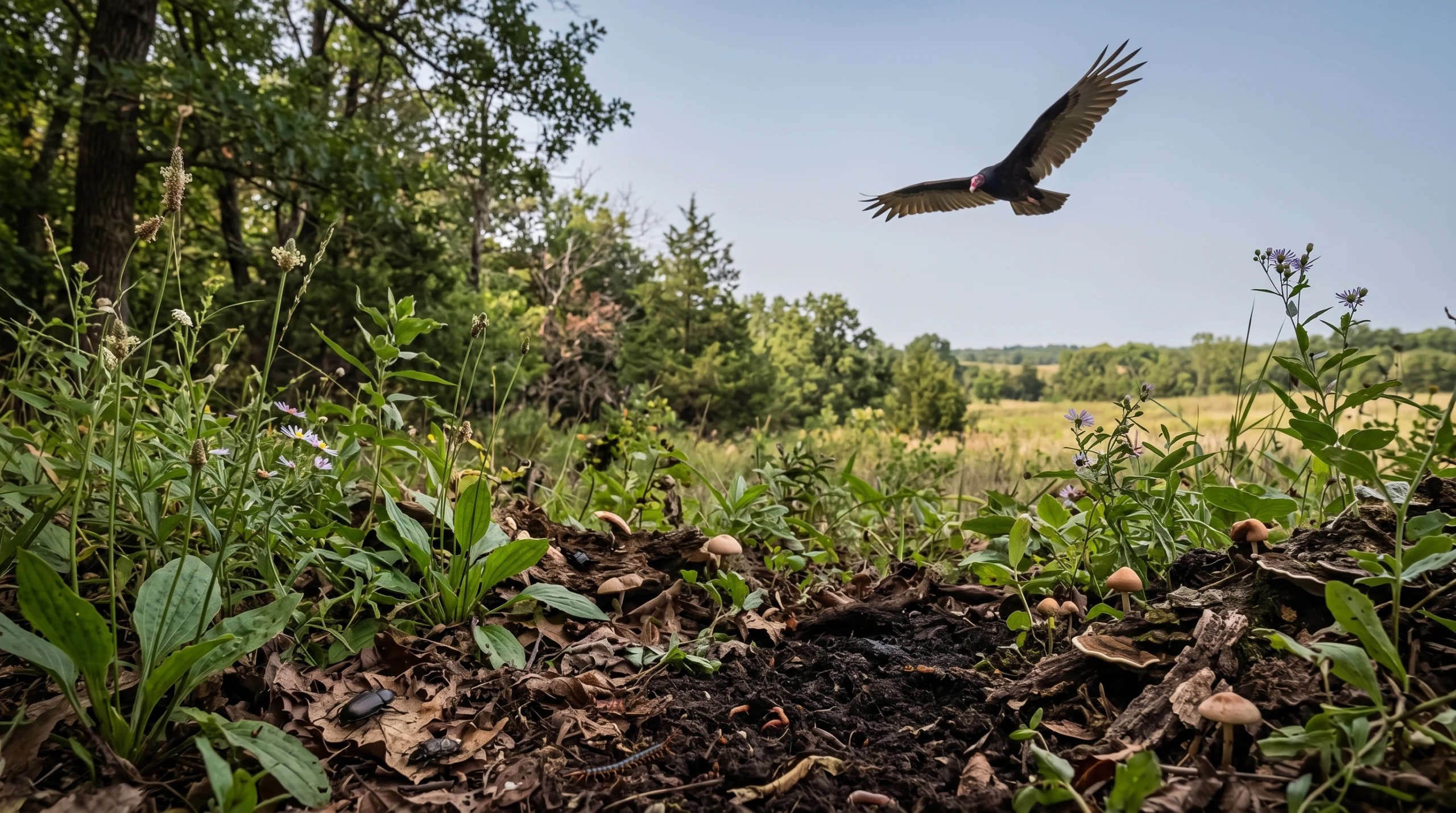
A group of dark birds circling over a field can create an unsettling impression, especially when a dead deer is later discovered nearby. It is easy to connect the two events and assume the vultures were responsible.
For turkey vultures, Cathartes aura, that conclusion is usually backward.
Turkey vultures are highly specialized scavengers. Their normal feeding strategy is to locate animals that are already dead, not to pursue and overpower healthy deer or other large mammals. Cornell Lab of Ornithology describes carrion as their primary food and notes that turkey vultures almost never attack living prey. Occasional feeding on small or vulnerable living animals has been reported, so “never” would be too absolute, but such behavior does not characterize the species’ feeding ecology.
Their role goes far beyond simply making a carcass disappear. A dead animal becomes the center of a temporary ecological community involving vertebrate scavengers, insects, fungi, bacteria, and other decomposers. The turkey vulture participates in that process by finding scattered carrion, consuming tissues, altering what remains available to other organisms, and helping move nutrients through food webs.
Understanding the turkey vulture scavenger lifestyle reveals why an animal associated with death is actually an important participant in how ecosystems process it.
Table of Contents
- Turkey vultures are scavengers, not deer hunters
- How a turkey vulture finds a dead animal
- Why turkey vultures have bare heads
- A digestive system adapted to carrion
- What happens to a carcass in nature?
- From dead animal to living soil
- Why removing carrion matters
- Turkey vultures share the cleanup crew
- Why turkey vultures are built for efficient soaring
- Common misconceptions
- The bigger ecological picture
- Frequently asked questions
Turkey Vultures Are Scavengers, Not Deer Hunters
Predation and scavenging are different feeding strategies.
A predator actively captures living prey. A scavenger obtains much or most of its food from animals that have already died.
Turkey vultures belong overwhelmingly in the second category.
Cornell reports that their diet consists primarily of carrion, especially mammals, although they also feed on dead reptiles, birds, amphibians, fish, and invertebrates. They tend to prefer relatively fresh carrion rather than waiting for a carcass to become extremely decomposed.
That distinction matters when people encounter vultures around dead livestock or wildlife.
A vulture beside a deer did not necessarily kill it
A deer can die from vehicle collisions, disease, injury, starvation, predation by another animal, hunting, or numerous other causes. Once the carcass becomes available, scavengers begin using it.
Finding turkey vultures feeding on the remains only demonstrates that they discovered a food source.
It does not establish the cause of death.
Turkey vultures are particularly poorly suited to attacking a healthy adult deer compared with specialized mammalian predators. Their feeding ecology, sensory systems, and search behavior are centered on locating carrion rather than chasing large live prey.
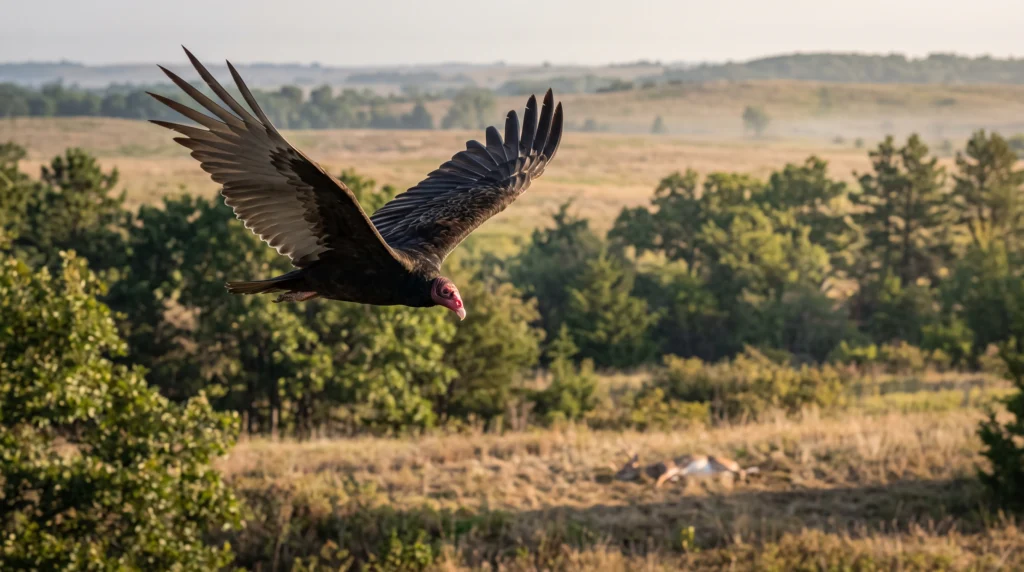
Cornell states that turkey vultures almost never attack living prey. Other references document occasional feeding on vulnerable small animals, live insects, fish, reptiles, or nestlings. Those observations are worth acknowledging because biology rarely fits absolute statements. They are exceptions rather than evidence that turkey vultures routinely hunt large healthy animals.
Turkey vultures are not black vultures
Confusion is especially common where turkey vultures overlap with black vultures (Coragyps atratus).
Black vultures are also primarily scavengers, but Cornell documents occasional attacks by black vultures on live animals, including young livestock such as calves, lambs, and pigs. This behavior should not automatically be attributed to turkey vultures simply because the two species may occur together.
Correct identification matters whenever behavior is being discussed.
How a Turkey Vulture Finds a Dead Animal
Carrion is an unpredictable resource.
A rabbit may die beside a road. A deer may fall in woodland. A fish may wash onto a shoreline. Unlike vegetation, these food sources do not remain predictably rooted in the same place.
A successful scavenger therefore needs an efficient way to search enormous areas.
Turkey vultures accomplish this partly through soaring.
From the air, they can cover large landscapes while searching visually and sampling odors carried through the atmosphere. Their sensory system combines good vision with an unusually sophisticated sense of smell.
A remarkable sense of smell for a bird
For much of ornithological history, birds were commonly assumed to have relatively poor olfaction. Turkey vultures became one of the classic exceptions.
An anatomical study published in 2017 found striking differences between turkey vultures and black vultures. Turkey vultures had olfactory bulbs approximately four times larger and about twice as many mitral cells as black vultures, despite having smaller overall brains. The study provided strong anatomical support for scent-guided foraging in Cathartes aura.
Field observations support the same conclusion.
Cornell describes experiments in which turkey vultures found hidden carcasses as readily as exposed ones, demonstrating that visual detection alone could not explain their success.
Smell and sight work together
Calling turkey vultures “birds that smell carrion” is accurate but incomplete.
They also watch the ground, observe other scavengers, and use visual information while searching. Their advantage lies in having several useful sources of information available simultaneously.
Popular accounts sometimes focus on individual sulfur-containing chemicals produced during decomposition. Controlled observations and industrial reports have helped establish that turkey vultures can respond to decomposition odors, but reducing their entire olfactory system to one supposedly magical “dead animal chemical” oversimplifies a complex sensory process.
The safer conclusion is that volatile compounds associated with decomposition provide olfactory information that turkey vultures are unusually well equipped to detect.
Why Turkey Vultures Have Bare Heads
An adult turkey vulture has a conspicuous red, largely featherless head.
That feature is closely associated with its feeding behavior.
When a vulture feeds, its head may come into contact with blood, fluids, and decomposing tissue, particularly when reaching inside a carcass. A featherless surface is easier to keep relatively clean than a densely feathered head would be under those conditions. The National Park Service identifies the bare head as an adaptation associated with feeding inside carcasses.
This should not be exaggerated into the claim that a bare head sterilizes the bird.
Turkey vultures still encounter diverse microorganisms. Their skin, immune system, digestive physiology, grooming behavior, and microbial communities all contribute to how they tolerate a scavenging lifestyle.
The absence of head feathers is one adaptation among several.
A Digestive System Adapted to Carrion
Carrion can contain large populations of microorganisms, including some capable of causing disease in other animals.
For vultures, feeding on carcasses therefore requires more than a strong stomach in the everyday sense.
Research comparing scavenging animals has linked carrion feeding with highly acidic digestive conditions. Strong stomach acidity can act as a biological filter, destroying or reducing many microorganisms swallowed with food.
But the digestive story is more complex than acidity alone.
The vulture microbiome is highly specialized
A study examining black and turkey vultures found distinctive microbial communities on their facial skin and in their large intestines. The researchers concluded that vultures are repeatedly exposed to potentially harmful microorganisms through carrion while maintaining gut communities adapted to this unusual diet.
Other genomic research has identified signatures of selection involving immune-system processes in turkey vultures, suggesting that adaptation to scavenging involves multiple physiological systems rather than one single defensive mechanism.
That does not mean turkey vultures are immune to every pathogen, toxin, or contaminant.
They can still be poisoned. Cornell specifically notes that vultures can ingest lead from carcasses or gut piles containing ammunition fragments.
A more accurate description is that their digestive and immune physiology allows them to exploit carrion carrying microbial challenges that many animals would be poorly equipped to handle.
What Happens to a Carcass in Nature?
A dead deer does not belong to one scavenger.
It becomes an ecological resource used by a succession of organisms.
Large vertebrate scavengers may remove substantial pieces of tissue. Depending on location, turkey vultures may encounter black vultures, ravens, crows, coyotes, and other mammals at or around carrion.
Insects arrive as well.
Various flies use carcasses for feeding and reproduction, and their larvae can consume substantial amounts of decomposing tissue. Carrion beetles and other invertebrates exploit different parts or stages of the remains.
Meanwhile, bacteria and fungi break down organic molecules at microscopic scales.
The exact community depends on climate, habitat, season, carcass size, accessibility, cause of death, and which scavengers find it first.
Decomposition is therefore a network rather than an assembly line with one organism assigned to each step.
From Dead Animal to Living Soil
An animal’s body contains carbon, nitrogen, phosphorus, and many other nutrients that were assembled while it was alive.
Death does not make those elements disappear.
Instead, the carcass becomes a concentrated store of organic matter.
Turkey vultures and other vertebrate scavengers remove and digest portions of it. Insects fragment and consume additional tissues. Microorganisms chemically break down organic compounds. Fluids enter the surrounding environment, while waste produced by scavengers and decomposers redistributes material elsewhere.
Over time, nutrients can enter soil pools, microbial biomass, vegetation, and additional food-web pathways.
That is why saying a vulture “turns a deer into fertilizer” is too simplistic.
The vulture participates in nutrient cycling, but it is one actor within a much larger community of scavengers and decomposers.
The National Park Service specifically recognizes turkey vultures as contributors to ecosystem nutrient cycling through their consumption of dead animals.
Why Removing Carrion Matters
Rapid scavenging changes what happens to a carcass.
When vultures consume tissue, that material is no longer available in the same form to insects, mammals, or microorganisms. Removing carrion quickly can therefore change both the duration of the carcass resource and the community of animals capable of exploiting it.
Experiments excluding vultures from carcasses have shown that vulture access can alter carrion-consumption patterns and interactions among scavenging vertebrates. Research also suggests that rapid consumption may reduce some opportunities for pathogen persistence or transmission associated with carcasses.
That evidence deserves careful wording.
Vultures do not sterilize landscapes, and their presence does not guarantee that wildlife disease will disappear. Pathogen ecology depends on the organism involved, transmission route, hosts, environmental persistence, and many other variables.
A defensible conclusion is that efficient carcass removal can influence disease dynamics by changing how long potentially infectious material remains available and which animals contact it.
That is much more precise than claiming that vultures simply “prevent epidemics.”
Turkey Vultures Share the Cleanup Crew
Carrion often creates both competition and opportunity.
Black vultures provide a particularly interesting example.
Their sense of smell is less developed than that of turkey vultures. Cornell reports that black vultures may watch turkey vultures descending toward carrion and then follow them to the food. Once several black vultures arrive, their social behavior and numbers can allow them to displace turkey vultures.
Ravens, crows, coyotes, and numerous other vertebrates may also consume carrion.
At smaller scales, flies, beetles, fungi, and bacteria continue the process.
These organisms do not all perform identical functions. They differ in how quickly they discover carcasses, what tissues they can access, how much they consume, and what they leave for others.
Research on scavenger communities shows that species differ substantially in their ecological roles, with traits such as olfactory ability, social behavior, and scavenging specialization influencing how broadly they exploit carrion resources.
Why Turkey Vultures Are Built for Efficient Soaring
Finding carrion means searching without knowing exactly where the next meal will be.
Constant powered flight would be energetically expensive.
Turkey vultures instead spend long periods soaring, taking advantage of rising air and aerodynamic lift to remain aloft with relatively little flapping.
Their long, broad wings are typically held in a shallow V-shaped posture called a dihedral. They frequently rock or tilt from side to side, creating the characteristic unsteady-looking flight that makes them recognizable at a distance.
This rocking does not mean the bird is struggling to fly.
It is part of an efficient soaring style that allows turkey vultures to search low over landscapes while responding to small changes in air movement. Cornell notes that the raised-wing posture helps them maintain stability and lift at low altitudes.
The result is a search system well suited to a scattered, unpredictable food supply.
Common Misconceptions About Turkey Vultures
“Turkey vultures commonly kill healthy deer”
There is no evidence that hunting healthy adult deer is a normal turkey vulture feeding strategy. The species feeds overwhelmingly on carrion and almost never attacks live prey.
“Circling vultures mean an animal below is dying”
Circling is fundamentally a flight behavior. Vultures use rising air currents to gain altitude and search efficiently. A circling group does not prove that an injured or dying animal is directly beneath them.
“Vultures circle while waiting for prey to die”
Turkey vultures search for carrion rather than routinely shadowing healthy animals until death. Their soaring behavior is an efficient way to travel and forage.
“Turkey vultures rely entirely on eyesight”
They possess useful vision, but turkey vultures also have one of the best-developed olfactory systems documented among birds.
“Vultures are dirty and biologically useless”
Contact with carrion exposes vultures to microbes, but their physiology is specialized for that feeding strategy. Their consumption of carcasses also changes scavenger interactions, decomposition pathways, and nutrient movement through ecosystems.
“Every animal eating a carcass is a predator”
Scavenging describes eating animals that are already dead. Predation involves capturing living prey. Many species can do both, but the behaviors are ecologically distinct.
“Vultures recycle the whole carcass by themselves”
They do not. Insects, mammals, birds, fungi, bacteria, and other organisms participate in carcass consumption and decomposition.
The Bigger Picture — Nature Needs Scavengers
Predators and scavengers both consume animal tissue, but they enter the food web at different stages.
Predators obtain energy by capturing living prey.
Scavengers recover energy and nutrients from organisms that have already died.
Decomposers continue breaking down material that remains.
These categories overlap in real ecosystems, but together they ensure that animal biomass does not simply sit outside the food web after death.
Turkey vultures are particularly effective members of this system because they combine efficient soaring, strong visual abilities, exceptional olfaction, carrion-adapted digestion, and the ability to locate resources scattered across immense areas.
Calling them “nature’s garbage disposal” captures only the most superficial part of their ecology.
A carcass is not garbage from an ecosystem’s perspective.
It is stored energy and nutrients. The turkey vulture is one of the organisms capable of reconnecting those resources with the living food web.
Frequently Asked Questions
Do turkey vultures kill deer?
Turkey vultures are not normal predators of healthy deer. Their diet consists primarily of animals that are already dead. Occasional feeding on small or vulnerable living animals has been documented, but Cornell describes attacks on living prey as extremely unusual.
Black vultures should not be confused with turkey vultures when discussing occasional attacks on young livestock.
Why do turkey vultures circle in the sky?
Circling often allows them to use rising air currents to gain altitude while minimizing energy-intensive flapping. From the air they can search large areas for carrion using vision and smell.
Can turkey vultures smell dead animals?
Yes. Olfaction is unusually important in this species. Anatomical research found exceptionally large olfactory bulbs in turkey vultures, and behavioral observations demonstrate that they can locate carrion that is hidden from view.
Why is a turkey vulture’s head bald?
The featherless head is associated with carrion feeding and can be kept cleaner than a heavily feathered head when the bird reaches into animal remains. It is an adaptation that reduces fouling, not a mechanism that makes the bird completely germ-free.
Are turkey vultures dangerous to people or pets?
Turkey vultures are primarily carrion feeders and generally do not behave like predators that hunt people or healthy pets. Like any wild animal, however, they should be given space rather than handled or approached closely. Their defensive behavior can include regurgitation when threatened.
What would happen if vultures disappeared?
Carrion would still be consumed and decomposed by other scavengers, insects, fungi, and microorganisms, so decomposition would not stop. However, research on scavenger communities indicates that removing vultures can change how quickly carcasses are consumed and which vertebrate scavengers gain access to them, potentially altering ecological interactions and some disease-transmission pathways.
Conclusion
A turkey vulture feeding on a deer carcass is not evidence of a failed hunt.
It is evidence that a scavenger found an existing resource.
The turkey vulture, Cathartes aura, is equipped for that task with energy-efficient soaring, strong vision, exceptional olfactory abilities, a featherless head suited to carrion feeding, and digestive and microbial adaptations that allow it to tolerate a challenging diet.
But the bird works within a larger system.
Mammalian scavengers, other birds, carrion insects, fungi, bacteria, soil organisms, and plants all participate—directly or indirectly—in what happens to an animal after death.
Seen this way, the turkey vulture scavenger is neither a sinister observer waiting for something to die nor merely a flying garbage collector. It occupies an important ecological position between death, decomposition, scavenger food webs, and the eventual redistribution of nutrients through the environment.
The deer was already part of the ecosystem while alive. The vultures simply help ensure that, after death, its stored energy and nutrients remain part of that ecosystem too.
Natural Internal-Linking Suggestions
Naturally link this article to:
- an article explaining the difference between predators, scavengers, and decomposers;
- a guide to North American vultures and how to distinguish turkey vultures from black vultures;
- an article about how animal carcasses support insects and wildlife;
- a feature on the ecological role of coyotes;
- an article explaining nutrient cycling in natural ecosystems;
- a guide to carrion beetles and other decomposer insects.
Authoritative External Sources
- Cornell Lab of Ornithology — Turkey Vulture Life History. Authoritative overview of diet, scavenging behavior, carrion preferences, and the rarity of attacks on living prey.
- Grigg, N. P., et al. (2017), “Anatomical evidence for scent guided foraging in the turkey vulture.” Peer-reviewed anatomical research documenting the unusually developed olfactory system of Cathartes aura.
- Zepeda Mendoza, M. L., et al. (2018), “Protective role of the vulture facial skin and gut microbiomes.” Peer-reviewed research examining facial and intestinal microbial communities in turkey and black vultures and their relationship to carrion feeding.
- Beasley, D. E., Koltz, A. M., Lambert, J. E., Fierer, N. & Dunn, R. R. (2015), “The Evolution of Stomach Acidity and Its Relevance to the Human Microbiome.” Comparative research examining the relationship between feeding ecology, carrion consumption, pathogen exposure, and stomach acidity.
- Hill, J. E., DeVault, T. L., Beasley, J. C., Rhodes, O. E. & Belant, J. L. (2018), research on vulture exclusion and carrion consumption. Experimental evidence showing that access by vultures affects carcass consumption and the vertebrate scavenger community, relevant to discussions of carrion persistence and disease ecology.