
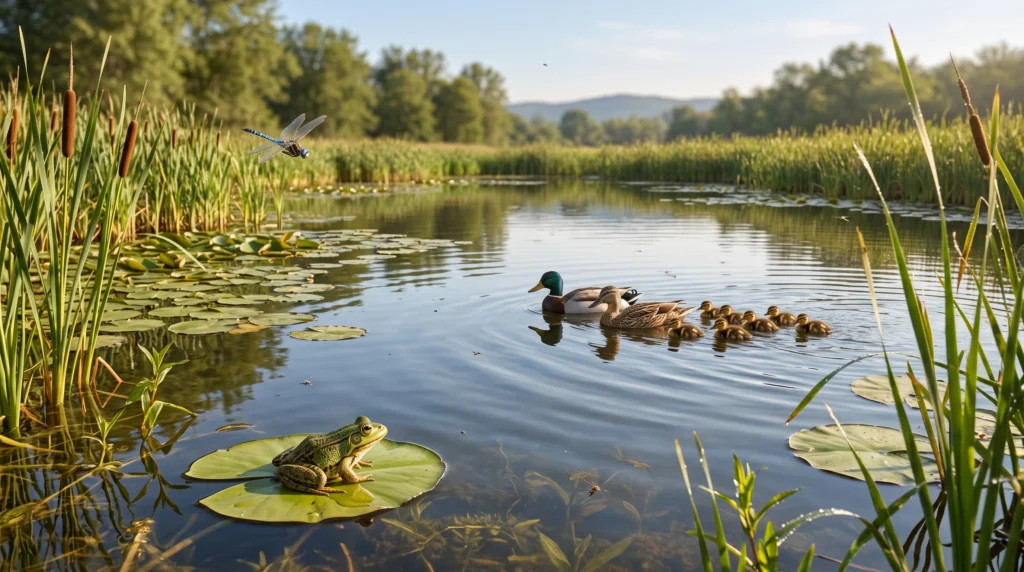
A pond in late afternoon may seem easy to understand. Dragonflies patrol the shoreline, ducks forage or rest on the water, insects move among emergent plants, and sunlight fuels photosynthesis beneath the surface.
Then the sun drops below the horizon.
The pond does not become a different ecosystem, and it certainly does not become inactive. Instead, changing light, temperature, and oxygen conditions alter which organisms are active and which ecological processes become most noticeable.
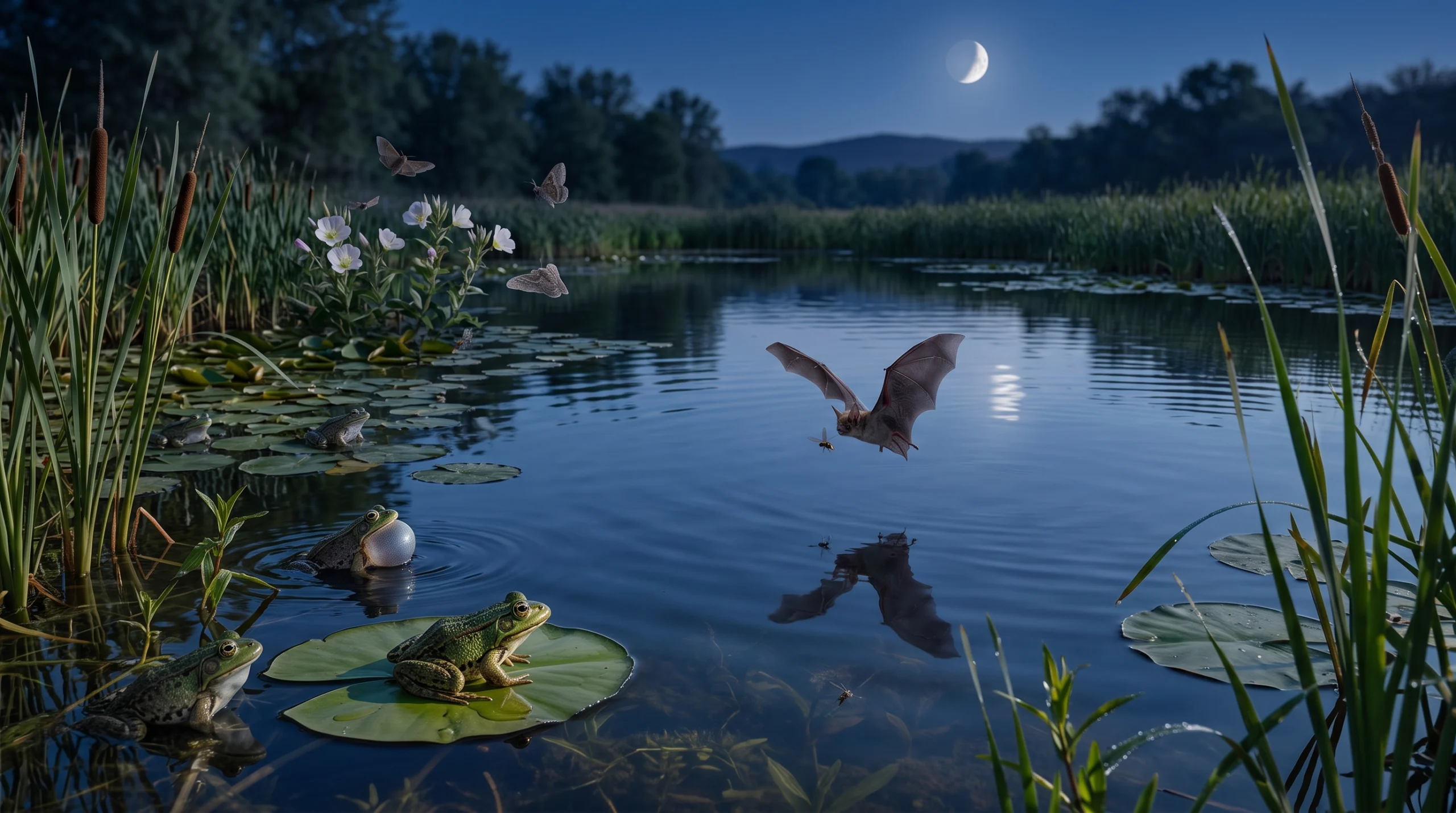
Frogs may begin calling from the margins. Aquatic insects emerge from the water. Insect-eating bats may hunt over the surface. Some fish change where or when they feed. Meanwhile, plants stop producing oxygen through photosynthesis once usable light disappears, even though plants, animals, fungi, bacteria, and other microorganisms continue respiration.
Understanding the pond ecosystem at night reveals something important about freshwater habitats: ecology runs on cycles. Day and night are two phases of the same continuously functioning system.
Table of Contents
- A pond doesn’t sleep when the sun goes down
- Daylight sets the stage
- What changes at sunset?
- Frogs create a nighttime soundscape
- Bats hunt above the water
- Moths and other insects join the night shift
- What happens beneath the surface?
- Why pond oxygen can fall overnight
- Plants have a night shift too
- The nighttime pond food web
- What happens to daytime animals?
- Dawn changes everything again
- Common misconceptions
- Frequently asked questions
A Pond Doesn’t Sleep When the Sun Goes Down
Animals organize their activity around different portions of the daily light-dark cycle.
Diurnal species are primarily active during daylight. Nocturnal animals concentrate much of their activity at night, while crepuscular species are particularly active around dawn or dusk.
These categories are useful, but they are not rigid labels. Activity can change with season, temperature, weather, reproductive condition, food availability, predators, and artificial lighting.
At a pond, sunset creates a transition between these overlapping schedules.
Light levels fall rapidly. Air and shallow-water temperatures may begin dropping. Visually hunting animals lose some of their daytime advantage, while species adapted to darkness gain new opportunities.
At the same time, an equally important transition is happening invisibly in the water: photosynthesis declines as usable light disappears.
Daylight Sets the Stage
During daylight, solar energy influences almost every part of pond ecology.
Aquatic plants, algae, and phytoplankton can photosynthesize when enough light reaches them. Through photosynthesis, these organisms use light energy to build organic compounds and release oxygen.
This biological oxygen production contributes to the daily cycle of dissolved oxygen in productive freshwater systems. The U.S. Geological Survey notes that photosynthesis adds oxygen during daylight, while respiration consumes oxygen.
Sunlight also warms the pond, especially in shallow areas. Because water temperature affects metabolism and the amount of oxygen water can physically hold, temperature becomes another important part of daily pond dynamics. Warmer water generally holds less dissolved oxygen than colder water.
Above the surface, many familiar pond animals are conspicuous during daylight.
Dragonflies and damselflies use vision extensively when hunting prey and interacting with other individuals. Waterbirds may forage, preen, defend territories, or rest. Some amphibians are active during the day, while others remain concealed until cooler or darker conditions arrive.
None of these patterns means that every member of a group follows the same schedule. A pond contains many species with different ecological strategies.
What Changes at Sunset?
Sunset changes much more than visibility.
Falling light levels alter predator-prey relationships because vision becomes less effective for some hunters while other animals are better adapted to low-light conditions.
Temperature may also begin to fall after the solar heating of the afternoon ends. The speed and extent of cooling depend on pond depth, weather, wind, season, surrounding vegetation, and other local conditions.
For animals, light itself can function as an environmental cue.
Some species become less active as illumination fades. Others emerge from shelter, begin feeding, move into different parts of the habitat, or start reproductive behavior.
The result is not a simple handoff in which one complete set of animals disappears and another arrives. Daytime, nighttime, and twilight activity overlap.
That overlap makes dusk one of the most dynamic periods around many freshwater habitats.
Frogs Turn the Pond Into a Nighttime Soundscape
One of the most obvious nighttime transformations is acoustic.
During breeding seasons, males of many frog and toad species call from ponds, wetlands, temporary pools, or surrounding vegetation.
The calls are primarily reproductive signals. Depending on the species, they can help females locate potential mates and may also communicate information among competing males.
USGS amphibian monitoring programs take advantage of this behavior by using calling surveys to detect breeding frogs and toads. USGS material on frogs in the Great Smoky Mountains, for example, describes male calls used to establish breeding territories and attract females.
Why calling often intensifies after dark
Many frog species are strongly nocturnal or become especially active during evening conditions.
Darkness can reduce exposure to some visually oriented predators, while cooler temperatures and higher nighttime humidity can help reduce water loss for amphibians with permeable skin.
But there is no universal “frog hour.”
Calling depends strongly on species and season. Temperature, rainfall, water availability, breeding condition, and geographic location all matter.
USGS observations show how seasonal frog soundscapes can change even within the same region. Wood frogs and spring peepers may dominate one period, while gray treefrogs and toads become prominent later.
What the vocal sac does
In many male frogs, a vocal sac inflates during calling and functions as an acoustic resonator. It helps amplify and broadcast the sound efficiently.
For a human standing near a breeding pond, dozens of calling males can create the impression that the pond suddenly became more active after sunset.
In reality, this is one highly detectable part of a much broader ecological transition.
Bats Begin Hunting Above the Water
Look above the pond shortly after sunset and another group may appear.
Many insectivorous bats use freshwater habitats for feeding and drinking. Ponds, lakes, wetlands, rivers, and streams can concentrate insects, making them productive foraging areas for particular bat species.
Research on bat use of freshwater habitats shows that bats can feed on both terrestrial insects and aquatic insects that emerge from the water as adults.
From underwater larva to flying bat food
This creates a remarkable ecological connection.
Many aquatic insects spend their juvenile stages underwater before emerging into the air as adults. Once airborne, they become available to terrestrial and aerial predators.
An insect may therefore begin life as part of the aquatic food web and later transfer energy out of the pond.
Bats can capture some of these insects using echolocation, producing calls and interpreting returning echoes to detect and track prey in darkness. Some species forage extensively around water, while others favor forests, open fields, vegetation, or different prey.
So “bats over ponds” is a genuine ecological pattern, but it should never be interpreted to mean that every bat species depends on ponds.
Bat Conservation International likewise notes that waterways can provide both drinking opportunities and insect-rich foraging habitat for many bats.
Moths and Other Insects Join the Night Shift
The insects visible after sunset are far more diverse than mosquitoes.
Moths, midges, mosquitoes, caddisflies, beetles, and numerous other insects may be active around freshwater, depending on habitat, location, and season.
Their ecological roles are equally diverse.
Some consume plants. Some are predators. Some visit flowers and contribute to pollination. Many become prey for frogs, bats, spiders, fish, birds, or other insects.
Caddisflies illustrate the connection especially well. Their larvae are primarily aquatic, but adults leave the water and become part of the terrestrial nighttime community.
Midges provide another major pathway through which aquatic production can reach animals hunting above the pond.
This movement of insects prevents the shoreline from functioning as a hard ecological boundary. Energy produced or consumed underwater can later support predators on land or in the air.
What Happens Beneath the Surface?
Darkness also changes the world underwater.
Visibility declines, changing the balance between predators and prey. Fish that depend heavily on vision may reduce certain activities, while other species continue feeding or shift their position.
There is no single nighttime behavior shared by all pond fish. Some species are more active during the day, some during low-light periods, and others can feed effectively at night.
Aquatic invertebrates also respond to changing light.
Zooplankton can change depth
In larger or sufficiently deep freshwater environments, some zooplankton perform diel vertical migration.
A common pattern involves remaining deeper during daylight, where the risk from visually hunting predators may be lower, and moving toward surface waters at night to feed.
Research shows that predator cues and light can help regulate this behavior in organisms such as Daphnia.
However, this should not be generalized to every pond.
Diel vertical migration is most relevant where sufficient depth and environmental structure make vertical movement meaningful. A shallow backyard pond cannot simply be assumed to behave like a deep lake.
Why Pond Oxygen Can Fall Overnight
One of the most important changes after sunset is invisible.
It involves dissolved oxygen.
Day: photosynthesis plus respiration
During daylight, aquatic plants, phytoplankton, and algae can photosynthesize when sufficient light is available.
Photosynthesis releases oxygen.
At the same time, respiration is occurring throughout the ecosystem. Fish, invertebrates, plants, algae, bacteria, fungi, and other organisms use oxygen as part of aerobic cellular respiration.
Night: respiration continues, photosynthesis largely stops
When light falls below the level needed for photosynthesis, biological oxygen production through photosynthesis largely stops.
Respiration does not.
Organisms continue consuming oxygen through the night.
As a result, dissolved oxygen can decline between evening and morning. USGS monitoring describes daily oxygen fluctuations driven by the alternating influence of sunlight-dependent photosynthesis and continuous respiration.
In ponds with strong daily biological production, oxygen may be relatively high during or after the afternoon and considerably lower toward dawn.
Not every pond becomes oxygen-starved
This distinction is essential.
A healthy pond does not automatically experience dangerous oxygen depletion every night.
The magnitude of the overnight drop depends on many factors, including water temperature, pond depth, wind and mixing, the amount of algae and vegetation, microbial activity, organic matter, nutrient levels, and weather.
Warm water complicates the situation because it holds less dissolved oxygen, while biological respiration can also be substantial under warm conditions. Dense algal production can create especially pronounced daily oxygen fluctuations, and severe blooms can contribute to low-oxygen conditions.
Therefore, pond oxygen at night is best understood as a dynamic balance, not an inevitable crisis.
Plants Have a Night Shift Too
Aquatic plants do not become metabolically inactive after sunset.
What changes is their energy pathway.
Without sufficient light, photosynthesis stops or becomes negligible. Cellular respiration continues, meaning plant cells still use oxygen while breaking down stored organic molecules to obtain usable energy.
The same principle applies to algae.
This is why it is misleading to say that aquatic plants “produce oxygen 24 hours a day.” They can contribute oxygen through photosynthesis in adequate light, but they also respire day and night.
Around the shoreline, terrestrial and marginal plants add another nighttime dimension.
Some plant species open or release stronger scents at night and can be visited by nocturnal pollinators such as moths. That is a species-specific adaptation, however. It should not be generalized to all pond plants or all water lilies, whose flowering schedules vary among species.
The Pond Food Web After Dark
Night makes the connections within the pond food web particularly visible.
Aquatic larvae can emerge as flying insects, which may then be captured by bats.
Flying insects may become prey for frogs.
Zooplankton can be eaten by fish and larger aquatic invertebrates.
Moths visiting vegetation around the shoreline can feed spiders, bats, amphibians, and other nocturnal predators.
Dead organic material eventually enters decomposition pathways involving microorganisms and detritivores.
The pond therefore does not function independently from the landscape surrounding it.
Research on bats and aquatic insect emergence demonstrates this cross-boundary exchange particularly well: aquatic production can subsidize terrestrial predators when insects leave freshwater and enter the air.
A pond is simultaneously an aquatic habitat and a source of energy for the surrounding terrestrial ecosystem.
What Happens to the Daytime Animals?
The arrival of darkness does not mean every daytime animal simply “goes to sleep.”
Different species respond differently.
Many adult dragonflies are primarily active under daylight conditions and become much less conspicuous after dark, often resting on vegetation.
Waterbirds such as ducks may rest or roost at night, but activity varies by species and circumstances. Some continue feeding or moving after sunset.
Predators likewise follow different schedules. Darkness can reduce the effectiveness of visually oriented hunters while benefiting predators equipped to locate prey through hearing, smell, touch, low-light vision, or echolocation.
Moonlight adds another layer.
Research across nocturnal animals shows that natural light levels can influence behavior, but responses differ among taxa and ecological situations. Some animals avoid brighter conditions, while others may use increased visibility for feeding or movement. It is therefore inaccurate to describe moonlight as a universal switch controlling nocturnal wildlife.
Dawn Changes Everything Again
Before sunrise, a biologically productive pond may have experienced hours of continuous respiration without meaningful photosynthetic oxygen production.
That is why dissolved oxygen can be relatively low around dawn in some ponds.
Then light returns.
As illumination increases, photosynthetic organisms resume oxygen production. Water begins receiving solar energy again, and the behavioral schedules of many animals shift.
Nocturnal frogs may reduce calling. Bats return toward roosts. Visually oriented insects become active. Birds become more conspicuous.
The freshwater ecosystem has completed another daily cycle.
Common Misconceptions About Ponds at Night
“Ponds become inactive after sunset”
They do not. Different organisms and processes become prominent as light, temperature, predation risk, and physiological conditions change.
“Frogs call every night”
Calling is strongly dependent on species, breeding season, temperature, rainfall, and other environmental conditions. A silent pond one month can support a loud breeding chorus at another time.
“All bats hunt over ponds”
Many bat species use freshwater for drinking or foraging, but habitat and feeding strategies differ greatly among species.
“Aquatic plants produce oxygen all night”
Photosynthetic oxygen production requires sufficient light. Plants continue respiration after dark.
“Every pond becomes dangerously low in oxygen overnight”
No. Overnight oxygen decline is common in productive waters, but its magnitude varies enormously among ponds.
“Nighttime pond insects are basically mosquitoes”
Freshwater habitats support an enormous diversity of insects, including midges, caddisflies, beetles, moths around the margins, and many others.
“Moonlight controls every nocturnal animal”
Light can affect behavior, but responses depend on the organism and ecological context. There is no universal moonlight response.
Frequently Asked Questions
Why are frogs louder around ponds at night?
Many frog species perform much of their reproductive calling after dark. Male advertisement calls help attract females, while some calls also function in interactions between males. Temperature, moisture, season, rainfall, and species identity strongly influence how much calling occurs.
Why do bats fly over ponds after sunset?
Freshwater can provide both drinking opportunities and concentrations of insects. Aquatic insects emerging into the air can create useful feeding opportunities for insectivorous bats, although not every bat species specializes in hunting over water.
Does pond oxygen decrease at night?
It can. Once sufficient light disappears, photosynthetic oxygen production largely stops while respiration continues. This can cause dissolved oxygen to decline overnight, sometimes reaching relatively low levels near dawn. How much it falls depends on the characteristics of the individual pond.
Do fish sleep at night?
Fish have periods of reduced activity or rest, but their behavior varies greatly among species. Some become less active at night, while others continue feeding or become more active under low-light conditions. Calling all of these states “sleep” can oversimplify the diversity of fish physiology and behavior.
What happens to dragonflies after sunset?
Many familiar adult dragonflies are strongly associated with daylight activity. As darkness arrives, their flight activity generally decreases and individuals may rest on vegetation. Species and environmental conditions matter, so this should not be treated as an absolute rule for every dragonfly.
Are ponds more active at night than during the day?
Not necessarily. They are active differently. Daylight favors photosynthesis and many visually oriented animals, while nighttime favors other predators, insects, amphibian behaviors, microbial respiration, and different predator-prey interactions. Comparing the two periods as simply “more” or “less” active misses the ecological transition.
Conclusion
A pond does not shut down when the last sunlight disappears.
Instead, the balance of activity changes.
Frogs may begin reproductive calling. Aquatic insects emerge into the air. Certain bats exploit insect concentrations above freshwater. Fish and invertebrates may alter feeding or movement. Plants stop photosynthesizing in darkness but continue respiration, while microorganisms keep processing organic material.
At the same time, oxygen production and consumption shift. Dissolved oxygen may fall through the night in some ponds before photosynthesis resumes after sunrise.
The pond ecosystem at night is therefore not a separate ecosystem hidden behind the daytime one. It is another phase of the same freshwater community, shaped by changing light, temperature, oxygen, behavior, and millions of interactions extending from the pond bottom to the air above it.
Seeing both phases gives us a much more complete picture of how a pond actually works.
Natural Internal-Linking Suggestions
Naturally link this article to content about:
- creating a wildlife-friendly garden pond;
- frog and toad breeding behavior;
- dragonfly and damselfly life cycles;
- attracting bats to a wildlife garden;
- beneficial aquatic insects;
- freshwater food webs;
- how algae and aquatic plants affect pond water quality.
Authoritative External Sources
- U.S. Geological Survey — Water Science School, “Dissolved Oxygen and Water.” Useful background on dissolved oxygen, water temperature, and the importance of oxygen to aquatic organisms.
- U.S. Geological Survey — Diurnal variations in water quality. Explains daily dissolved-oxygen changes driven by daylight photosynthesis and respiration by algae, microbes, and plants.
- U.S. Geological Survey — Amphibian Research and Monitoring Initiative. Provides field-based information on seasonal frog calling and the role of male vocalizations in breeding behavior.
- Salvarina et al. — research on bat activity near freshwater habitats. Peer-reviewed research showing that bats use ponds for drinking and foraging and can exploit emerging aquatic insects and terrestrial prey.
- Hölker et al. and related freshwater light-ecology research. Reviews how natural and artificial light influence freshwater organisms, ecological interactions, and nighttime behavior, supporting a cautious interpretation of light and moonlight effects rather than assuming universal responses.