
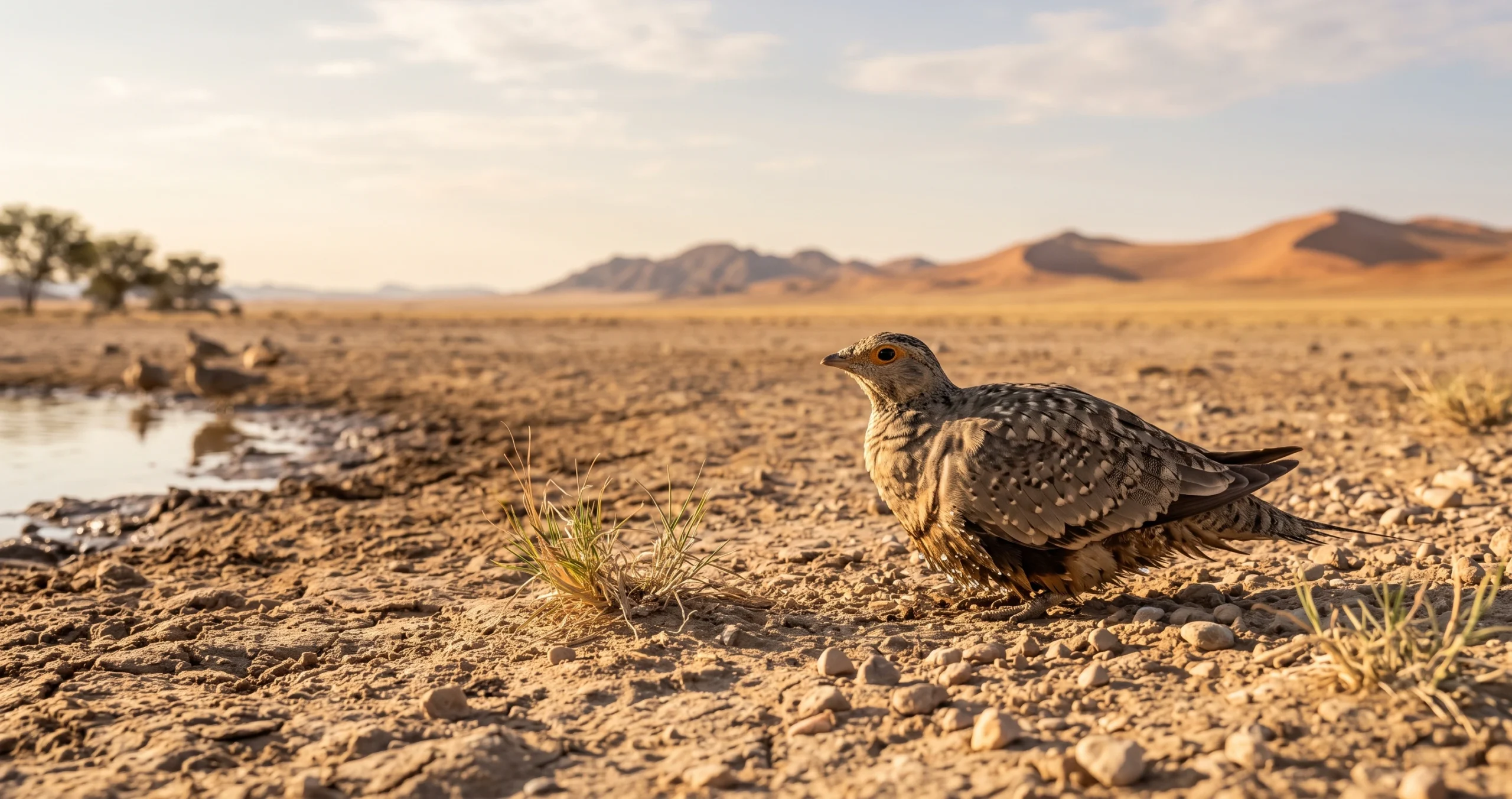
The sandgrouse water-carrying feathers are among the most remarkable parental adaptations in the bird world. In some of Earth’s hottest and driest deserts, where water may be many miles from nesting areas, male sandgrouse have evolved a unique solution: they transport water directly to their chicks inside specially adapted belly feathers.
At first glance, a sandgrouse looks like an ordinary ground-dwelling bird. Yet beneath its modest appearance lies a biological innovation unlike anything found in most other birds. A male can fly to a distant watering hole, soak his breast feathers until they become saturated, and then return to the nest with enough water for waiting chicks to drink.
Scientists have known about this behavior for more than a century, but only in recent years have detailed microscopic studies revealed exactly how the feathers trap and hold water so effectively. These discoveries highlight one of evolution’s most elegant solutions to raising young in an unforgiving environment.
Table of Contents
- What Are Sandgrouse Water-Carrying Feathers?
- Meet the Sandgrouse
- How Males Collect Water
- The Feather Anatomy That Makes It Possible
- Why Only the Chicks Drink from the Feathers
- Life in Extreme Desert Environments
- Daily Behavior and Breeding
- Ecological Importance
- Conservation Challenges
- What People Often Get Wrong
- Tips for Observing Sandgrouse Responsibly
- Frequently Asked Questions
- Conclusion
What Are Sandgrouse Water-Carrying Feathers?
The sandgrouse water-carrying feathers are specialized feathers located on the belly and breast of adult males in several sandgrouse species.
Unlike ordinary feathers, these structures can absorb and temporarily retain water between intricate feather filaments. After soaking them at a water source, the male flies back to the nesting area, where chicks drink directly from the damp plumage.
This adaptation is especially important in deserts where young birds cannot safely travel long distances to water.
Although the overall behavior has been recognized for generations, modern imaging techniques have helped scientists understand how the microscopic feather structure traps water while remaining light enough for flight.
Meet the Sandgrouse
Sandgrouse belong to the family Pteroclidae, a group of birds found across Africa, the Middle East, southern Europe, and much of Asia.
They inhabit landscapes that include:
- Sandy deserts
- Stony plains
- Semi-arid grasslands
- Dry shrublands
- Desert steppe
Despite living in harsh climates, sandgrouse are highly social birds.
Many species gather in flocks outside the breeding season and fly remarkable distances between feeding areas and reliable water sources.
Their compact bodies, pointed wings, and strong flight muscles make them efficient long-distance fliers.
Most species feed primarily on seeds, an abundant but often dry food resource that reinforces their dependence on regular access to water.
How Males Collect Water
The daily water-collecting routine follows a carefully coordinated sequence.
Shortly after sunrise, males leave nesting areas and fly to permanent or seasonal waterholes.
These flights may cover many miles depending on local conditions.
Once they reach the water, males wade into the shallows.
Instead of simply drinking, they lower their breasts into the water while rocking gently.
Using repeated movements, they work water deep into their specialized belly feathers.
The soaking process takes only a few minutes.
After the feathers become saturated, the male carefully lifts off.
Despite carrying extra weight, the water remains trapped within the feather structure during the return flight.
Back at the nest, waiting chicks press their bills against the damp feathers and drink directly from them.
The parent does not regurgitate water.
Instead, the chicks extract moisture from the feather surface.
The Feather Anatomy That Makes It Possible
The ability to transport water depends on an extraordinary feather design.
Specialized Belly Feathers
The water-carrying feathers differ from ordinary contour feathers covering most of the bird’s body.
Their internal structure has evolved specifically to trap liquid.
Microscopic branching filaments help retain water while preventing it from immediately dripping away.
Coiled Feather Barbs
Research using high-resolution microscopy has shown that some feather barbules possess tightly coiled structures.
When wet, these coils partially unwind.
Combined with tiny hook-like features, they help hold water between neighboring feather elements.
As the feathers dry, the structures gradually return toward their original shape.
Capillary Action
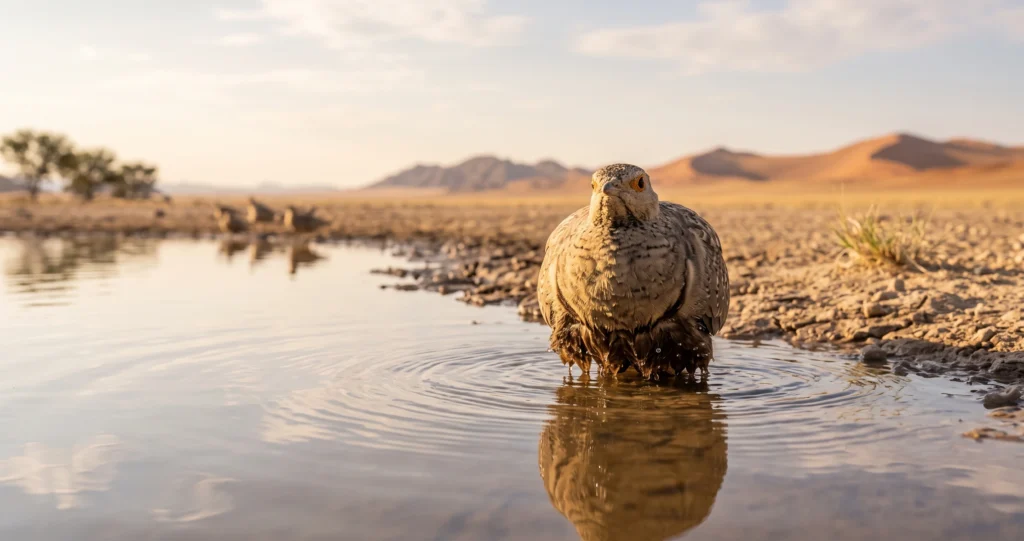
Much of the feather’s water-holding ability comes from capillary forces.
Water naturally moves into extremely narrow spaces between feather structures, where surface tension helps keep it in place.
This allows the bird to transport surprisingly large amounts of water without requiring sealed containers or absorbent skin.
Flight Efficiency
Although the feathers become saturated, they remain organized enough to allow flight.
Researchers continue studying exactly how sandgrouse balance water retention with aerodynamic performance, but the adaptation appears remarkably efficient.
Why Only the Chicks Drink from the Feathers
Adult sandgrouse can fly directly to water whenever necessary.
Young chicks cannot.
Soon after hatching, sandgrouse chicks leave the nest and begin walking with their parents.
Although mobile, they are still too small to travel safely across long desert distances.
Heat, predators, and exhaustion make such journeys risky.
Instead, males deliver water directly to them.
This system allows chicks to remain in relatively safe feeding areas while still receiving essential hydration.
The adaptation greatly increases the chances of survival during the vulnerable early weeks of life.
Life in Extreme Desert Environments
Deserts create extraordinary challenges for birds.
Rainfall is often unpredictable.
Surface water may disappear for weeks or months.
Temperatures can become extremely high during the day.
Sandgrouse survive through a combination of behavioral and physiological adaptations.
They often feed during cooler morning and evening hours.
Their plumage helps insulate against both heat and cold.
Many species rely on camouflage to avoid predators while resting on open ground.
Strong, pointed wings allow rapid flight between scattered resources.
The water-carrying behavior fits naturally into this suite of desert adaptations.
Rather than forcing chicks to travel across dangerous terrain, the parent brings water to them.
Daily Behavior and Breeding
Most sandgrouse nest directly on the ground.
The nest itself is usually a shallow scrape lined with little or no vegetation.
Females typically lay several well-camouflaged eggs.
Both parents participate in incubation, although responsibilities differ among species.
After hatching, chicks develop quickly.
Within hours they can walk and follow adults.
Even so, they remain dependent on their parents for protection and, importantly, for access to water.
Males often continue making regular flights between waterholes and brood areas until chicks become capable of independent movement over greater distances.
The exact timing varies among species and environmental conditions.
Ecological Importance
Sandgrouse play several important ecological roles in arid environments.
As seed eaters, they help influence plant communities by dispersing seeds and consuming seasonal vegetation.
They also serve as prey for desert predators, including raptors and mammalian carnivores.
Their daily flights between feeding grounds and waterholes connect different parts of desert ecosystems.
Because sandgrouse depend on reliable water sources and healthy dryland habitats, population changes may also reflect broader environmental conditions.
For ecologists, these birds can serve as indicators of desert ecosystem health.
Conservation Challenges
Many sandgrouse species remain widespread, but some populations face increasing pressures.
Habitat degradation is one concern.
Expansion of agriculture, overgrazing, mining, and infrastructure development may alter nesting areas or reduce access to traditional feeding grounds.
Reliable water sources can also be affected by groundwater extraction, prolonged drought, or climate-related changes in rainfall patterns.
Disturbance at waterholes presents another challenge.
Repeated human activity during the hottest months may interfere with the birds’ tightly scheduled visits to drinking sites.
Because breeding success depends on adults reaching water regularly, protecting key watering areas is particularly important.
Conservation measures often focus on maintaining natural desert habitats, protecting important water sources, monitoring populations, and reducing disturbance during breeding.
What People Often Get Wrong
Several misconceptions surround this remarkable behavior.
The birds do not carry water inside their bills.
The water is transported within specialized breast feathers.
Adult birds are not drinking from the feathers.
The feathers mainly serve to provide water for chicks.
Not every bird species can do this.
The adaptation is highly specialized and is unique among sandgrouse.
The feathers are not sponge-like.
They do not absorb water like a household sponge.
Instead, intricate feather structures trap water through specialized microscopic architecture and capillary forces.
Chicks still learn to find water later.
The feather system is a temporary parental adaptation while young birds are too vulnerable to travel long distances.
Tips for Observing Sandgrouse Responsibly
Observing sandgrouse at natural waterholes requires patience and respect.
- Watch from a concealed location well before birds arrive.
- Avoid approaching active watering sites.
- Never block access to water.
- Use binoculars or spotting scopes instead of moving closer.
- Keep noise to a minimum.
- Avoid repeated visits during sensitive breeding periods if disturbance is possible.
- Follow local wildlife regulations in protected areas.
Responsible observation allows natural behaviors to continue uninterrupted.
Frequently Asked Questions
Which sandgrouse carry water in their feathers?
Several species possess this adaptation, particularly those living in arid environments where chicks cannot easily reach permanent water sources.
How do the feathers hold water?
Microscopic feather structures create narrow spaces where capillary action and specialized barbules retain water during flight.
How far can males carry water?
The distance varies depending on habitat and the location of water sources. Some populations regularly travel many miles between nesting areas and watering sites.
Do female sandgrouse also carry water?
The best-documented water-carrying behavior is performed by males, which typically make the regular trips between broods and waterholes.
Can chicks survive without these water deliveries?
In many desert environments, regular access to water delivered by adult males is considered an important factor in chick survival until they become more independent.
Conclusion
The sandgrouse water-carrying feathers represent one of the most remarkable examples of parental care in birds. Through a combination of specialized feather anatomy, capillary physics, and carefully timed behavior, male sandgrouse transport life-sustaining water across some of the world’s driest landscapes. Waiting chicks then drink directly from their father’s saturated breast feathers, allowing them to remain safely away from distant waterholes during their most vulnerable stage of life.
This extraordinary adaptation illustrates how evolution often solves environmental challenges not with dramatic changes in body size or strength, but through highly refined biological innovations. Protecting healthy desert ecosystems and reliable natural water sources will help ensure that future generations of sandgrouse can continue performing one of the bird world’s most distinctive acts of parental care.
Suggested Internal-Link Opportunities
Since I cannot verify your website’s exact URLs, consider linking naturally to existing or future articles covering:
- How Pangolins Use Their Extraordinary Tongues to Eat Ants
- How Western Grebes Run Across Water During Courtship
- How Greater Sage-Grouse Perform Their Booming Courtship Displays
- Desert Animal Adaptations
- Birds With Extraordinary Parenting Behaviors
- How Animals Survive Extreme Heat
Recommended Authoritative External Sources
- Cornell Lab of Ornithology – Birds of the World (sandgrouse species accounts)
- Smithsonian National Museum of Natural History – Bird evolution and feather biology
- Peer-reviewed research published in Science (2020) describing the microscopic structure of sandgrouse water-carrying feathers
- IUCN Red List – Sandgrouse species assessments
- BirdLife International – Species factsheets and conservation information