
Introduction
Stretching from the Canadian Prairies through the central United States and into northern Mexico, the Great Plains form one of the largest temperate grassland ecosystems on Earth. Although they may appear open and uniform from a distance, these vast landscapes support an extraordinary diversity of wildlife uniquely adapted to life with few trees, strong winds, harsh winters, scorching summers, and periodic drought.
Among the most iconic inhabitants are the mammals that have evolved alongside the prairie itself. Massive bison once roamed these grasslands in herds numbering in the millions, while swift pronghorn developed unmatched endurance to outrun ancient predators. Underground, prairie dogs and pocket gophers reshape the soil, while elusive hunters like bobcats, coyotes, and swift foxes patrol the open country.
Each species plays a distinct ecological role, contributing to one of North America’s most fascinating and dynamic ecosystems. Understanding these mammals offers a deeper appreciation of how grasslands function—and why conserving them remains so important today.
What Are the Great Plains?
The Great Plains cover approximately 1.3 million square miles (3.4 million km²), extending from Alberta, Saskatchewan, and Manitoba south through the central United States into Texas and parts of northern Mexico.
Major habitats include:
- Shortgrass prairie
- Mixed-grass prairie
- Tallgrass prairie
- Sagebrush steppe
- Rolling hills
- Seasonal wetlands
- River valleys
These varied environments support a surprisingly rich community of mammals.
Bison: The Giant of the Prairie
The American bison (Bison bison) is the largest land mammal in North America.
Adult bulls may weigh over 2,000 pounds (900 kg).
Bison influence the prairie by:
- Grazing grasses.
- Creating wallows that collect rainwater.
- Dispersing seeds.
- Recycling nutrients.
Their grazing patterns increase plant diversity and benefit many other grassland species.
Although their numbers declined dramatically during the nineteenth century, conservation efforts have helped restore populations in protected areas.
Pronghorn
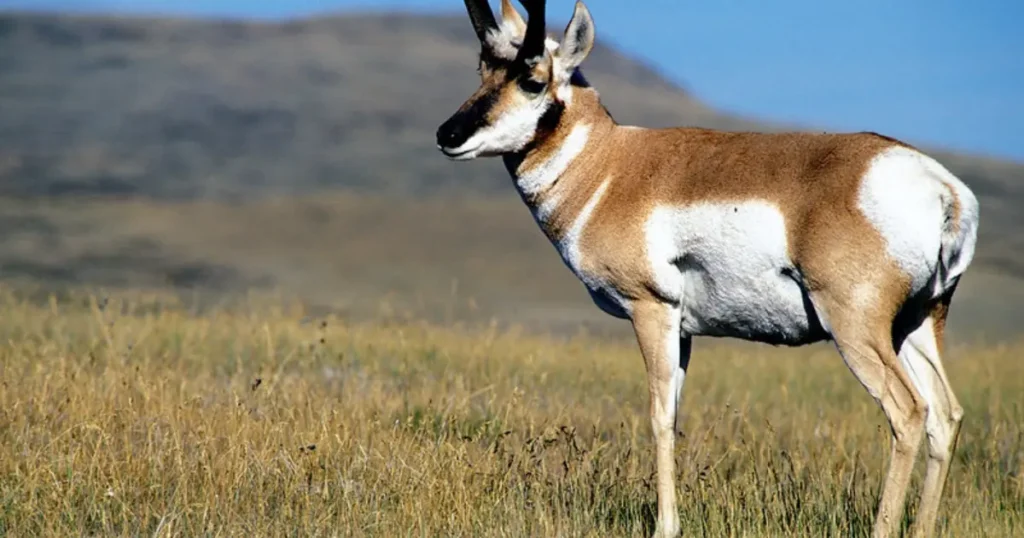
Often mistaken for an antelope, the pronghorn (Antilocapra americana) is actually the only surviving member of its own unique family.
It is the fastest land mammal in North America.
Pronghorn can sustain speeds of approximately 35–40 mph (56–64 km/h) for long distances, with short bursts exceeding 55 mph (89 km/h).
Their exceptional eyesight allows them to detect predators across the open prairie.
Swift Fox
The swift fox (Vulpes velox) is one of the smallest wild canids in North America.
Perfectly adapted to prairie life, it spends much of the day resting in underground dens before emerging at dusk to hunt.
Its diet includes:
- Rodents
- Insects
- Birds
- Reptiles
- Fruits
The swift fox has benefited from conservation programs following major population declines during the twentieth century.
Black-Footed Ferret
The black-footed ferret (Mustela nigripes) is among the rarest mammals in North America.
It depends almost entirely on prairie dog colonies for both food and shelter.
More than 90% of its diet consists of prairie dogs.
After being declared extinct in the wild during the 1980s, a small surviving population led to one of the world’s most successful captive breeding and reintroduction programs.
American Badger
The American badger (Taxidea taxus) is a powerful digger capable of excavating prey within minutes.
Its muscular forelimbs and long claws allow it to capture:
- Ground squirrels
- Pocket gophers
- Prairie dogs
- Mice
Badgers often modify soil structure by creating extensive burrow systems.
Coyote
Few mammals have adapted to changing landscapes as successfully as the coyote (Canis latrans).
Coyotes occupy:
- Grasslands
- Farmland
- Deserts
- Mountains
- Forest edges
- Urban environments
Highly intelligent and opportunistic, they feed on mammals, birds, insects, fruit, and carrion.
Prairie Dog
Prairie dogs are highly social ground squirrels that live in extensive underground colonies called “towns.”
Their burrows provide shelter not only for themselves but also for many other species, including:
- Burrowing owls
- Black-footed ferrets
- Snakes
- Rabbits
- Insects
For this reason, prairie dogs are considered a keystone species.
Jackrabbit
Despite its name, the jackrabbit is actually a hare rather than a rabbit.
Its adaptations include:
- Long ears that help regulate body temperature.
- Powerful hind legs.
- Excellent speed.
Jackrabbits can escape predators by making sudden changes in direction while running across open grasslands.
Bobcat
The bobcat (Lynx rufus) is a versatile predator found throughout much of North America.
Although commonly associated with forests, bobcats also inhabit prairie regions where they hunt:
- Rabbits
- Rodents
- Birds
- Reptiles
Their spotted coats provide excellent camouflage among grasses and shrubs.
Elk
Elk (Cervus canadensis) historically occupied portions of the Great Plains alongside forests and mountain foothills.
Large bulls develop impressive antlers used during the autumn breeding season.
Elk primarily graze grasses but also browse shrubs depending on seasonal availability.
Mule Deer
Named for their large ears, mule deer (Odocoileus hemionus) inhabit western portions of the Great Plains.
Unlike white-tailed deer, mule deer escape predators using a distinctive stiff-legged bouncing gait known as stotting.
Striped Skunk
The striped skunk (Mephitis mephitis) is instantly recognizable by its bold black-and-white coloration.
Its famous defensive spray serves as a warning to predators.
Despite their reputation, skunks are beneficial because they consume:
- Beetles
- Grasshoppers
- Rodents
- Grubs
- Fallen fruit
Raccoon
Although often associated with forests and rivers, raccoons also occupy wooded portions of the Great Plains.
Their highly dexterous front paws allow them to manipulate food and investigate their surroundings with remarkable precision.
Pocket Gopher
Pocket gophers spend nearly their entire lives underground.
Their tunneling:
- Aerates soil.
- Mixes nutrients.
- Improves water infiltration.
- Influences plant communities.
Although sometimes considered garden pests, they perform important ecological functions.
Deer Mouse
The deer mouse (Peromyscus maniculatus) is one of North America’s most widespread small mammals.
It serves as prey for numerous predators, including:
- Owls
- Foxes
- Coyotes
- Snakes
- Bobcats
Its role in transferring energy through the food web is vital.
North American Porcupine
Porcupines are slow-moving herbivores protected by thousands of sharp quills.
Contrary to popular myth, porcupines cannot shoot their quills.
Instead, quills detach easily when predators make contact.
How These Mammals Shape the Prairie
Together, these mammals perform essential ecological functions.
They:
- Control herbivore populations.
- Regulate rodents.
- Improve soil structure.
- Disperse seeds.
- Cycle nutrients.
- Support predator-prey relationships.
The health of the prairie depends on this complex web of interactions.
Conservation Challenges
Many Great Plains mammals face pressures from:
- Habitat fragmentation.
- Agricultural expansion.
- Urban development.
- Road mortality.
- Climate change.
- Declining native grasslands.
Large-scale prairie conservation benefits not only mammals but also birds, pollinators, reptiles, and countless plant species.
Practical Tips
If visiting the Great Plains:
- Observe wildlife from a respectful distance.
- Stay on designated trails.
- Never feed wild mammals.
- Carry binoculars for better viewing.
- Respect protected areas and seasonal closures.
Common Misconceptions
Pronghorn Are Antelope
They resemble antelope but belong to their own unique family found only in North America.
Prairie Dogs Are Pests Only
Prairie dogs are ecosystem engineers that support dozens of other species.
Coyotes Only Eat Meat
Coyotes are omnivores with a highly varied diet.
Porcupines Throw Their Quills
Porcupines cannot project their quills; they detach only through contact.
Frequently Asked Questions
Which is the largest mammal in the Great Plains?
The American bison is the largest native land mammal in North America.
What is the fastest mammal on the Great Plains?
The pronghorn is North America’s fastest land mammal.
Why are prairie dogs important?
Their burrows provide habitat for many other animals, making them a keystone species.
Are black-footed ferrets still endangered?
Yes. They remain one of North America’s rarest mammals despite successful recovery efforts.
Which predators hunt on the Great Plains?
Coyotes, bobcats, badgers, swift foxes, raptors, and historically wolves all play important roles in prairie ecosystems.
Conclusion
The mammals of the Great Plains represent millions of years of adaptation to one of Earth’s most demanding landscapes. From the immense strength of the bison and the astonishing speed of the pronghorn to the underground engineering of prairie dogs and pocket gophers, each species contributes to the health and resilience of the prairie.
Together, they illustrate that grasslands are far more than empty open spaces—they are vibrant ecosystems where every mammal, whether large or small, helps shape the landscape. Protecting these remarkable animals means protecting one of North America’s last great natural grassland ecosystems for future generations.
reat Plains, Mammals, Wildlife, Bison, Prairie, North America, Conservation, Grasslands
Internal Linking
Learn about the incredible diversity of wild cats found across the Americas:
https://secretsofthegreengarden.com/wild-cats-of-the-americas/
Discover how wolves transformed Yellowstone’s ecosystem:
https://secretsofthegreengarden.com/yellowstone-wolves-river-ecosystem/
Explore the oldest living tree in North America:
https://secretsofthegreengarden.com/bristlecone-pine-oldest-tree/
See how biodiversity keeps natural ecosystems healthy:
https://secretsofthegreengarden.com/companion-planting-science/
Recommended External Sources
- National Park Service: https://www.nps.gov
- Smithsonian’s National Zoo & Conservation Biology Institute: https://nationalzoo.si.edu
- International Union for Conservation of Nature (IUCN): https://www.iucn.org