

Most people think of sharks as cold-blooded predators whose body temperature simply matches the surrounding water. While that is true for most shark species, the great white shark warm blooded adaptation makes this famous predator a remarkable exception. Great white sharks possess a specialized biological system that allows parts of their bodies to remain significantly warmer than the surrounding ocean, giving them major advantages in speed, strength, and endurance.
Scientists refer to this ability as regional endothermy. Rather than maintaining a constant body temperature like mammals and birds, great white sharks selectively warm key organs and muscles while swimming through cold seas. Understanding the biology behind this adaptation not only reveals why these apex predators are such efficient hunters but also helps researchers predict how changing ocean temperatures may affect their future.
Table of Contents
- Are Great White Sharks Really Warm-Blooded?
- Understanding Regional Endothermy
- The Rete Mirabile Explained Simply
- How Great White Sharks Produce Heat
- Which Other Sharks Share This Ability?
- Why Warm Muscles Make Better Hunters
- How Warm Blood Helps in Cold Oceans
- Conservation Challenges in a Warming Climate
- Safe Shark Viewing for Divers
- Common Myths About Great White Sharks
- Frequently Asked Questions
- Conclusion
Are Great White Sharks Really Warm-Blooded?
The answer is both yes and no.
Great white sharks are not fully warm-blooded like whales, dolphins, or humans. Instead, they possess regional endothermy, meaning they maintain elevated temperatures in specific parts of their bodies.
Their swimming muscles, digestive organs, stomach, brain, and eyes can remain much warmer than the surrounding seawater.
Depending on environmental conditions, these tissues may be maintained as much as 10–15°C (18–27°F) above ambient water temperature.
This gives great white sharks capabilities unavailable to most other fish.
Understanding Regional Endothermy
Most fish are ectothermic, meaning their body temperature changes with the surrounding water.
As water cools, muscle performance slows.
Digestion becomes less efficient.
Reaction time decreases.
Great white sharks largely avoid these problems through regional endothermy.
Instead of warming the entire body, they selectively retain heat where it matters most.
This strategy requires much less energy than maintaining a uniformly warm body while still delivering substantial performance benefits.
It represents one of the most sophisticated physiological adaptations among fishes.
Great White Shark Warm Blooded Adaptation: The Rete Mirabile Explained Simply
The secret behind the great white shark warm blooded adaptation lies in a specialized network of blood vessels called the rete mirabile, Latin for “wonderful net.”
This structure acts as an extremely efficient heat exchanger.
Here’s how it works:
Warm blood leaving active swimming muscles flows through vessels that run alongside cooler blood arriving from the gills.
Instead of allowing valuable heat to escape into the surrounding water, the warm outgoing blood transfers much of its heat directly into the cooler incoming blood.
The recycled heat stays inside the shark’s body.
As a result, muscles remain warm while heat loss through the gills is greatly reduced.
Rather than continuously generating new heat, the shark conserves the heat it already produces through muscular activity.
This elegant system allows great white sharks to remain powerful hunters even in surprisingly cold waters.
How Great White Sharks Produce Heat
Unlike mammals, great white sharks do not shiver to stay warm.
Their heat comes primarily from powerful swimming muscles.
As muscles contract repeatedly during swimming, they naturally generate heat as a byproduct of metabolism.
Normally, this heat would quickly disappear into the surrounding ocean.
The rete mirabile captures and recycles much of that energy.
Specialized heat exchangers also help warm important organs including the stomach.
Maintaining elevated stomach temperatures allows food to digest much faster than would otherwise be possible in cold seawater.
Scientists have even recorded stomach temperatures substantially above surrounding ocean temperatures shortly after feeding.
Warm Brains and Sharp Vision
Regional endothermy benefits more than muscles.
Great white sharks also maintain warmer temperatures around the brain and eyes.
These warmer tissues improve nerve conduction and visual processing.
Faster information processing allows sharks to react more quickly during high-speed pursuits.
This becomes especially valuable in cold, deep water where many prey species remain active despite low temperatures.
Maintaining sharp vision and rapid coordination may significantly increase hunting success.
Which Other Sharks Share This Ability?
Great white sharks are members of the family Lamnidae, often called mackerel sharks.
Several close relatives possess similar adaptations.
Shortfin Mako Shark
The shortfin mako is perhaps the fastest shark in the ocean.
Regional endothermy helps support its incredible swimming speeds and explosive acceleration.
Longfin Mako Shark
Although less studied, the longfin mako also exhibits heat-retaining adaptations similar to its close relatives.
Porbeagle Shark
Porbeagles inhabit cold northern oceans where elevated body temperatures improve muscle function and digestion.
Salmon Shark
Found in the North Pacific, salmon sharks regularly hunt in near-freezing waters.
Their body temperatures may remain dramatically warmer than surrounding seawater.
Among fishes, these sharks represent some of the most advanced examples of regional endothermy.
Why Warm Muscles Make Better Hunters
Cold muscles contract more slowly.
They generate less power.
Recovery after intense exercise also becomes slower.
By keeping swimming muscles warm, great white sharks maintain:
- Faster acceleration
- Greater cruising endurance
- Stronger bursts of speed
- Improved maneuverability
- Better hunting efficiency
These advantages allow them to pursue agile prey such as seals, sea lions, tuna, and other large fishes.
Warm muscles also permit rapid vertical movements between cold deep water and warmer surface waters without major performance losses.
How Warm Blood Helps in Cold Oceans
Great white sharks occur in temperate oceans around the world.
Many regularly hunt in waters far colder than most sharks prefer.
Without regional endothermy, cold temperatures would greatly reduce swimming efficiency.
Instead, these sharks remain highly active across a wide temperature range.
This expands their hunting grounds and allows them to exploit prey unavailable to many competitors.
Their ability to function efficiently in cooler environments partly explains their broad geographic distribution.
Conservation Challenges in a Warming Climate
Regional endothermy has evolved under millions of years of relatively stable environmental conditions.
Rapid climate change now introduces new uncertainties.
As ocean temperatures rise, prey species are shifting their ranges toward cooler waters.
Great white sharks may alter migration routes in response.
Scientists are monitoring whether warming oceans will change breeding grounds, hunting behavior, or seasonal movements.
Temperature is only one concern.
Climate change also influences prey abundance, oxygen availability, and ecosystem structure.
Protecting healthy marine food webs remains essential for conserving apex predators like great white sharks.
Long-term monitoring programs continue to improve understanding of how these remarkable animals respond to changing oceans.
For reliable information about shark conservation, the International Union for Conservation of Nature (IUCN) maintains updated species assessments:
https://www.iucnredlist.org/
Why Great White Sharks Matter to Ocean Ecosystems
As apex predators, great white sharks help regulate marine food webs.
They influence prey behavior, remove weakened individuals, and contribute to healthier marine ecosystems.
The loss of top predators can trigger ecological changes that affect many other species.
Conserving sharks therefore supports overall ocean biodiversity rather than protecting a single species alone.
If you enjoy learning how predators maintain balanced ecosystems, you may also like our guide to wildlife and ecological relationships at secretsofthegreengarden.com.
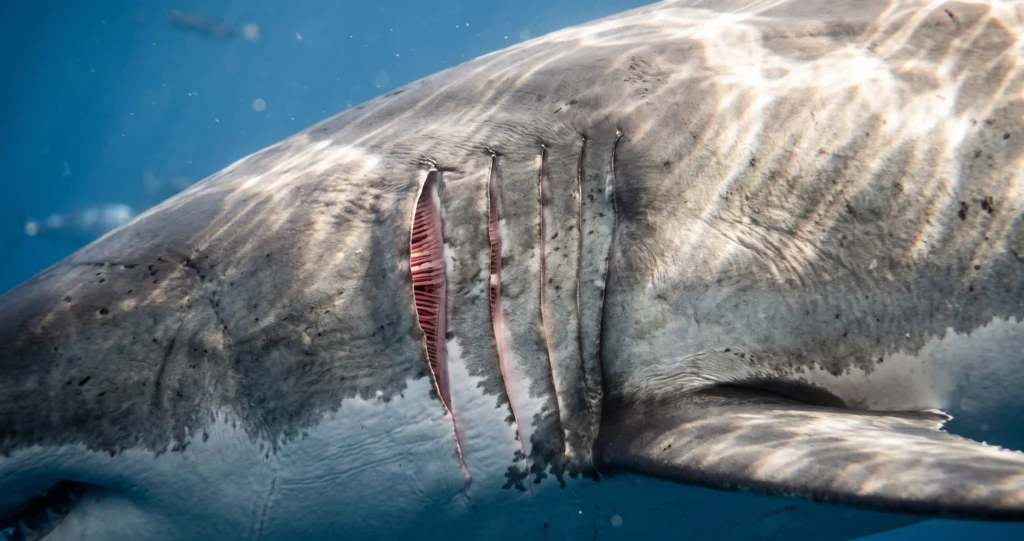
great white shark warm blooded anatomy showing the rete mirabile heat exchange system.”
Safe Shark Viewing for Divers
Seeing a great white shark in its natural environment can be an unforgettable experience.
Responsible wildlife viewing helps protect both people and sharks.
Always dive with experienced operators that follow local regulations and established safety protocols.
Listen carefully to guides before entering the water.
Maintain calm, predictable movements rather than sudden splashing.
Avoid attempting to touch, feed, or attract sharks outside professionally managed research or ecotourism activities where permitted.
Remain aware of your surroundings and stay with your group.
Respect minimum viewing distances and never interfere with natural hunting behavior.
Responsible ecotourism can promote shark conservation by demonstrating their ecological value.
Common Myths About Great White Sharks
Myth: Great white sharks are completely warm-blooded.
False.
Only certain muscles and organs remain significantly warmer than surrounding water.
Myth: Warm blood makes them aggressive.
False.
Regional endothermy improves physiological performance but does not determine behavior toward humans.
Myth: Great white sharks constantly hunt people.
False.
Humans are not natural prey.
Most encounters are rare, and many bites are believed to involve mistaken identity or exploratory behavior.
Myth: All sharks have this adaptation.
False.
Only a small number of shark species possess regional endothermy.
Myth: Great white sharks must remain in warm water.
False.
Their heat-retention system actually allows them to hunt efficiently in relatively cold oceans.
Frequently Asked Questions
Are great white sharks mammals?
No. They are cartilaginous fishes despite sharing some physiological similarities with warm-blooded animals.
What is the rete mirabile?
It is a network of blood vessels that conserves metabolic heat by transferring warmth from outgoing blood to cooler incoming blood.
Which shark is the fastest?
The shortfin mako shark is generally considered the fastest shark, aided by regional endothermy.
Why is a warm stomach important?
Higher stomach temperatures speed digestion, allowing sharks to process large meals more efficiently.
Do warming oceans benefit great white sharks?
Not necessarily. Climate change affects prey distribution, habitats, and ecosystem balance in complex ways that may create new conservation challenges.
Conclusion
The great white shark warm blooded adaptation represents one of the most remarkable physiological innovations in marine biology. Through regional endothermy and the sophisticated rete mirabile heat-exchange system, these sharks maintain warm muscles, brains, eyes, and digestive organs that dramatically improve their hunting performance in cold oceans.
Far from being simple predators, great white sharks are highly specialized animals shaped by millions of years of evolution. Their unique biology continues to inspire research into animal physiology while highlighting the importance of protecting healthy marine ecosystems in a rapidly changing world.
Understanding how these extraordinary predators conserve heat not only deepens our appreciation of shark biology but also reinforces why conserving apex predators remains essential for maintaining resilient and balanced oceans.
2 Internal Link Suggestions:
- https://secretsofthegreengarden.com/how-pollinators-help-your-garden-thrive/
- https://secretsofthegreengarden.com/why-fireflies-are-important-for-healthy-gardens/
3 External Dofollow Authoritative Sources with URLs:
- International Union for Conservation of Nature (IUCN) Red List: https://www.iucnredlist.org/
- Smithsonian Ocean – Sharks: https://ocean.si.edu/ocean-life/sharks-rays
- NOAA Fisheries – White Shark: https://www.fisheries.noaa.gov/species/white-shark