
Introduction
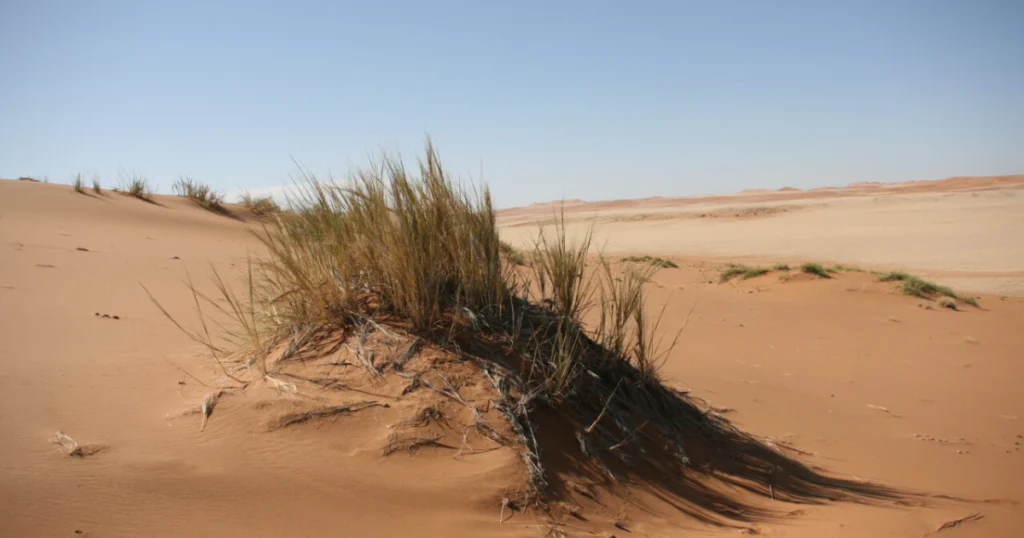
The Namib Desert stretches along the Atlantic coast of southwestern Africa, where immense dunes meet one of the coldest ocean currents on the continent. Parts of this landscape receive less than 10 millimetres of rain in an average year, and long periods may pass without measurable rainfall.
Yet the Namib is not empty.
Beetles cross dune ridges before sunrise. Geckos move through loose sand with specialized feet. Antelope travel between sparse feeding grounds, and small animals shelter beneath the surface during the hottest part of the day. Their survival depends on a collection of adaptations shaped by one of Earth’s longest-running experiments in aridity.
The Namib is widely described as one of the world’s oldest deserts, with arid conditions extending back tens of millions of years. NOAA notes an estimated age of about 55 million years, while the coastal dune landscape is strongly influenced by fog generated over the cold Benguela Current.
For animals living permanently in this environment, waiting for rain is not a viable strategy. They must capture water from fog, absorb moisture through food or body surfaces, reduce water loss, avoid daytime heat, and use the desert’s shifting microclimates with extraordinary precision.
Why the Namib Is So Dry
The Namib’s extreme dryness results from the interaction of geography, ocean circulation, and atmospheric conditions.
Off the coast, the Benguela Current carries cold water northward from the Southern Ocean. Air passing over this cold surface cools and becomes stable, limiting the formation of the tall rain-producing clouds common in wetter regions.
Moist ocean air frequently produces fog near the coast, but it often fails to generate significant rainfall. As a result, the coastal Namib can remain almost rainless while still experiencing regular periods of atmospheric moisture.
This distinction is essential. Rainfall may be exceptionally scarce, but fog and dew create a second, less obvious water cycle that supports much of the desert’s life. Scientific reviews have documented the dependence of numerous Namib animals on fog as a source of free water.
Fog: The Namib’s Hidden Water Supply
Fog usually enters the coastal desert during the night or early morning.
Tiny droplets drift inland with the wind, wetting dune crests, stones, plants, spider webs, and animal bodies. The total amount deposited at one location may be small, but in an ecosystem where every drop matters, even a thin film of moisture can determine whether an animal survives.
At least dozens of Namib animal species are known or strongly suspected to consume water derived from fog, either by collecting liquid droplets directly or by using moisture that has accumulated on plants and sand.
Fog also supports the plants and microorganisms that form the base of local food webs. An animal may therefore benefit from fog without drinking it directly. It may eat a moisture-rich plant, consume insects that fed during fog events, or shelter in soil where atmospheric water has condensed.
The Beetles That Drink from the Air
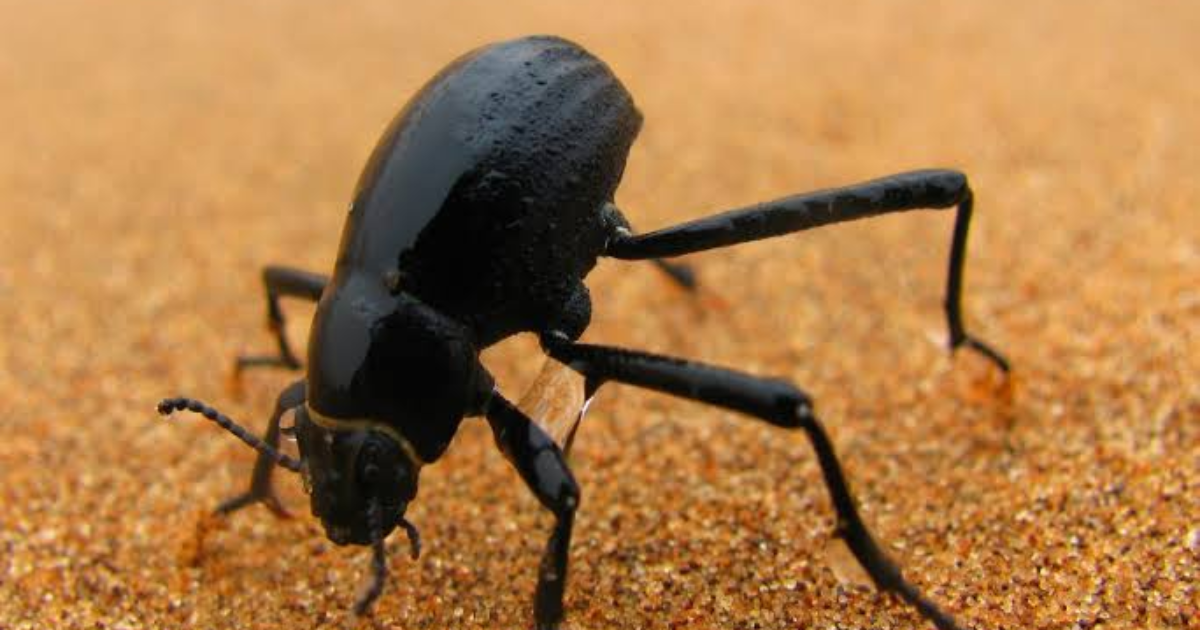
The Namib’s fog-harvesting darkling beetles are among the best-known examples of animal adaptation to extreme aridity.
Several species climb to the crests of dunes when fog arrives. Some adopt a head-down posture with their bodies raised into the wind. Fog droplets strike the hardened wing covers, merge into larger drops, and run toward the mouth.
Research on Onymacris unguicularis and related species has shown that this behaviour can provide a significant amount of drinking water during fog events. Other beetles dig trenches or construct ridges in the sand to collect moisture instead of using their bodies directly.
Fog Basking
During fog basking, the beetle positions itself so that moist air flows across its back.
The behaviour generally involves:
- Climbing to an exposed dune ridge
- Facing into the fog-bearing wind
- Raising the abdomen
- Allowing droplets to collect and coalesce
- Drinking water as it flows toward the mouth
The posture is simple, but its timing must be precise. Too early and there may be insufficient fog. Too late and the rising sun may evaporate the moisture.
More Than a Special Surface
Popular descriptions often focus on the beetle’s textured outer surface, but behaviour is equally important. The animal must choose the correct location, body angle, wind direction, and time of day.
That combination of anatomy and behaviour is why the beetle has become a major inspiration for biomimetic water-collection materials. Scientists have studied beetle-inspired surfaces designed to capture atmospheric moisture for human use.
Drinking Dew from Plants and Sand
Not every Namib animal has a specialized fog-collecting body.
Many obtain water indirectly from droplets deposited on vegetation, stones, or the surface of the dunes. Small insects may drink from wet plant stems, while other animals consume vegetation at night or early in the morning when its moisture content is highest.
Some desert species also take advantage of water collecting beneath fog-harvesting plants. Grasses can intercept droplets and channel moisture toward their bases, creating tiny humid refuges used by insects and other small organisms.
These patches may support more biological activity than the surrounding open sand, making individual plants important centres of desert life.
The Desert Rain Frog’s Unusual Strategy
The desert rain frog lives in coastal dunes of Namibia and northwestern South Africa. Unlike many frogs, it does not depend on permanent ponds or open bodies of water.
It spends long periods buried in sand, where temperatures are more stable and humidity is higher than at the surface. When moisture becomes available, the frog may absorb water through a highly vascularized area of skin on its underside.
Recent reporting based on amphibian specialists describes the frog using damp sand and moisture deposited by fog, absorbing water through a belly patch rich in blood vessels. Its compact body also reduces surface area relative to volume, helping limit water loss.
This strategy demonstrates that animals do not always need to drink water through the mouth. In amphibians, skin can play a central role in hydration.
Water from Food
Many desert animals obtain most or all of their water from what they eat.
Insects contain body fluids. Leaves and seeds hold moisture. Prey captured shortly after fog events may contain more water than prey taken later in the day.
Predators and insect-eating animals can therefore acquire water metabolically and through the tissues of their food.
This approach reduces the need to search for exposed water, which is especially valuable in open desert where movement increases the risk of overheating or predation.
Metabolic Water
Animals also produce a small amount of water when food is broken down during cellular respiration.
Fats can generate relatively high amounts of metabolic water compared with carbohydrates or proteins. Desert animals may therefore benefit from energy-rich food sources that provide both calories and internally produced moisture.
Metabolic water alone is not enough for every species, but it can form an important part of a broader water-conservation strategy.
Avoiding the Heat
Finding water is only half the challenge. Animals must also prevent that water from being lost.
The exposed surface of a Namib dune can become extremely hot during the day. Small animals are particularly vulnerable because their bodies can heat rapidly.
Many species avoid these conditions through behavioural timing.
They may be:
- Nocturnal
- Active around dawn or dusk
- Hidden beneath sand during midday
- Restricted to shaded sides of dunes
- Active only during fog events
Burrowing can reduce exposure to heat, wind, and dry air. Just a short distance beneath the surface, temperature fluctuations may be less severe and humidity higher.
Sand as Shelter
Loose dune sand may appear unstable, but for specialized animals it offers an effective refuge.
Some Namib reptiles and invertebrates move beneath the surface, effectively swimming through sand. This protects them from heat and predators while placing them closer to cooler, moister layers.
Adaptations may include:
- Smooth body shapes
- Reduced external projections
- Specialized scales
- Broad feet
- Strong digging limbs
- Eyes and nostrils protected from sand
The ability to disappear below the surface allows animals to survive temperatures that would be dangerous in exposed air.
Conserving Water Inside the Body
Desert animals also possess physiological adaptations that reduce internal water loss.
Depending on the species, these may include:
- Highly concentrated urine
- Dry feces
- Reduced sweating or evaporative cooling
- Efficient kidneys
- Water recovery from exhaled air
- Protective body coverings
- Low rates of cutaneous water loss
Reptiles and insects are particularly well suited to arid environments because their outer coverings restrict evaporation more effectively than the moist skin of most amphibians.
Even so, no single adaptation is sufficient. Survival usually depends on a combination of behaviour, anatomy, physiology, and access to favourable microhabitats.
Large Animals of the Namib
The Namib is also home to larger animals, including gemsbok, springbok, ostriches, brown hyenas, and desert-adapted elephants in some regions.
These animals cannot harvest individual fog droplets as efficiently as beetles, but they use broader strategies.
Gemsbok
Gemsbok can tolerate significant increases in body temperature, reducing the need to cool themselves through sweating. They also obtain moisture from the plants they eat and can travel long distances between feeding areas.
Their ability to allow body temperature to fluctuate helps conserve water that would otherwise be lost through evaporation.
Ostriches
Ostriches tolerate heat through a combination of behavioural and physiological regulation. They may adjust activity patterns, seek favourable air movement, and conserve water through efficient internal systems.
Desert-Adapted Elephants
Elephants living in the wider Namib region follow seasonal drainage lines and ancient travel routes to locate scattered water, vegetation, and shaded resting areas.
They are not a separate species from other African savanna elephants, but their movement patterns and knowledge of the landscape allow them to survive in environments where water sources are widely dispersed.
The Importance of Dry Riverbeds
Although the Namib receives very little rainfall, rivers originating inland occasionally cross parts of the desert.
Many are dry at the surface for most of the year, yet water may remain underground beneath their sandy channels. These linear corridors support trees, shrubs, insects, birds, and larger mammals.
The desert is therefore not uniformly dry.
Instead, it contains a mosaic of water sources:
- Coastal fog
- Dew
- Moisture-rich food
- Underground water
- Temporary pools
- Ephemeral rivers
- Humid burrows
- Fog-fed vegetation
Animals survive by knowing which source is available, where it occurs, and how long it will last.
Why These Adaptations Matter Beyond the Desert
The Namib’s animals have become important models for engineering, architecture, and water-conservation research.
The fog-basking beetles in particular have inspired attempts to develop:
- Fog-catching meshes
- Water-harvesting building surfaces
- Self-filling containers
- Condensation systems
- Agricultural moisture collectors
These technologies imitate principles found in nature, including surface texture, droplet coalescence, directional water transport, and efficient drainage.
The goal is not to copy an animal perfectly, but to understand the physical strategies that allow it to survive with almost no rainfall.
Threats to Namib Desert Wildlife
Despite their remarkable adaptations, Namib species remain vulnerable to environmental change.
Climate Change
Changes in ocean temperature, wind patterns, or atmospheric circulation could alter the frequency and inland reach of coastal fog.
Because many species depend on fog directly or indirectly, even subtle changes could influence food availability, activity patterns, and survival.
Scientific reviews warn that future changes in Namib fog may have broad consequences for desert fauna.
Mining and Development
Mining, roads, urban expansion, and infrastructure projects can damage highly specialized dune habitats.
Animals adapted to a narrow strip of coastal desert may have nowhere else to go when their habitat is fragmented.
Off-Road Vehicles
Vehicle traffic can crush burrows, damage vegetation, compact sand, and disturb breeding areas.
Tracks may remain visible for long periods in environments where biological recovery is slow.
Practical Lessons from Namib Wildlife
The Namib offers several principles that can inform water-conscious gardening and landscape design.
Capture water where it naturally appears. Fog, dew, roof runoff, and condensation can all become useful resources.
Deliver water close to roots. Systems such as buried clay pots and drip irrigation reduce evaporation.
Protect soil from direct sun. Mulch creates cooler, more humid conditions similar to the sheltered microhabitats used by desert animals.
Water during cooler hours. Early-morning or evening irrigation reduces losses.
Choose drought-adapted species. Plants suited to local conditions require less supplemental water and support more resilient ecosystems.
Common Misconceptions
Nothing Lives in the Namib
The desert supports a highly specialized community of plants, insects, reptiles, birds, amphibians, and mammals.
All Desert Animals Store Water
Most do not carry large reserves of liquid water. They survive by obtaining small amounts regularly and minimizing loss.
Fog-Harvesting Beetles Are the Only Animals Using Fog
Beetles are the most famous example, but many animals benefit from fog directly or through plants, prey, damp sand, and food webs.
The Entire Namib Receives the Same Rainfall
Rainfall and fog frequency vary considerably from the coast toward inland regions. The desert includes several distinct ecological zones.
Desert Survival Depends on One Adaptation
Animals usually rely on multiple strategies simultaneously, including behavioural timing, water-efficient physiology, specialized body surfaces, and careful habitat use.
Frequently Asked Questions
Is the Namib really the world’s oldest desert?
It is widely described as the world’s oldest continuously arid desert, with estimates placing its origins tens of millions of years ago. NOAA cites an approximate age of 55 million years.
How do Namib beetles collect water?
Some species climb dune ridges during fog and raise their bodies into the wind. Droplets collect on their outer surfaces and flow toward the mouth. Other species dig trenches that trap moisture.
Can animals survive without drinking liquid water?
Some species obtain nearly all the water they need from food and metabolic processes. Others occasionally drink fog droplets, dew, or underground water.
Why is there fog in such a dry desert?
The cold Benguela Current cools moist ocean air, producing frequent coastal fog even when conditions do not create rainfall.
Could climate change affect fog-dependent animals?
Yes. Changes in ocean and atmospheric conditions may alter fog frequency, duration, or inland movement, potentially affecting species that depend on it.
Conclusion
The Namib Desert is not sustained by rain in the conventional sense. Its animals survive through a quieter water system built from fog, dew, food, underground moisture, and extraordinary efficiency.
Beetles turn their bodies into collectors. Frogs absorb dampness through their skin. Reptiles retreat beneath the sand. Antelope reduce evaporative cooling, and predators obtain water from prey. Each strategy solves only part of the problem, but together they allow complex animal communities to persist in one of the driest landscapes on Earth.
Their survival is a reminder that adaptation is rarely about overcoming an environment through force. It is about detecting opportunities so small that other organisms miss them: a fog bank moving inland before dawn, a humid layer beneath the sand, or a few droplets caught on the surface of a desert plant.
In the Namib, those small opportunities are enough to sustain life.
Internal Linking Opportunities
Learn how an ancient clay pot delivers water directly to plant roots:
https://secretsofthegreengarden.com/olla-irrigation-clay-pot-watering/
Discover how sundew plants survive in nutrient-poor environments:
https://secretsofthegreengarden.com/sundew-plant-carnivorous-insect-trap/
Explore the wandering albatross and its adaptations for life over the Southern Ocean:
https://secretsofthegreengarden.com/wandering-albatross-largest-wingspan/
Learn how protecting bare soil conserves water and reduces erosion:
https://secretsofthegreengarden.com/why-not-leave-bare-soil-winter/
Recommended External Sources
NOAA’s National Environmental Satellite, Data, and Information Service provides an overview of the Namib’s age, geography, and fog-influenced climate.
The peer-reviewed journal Ecosphere offers a scientific review of fog-dependent fauna and the possible effects of changing fog conditions.
The peer-reviewed study published in Frontiers in Zoology examines fog-basking behaviour and water-collection efficiency in Namib darkling beetles.