
Introduction
Along roadsides, at woodland margins, across neglected fields, and through sunny fence lines in the eastern United States, a native vine produces flowers so elaborate that they seem almost imaginary.
The plant is Passiflora incarnata, commonly called maypop, purple passionflower, or native passionflower. Its lavender-and-white blossoms combine broad petals, a dense crown of threadlike filaments, prominent reproductive structures, and an almost architectural symmetry. A person driving past may see only a tangle of green leaves. Anyone who stops to look closely discovers one of the most intricate flowers growing wild in North America.
Maypop is more than an ornamental curiosity. It is a vigorous perennial vine, a food source for pollinators, a host plant for several butterflies, and a producer of fragrant edible fruit. It also offers gardeners something increasingly valuable: the drama of a tropical-looking passionflower in a species adapted to temperate parts of the United States.
However, maypop is not a restrained little climber. It spreads through underground shoots, climbs quickly when summer arrives, and may appear several feet from its original planting site. Understanding that energy is essential to growing it successfully.
What Is Maypop Passionflower?
Maypop is an herbaceous perennial vine in the passionflower family, Passifloraceae. It is indigenous to the southeastern United States and occurs through much of the eastern and south-central country. Natural habitats include forest edges, open woods, roadsides, thickets, fallow fields, and other sunny or partially shaded disturbed ground.
Unlike tropical passion vines that remain evergreen in warm climates, maypop commonly dies back to the ground during winter in colder parts of its range. Its underground root system survives, sending up vigorous new growth once the soil warms in spring.
The vine climbs by means of tendrils. These slender structures wrap around nearby stems, wires, trellises, and fences, helping the plant rise above surrounding vegetation without investing in a self-supporting woody trunk.
Under favorable conditions, a vine can grow approximately 6 to 10 feet or more during one season. Missouri Botanical Garden lists it as hardy in roughly USDA Zones 5 through 9 and suitable for full sun to partial shade.
Why the Flower Looks So Unusual
A maypop flower is not difficult to recognize once you have seen one closely.
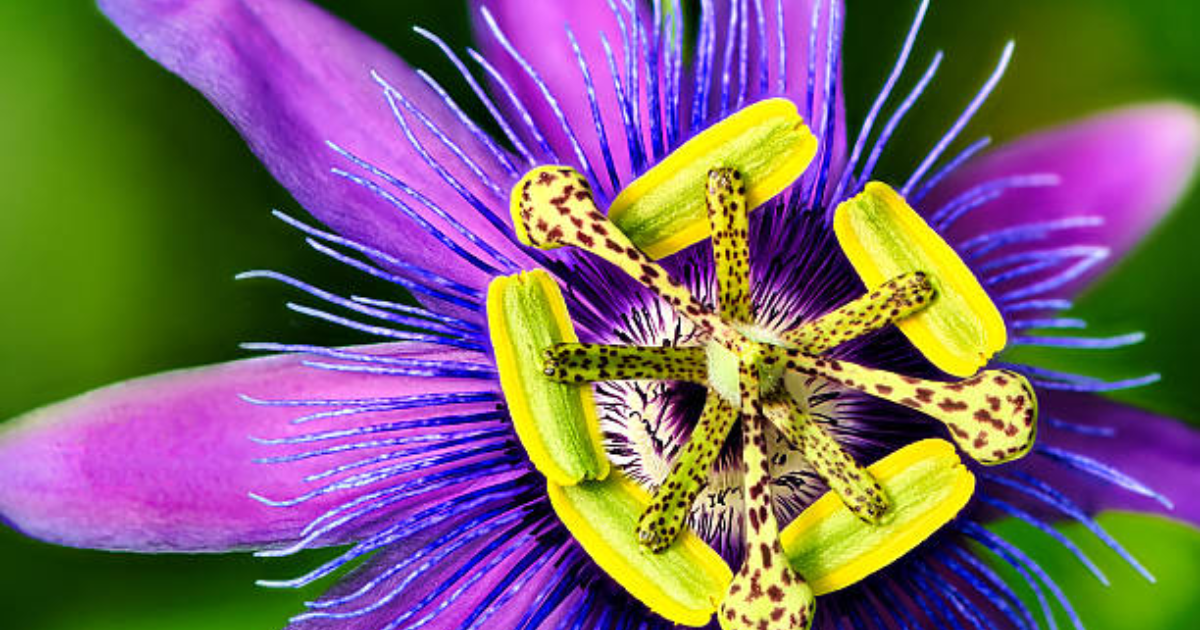
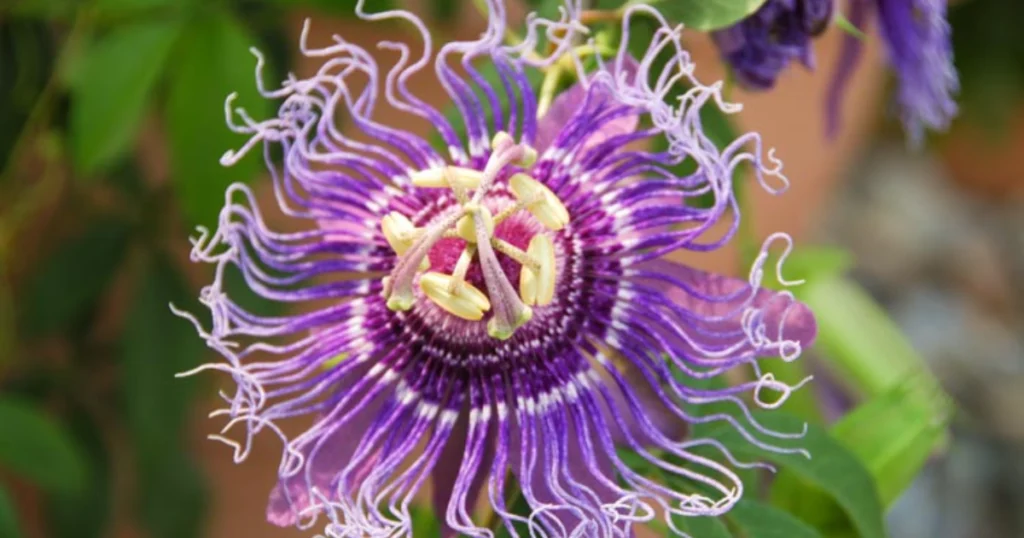
The blossom is typically around 3 inches across and contains several visually distinct layers. Pale lavender or whitish petals and sepals form the outer structure. Above them sits a corona composed of numerous narrow, wavy filaments, often banded in purple and white.
At the center rises a stalk that holds the reproductive structures above the corona. Five pollen-bearing anthers project outward, while three stigma-bearing styles sit above them.
The result resembles a combination of a flower, a clock face, and an astronomical instrument.
This unusual arrangement is functional rather than decorative. Visiting insects must move beneath the elevated anthers and stigmas while reaching the flower’s nectar. Their bodies can collect pollen from one blossom and transfer it to another.
The flowers are often fragrant and generally appear during the warmer months. Blooming time varies with climate; Missouri Botanical Garden notes summer flowering, while Florida sources describe a longer season extending from spring into fall under warmer conditions.
How Passionflower Received Its Name
The name “passionflower” does not refer to romance. It comes from Christian symbolism developed by European missionaries, who interpreted parts of the flower as representations of the Passion of Christ.
The corona was compared with the crown of thorns, the three stigmas with nails, and the five anthers with wounds. Additional parts of the flower were assigned other religious meanings over time.
The symbolism was applied to passionflowers after Europeans encountered members of the genus in the Americas. Although the interpretation is cultural rather than botanical, it helped give one of the world’s most distinctive flower groups its enduring common name.
Why It Is Called Maypop
The origin of “maypop” is less certain.
One popular explanation connects the name with the sound the hollow or partially hollow fruit may make when stepped on. Another associates it with the plant’s habit of suddenly “popping” from the ground during spring after disappearing completely over winter.
Whatever its precise origin, the name captures the plant’s seasonal behavior. In cooler regions, a bare patch of ground can suddenly produce fast-growing shoots once warm weather arrives.
Gardeners unfamiliar with this growth pattern sometimes assume the plant has died during winter, only to find vines emerging again from an established underground system.
The Maypop Fruit
After successful pollination, the flower may produce a green, egg-shaped or rounded fruit that matures toward yellow-green.
Inside is a mass of seeds surrounded by aromatic pulp. Fully ripe maypop fruit is edible and has a sweet-tart tropical flavor, although quality varies considerably among individual plants. Some fruits are fragrant and pleasantly flavored; others contain relatively little pulp or taste less impressive.
Maypop should not be confused with the commercial purple passionfruit, usually produced by Passiflora edulis. The two belong to the same genus but differ in climate requirements, appearance, and commercial importance. Maypop is generally more cold-tolerant, while P. edulis is a tropical or subtropical crop. Missouri Botanical Garden describes P. edulis as an evergreen vine suited to much warmer zones.
Only correctly identified, fully ripe fruit should be considered for eating. Wild plants should never be harvested from contaminated roadsides, treated land, protected areas, or private property without permission.
An Important Butterfly Host Plant
One of maypop’s greatest ecological values is not immediately visible in the flower.
The leaves provide food for the caterpillars of several native butterflies. These include the Gulf fritillary, variegated fritillary, and, in appropriate southern areas, the zebra longwing. UF/IFAS and the Florida Museum describe native passion vines as important larval host plants for these species.
A host plant serves a different purpose from a nectar plant. Adult butterflies may visit many flowers for nectar, but their caterpillars often require a narrow group of plants to survive.
A gardener who grows maypop may therefore notice:
- Butterfly eggs attached to leaves
- Orange or dark-colored caterpillars feeding on foliage
- Partially eaten leaves
- Adult fritillaries patrolling the vine
This damage is usually evidence that the plant is performing an important ecological function. A vigorous established maypop can often replace lost foliage quickly.
The flowers also attract bees and other pollinating insects. Their unusual structure makes large bees particularly noticeable visitors as they move beneath the elevated reproductive parts.
How to Grow Maypop in the Garden
Maypop is adaptable, but thoughtful placement makes the difference between an impressive native feature and an aggressive maintenance problem.
Choose a Sunny Position
The vine generally flowers and fruits most heavily in full sun. It can tolerate partial shade, particularly in hot climates, but deeply shaded plants may produce more foliage and fewer blossoms.
A position receiving at least six hours of direct sunlight is ideal where summers are moderate.
Provide a Strong Support
Maypop climbs through tendrils rather than attaching directly to masonry.
Suitable supports include:
- Wire fencing
- Trellises
- Pergolas
- Arbors
- Sturdy obelisks
- Horizontal wires fixed to posts
The support should allow tendrils to wrap around narrow elements. A flat, smooth wall by itself offers little for the vine to grip.
Use Well-Drained Soil
The plant is adaptable to various soil conditions but performs best in reasonably fertile, well-drained ground with consistent moisture during establishment.
Missouri Botanical Garden recommends average, medium-moisture, well-drained soil, while Florida sources describe it as adaptable and relatively drought tolerant once established.
Avoid planting in a permanently waterlogged site.
Water During Establishment
A newly planted maypop needs regular watering while its roots become established. Once mature, it can tolerate periods of dryness, although prolonged drought may reduce flowering, fruit development, and overall growth.
A layer of organic mulch can help conserve soil moisture, but keep mulch from piling directly against emerging stems.
Managing Its Underground Spread
The most important fact for home gardeners is that maypop can spread beyond the original planting location.
Its underground system may send up shoots some distance from the parent vine. In a meadow, wildlife garden, or large informal border, this behavior can be useful. In a small formal garden, it may become frustrating.
Ways to manage the plant include:
- Installing it where mowing controls unwanted shoots
- Growing it beside a lawn rather than in a densely planted border
- Removing new suckers promptly
- Using a large container in mild climates, with appropriate winter protection
- Providing a defined area where natural spread is acceptable
Do not place it beside delicate plants that cannot tolerate competition or in a narrow bed where every new shoot will become a problem.
Its vigor is not a defect. It is part of how the species survives disturbance, winter dieback, drought, browsing, and periodic damage in the wild.
Pruning and Seasonal Care
In colder climates, the top growth may die naturally after frost. Dead vines can be cut back once they have finished providing habitat or visual structure.
New growth usually emerges from below ground in spring. Because its appearance can be late compared with some garden perennials, mark the location to avoid accidentally digging into the root area.
During summer, pruning can be used to:
- Keep paths clear
- Direct growth onto a support
- Prevent vines from smothering smaller plants
- Remove damaged stems
- Improve access for harvesting fruit
Avoid excessive high-nitrogen fertilizer. Rich feeding can produce abundant leaves without necessarily improving flowering. Compost and a modest organic mulch are usually sufficient in reasonably healthy soil.
Propagating Maypop
Maypop can be propagated from seed, root divisions, or cuttings.
Growing from Seed
Seeds may germinate slowly and irregularly. Fresh seed often performs better than old, poorly stored material, but germination can still require patience.
Seed-grown plants may differ from the parent in vigor, flower characteristics, and fruit quality.
Dividing Root Shoots
Because the vine naturally produces shoots from its underground system, rooted offsets can sometimes be separated and transplanted while dormant or during mild weather.
This is often the simplest way to reproduce a known plant.
Taking Cuttings
Stem cuttings may root under warm, humid conditions. A cutting produces a genetic copy of the parent, preserving its flower color and other inherited characteristics.
Practical Tips for Growing Maypop
Give the vine more space than its young size suggests. A small plant can become a large seasonal climber once established.
Place it where caterpillar feeding will not be considered a disaster. Maypop is particularly appropriate for butterfly gardens and naturalistic landscapes.
Train the first stems carefully onto a support. Once the tendrils find suitable structures, the plant usually climbs without much assistance.
Allow fruit to ripen fully before evaluating flavor. Unripe fruit does not provide an accurate impression of its mature taste.
Check nearby beds for new shoots each spring and summer. Early removal is much easier than extracting an established spreading section later.
Common Mistakes
Planting It in a Tiny Formal Border
Maypop’s spreading root system can overwhelm a tightly controlled planting scheme.
Expecting Evergreen Growth
In much of its range, the vine dies back during winter and reappears from below ground.
Removing Every Caterpillar
Caterpillars on maypop are often native fritillaries or other butterflies using their required host plant.
Confusing It with Tropical Passionfruit
Maypop and commercial passionfruit are related but are not the same species.
Assuming Leaf Damage Means the Plant Is Failing
A healthy vine can tolerate substantial caterpillar feeding and continue producing new foliage.
Frequently Asked Questions
Is maypop native to the United States?
Yes. Passiflora incarnata is indigenous to the southeastern United States and occurs across a broad section of the eastern and south-central country.
Is maypop fruit edible?
The ripe fruit contains edible aromatic pulp. Flavor and pulp quantity vary among plants, and correct identification is essential before consuming any wild fruit.
Does maypop return every year?
It is a perennial vine. In colder areas, the stems commonly die to the ground after frost, while the underground root system survives and produces new shoots.
Is maypop invasive?
It is native within much of the eastern United States, so “invasive” is usually not the correct term there. However, it can spread aggressively within a garden through underground shoots and may require regular control.
Which butterflies use maypop?
It is a larval host for butterflies including the Gulf fritillary and variegated fritillary, as well as zebra longwings in regions where that species occurs.
Conclusion
Maypop passionflower is the kind of native plant that changes when you give it your full attention.
From a moving car, it may look like another vine tangled through roadside vegetation. Up close, it reveals one of the most astonishing flower structures in the North American landscape: layered petals, an intricate purple corona, elevated anthers, and three prominent stigmas arranged with almost mechanical precision.
Its value extends far beyond appearance. Maypop feeds pollinators, supports specialist butterfly caterpillars, produces edible fruit, and brings tropical visual drama to temperate gardens.
It does demand space and management. This is a plant to place deliberately, not squeeze casually into the smallest border. In the right setting, however, its vigor becomes an advantage. It can cover a fence, animate a wildlife garden, and return year after year with flowers that still look impossible, no matter how many times you have seen them.
SEO Package
SEO Title: Maypop Passionflower: How to Grow America’s Most Extraordinary Native Vine
Meta Description: Discover how to grow maypop passionflower, identify its remarkable blooms, manage its spread, harvest the fruit, and support native butterflies.
Focus Keyword: maypop passionflower
Related Keywords:
- Passiflora incarnata
- native passionflower
- purple passionflower
- maypop fruit
- passionflower vine
- butterfly host plants
- native vines
- Gulf fritillary host plant
- edible native fruit
URL Slug: maypop-passionflower-passiflora-incarnata
Suggested Category: Planting & Transplanting
Suggested Tags: Maypop, Passionflower, Native Plants, Flowering Vines, Butterfly Garden, Pollinators, Edible Fruit, Wildlife Gardening
Internal Linking Opportunities
Learn how to multiply favorite garden plants from cuttings:
https://secretsofthegreengarden.com/propagation-from-cuttings/
Discover how to turn difficult garden corners into productive planting spaces:
https://secretsofthegreengarden.com/best-shade-garden-plants/
Learn how to protect soil and maintain living roots through winter:
https://secretsofthegreengarden.com/why-not-leave-bare-soil-winter/
Explore a natural plant tonic used in Korean Natural Farming:
https://secretsofthegreengarden.com/korean-natural-farming-fermented-plant-juice-fpj/
Recommended External Sources
Missouri Botanical Garden Plant Finder provides cultivation details, mature size, hardiness, and growing requirements for Passiflora incarnata.
The Florida Museum of Natural History explains the plant’s ornamental value and importance as a butterfly host and pollinator plant.
UF/IFAS Gardening Solutions provides regionally informed guidance on native passionflower species and the butterflies that depend on them