
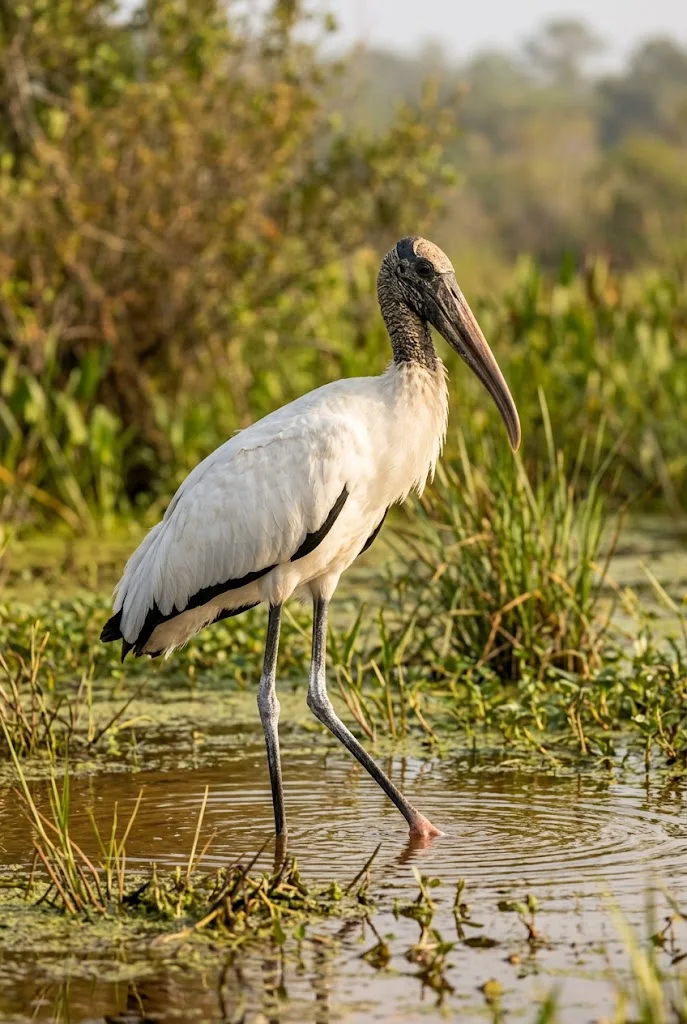
Why wood storks poop on their legs is one of the most fascinating examples of natural cooling in the bird world. These large wetland birds use an unusual behavior called urohidrosis, depositing watery waste onto their long legs to help regulate body temperature.
As moisture evaporates from the legs, it carries heat away from the body. This natural cooling mechanism is especially useful in warm environments where wood storks spend much of their time feeding and resting.
Unlike humans, birds do not sweat to cool themselves. Instead, they rely on specialized adaptations such as panting, behavioral changes, and evaporative cooling.
The science behind wood stork urohidrosis reveals how a seemingly strange behavior can serve an important biological function.
Table of Contents
- Why Wood Storks Poop on Their Legs
- What Is Urohidrosis?
- How Evaporation Helps Wood Storks Stay Cool
- Why Wood Storks Need Effective Cooling Mechanisms
- Other Birds That Use Urohidrosis
- How Urohidrosis Differs From Other Bird Cooling Behaviors
- Does Urohidrosis Have Any Disadvantages?
- Common Myths About Wood Stork Cooling
- Frequently Asked Questions
- Conclusion
Why Wood Storks Poop on Their Legs
A Natural Cooling Response
Wood storks are large wading birds that frequently inhabit warm, exposed wetlands. During hot conditions, maintaining a stable internal temperature becomes especially important.
Urohidrosis helps by placing moisture on the legs, where evaporation can remove heat.
This is a physiological cooling behavior, not evidence that the bird understands the science of evaporation.
How the Waste Reaches the Legs
Birds eliminate digestive and urinary waste through a shared opening called the cloaca.
During urohidrosis, watery excretory material is deposited onto the legs rather than simply falling away from the body.
The moisture spreads over portions of the exposed skin, creating an opportunity for evaporation.
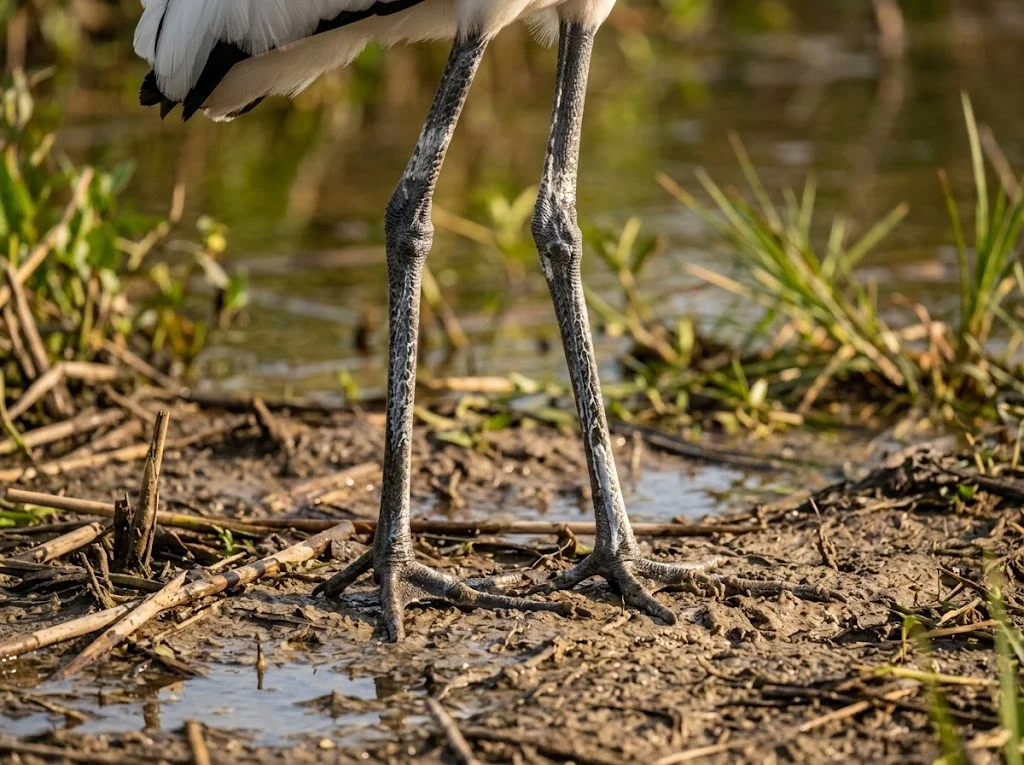
Repeated deposits may also leave pale or whitish residues on the legs.
Why Evaporation Matters
The cooling effect comes primarily from the evaporation of water.
As liquid water changes into vapor, it requires energy. Some of that energy is drawn from the bird’s body and the surrounding moist surfaces.
This process helps remove heat from the legs and contributes to overall thermoregulation.
What Is Urohidrosis?
Urohidrosis is a thermoregulatory behavior in which certain birds deposit excretory fluid onto their legs to promote evaporative cooling.
It is particularly associated with some storks and New World vultures.
Unlike ordinary waste elimination, the placement of moisture on the legs contributes to heat loss.
The Role of the Cloaca
Birds have a cloaca, a common chamber and external opening involved in the elimination of digestive and urinary waste, as well as reproduction.
Their kidneys produce nitrogenous waste, largely in the form of uric acid and related urates, which may appear as whitish material.
Urinary and digestive wastes are commonly expelled together, although their relative proportions and consistency vary.
Consequently, the popular phrase “pooping on their legs” is understandable but anatomically simplified.
Why the Waste Is Watery
For evaporation to occur, the deposited material must contain water.
The liquid portion provides the moisture that can evaporate from the leg surfaces.
The solid or semisolid components do not produce the same cooling effect.
Not all bird droppings have identical moisture content, and the composition of excreta can vary with hydration, diet, and physiology.
How Evaporation Helps Wood Storks Stay Cool
The Physics of Evaporative Cooling
Evaporation requires energy to convert liquid water into water vapor.
When moisture evaporates from a bird’s legs, some of that energy comes from the moist skin and underlying tissues, helping reduce their temperature.
This is the same basic physical principle involved in human sweat evaporation, although the biological mechanisms supplying the moisture are very different.
Research confirms that urohidrosis can produce measurable cooling in storks. A 2023 study of free-ranging white storks recorded substantial, short-lived reductions in leg surface temperature following the behavior. These measurements should not be assumed to apply identically to wood storks.
Cooling Through the Legs
Storks have long, largely unfeathered legs with blood vessels that participate in heat exchange.
In warm conditions, changes in blood flow can help transfer heat toward exposed surfaces.
When the legs become wet, evaporation can increase heat loss.
The combination of blood circulation and evaporative cooling makes the legs useful surfaces for temperature regulation.
Temperature and Humidity
Environmental conditions influence how effectively moisture evaporates.
High humidity generally reduces the air’s capacity to accept additional water vapor, potentially limiting evaporative cooling.
Air movement can improve evaporation by carrying moisture-laden air away from the skin.
Interestingly, research across stork species found that urohidrosis was observed more frequently under combinations of high temperature, humidity, and solar radiation, particularly when wind speeds were low.
This does not mean humidity makes evaporation more efficient. Rather, birds may rely more heavily on cooling behaviors when environmental conditions make heat loss difficult.
Why Wood Storks Need Effective Cooling Mechanisms
The wood stork (Mycteria americana) is a large wading bird found in wetlands across the southeastern United States and parts of Central and South America.
Its habitats include marshes, swamps, shallow wetlands, and seasonally flooded landscapes.
Wood storks often forage in exposed environments where sunlight and warm air can increase heat exposure.
Like other birds, they must maintain internal temperatures within a range compatible with normal physiological function.
Excessive heat can disrupt these processes and create potentially dangerous heat stress.
Urohidrosis provides one additional method of heat dissipation, complementing respiratory cooling and behavioral adjustments.
Its importance is supported by earlier experimental research on captive wood storks, discussed in later studies of stork thermoregulation.
Other Birds That Use Urohidrosis
Wood storks are not the only birds that use their own excretory fluids for cooling.
New World Vultures
New World vultures, including turkey vultures and black vultures, are well-known examples of birds that practice urohidrosis.
They deposit watery waste onto their legs, where evaporation helps remove heat.
Their exposed lower legs provide surfaces through which heat exchange can occur.
Other Stork Species
Urohidrosis has also been documented in several other storks, including white storks, painted storks, marabou storks, and woolly-necked storks.
A 2021 study examined urohidrosis across living stork species and identified important relationships between the behavior, environmental conditions, and habitat use.
However, the frequency of urohidrosis differs among species. It should not be assumed that every long-legged bird performs the behavior in the same way.
How Urohidrosis Differs From Other Bird Cooling Behaviors
Birds possess several strategies for coping with high temperatures.
Panting
Panting increases respiratory evaporation.
As moisture evaporates from respiratory surfaces, heat can leave the body.
This strategy is widespread among birds, although its effectiveness and physiological costs vary among species.
Gular Fluttering
Some birds use rapid movements of the throat region, called gular fluttering, to promote evaporative heat loss.
This mechanism differs from panting in the muscular movements involved and varies among bird groups.
Shade Seeking and Behavioral Thermoregulation
Birds may reduce heat exposure by moving into shade, changing their posture, adjusting activity periods, or using their wings to alter exposure to sunlight and air.
These behaviors can complement physiological cooling mechanisms.
Urohidrosis Versus Sweating
Humans possess sweat glands that release moisture onto the skin.
Birds lack the widespread sweat-gland system used by humans.
Urohidrosis achieves evaporative cooling through a different source of moisture: watery excretory material deposited onto exposed body surfaces.
Does Urohidrosis Have Any Disadvantages?
Although urohidrosis can help birds manage heat, it involves potential trade-offs.
Water Availability
Evaporative cooling requires water.
Repeated deposition of watery excreta may contribute to water loss, making hydration important, particularly in hot environments.
Environmental Limitations
High humidity can reduce the efficiency of evaporation, while low airflow may slow the removal of moist air from the skin.
As a result, urohidrosis is not equally effective under every environmental condition.
Possible Biological Trade-Offs
Researchers have proposed that excretory deposits might influence the appearance of pigmented legs in certain species, potentially affecting visual signaling.
However, this proposed trade-off remains insufficiently tested.
Claims that urohidrosis routinely causes infections or significant health problems in healthy wild storks would require additional evidence.
Common Myths About Wood Stork Cooling
Myth 1: Wood Storks Cover Their Legs for Decoration
Urohidrosis is associated with temperature regulation, not decoration. The deposited moisture provides a surface from which water can evaporate.
Myth 2: Bird Waste Contains a Special Cooling Chemical
The cooling effect comes from water evaporation, not a unique chemical ingredient in the waste.
Myth 3: Only Wood Storks Practice Urohidrosis
Several stork species and New World vultures use this cooling mechanism.
Myth 4: Every Long-Legged Bird Uses Urohidrosis
The behavior varies among species. Long legs alone do not establish that a bird practices urohidrosis.
Myth 5: Urohidrosis Is the Only Cooling Method Wood Storks Use
Wood storks can also regulate heat through respiratory evaporation, blood-flow adjustments, and behavioral responses.
Frequently Asked Questions
1. Why do wood storks poop on their legs?
Wood storks deposit watery excretory waste onto their legs to promote evaporative cooling. As the moisture evaporates, it removes heat from the exposed surfaces.
2. What is urohidrosis in birds?
Urohidrosis is a thermoregulatory behavior in which birds wet their legs with excretory fluids to increase evaporative heat loss.
3. How does urohidrosis help wood storks stay cool?
Evaporation requires energy. As moisture evaporates from the legs, it draws heat from the surrounding surfaces and helps cool the bird.
4. Do wood storks urinate like mammals?
Not exactly. Birds eliminate urinary and digestive waste through the cloaca, and their nitrogenous waste is primarily excreted as uric acid and urates.
5. Do vultures also poop on their legs?
Yes. New World vultures, including turkey vultures and black vultures, also practice urohidrosis.
6. Does urohidrosis work in humid weather?
Yes, although high humidity can reduce evaporation efficiency. Birds may still use the behavior during humid conditions when additional heat loss is needed.
7. Do all storks use urohidrosis?
The behavior has been documented across multiple stork species, but its frequency and environmental triggers vary. It should not be assumed to occur equally in every species.
8. What other methods do birds use to cool themselves?
Birds may use panting, gular fluttering, shade seeking, posture changes, and adjustments in blood flow to exposed body surfaces.
Conclusion
The reason why wood storks poop on their legs is rooted in a simple physical principle: evaporation removes heat.
Through urohidrosis, these remarkable wetland birds use watery excretory waste to increase heat loss from their exposed legs.
What may appear strange or unpleasant to humans is actually a specialized cooling behavior supported by scientific research.
Wood stork adaptations demonstrate that animals have evolved many different ways to cope with environmental challenges.
From respiratory cooling to changes in behavior and blood circulation, each mechanism contributes to the complex process of maintaining a stable body temperature.
The next time a wood stork stands quietly in a sunlit marsh, its long legs may be doing far more than supporting its body. They may also be helping the bird stay cool.
Eternal sources:
1. Cabello-Vergel and colleagues (2021). Urohidrosis as an overlooked cooling mechanism in long-legged birds. Scientific Reports. DOI: 10.1038/s41598-021-99296-8. Read scientific study.
2. Cabello-Vergel and colleagues (2023). Keeping cool with poop: Urohidrosis lowers leg surface temperature by up to 6°C in breeding White storks. Ecosphere. DOI: 10.1002/ecs2.4661. Read scientific study.
3. Smithsonian’s National Zoo and Conservation Biology Institute (2023). How Do Birds Handle the Heat? Read Smithsonian article.
4. Smithsonian Magazine (2014). From Panting to Pooping, 8 Weird Ways Animals Keep Cool. Read article.
5. The Physiology of Heat Tolerance in Small Endotherms (2019). American Physiological Society, Physiology. Read scientific review.