
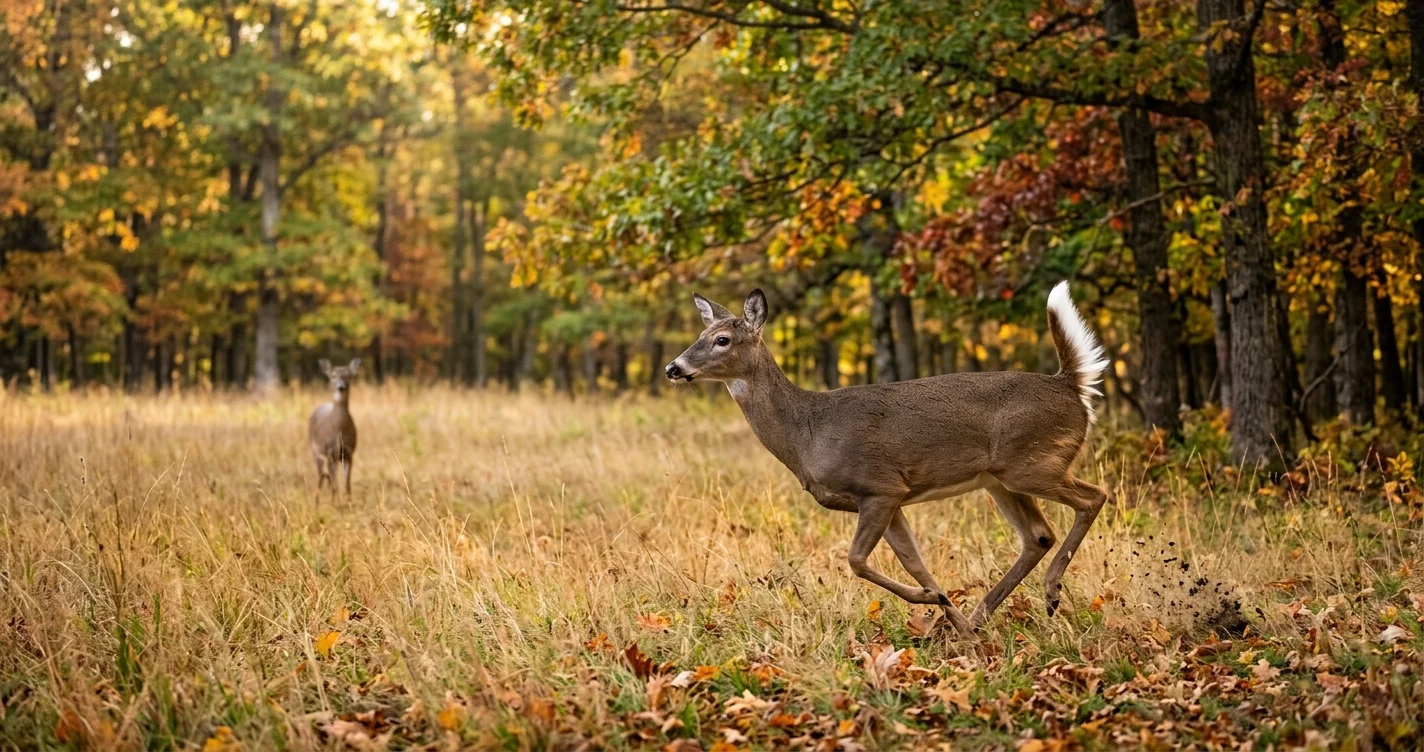
A white-tailed deer is grazing peacefully at the edge of a forest. Suddenly, its head rises, its ears turn forward, and its body becomes tense. A moment later, the deer bounds away, displaying a brilliant flash of white behind it.
This familiar woodland scene raises a fascinating question: why white-tailed deer raise their tails when they become alarmed.
The behavior is called tail flagging, and it is one of the most recognizable displays in North American wildlife. The raised white tail can make a fleeing deer highly visible to nearby animals, but scientists continue to investigate exactly what this display communicates and why it evolved.
Understanding deer tail flagging reveals how these animals detect danger, respond to predators, and communicate through movement, posture, scent, and sound.
Table of Contents
- The White Tail That Gives the Deer Its Name
- What Is Tail Flagging?
- Why White-Tailed Deer Raise Their Tails
- Three Observable Stages of Deer Alarm Behavior
- How Deer Detect Danger
- Other Ways Deer Communicate
- Why Fawns and Adults Behave Differently
- Where Tail Flagging Is Commonly Observed
- How to Observe Deer Responsibly
- Common Myths About Deer Tail Flagging
- Frequently Asked Questions
- Conclusion
The White Tail That Gives the Deer Its Name
The white-tailed deer (Odocoileus virginianus) is one of North America’s most widespread and recognizable large mammals.
Its coat is generally reddish brown during warmer months and becomes grayer or browner in winter. Its underside is lighter, and its tail has a particularly distinctive feature.
The Hidden White Underside
When a white-tailed deer is relaxed, its tail usually hangs downward.
From behind, the upper surface blends reasonably well with the animal’s brown coat. The bright white underside is less conspicuous.
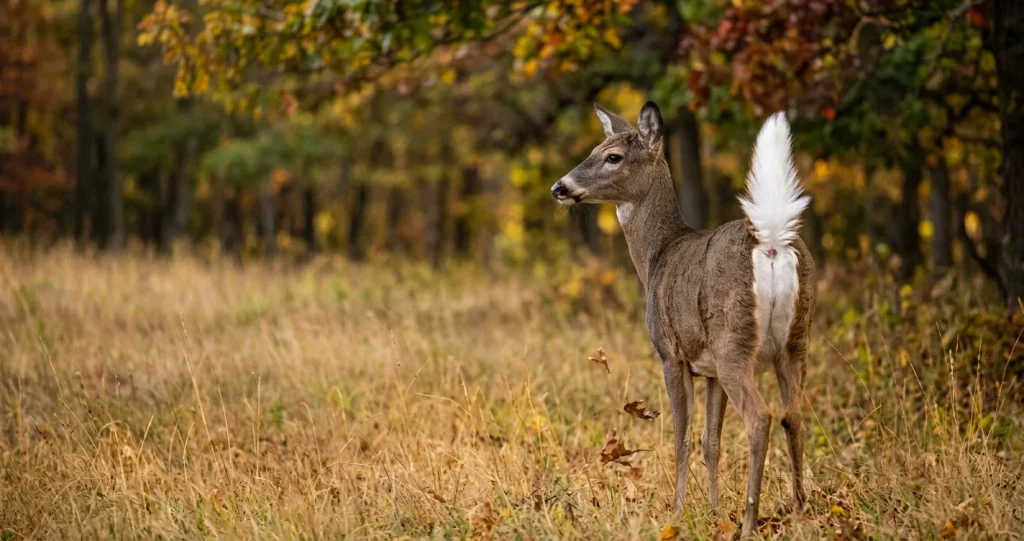
When the deer raises its tail, however, that white surface becomes clearly visible.
The sudden contrast between the white tail and the surrounding woodland can be striking, especially against dark vegetation.
A Tail Built for Visibility
A white-tailed deer’s tail is relatively short compared with its long legs and body.
Its signaling potential comes primarily from the contrast between its brown upper surface and white underside, rather than from extraordinary tail length.
Raising the tail exposes a large, conspicuous patch of pale fur.
Because the tail moves with the animal, the display may become especially noticeable during running and bounding.
What Is Tail Flagging?
Tail flagging describes the behavior of lifting the tail to expose its white underside, often during an alarm or escape response.
The display is well documented in white-tailed deer, but it does not occur in every threatening situation.
From Relaxed Feeding to Alertness
A deer may initially detect something unusual through sound, scent, or movement.
It often interrupts feeding, raises its head, and directs its ears toward the disturbance.
The animal may remain motionless while gathering more information.
If the situation appears threatening, it may move away, flee, or adopt another defensive response.
The Sudden White Flash
During some escape responses, the deer raises its tail prominently.
The white underside becomes visible as the animal runs, producing the familiar flashing appearance.
This behavior is often associated with alarm, but a raised tail should not automatically be interpreted as proof that a predator is nearby.
Context matters. Deer behavior changes with the animal’s age, surroundings, level of disturbance, and available escape routes.
Not Every Frightened Deer Flags Its Tail
A deer may flee with its tail lowered.
Others may raise their tails while remaining alert or moving only a short distance.
Some animals respond to danger by freezing, hiding, or slipping quietly into cover.
Tail flagging is therefore one possible component of deer alarm behavior, not an automatic reflex that accompanies every threat.
Why White-Tailed Deer Raise Their Tails
Scientists have proposed several explanations for why white-tailed deer raise their tails.
The behavior itself is easy to observe, but determining its evolutionary function is more difficult.
A display can have multiple effects, and an effect does not necessarily reveal the original reason the behavior evolved.
Hypothesis 1: Warning Other Deer
One explanation is that the raised white tail serves as a visual alarm signal.
Nearby deer may notice the conspicuous display and become more vigilant or begin moving away.
This possibility makes sense because white-tailed deer frequently occupy habitats where vegetation can limit visibility.
A bright moving patch may be easier to detect than the outline of a brown animal against a forest background.
However, observing nearby deer react to a raised tail does not prove that warning other deer is its only function.
Hypothesis 2: Coordinating Escape
Tail flagging may also help deer maintain visual contact while moving away from danger.
For animals traveling together, a conspicuous white tail could make a fleeing individual easier to follow through vegetation.
This potential function is sometimes described as an aid to group cohesion.
Nevertheless, deer do not always flee in coordinated groups, and the importance of this explanation may vary with circumstances.
Hypothesis 3: Signaling to a Predator
Another hypothesis proposes that a conspicuous tail display may communicate something to a pursuing predator.
For example, it might indicate that the deer has detected the threat and is prepared to escape.
In behavioral ecology, signals of this general kind are sometimes discussed as pursuit-deterrent signals.
The idea is that a predator may gain less from chasing prey that is already alert.
However, the exact role of tail flagging in predator-directed communication remains debated.
It would be inaccurate to claim that every raised tail deliberately tells a predator it has been spotted.
Could Several Explanations Be Correct?
Yes.
A single visible behavior may influence predators, companions, and other nearby animals simultaneously.
Its function may also depend on whether the deer is alone, traveling with others, or responding to a particular kind of disturbance.
The safest scientific conclusion is that tail flagging is strongly associated with certain alarm and escape responses, while its complete evolutionary explanation is not settled.
Three Observable Stages of Deer Alarm Behavior
Watching a deer from a respectful distance can reveal several changes in posture and movement.
The following stages describe a useful observational pattern, not a fixed sequence that every deer follows.
Stage 1: Calm Feeding
A relaxed deer often lowers its head to graze or browse.
Its tail usually hangs down, and its movements may appear slow and deliberate.
Even while feeding, deer remain attentive to their surroundings.
They may pause occasionally to look, listen, or smell the air.
Stage 2: Alert to a Disturbance
When something attracts attention, the deer may raise its head suddenly.
Its ears can rotate toward a sound, and its body may become noticeably still.
The animal may stare toward the disturbance, stamp a foot, or change position.
These actions allow it to assess the situation before deciding what to do.
Stage 3: Tail Flagging and Escape
If the deer decides to flee, it may raise its tail and expose the white underside.
The animal can then move rapidly toward cover, sometimes using bounding movements.
Other deer nearby may respond to the disturbance or the fleeing animal.
However, some deer escape without flagging, and others remain motionless rather than running.
How Deer Detect Danger
White-tailed deer rely on several senses to identify potential threats.
Their responses are shaped by the combination of information available at a particular moment.
Hearing
Deer have large, mobile ears that can turn toward different sounds.
This helps them detect movement in vegetation and locate unfamiliar noises.
A snapping branch or sudden rustling may cause a deer to become alert before it sees anything unusual.
Smell
A deer’s sense of smell plays an important role in detecting predators and interpreting its surroundings.
Wind direction influences how scent reaches an animal.
A deer may detect an approaching person or predator through scent even when visibility is poor.
Vision and Movement
Deer have eyes positioned on the sides of their heads, providing a broad field of view.
Their visual system is well suited to detecting movement, particularly under low-light conditions.
They do not perceive colors exactly as humans do, but they can recognize movement and contrast in their environment.
Combining Sensory Information
A deer may hear a sound, look toward it, and then use scent to assess whether a threat is present.
This combination helps explain why deer sometimes remain motionless for several seconds before moving.
A sudden escape is often the visible end of a longer process of gathering information.
Other Ways Deer Communicate
Tail flagging is only one part of white-tailed deer communication.
These animals also use body language, sounds, and chemical signals.
Ear and Body Posture
Ear position can reveal where a deer is directing its attention.
An upright, tense posture often accompanies heightened vigilance.
A lowered head and relaxed movements may suggest that the animal is feeding or resting, although posture must always be interpreted in context.
Foot Stomping
Deer sometimes stamp a front foot when they are suspicious or alarmed.
The movement may accompany staring, head movements, or other alert behaviors.
Its precise meaning depends on the situation, and it should not be interpreted as a universal warning signal.
Vocalizations
White-tailed deer produce various sounds, including snorts, bleats, and grunts.
Different vocalizations occur in different social and behavioral contexts.
An alarm snort, for example, may be heard when a deer detects something suspicious.
Scent Communication
Deer also communicate through scent glands and scent-marking behavior.
Chemical cues can convey information related to identity, reproductive condition, and social activity.
This is especially important during the breeding season, when scent communication becomes a prominent part of deer behavior.
Why Fawns and Adults Behave Differently
Newborn fawns face different challenges from adult deer.
Their survival strategy initially relies heavily on concealment.
The Importance of Staying Hidden
Young white-tailed deer fawns often spend long periods lying quietly in vegetation.
Their spotted coats help break up their outlines against dappled light and plants.
A fawn’s mother may leave it hidden while she feeds, returning periodically to nurse.
This behavior is normal and does not necessarily mean the fawn has been abandoned.
Alarm Responses Change With Age
As fawns grow stronger and more mobile, they become increasingly capable of following adults and fleeing from disturbances.
Their behavior gradually changes from relying heavily on concealment to using a wider range of escape responses.
Young deer may display tail movements, but their behavior should not be assumed to match that of experienced adults in every situation.
Where Tail Flagging Is Commonly Observed
White-tailed deer occupy diverse habitats across much of North America.
Their ability to use woodland, open vegetation, and human-modified landscapes makes them familiar to many wildlife watchers.
Forest Edges and Meadows
Woodland edges offer feeding opportunities near protective cover.
Deer may move between open feeding areas and wooded shelter, particularly around dawn and dusk.
These transitions can provide opportunities to observe changes in alert posture and movement.
Agricultural Landscapes
Deer frequently use fields, hedgerows, and nearby wooded areas.
When disturbed in open spaces, they may move quickly toward cover.
A raised white tail can be particularly noticeable against darker vegetation.
Suburban Green Spaces
White-tailed deer also inhabit parks, greenbelts, and neighborhoods with suitable habitat.
They may become accustomed to certain human activities, but they remain wild animals.
Their responses can be unpredictable, especially when they feel cornered or are protecting young.
How to Observe Deer Responsibly
Observing deer can be rewarding, but their welfare should come first.
Keep a Respectful Distance
Use binoculars or a telephoto lens rather than approaching closely.
If a deer repeatedly watches you, changes direction, or begins moving away, you may be too close.
Give the animal enough space to continue its normal activities.
Never Trigger Tail Flagging Deliberately
Do not chase, shout at, or otherwise frighten deer to photograph their alarm responses.
Repeated disturbance can waste energy and interfere with feeding, resting, or caring for young.
A natural observation is more valuable than a staged reaction.
Leave Fawns Alone
A solitary fawn is not necessarily orphaned.
Its mother may be feeding nearby and avoiding unnecessary attention.
Unless there is clear evidence of injury or immediate danger, observe from a distance and contact a licensed wildlife rehabilitator for guidance when genuinely concerned.
Avoid Feeding Deer
Feeding deer can encourage unnatural concentrations of animals and increase disease-transmission risks.
It may also draw deer toward roads and residential areas.
Supporting healthy natural habitat is preferable to providing artificial food.
Common Myths About Deer Tail Flagging
Myth 1: Every Raised Tail Means Immediate Danger
A raised tail can occur during alarm or escape behavior, but its meaning depends on context.
Not every tail movement signals an immediate predator threat.
Myth 2: Tail Flagging Is Always Directed at Other Deer
The display may influence nearby deer, but researchers have also considered predator-directed signaling and other functions.
Its exact evolutionary role remains uncertain.
Myth 3: All Deer Species Use the Same White-Tail Signal
Different deer species have different tail markings and escape behaviors.
White-tailed deer are particularly recognizable for their conspicuous white underside.
Myth 4: Deer Always Raise Their Tails When Running Away
Some fleeing deer keep their tails lowered.
Escape behavior varies with the situation and individual animal.
Myth 5: Tail Flagging Proves the Deer Has Seen a Predator
Deer may respond to unfamiliar sounds, scents, or movements without identifying a specific predator.
A visible alarm response does not reveal exactly what the animal detected.
Frequently Asked Questions
Why do deer lift their white tails?
White-tailed deer often raise their tails during certain alarm and escape responses. The conspicuous display may influence nearby deer or predators, but its precise function is still being studied.
Do deer always raise their tails when scared?
No. Some deer flee with their tails lowered, while others freeze or move quietly into cover.
Can other deer see the white-tail signal from far away?
The bright white underside can be visually conspicuous, particularly against dark vegetation. Actual visibility depends on distance, lighting, terrain, and vegetation.
Do fawns flag their tails?
Young deer can display tail movements, but newborn fawns initially rely heavily on hiding rather than running away.
Why do deer stomp their feet?
Foot stomping can occur when a deer is alert or suspicious. It is one of several behaviors associated with assessing a possible disturbance.
Does tail flagging warn predators?
Predator-directed signaling is one scientific hypothesis. However, the evidence does not establish that every instance of tail flagging is intended to communicate with a predator.
Why do some deer run without showing their white tails?
Tail position varies with circumstances, and flagging is not required for escape.
Is tail flagging unique to white-tailed deer?
Other deer species have conspicuous tail or rump displays, but their anatomy and behavior differ. The familiar raised white tail is especially characteristic of white-tailed deer.
Conclusion
The bright white underside of a white-tailed deer’s tail is one of the most recognizable features in North American wildlife.
When a deer becomes alarmed, raising the tail can create a highly visible display during movement or escape.
Scientists have proposed several possible functions, including communication with other deer, maintaining visual contact during escape, and signaling to predators. None should be treated as the complete explanation in every situation.
Understanding why white-tailed deer raise their tails requires looking beyond the white flash itself to the animal’s senses, social behavior, habitat, and response to danger.
The next time you observe a deer from a safe distance, its ears, posture, movements, and tail position may reveal a fascinating glimpse into the complex behavior of this familiar woodland animal.
External Sources
1. Caro et al. (1995) — Tail-Flagging and Other Antipredator Signals in White-Tailed Deer A peer-reviewed study examining the evidence for different functions of tail flagging. Its findings did not support every proposed warning-signal explanation and suggested that flagging might advertise escape ability.
2. Smith (1991) — Ontogeny and Adaptiveness of Tail-Flagging Behavior in White-Tailed Deer. Research examining age differences, habitat conditions, and possible social functions of tail flagging. Notably, tail flagging was observed even in very young fawns.
3. Bildstein (1983) — Why White-Tailed Deer Flag Their Tails. An earlier peer-reviewed investigation testing several explanations for the display, including predator detection and social cohesion.