
Peel back a piece of loose bark from a dead pine tree, and you might discover something that resembles an ancient inscription carved into the wood. These intricate patterns, complete with branching tunnels and delicate lines, are the work of insects smaller than a grain of rice.
Engraver beetles are tiny bark beetles that construct elaborate tunnel systems beneath the bark of pine, spruce, and other coniferous trees. Although they play an important role in natural forest regeneration, their populations can become destructive when trees experience drought, storm damage, or other environmental stresses.
Learning to recognize their distinctive galleries, early warning signs, and preferred breeding conditions can help homeowners protect valuable evergreen trees.
Table of Contents
- What Are Engraver Beetles?
- How to Identify Engraver Beetles
- Seven Signs of an Engraver Beetle Infestation
- The Science Behind Their Intricate Bark Galleries
- Why Engraver Beetles Attack Pine and Spruce Trees
- Understanding the Engraver Beetle Life Cycle
- Engraver Beetles vs. Other Bark Beetles
- How to Prevent Engraver Beetle Infestations
- Managing Infested Pine and Spruce Trees
- In Your Own Yard: Protecting Evergreen Trees
- Frequently Asked Questions
What Are Engraver Beetles?
Engraver beetles are small insects belonging to the bark beetle group within the weevil family Curculionidae. Many North American engraver beetles belong to the genus Ips, although other genera also include insects commonly called engraver beetles.
Their common name comes from the distinctive tunnels they excavate beneath tree bark.
Unlike insects that feed primarily on leaves, engraver beetles spend much of their lives hidden within the inner bark of coniferous trees.
Common North American Species
Several species occur across the United States, including:
- Pine engraver (Ips pini).
- Six-spined ips (Ips calligraphus).
- Five-spined ips (Ips grandicollis).
- Small southern pine engraver (Ips avulsus).
- Northern spruce engraver (Ips perturbatus).
Different species favor different host trees, climates, and environmental conditions.
Their Natural Role in Forest Ecosystems
Under ordinary conditions, engraver beetles frequently colonize weakened, dying, or recently fallen trees.
Their activities contribute to wood decomposition, nutrient cycling, and the creation of habitats for other organisms.
However, when populations increase substantially, some species may also attack living trees, especially those already experiencing environmental stress.
How to Identify Engraver Beetles
Adult engraver beetles are surprisingly small, making them difficult to notice without close inspection.
Physical Characteristics
Most common Ips beetles share several recognizable features:
- Small, cylindrical bodies.
- Reddish-brown to nearly black coloration.
- Short, clubbed antennae.
- Hardened wing covers.
- A scooped-out rear section bordered by small toothlike spines.
- Body lengths commonly ranging from approximately 2–6 millimeters, depending on species.
The number and arrangement of spines on the rear of the abdomen can help specialists distinguish between species.
Identifying the Larvae
Engraver beetle larvae are small, creamy-white, legless grubs with brownish head capsules.
They develop beneath the bark, feeding within individual tunnels that gradually widen as the larvae grow.
Homeowners are often more likely to discover the evidence left behind by these insects than the beetles themselves.
Seven Signs of an Engraver Beetle Infestation
Early detection can help prevent additional trees from becoming infested. Examine susceptible evergreen trees carefully, especially following droughts, storms, and nearby tree removal.
1. Reddish-Brown Boring Dust
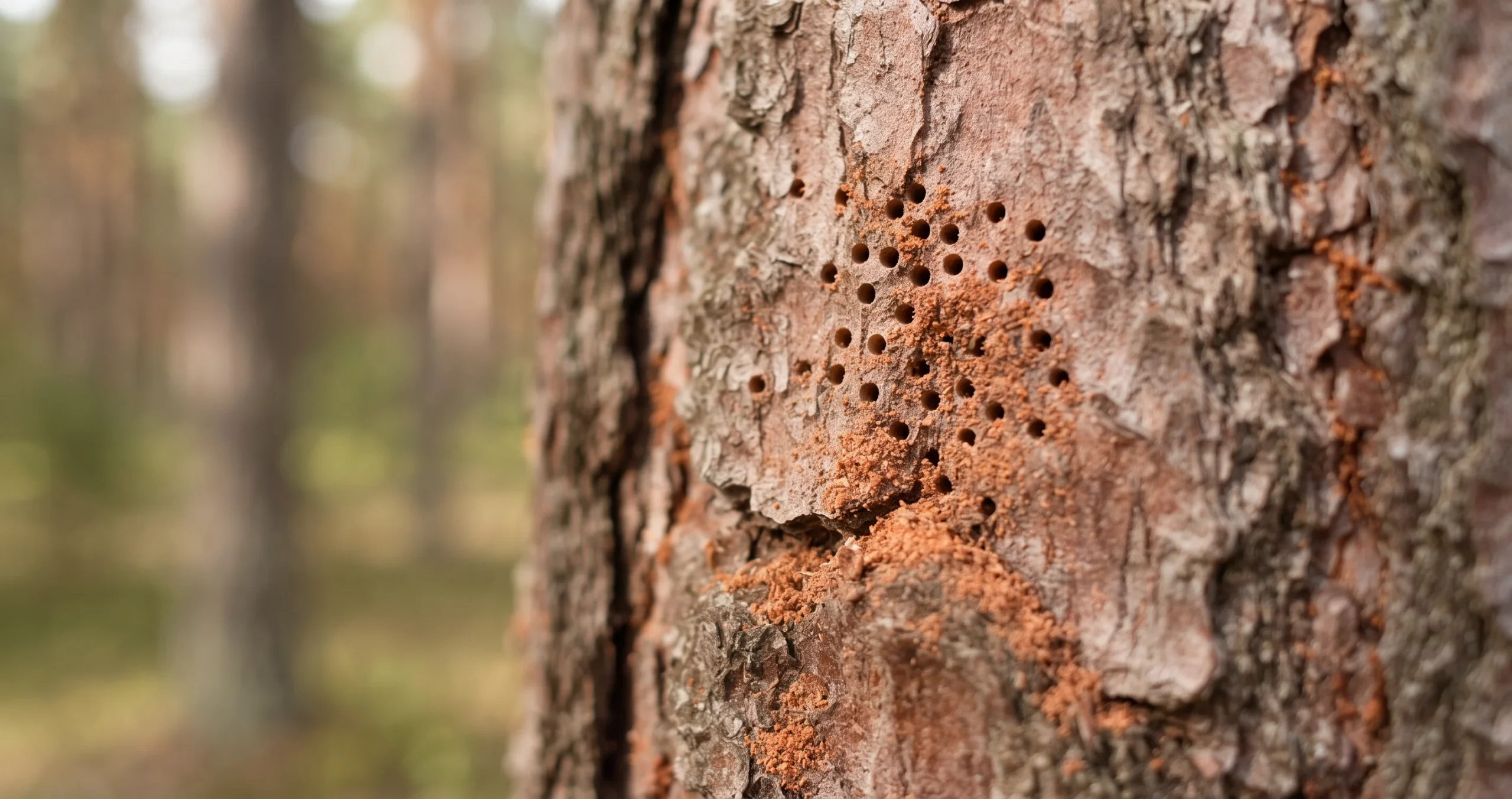
Fine, reddish-brown material resembling sawdust may accumulate in bark crevices, around branches, or near the base of an infested tree.
This material, commonly called frass, is produced as beetles excavate tunnels.
2. Small Holes in the Bark
Adult beetles create small, approximately round openings when entering or emerging from trees.
Numerous tiny holes may indicate bark beetle activity, although holes alone cannot confirm the species responsible.
3. Small Resin Deposits
Pine trees sometimes release resin in response to beetle attacks.
These deposits may appear as small whitish, pinkish, or reddish masses on the bark.
Severely stressed trees may produce very little resin, so the absence of these deposits does not rule out an infestation.
4. Fading or Discolored Needles
Affected branches may gradually change from green to yellow, reddish-brown, or brown.
In some cases, discoloration begins near the top of the tree or within individual branches before spreading more extensively.
5. Distinctive Galleries Beneath the Bark
Branching tunnels under loose bark are among the most useful identification features.
Depending on the species, these galleries may resemble the letters Y, H, or I.
6. Increased Woodpecker Activity
Woodpeckers sometimes remove pieces of bark while searching for beetles and their larvae.
Unusual concentrations of woodpecker activity may justify closer inspection, although they do not necessarily indicate engraver beetles.
7. Progressive Branch Dieback
Infested trees may develop dying upper branches, thinning crowns, or extensive needle loss.
These symptoms often become visible after significant feeding damage has already occurred beneath the bark.
The Science Behind Their Intricate Bark Galleries
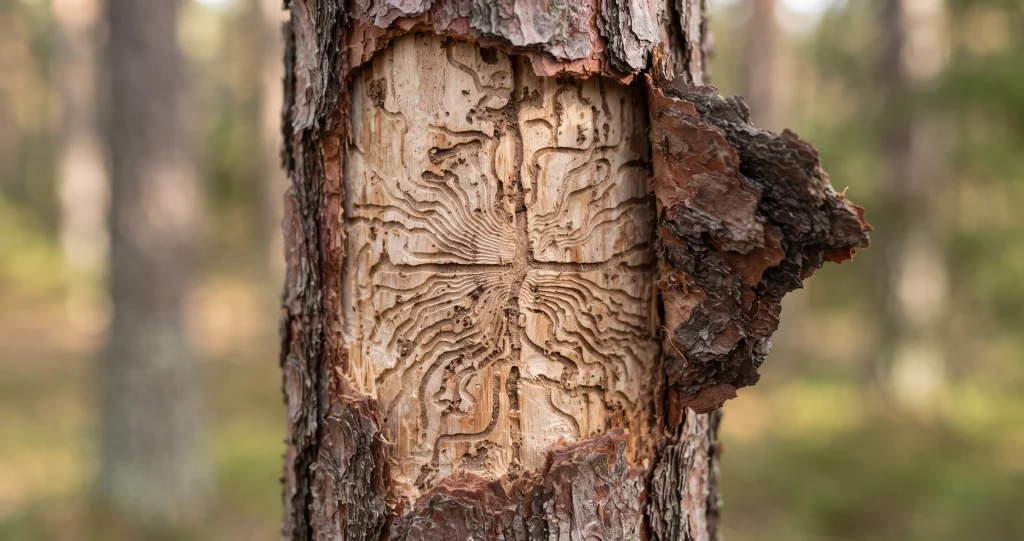
The beautiful patterns created by engraver beetles serve a practical purpose. Each tunnel forms part of a carefully organized reproductive and feeding system.
How the Central Chamber Is Created
In many Ips species, a male beetle enters suitable bark and excavates a central mating chamber.
The beetle releases chemical signals known as aggregation pheromones, which can attract additional beetles to the same host material.
These signals help bring potential mates together and may facilitate concentrated attacks on susceptible trees.
Female Beetles Construct Egg Galleries
After mating, females excavate tunnels extending away from the central chamber.
They deposit eggs individually in small niches along the sides of these galleries.
The arrangement of the maternal tunnels often creates the characteristic branching patterns associated with engraver beetles.
Larvae Create Their Own Feeding Tunnels
Once the eggs hatch, the larvae begin feeding through the nutrient-rich inner bark.
Their tunnels generally extend outward from the maternal galleries, becoming wider as the larvae develop.
Together, these networks produce the intricate, engraved appearance visible when bark separates from the wood beneath it.
How Feeding Interrupts Nutrient Transport
The inner bark contains phloem, a specialized tissue responsible for transporting sugars and other organic compounds throughout the tree.
Extensive gallery construction can damage this tissue and disrupt the movement of nutrients.
When attacks become dense enough to girdle a trunk or branch, the affected portion may die.
The Role of Fungi
Some engraver beetles carry fungi that become established within colonized trees.
Certain associated fungi produce bluish-gray discoloration in the sapwood, commonly known as blue stain.
Some fungal associates may also contribute to tree stress or interfere with water transport. Their effects vary depending on the beetle species, fungal species, and condition of the host tree.
This combination of insect feeding and biological interactions makes bark beetle infestations more complex than simple physical damage.
Why Engraver Beetles Attack Pine and Spruce Trees
Healthy conifers possess natural defense mechanisms, including resin production, that can help resist invading insects.
However, environmental stress can weaken these defenses.
Prolonged Drought
Water shortages reduce a tree’s ability to maintain normal physiological processes and produce defensive resin.
Trees growing in unusually dry conditions may consequently become more vulnerable to beetle attacks.
Storm and Construction Damage
Broken branches, damaged trunks, and injured roots can increase susceptibility to infestation.
Construction activities that compact soil or damage root systems may also weaken otherwise healthy trees.
Freshly Cut Firewood
Fresh conifer logs and pruning debris can provide favorable breeding conditions for engraver beetles.
When this material is stored near living evergreens, emerging beetles may subsequently colonize susceptible trees. Colorado State University Extension
Understanding the Engraver Beetle Life Cycle
Engraver beetles undergo complete metamorphosis, progressing through four developmental stages.
| Life stage | Development |
|---|---|
| Egg | Deposited along maternal galleries |
| Larva | Feeds through the inner bark |
| Pupa | Develops within a small chamber |
| Adult | Emerges and searches for suitable host material |
Depending on the species and regional climate, engraver beetles may produce one or several generations annually.
Warmer conditions can accelerate development, potentially allowing populations to increase more rapidly.
Many species overwinter as adults beneath bark or within protective forest litter.
Engraver Beetles vs. Other Bark Beetles
Several types of bark beetles infest North American conifers. Their gallery patterns and physical characteristics can help distinguish them.
| Beetle | Typical gallery pattern | Common hosts |
|---|---|---|
| Engraver beetles | Y-shaped or H-shaped | Pine and spruce |
| Mountain pine beetle | Long vertical galleries | Pine |
| Southern pine beetle | Winding, S-shaped galleries | Pine |
| Spruce beetle | Longitudinal galleries | Spruce |
| Ambrosia beetles | Tunnels extending into wood | Various trees |
Another useful distinction is that adult Ips beetles generally clear debris from their egg galleries, whereas galleries created by many Dendroctonus species contain accumulated boring material. US Forest Service
How to Prevent Engraver Beetle Infestations
Prevention is generally more effective than attempting to eliminate beetles after they become established beneath the bark.
Maintain Adequate Soil Moisture
Provide deep, appropriate watering during extended dry periods, particularly for recently planted trees.
Adjust watering according to soil drainage, rainfall, and the species’ requirements.
Apply Organic Mulch
Spread approximately 2–4 inches of organic mulch around the root zone.
Leave several inches of open space around the trunk to prevent moisture accumulation against the bark.
Protect Roots and Trunks
Avoid damaging tree trunks with lawnmowers and gardening equipment. Minimize soil compaction and unnecessary excavation around established trees.
Manage Fresh Pruning Debris
Remove or appropriately process freshly cut pine and spruce branches, particularly during periods of beetle activity.
Avoid transporting potentially infested firewood to other areas.
Choose Suitable Planting Locations
Select conifers adapted to your local climate, soil, and moisture conditions. Provide sufficient growing space to minimize competition between neighboring trees.
Managing Infested Pine and Spruce Trees
When an infestation is suspected, identifying the responsible insect should be the first priority.
Avoid removing attached bark from living trees simply to inspect for galleries, since this can create additional injuries.
A certified arborist or local cooperative extension specialist can assess the damage and recommend appropriate management.
Severely infested trees may require removal. Preventive insecticide treatments are sometimes appropriate for nearby high-value trees, but they generally cannot rescue trees already extensively colonized.
In Your Own Yard: Protecting Evergreen Trees
A simple seasonal maintenance routine can help reduce the risk of bark beetle damage.
During fall, inspect your conifers for unusual needle discoloration, damaged branches, and accumulations of boring dust.
Maintain suitable soil moisture before the ground freezes, where conditions require it, and remove potentially infested woody debris.
During spring and summer, monitor recently transplanted trees and specimens recovering from drought or storm damage.
Remember that engraver beetles are also natural members of forest ecosystems. In appropriate woodland settings, retaining some older deadwood can support biodiversity, provided it does not create an unacceptable infestation or safety risk.
Frequently Asked Questions
1. Are engraver beetles harmful to humans?
Engraver beetles do not normally bite or sting people. They primarily inhabit tree tissues and do not typically infest seasoned structural lumber inside homes.
2. Can a tree recover from an engraver beetle infestation?
Trees with limited branch infestations may survive, particularly if their overall health improves. However, extensive damage to the main trunk can interrupt nutrient transport and cause irreversible decline.
3. Are engraver beetles active during winter?
Many engraver beetles overwinter beneath tree bark or within forest litter. Their activity generally decreases during cold weather, although development or flight may occur during sufficiently warm conditions, depending on the species and location.
Conclusion
The intricate patterns beneath pine and spruce bark reveal a surprisingly complex world of insect communication, reproduction, and survival.
Although engraver beetles contribute to natural forest processes, their populations can threaten stressed conifers under favorable conditions.
By recognizing early warning signs, maintaining healthy trees, and managing fresh woody debris responsibly, gardeners can reduce the risk of serious infestations.
Those mysterious engravings beneath the bark are more than beautiful patterns. They are the hidden records of an extraordinary insect life cycle.
External Sources
1. Chemical Communication in Engraver Beetles
Researchers in Alaska investigated how different combinations of chemical signals influence the attraction of northern spruce engraver beetles. USDA Forest Service. Attractant Semiochemicals of the Engraver Beetle
2. Southern Pine Bark Beetle Guild
Several bark beetle species can occupy the same host tree and use chemical, visual, and acoustic signals to locate suitable habitats. USDA Forest Service. Southern Pine Bark Beetle Guild
3. Ips Beetles
The removal of boring dust from adult egg galleries is a useful characteristic for distinguishing Ips beetles from certain other bark beetles. Colorado State University Extension. Ips Beetles: Identification and Management