
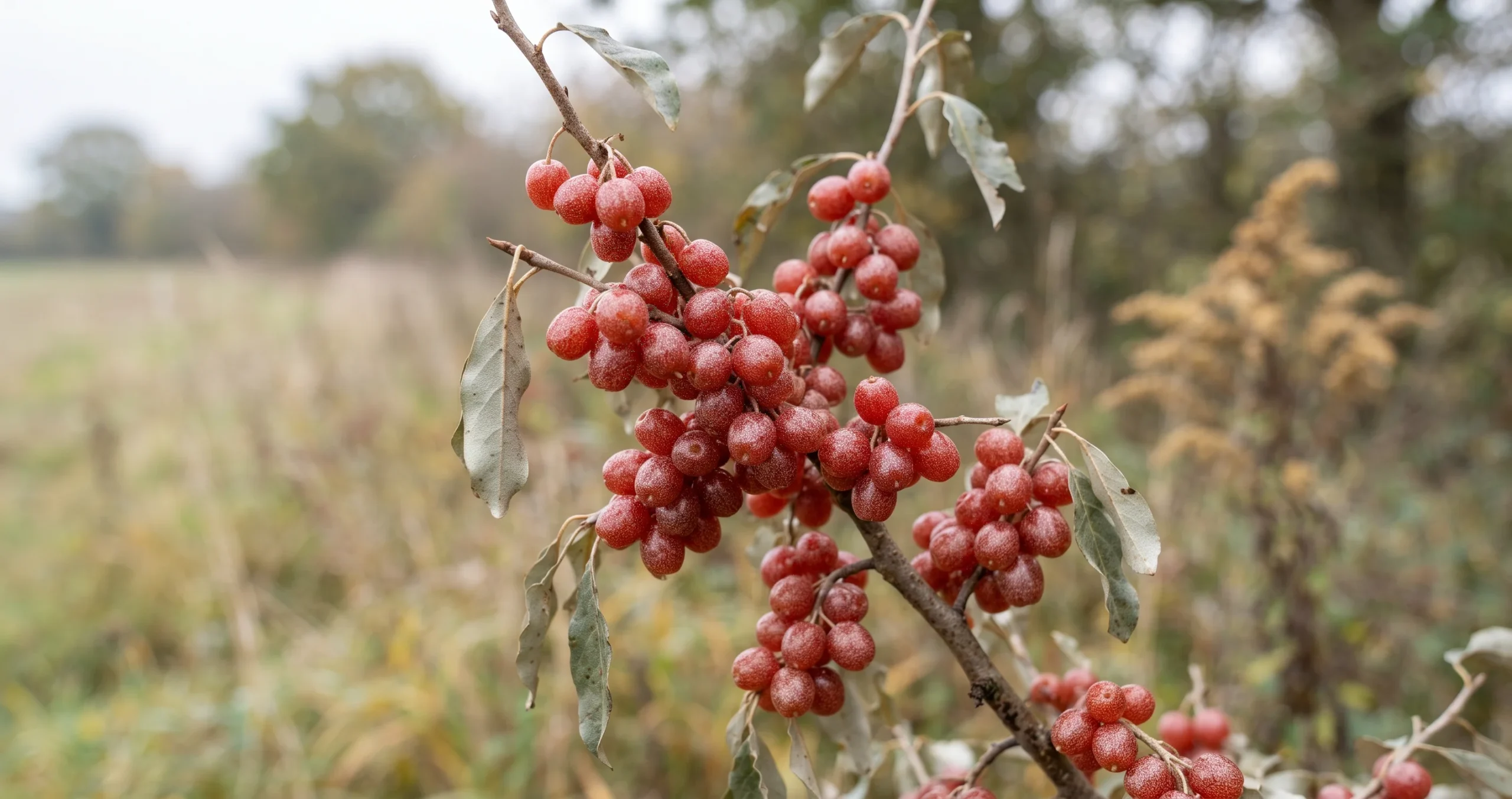
A shrub covered in hundreds of bright red berries might seem like a wonderful addition to a wildlife garden. Yet beneath its beautiful appearance, autumn olive has the ability to transform entire landscapes and crowd out native vegetation.
Learning the basics of autumn olive identification is particularly useful during fall, when its colorful berries and silvery leaves make it easier to recognize.
Autumn olive (Elaeagnus umbellata) is a fast-growing invasive shrub originally native to Asia. Once introduced to the United States for erosion control, wildlife habitat, and ornamental landscaping, it has since spread into forests, abandoned fields, roadsides, and residential properties.
Understanding how this plant grows, reproduces, and affects surrounding ecosystems can help gardeners make more informed decisions about managing their landscapes.
Table of Contents
- What Is Autumn Olive?
- Autumn Olive Identification: Six Key Features to Look For
- Where Autumn Olive Grows in the United States
- The Science Behind Autumn Olive’s Invasive Success
- How Autumn Olive Affects Native Wildlife
- Autumn Olive vs. Similar-Looking Shrubs
- Why Fall Is the Best Time to Identify Autumn Olive
- How to Remove Autumn Olive From Your Property
- In Your Own Yard: Replacing Autumn Olive With Native Shrubs
- Frequently Asked Questions
What Is Autumn Olive?
Autumn olive is a deciduous shrub belonging to the Elaeagnaceae family. Despite its common name, it is not closely related to the olive trees traditionally cultivated for olive oil.
The species is native to parts of eastern Asia and was introduced to the United States during the nineteenth century.
Its tolerance of poor soils, rapid growth, and abundant fruit production initially made it attractive for landscaping and land restoration projects.
Unfortunately, these same characteristics helped it establish itself beyond cultivated areas.
How Large Does Autumn Olive Grow?
Autumn olive commonly reaches heights of 10–20 feet, although its mature size depends on growing conditions.
It develops a spreading, irregular shape with numerous branches emerging from its base.
Older specimens can form dense thickets that occupy considerable space and restrict the growth of neighboring plants.
Its Seasonal Appearance
In spring, autumn olive produces small, fragrant, cream-colored flowers.
Throughout summer, its green and silvery foliage creates a distinctive appearance. By late summer and fall, clusters of small red fruits become one of its most recognizable features.
Autumn Olive Identification: Six Key Features to Look For
Identifying autumn olive becomes easier when you examine several physical characteristics together rather than relying on berry color alone.
1. Silvery Undersides of Leaves
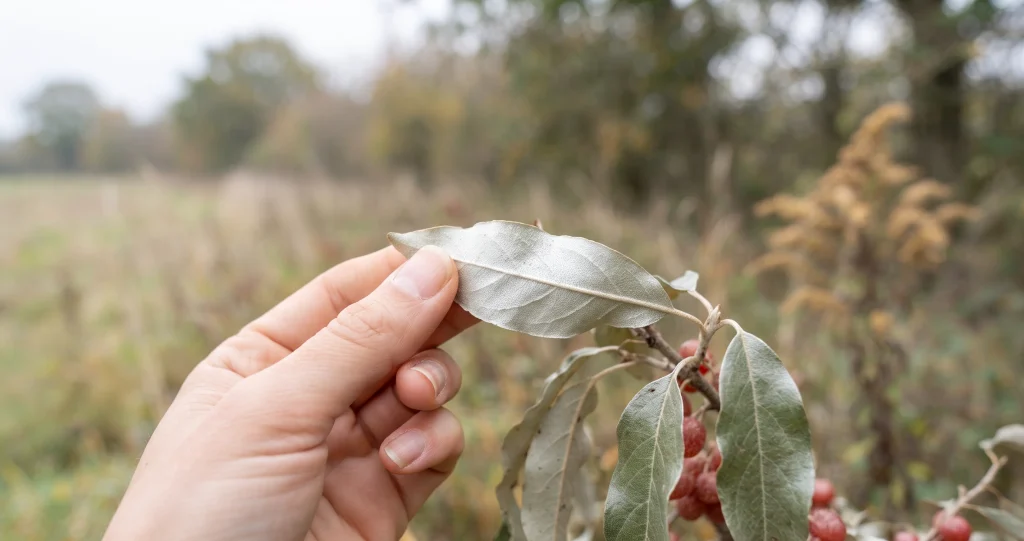
One of the most reliable identification features is the contrast between the upper and lower leaf surfaces.
The upper surface is generally green or grayish-green, while the underside has a distinctive silvery appearance.
Tiny scales covering the leaf surface reflect light, making the foliage appear almost metallic when viewed from certain angles.
2. Oval Leaves With Smooth Edges
Autumn olive leaves are typically oval to elongated, with smooth margins and sometimes slightly wavy edges.
They grow alternately along the branches and generally measure around 1–3 inches long.
Unlike many native shrubs, autumn olive does not have prominently toothed leaf edges.
3. Red Berries With Silver Speckles
The fruits are perhaps the easiest feature to recognize during autumn.
They are small, round to oval, and usually develop a bright red color when mature.
Look closely, and you will notice numerous tiny silvery or pale speckles covering their surfaces.
These distinctive markings help separate autumn olive from many other red-fruited shrubs.
4. Silvery Young Branches
Young twigs often have a silvery or bronze-colored appearance due to the presence of small scales.
Older branches gradually develop a darker, grayish-brown surface.
Examining the twigs can help confirm identification when the plant has fewer leaves.
5. Occasional Sharp Thorns
Some autumn olive branches develop sharp, thornlike tips.
These are not equally prominent on every specimen, so their absence does not rule out autumn olive.
Wear sturdy gardening gloves when inspecting unfamiliar shrubs.
6. Fragrant, Cream-Colored Spring Flowers
Although flowers are usually absent during fall, they provide another useful identification clue during spring.
The flowers are small, tubular, and typically cream to pale yellow, with four spreading lobes.
They often appear in clusters along the branches and release a noticeable fragrance.
Where Autumn Olive Grows in the United States
Autumn olive has become established across much of the eastern and central United States, with additional populations in other regions.
Its ability to tolerate challenging growing conditions allows it to colonize areas where some other shrubs struggle.
Common Habitats
Autumn olive is frequently encountered in:
- Abandoned agricultural fields.
- Roadsides and highway margins.
- Forest edges.
- Overgrown pastures.
- Disturbed grasslands.
- Reclaimed mining sites.
- Residential properties.
The shrub generally grows most vigorously in sunny locations, although it can tolerate partial shade.
Why Disturbed Landscapes Are Vulnerable
Areas affected by construction, land clearing, or agricultural abandonment often contain exposed soil and reduced competition from established vegetation.
These conditions can create opportunities for autumn olive seedlings to establish themselves.
Once mature shrubs begin producing fruit, nearby areas may become increasingly vulnerable to invasion.
The Science Behind Autumn Olive’s Invasive Success
Autumn olive’s ability to spread is not simply a result of fast growth. Several biological adaptations work together to give this shrub an advantage in many American landscapes.
A Remarkable Partnership With Soil Bacteria
One of autumn olive’s most fascinating characteristics occurs underground.
Its roots form specialized nodules containing nitrogen-fixing bacteria belonging to the genus Frankia.
These microorganisms can convert atmospheric nitrogen into forms that the plant can use for growth.
In return, the shrub supplies the bacteria with energy-rich compounds produced through photosynthesis.
This mutually beneficial relationship allows autumn olive to thrive in some soils where available nitrogen is limited.
How Nitrogen Fixation Changes the Soil
Nitrogen fixation may appear beneficial because nitrogen is an essential plant nutrient.
However, increasing nitrogen availability can alter ecosystems that naturally developed under nutrient-poor conditions.
As autumn olive grows and its leaves decompose, nitrogen can enter the surrounding soil.
Over time, these changes may favor certain fast-growing plants while creating less suitable conditions for native species adapted to low-nutrient environments.
The extent of these effects depends on the site, soil conditions, and density of the invasion.
Birds Help Distribute the Seeds
Autumn olive produces abundant small fruits that attract fruit-eating birds and other wildlife.
After animals consume the fruits, viable seeds may be deposited elsewhere through their droppings.
This process allows autumn olive to spread beyond the immediate area surrounding the parent shrub.
A single established plant can therefore contribute to the appearance of seedlings in neighboring fields, woodland edges, and gardens.
Dense Growth Creates Competition
Autumn olive develops an extensive network of branches and leaves that can shade surrounding vegetation.
As several shrubs become established together, they may form dense thickets.
These thickets compete with native plants for sunlight, water, nutrients, and growing space, potentially reducing the diversity of the plant community.
The Michigan Department of Natural Resources identifies autumn olive as a particular threat to prairies, savannas, and open woodlands, where its growth and nitrogen-fixing abilities can disrupt native plant communities. Michigan.gov
How Autumn Olive Affects Native Wildlife
At first glance, a shrub that produces abundant fruit might seem beneficial to wildlife. However, the relationship between autumn olive and native animals is more complicated.
Abundant Berries Do Not Guarantee Better Nutrition
Although birds readily consume autumn olive fruits, the berries tend to contain less fat and protein than the fruits of certain native shrubs.
These nutrients can be particularly valuable for migrating birds with high energy requirements.
Loss of Native Plant Diversity
When autumn olive replaces native vegetation, it can reduce the availability of specialized food sources for insects, birds, and other animals.
Many native caterpillars, for example, depend on particular host plants to complete their life cycles.
Protecting diverse native vegetation helps maintain these important ecological relationships.
Autumn Olive vs. Similar-Looking Shrubs
Several shrubs share characteristics with autumn olive. Examining their leaves, fruits, and growth habits can help prevent misidentification.
| Plant | Fruit | Distinguishing feature |
|---|---|---|
| Autumn olive | Red with silver speckles | Silvery leaf undersides |
| Russian olive | Yellowish or silvery | Long, narrow leaves |
| Goumi | Red with pale speckles | Typically fruits earlier |
| Winterberry holly | Bright red | Finely toothed leaves |
| Red chokeberry | Bright red | Finely serrated leaf margins |
| Common buckthorn | Dark purple or black | Prominent curved leaf veins |
Russian olive (Elaeagnus angustifolia) is another invasive species in the United States. It generally develops narrower leaves and a more tree-like growth habit than autumn olive. extension.psu.edu
Always examine multiple characteristics before confirming a plant’s identity.
Why Fall Is the Best Time to Identify Autumn Olive
Autumn offers an excellent opportunity to recognize this invasive shrub because several distinctive characteristics are visible simultaneously.
Bright Fruits Stand Out
As surrounding vegetation develops yellow, orange, and brown autumn colors, the shrub’s red fruits become especially noticeable.
Leaves Often Remain Visible Longer
Autumn olive frequently retains its foliage relatively late into the growing season.
This can make its silvery-green leaves easier to distinguish when neighboring deciduous plants begin losing theirs.
Seedlings Become Easier to Locate
As surrounding herbaceous vegetation dies back, young autumn olive plants may become more visible.
Identifying these seedlings early can make future management considerably easier.
How to Remove Autumn Olive From Your Property
Managing autumn olive requires patience because established plants can regenerate after cutting.
Hand-Pull Small Seedlings
Young seedlings can often be removed manually, particularly when the soil is moist.
Try to remove the entire root system to reduce the likelihood of regrowth.
Manage Larger Shrubs Carefully
Simply cutting mature autumn olive shrubs at ground level is generally insufficient. Established roots and stumps can produce vigorous new shoots.
Repeated cutting may help suppress growth, but more established infestations often require an integrated management approach.
Consult your local cooperative extension office for appropriate control methods. Where herbicide treatment is recommended, follow the product label and local regulations. extension.psu.edu
Prevent Accidental Seed Dispersal
Take care when removing branches carrying mature fruits.
Contain fruit-bearing material and follow local invasive plant disposal guidelines. Ordinary backyard composting may not destroy viable seeds.
Monitor the Area Regularly
Inspect treated areas during subsequent growing seasons.
New seedlings may emerge from existing seeds or arrive through continued wildlife dispersal.
In Your Own Yard: Replacing Autumn Olive With Native Shrubs
Removing invasive shrubs creates an opportunity to establish a more diverse and ecologically valuable garden.
Several North American native plants offer attractive foliage, colorful fruits, and important wildlife resources.
| Native shrub | Botanical name | Garden benefit |
|---|---|---|
| Winterberry holly | Ilex verticillata | Persistent winter berries |
| Red chokeberry | Aronia arbutifolia | Colorful autumn foliage |
| Black chokeberry | Aronia melanocarpa | Dark fruits and spring flowers |
| American elderberry | Sambucus canadensis | Flowers and wildlife food |
| Silky dogwood | Cornus amomum | Fruits for native birds |
| Red osier dogwood | Cornus sericea | Colorful winter stems |
University of Connecticut Extension recommends several of these shrubs as alternatives to autumn olive. Select species native to your particular region and appropriate for your soil and climate. University of Connecticut
Replacing invasive vegetation gradually can also help maintain shelter for wildlife while your new plants become established.
Frequently Asked Questions
1. Are autumn olive berries edible?
Correctly identified autumn olive fruits are edible and are sometimes used to prepare jams and jellies. However, unfamiliar wild berries should never be consumed without reliable identification. Avoid harvesting from contaminated areas or sites treated with herbicides, and prevent accidental seed dispersal.
2. Why is autumn olive considered invasive?
Autumn olive produces abundant seeds, grows rapidly, tolerates challenging soil conditions, and can alter soil nitrogen levels. These characteristics allow it to displace native vegetation in many American ecosystems.
3. Will autumn olive grow back after cutting?
Yes. Established autumn olive shrubs can produce new shoots from surviving stumps and roots. Successful management generally requires follow-up monitoring and additional control measures.
Conclusion
The bright red berries and shimmering silver leaves of autumn olive reveal a fascinating plant with remarkable survival adaptations.
However, understanding autumn olive identification also reveals the ecological challenges hidden behind its attractive appearance.
By recognizing this invasive shrub, managing its spread, and replacing it with suitable native plants, gardeners can help protect local biodiversity.
External Sources
1. Autumn Olive
Autumn olive’s nitrogen-fixing ability can threaten native plant communities naturally adapted to nutrient-poor soils. Michigan Department of Natural Resources. Autumn Olive Invasive Species Profile
2. Autumn Olive
Birds are not the only animals responsible for seed dispersal. Opossums, raccoons, and skunks can also contribute to its spread. University of Minnesota Extension. Autumn Olive Identification and Biology