
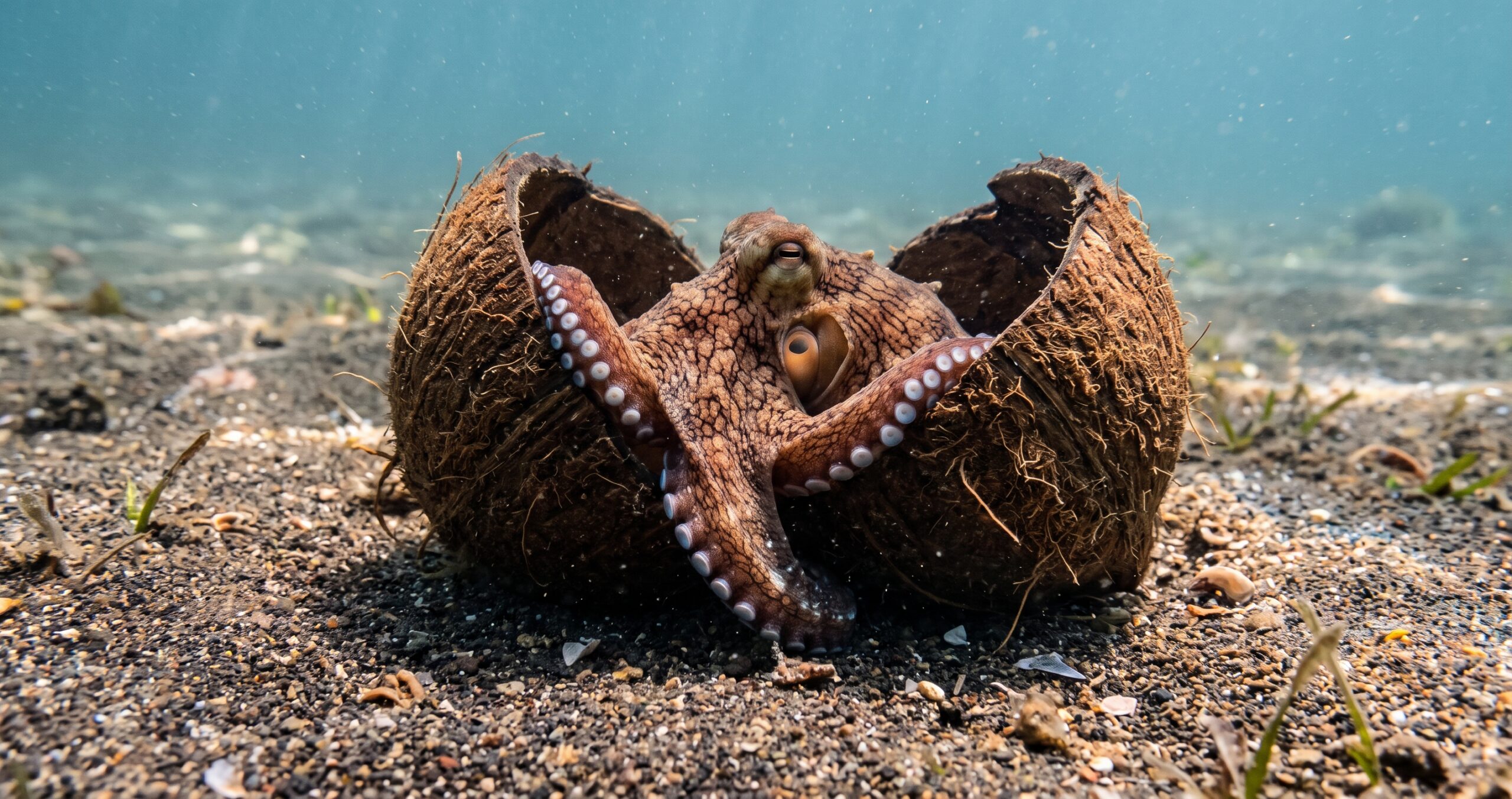
Imagine an octopus crossing a sandy ocean floor while carrying two empty coconut shell halves beneath its body. Its movements are awkward, its arms are occupied, and the shells provide almost no immediate protection. Yet when the animal reaches a suitable location, it can arrange the pieces into a temporary hiding place.
This remarkable behavior belongs to the veined octopus (Amphioctopus marginatus), commonly called the coconut carrying octopus. Its unusual habit of collecting, transporting, and assembling coconut shells has become an important example in scientific discussions of animal tool use.
Unlike animals that simply enter an available shelter, this octopus can move protective material from one location to another and use it later. The behavior raises fascinating questions about flexible decision-making, survival strategies, and the evolution of intelligence in invertebrates.
However, understanding the discovery requires separating what scientists actually observed from broader claims about planning, reasoning, and consciousness.
Table of Contents
- What Is the Coconut Carrying Octopus?
- Where Veined Octopuses Live
- The Original Scientific Discovery
- How Veined Octopuses Transport Coconut Shells
- How Coconut Shells Become Temporary Shelters
- Why Carrying Shells Is Unusual
- Does Coconut Shell Transport Count as Tool Use?
- What the Behavior Reveals About Octopus Intelligence
- How the Coconut Octopus Finds Food and Avoids Predators
- Other Animals That Use Tools Underwater
- Scientific Limitations and Unanswered Questions
- Conservation and Respectful Wildlife Observation
- Frequently Asked Questions
- Final Thoughts
What Is the Coconut Carrying Octopus?
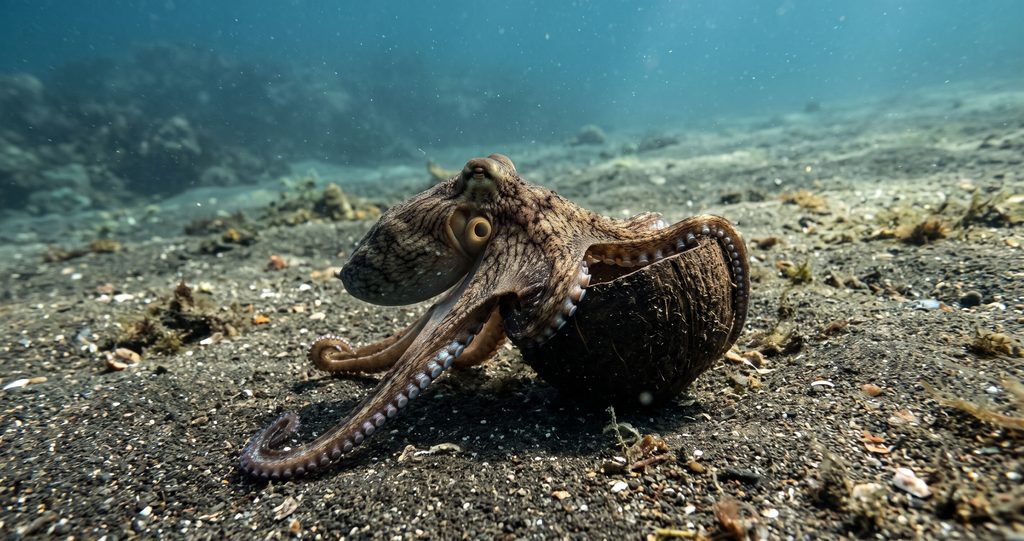
The coconut carrying octopus is a marine mollusk scientifically known as Amphioctopus marginatus.
It belongs to the class Cephalopoda, which also includes squid, cuttlefish, and nautiluses. Like other octopuses, it has eight flexible arms equipped with suckers that help it explore surfaces, capture prey, and manipulate objects.
Its common name comes from observations of individuals collecting discarded coconut shells and using them as portable protective structures.
The species is also called the veined octopus because of the branching dark markings across its body and arms.
How to Recognize It
The veined octopus typically has a brownish or mottled appearance with distinctive dark markings.
Its arms may display darker upper surfaces contrasting with pale suckers. A pale wedge-shaped marking beneath each eye is another useful identification feature.
The animal can modify its skin coloration and posture, making identification from photographs alone challenging.
According to the Australian Museum, the species can reach an arm span of approximately 50 centimeters, although size varies among individuals. The Australian Museum
The veined octopus should not be confused with similar species, including Amphioctopus aegina.
Accurate scientific identification matters because superficially similar octopuses do not necessarily display identical behaviors.
Where Veined Octopuses Live
The coconut carrying octopus inhabits tropical waters of the Indian Ocean and western Pacific Ocean.
Its documented distribution extends through parts of South and Southeast Asia, including Indonesia, and toward northern Australia and neighboring marine regions.
It is especially associated with sandy, muddy, and mixed seabeds.
Why Soft-Bottom Habitats Matter
Rocky reefs often contain numerous cracks, holes, and crevices that octopuses can use as shelters.
Soft-bottom environments may provide fewer permanent hiding places.
For an animal with a flexible body and limited physical armor, access to protective objects can be valuable.
Discarded coconut shells, empty mollusk shells, and other suitable structures may provide temporary refuge.
Are Coconut Octopuses Found in American Waters?
The veined octopus is not a native species of the continental United States.
Its tropical Indo-West Pacific distribution is distinct from that of the octopus species commonly encountered along American Atlantic, Gulf, and Pacific coastlines.
American readers may be familiar with the giant Pacific octopus or the common octopus, but these are different animals with different habitat requirements.
The coconut carrying octopus should therefore be understood as an Indo-Pacific marine species rather than a typical member of North American coastal wildlife.
The Original Scientific Discovery
The most influential scientific report describing coconut-shell transport appeared in December 2009 in the peer-reviewed journal Current Biology.
The study, titled Defensive tool use in a coconut-carrying octopus, was written by Julian K. Finn, Tom Tregenza, and Mark D. Norman.
The researchers documented wild veined octopuses gathering coconut shell halves, transporting them across the seabed, and assembling them into shelters.
This was important because the shell pieces were not always being used for protection while they were carried.
Instead, the animals appeared to accept the immediate difficulty of transporting objects that could provide a later benefit.
The original paper is available through Current Biology’s peer-reviewed research archive. ScienceDirect
What Scientists Actually Observed
The documented behavior involved octopuses collecting separate coconut shell halves and moving them along the seafloor.
Some individuals carried stacked shell pieces while traveling.
When suitable conditions arose, the animals could assemble the pieces into an enclosed protective structure.
The study described this as defensive tool use because the octopuses transported external objects that were subsequently deployed for shelter.
Why the Discovery Attracted Attention
Animal tool use had already been documented in several vertebrates, including certain primates, birds, and marine mammals.
The octopus observations expanded discussions about how tool-related behaviors could evolve in animals with very different nervous systems.
They were particularly notable because the animals acquired and transported objects before using them.
That separation between collection and deployment became central to the scientific interpretation.
How Veined Octopuses Transport Coconut Shells
The coconut carrying octopus does not simply drag a shell behind itself.
Researchers observed a distinctive method of movement sometimes described as stilt-walking.
Collecting the Shell Pieces
An octopus can encounter coconut shell halves lying on the seabed.
Using its suckers and flexible arms, it manipulates the pieces and positions them beneath its body.
When more than one suitable piece is available, the animal may stack the shells together before moving.
This arrangement allows the octopus to transport multiple protective components during a single journey.
Moving With the Shells
Ordinary octopus movement often involves crawling over the substrate using coordinated arm motions.
Carrying shells changes the mechanics of locomotion.
The octopus must keep the objects positioned beneath its body while using portions of its arms to move across the seabed.
The result is an awkward, elevated gait that differs from ordinary crawling.
Why Stilt-Walking Matters
The movement is important because carrying the shells creates an immediate inconvenience.
The animal’s normal mobility is restricted, and the objects are not functioning as a complete protective enclosure during transportation.
Yet the octopus continues moving with the material.
This suggests that the value of the shell pieces lies partly in their potential for later deployment.
It does not, by itself, prove that the animal imagines future events in the same way humans do.
How Coconut Shells Become Temporary Shelters
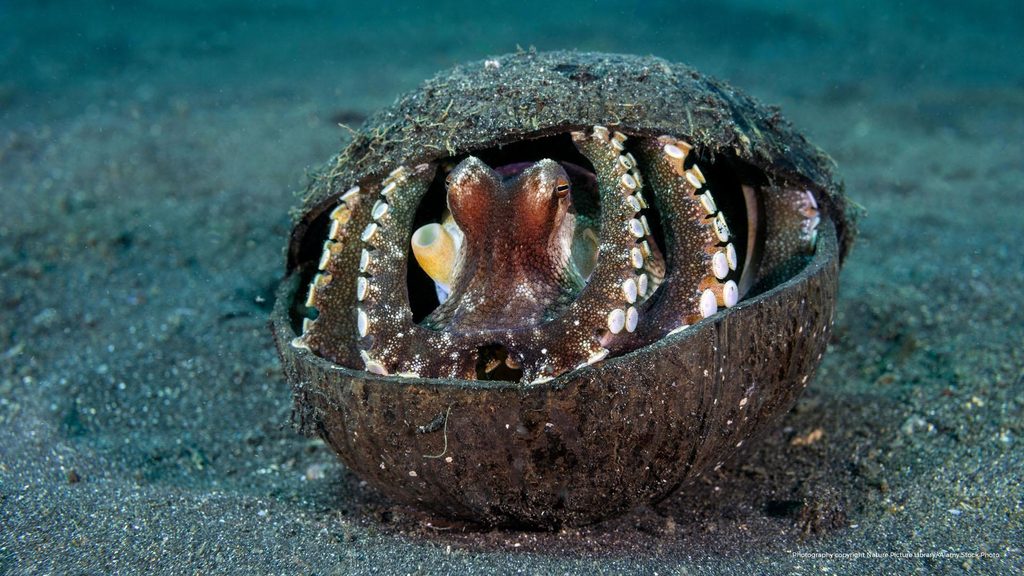
When the coconut carrying octopus stops moving, its transported shell pieces can be transformed into a protective enclosure.
This conversion from cargo to shelter is the defining feature of the behavior.
Using a Single Shell
One coconut shell half can provide a concave structure beneath or around the animal.
Depending on the shell’s position and the surrounding substrate, the octopus may use it as a partial refuge.
Such protection is not necessarily complete, but it can reduce exposure compared with remaining fully uncovered.
Assembling Two Shell Halves
Two appropriately shaped halves can be brought together to create a more enclosed space.
The octopus positions the pieces around its flexible body, producing a temporary shell-like refuge.
The arrangement resembles a small portable shelter rather than a permanent burrow.
Because the animal can manipulate the shell pieces, it can adjust their positions to enter or occupy the enclosure.
Why Shelter Is Valuable
Octopuses are soft-bodied animals without the hard external shells found in many other mollusks.
They rely on behavior, camouflage, hiding places, and other defensive strategies to reduce danger.
A portable enclosure may be especially useful where suitable natural crevices are scattered or absent.
However, researchers have not established that coconut shells always provide superior protection against every predator or in every habitat.
Image placement — after this section
Suggested image: A scientifically accurate underwater photograph or realistic documentary-style illustration showing a veined octopus on a sandy Indonesian seabed beside two coconut shell halves, with one shell positioned beneath its body and another nearby. Clearly show its dark veined markings, pale suckers, and natural marine habitat.
Alt text: Coconut carrying octopus Amphioctopus marginatus transporting coconut shell halves to assemble a protective underwater shelter.
Why Carrying Shells Is Unusual
Many marine animals use objects as shelter.
Hermit crabs occupy empty gastropod shells, while numerous fish and invertebrates hide beneath rocks or inside abandoned structures.
However, occupying an available shelter is not necessarily equivalent to carrying materials that will be assembled into one later.
Immediate Protection Versus Later Use
A hermit crab normally receives protection while occupying its adopted shell.
The coconut carrying octopus can transport shell pieces that are not functioning as a protective enclosure during movement.
Only after positioning the pieces does the shelter become available.
This distinction was central to the interpretation proposed in the original research.
The Importance of Object Manipulation
The octopus does not merely encounter an object and remain inside it.
It can collect, reposition, transport, and arrange external material.
These actions demonstrate behavioral flexibility and fine motor coordination.
Nevertheless, scientists distinguish observable actions from assumptions about the animal’s intentions.
Does Coconut Shell Transport Count as Tool Use?
The definition of tool use has been debated for decades.
Researchers generally agree that tool use involves manipulating an external object to achieve a functional outcome.
However, definitions differ in how they treat shelters, carried objects, environmental materials, and behavior that occurs before a tool is actually deployed.
A Scientific Definition
In a 2013 review published in Philosophical Transactions of the Royal Society B, Janet Mann and Eric M. Patterson examined tool use among aquatic animals.
Their framework emphasized the conditional manipulation of environmental objects to alter the condition or position of another object, organism, or the user itself.
The important elements include direct manipulation, functional deployment, and use in an appropriate context. PubMed Central (PMC)
Under this approach, carrying an object continuously does not automatically qualify as tool use.
Why the Coconut Octopus Qualifies
The coconut carrying octopus collects shell halves that may initially provide no direct protection.
It later manipulates them into a shelter when the objects become useful.
This conditional deployment distinguishes the behavior from simply living inside an existing shell.
The 2013 aquatic tool-use review included Amphioctopus marginatus among documented marine tool users.
Why Definitions Still Matter
Not every scientist uses exactly the same criteria for identifying tools.
Some definitions are relatively broad, while others require particular relationships between the animal, the object, and the task.
The shell observations provide strong evidence of purposeful object manipulation, but classification can depend on the theoretical definition adopted.
This is a normal feature of scientific debate, not evidence that the original observations were invalid.
What the Behavior Reveals About Octopus Intelligence
Octopuses possess sophisticated nervous systems and are capable of flexible responses to their surroundings.
They can investigate unfamiliar objects, navigate complicated spaces, and modify behavior according to environmental conditions.
The coconut carrying octopus provides a particularly interesting example because its actions involve transporting material that can become useful later.
Does the Octopus Plan Ahead?
The behavior is consistent with anticipating a possible need for shelter.
However, it does not conclusively demonstrate human-like foresight or conscious planning.
To establish specific cognitive processes, researchers would need controlled studies that distinguish among alternative explanations.
For example, an octopus might learn that carrying shells increases access to shelter without mentally representing a detailed future event.
Both explanations can produce similar visible behavior.
Intelligence Is Not a Single Ability
Scientific studies of animal cognition investigate different capacities, including learning, memory, behavioral flexibility, and problem-solving.
A species may perform well in one domain without showing comparable abilities in another.
Therefore, the coconut carrying octopus should not be treated as proof that octopuses think exactly like humans.
Its behavior is significant because it illustrates a functional solution to a particular ecological challenge.
Camouflage and Behavioral Flexibility
Shell transport is only one aspect of octopus survival.
Many octopus species can rapidly alter their appearance through specialized skin structures and controlled body postures.
Our related article, How Octopuses Change Color Faster Than the Human Eye Can Track, explains how camouflage combines skin physiology, posture, and behavior. green garden
Together, these adaptations demonstrate that avoiding predators can involve several different strategies.
How the Coconut Octopus Finds Food and Avoids Predators
The veined octopus is a predator of smaller marine animals.
Its diet includes crustaceans and mollusks, particularly organisms associated with the seabed.
It may explore holes and soft sediments using its flexible arms.
Hunting on the Seafloor
The octopus can probe beneath objects and into openings where potential prey animals hide.
Its suckers provide sensory information as well as grip.
Like other octopuses, it uses a beak to process captured prey.
This feeding behavior makes the animal an active participant in coastal food webs.
Combining Several Defensive Strategies
The coconut carrying octopus does not rely exclusively on coconut shells.
Its flexible body can enter confined spaces, and its appearance can change in response to its surroundings.
When threatened, an octopus may escape, conceal itself, or use another available defensive response.
Portable shells provide an additional option rather than replacing all other survival strategies.
Other Animals That Use Tools Underwater
The coconut octopus is not the only aquatic animal known to manipulate objects for practical purposes.
Several unrelated species display behaviors that researchers classify as tool use.
| Animal | Documented behavior | Main function |
|---|---|---|
| Veined octopus | Transports and assembles coconut shell halves | Defensive shelter |
| Sea otter | Uses stones to break open hard-shelled prey | Food access |
| Bottlenose dolphin | Some individuals carry marine sponges over their snouts | Protection while foraging |
| Certain wrasses | Strike hard-shelled prey against suitable surfaces | Food processing |
| Some sea urchins | Hold external materials against their bodies | Protection or covering |
These examples differ in their mechanics, ecological functions, and likely cognitive demands.
They should not be interpreted as evidence that every species using an object possesses the same level or type of intelligence.
Tool-related behavior has evolved in diverse animal groups facing different environmental challenges.
Scientific Limitations and Unanswered Questions
The original coconut-shell research documented an important behavior, but it did not answer every question about the species.
Much remains uncertain about how widespread the behavior is, how individuals acquire it, and how frequently it occurs under different environmental conditions.
Do All Veined Octopuses Carry Coconut Shells?
There is no evidence that every individual regularly transports coconut shells.
Behavior may vary with the availability of suitable objects, habitat structure, previous experience, and local environmental conditions.
Different populations may encounter different shelter materials.
Is the Behavior Learned?
The observations do not establish whether young octopuses learn shell transport through individual exploration, inherited behavioral tendencies, or other processes.
Controlled developmental studies would be needed to distinguish among these possibilities.
The existence of an elaborate behavior does not automatically prove social learning.
Does Shell Transport Improve Survival?
The behavior has an obvious potential defensive function.
However, demonstrating a measurable survival advantage would require comparisons between individuals using different shelter strategies under realistic conditions.
The original observations support the interpretation of defensive tool use, but they do not provide a universal estimate of its effectiveness.
Could Other Objects Work?
Veined octopuses have also been documented using mollusk shells and some human-made objects as shelters.
This suggests that their behavior is not necessarily restricted to coconuts.
Nevertheless, object shape, size, availability, and ease of manipulation likely influence suitability.
More comparative research could clarify these relationships.
Conservation and Respectful Wildlife Observation
Although coconut-shell transport attracts attention, divers and underwater photographers should avoid disturbing octopuses to obtain unusual footage.
Moving shell pieces, blocking escape routes, or repeatedly approaching an animal may alter its natural behavior.
Observe Without Interference
Maintain a respectful distance and allow the octopus to choose whether to remain visible or retreat.
Do not remove shell pieces being used as shelter.
Avoid repositioning animals or objects to create a more dramatic photograph.
Responsible observation is particularly important when documenting behaviors that scientists are still working to understand.
Protecting Soft-Bottom Marine Habitats
Marine conservation discussions often focus on coral reefs, but sandy and muddy habitats also support diverse ecological communities.
These environments provide feeding grounds, shelter opportunities, and living space for numerous specialized organisms.
Coastal development, destructive fishing practices, and pollution can affect the structure and ecological functioning of these habitats.
The coconut carrying octopus illustrates why even seemingly featureless seabeds deserve careful scientific attention.
Frequently Asked Questions
What is the scientific name of the coconut carrying octopus?
Its scientific name is Amphioctopus marginatus. It is also commonly called the veined octopus.
Why does a coconut octopus carry coconut shells?
Researchers have observed individuals transporting shell halves that can later be assembled into protective shelters.
This allows the octopus to bring potential shelter materials into areas where suitable hiding places may be limited.
Does the coconut octopus use tools?
Yes, its documented behavior qualifies as defensive tool use under widely applied scientific definitions.
The important feature is the collection, transport, and later manipulation of external objects for protection.
Can a coconut octopus carry two shell halves?
Yes. Researchers documented octopuses transporting stacked coconut shell halves and subsequently arranging them into shelters.
Is the coconut octopus intelligent?
Its behavior demonstrates flexible object manipulation and a potentially useful defensive strategy.
However, one behavior cannot establish an animal’s overall intelligence or prove human-like reasoning.
Where can coconut octopuses be found?
They inhabit tropical Indo-West Pacific marine environments, including waters around Indonesia and other parts of South and Southeast Asia.
They are especially associated with sandy and muddy seabeds.
Do coconut octopuses build permanent homes?
The documented shelters are temporary structures assembled from available materials.
The species may also use other cavities and objects as dens, but shell transport should not be confused with constructing a permanent dwelling.
Final Thoughts
The coconut carrying octopus demonstrates how an apparently simple animal behavior can raise important scientific questions.
By collecting coconut shell halves, moving them across the seabed, and assembling them into protective shelters, Amphioctopus marginatus shows remarkable flexibility in its use of environmental objects.
The original 2009 research provided compelling evidence of defensive tool use in a marine invertebrate.
At the same time, the observations do not establish that these animals plan, reason, or understand the future in precisely the way humans do.
The most valuable lesson is that sophisticated survival strategies can evolve in animals with very different bodies, nervous systems, and ecological histories.
The veined octopus remains an extraordinary example of how much scientists can learn by carefully observing wildlife in its natural habitat.