
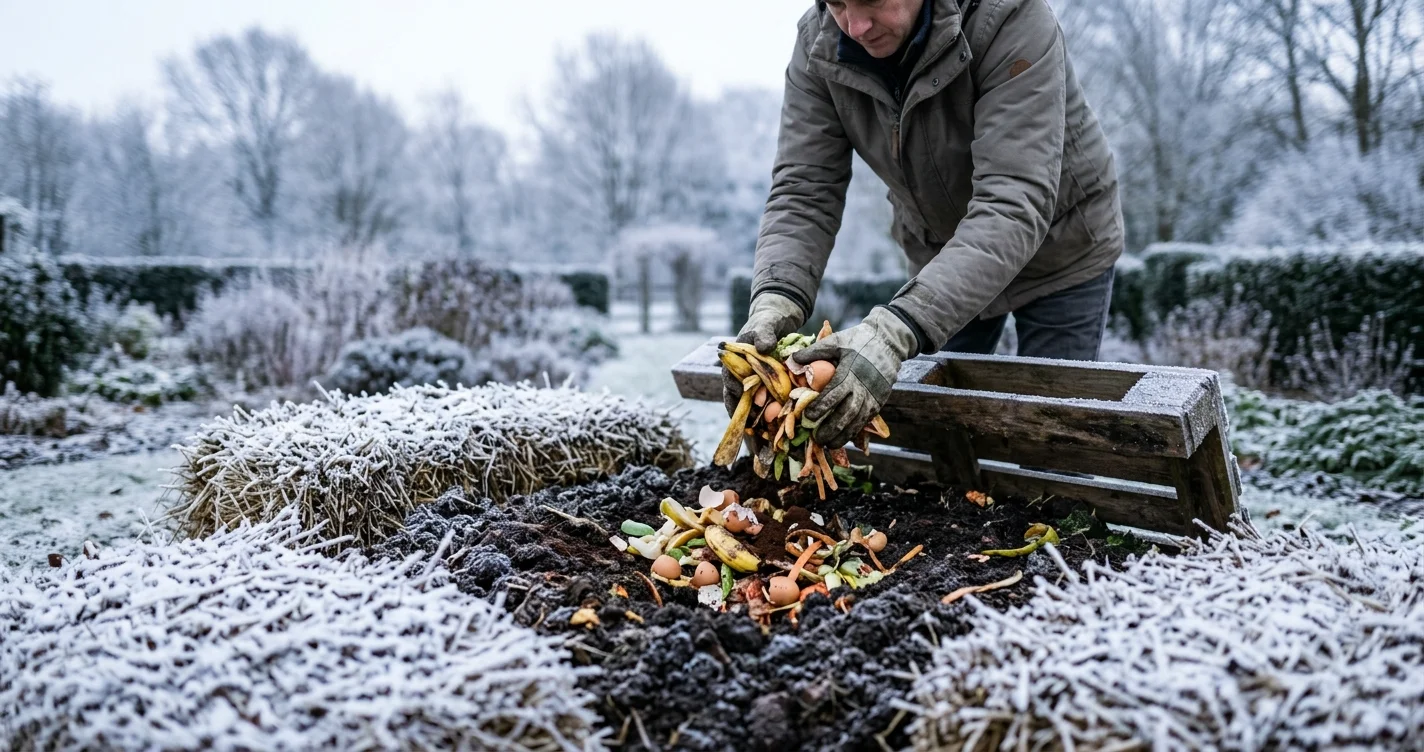
A compost pile can be surrounded by snow while its center remains surprisingly warm. Even when the garden is frozen and the trees have lost their leaves, billions of microorganisms may still be working beneath the surface.
That hidden activity is what makes winter composting so fascinating.
Cold weather slows decomposition, but it does not always stop it completely. A well-managed compost pile can continue breaking down organic materials during winter, especially when it has enough mass, balanced ingredients, moisture, and protection from harsh conditions.
These winter composting tips will help you understand what happens inside a cold-weather compost pile, how to maintain microbial activity, and what to do when temperatures drop below freezing.
Whether you use a backyard compost bin, a wooden enclosure, or a simple outdoor heap, winter can still be a productive season for building healthier garden soil.
Table of Contents
- Why Composting Slows Down in Winter
- How Compost Piles Generate Heat
- 12 Winter Composting Tips to Keep Your Pile Active
- Choosing the Best Winter Composting System
- Common Winter Composting Mistakes
- What to Do When Your Compost Pile Freezes
- How to Know Whether Your Compost Is Working
- In Your Own Yard: A Winter Composting Routine
- Frequently Asked Questions
Why Composting Slows Down in Winter
Composting is a biological process. Bacteria, fungi, and other decomposers break down organic materials, gradually transforming kitchen scraps, leaves, and garden debris into a dark, soil-like material.
These organisms need suitable conditions to remain active.
Temperature, oxygen, moisture, and the availability of organic matter all influence how quickly decomposition occurs.
Cold Temperatures Reduce Microbial Activity
Many microorganisms responsible for rapid composting are most active in warm conditions.
As outdoor temperatures fall, biological activity often slows.
In a small compost bin, the temperature of the material may approach the surrounding air temperature. During prolonged freezing weather, decomposition can become extremely slow.
Larger compost piles, however, may retain some of the heat produced by microbial activity.
This is why pile size matters during winter.
Winter Composting Is Different From Summer Composting
During summer, gardeners may turn their piles regularly, add fresh materials, and maintain relatively rapid decomposition.
Winter requires a slightly different approach.
Instead of trying to maintain maximum decomposition speed, the goal is often to conserve warmth, avoid excessive moisture, and continue adding suitable materials without disturbing the pile unnecessarily.
A compost pile that slows down in December can become active again as spring temperatures rise.
How Compost Piles Generate Heat: The Science Behind Winter Decomposition
The warmth inside an active compost pile does not come from sunlight alone.
It is primarily produced by microorganisms as they break down organic matter.
Understanding this process helps explain why some compost piles remain warm during freezing weather while others become inactive.
Microorganisms Release Heat
When microorganisms consume organic materials, they use some of the available energy for growth and maintenance.
Part of that energy is released as heat.
In a sufficiently large, active pile, heat can accumulate faster than it escapes.
This allows the center to become considerably warmer than the surrounding air.
During active hot composting, internal temperatures may reach approximately 130–150°F (54–66°C), although maintaining these temperatures during winter can be difficult.
Not every compost pile needs to become hot to produce useful compost.
Why Pile Size Matters
A larger pile has a lower surface-area-to-volume ratio than a smaller one.
That means it has proportionally less exposed surface through which heat can escape.
For many backyard hot-composting systems, a pile approximately 3 feet wide, 3 feet deep, and 3 feet tall is a useful starting size.
Smaller piles can still compost, but they generally lose heat more quickly.
Extremely large piles may develop problems with airflow or compaction, so bigger is not always better.
Oxygen Keeps Aerobic Decomposition Moving
Most managed backyard composting systems rely on aerobic microorganisms, which require oxygen.
When a pile becomes compacted or saturated, air spaces fill with water or collapse.
This can encourage anaerobic decomposition, which is often slower and may produce unpleasant odors.
Maintaining a loose structure helps air move through the material.
However, excessive turning during freezing weather can release valuable heat.
Winter composting therefore requires balancing oxygen availability with heat conservation.
Moisture Supports Microbial Life
Microorganisms need water to function.
A completely dry pile decomposes very slowly.
But a waterlogged pile loses air spaces and may become anaerobic.
A commonly used practical guideline is to keep compost about as moist as a wrung-out sponge.
In winter, precipitation, snowmelt, and freezing temperatures can make moisture management more complicated.
Why Frozen Compost Is Not Necessarily Dead
When the outer layers freeze, microbial activity may slow dramatically.
Some organisms survive cold conditions and become active again when temperatures rise.
A frozen pile does not automatically mean the composting process has failed.
In many cases, the material simply waits for warmer weather.
12 Winter Composting Tips to Keep Your Pile Active
The following practical techniques can help reduce heat loss, maintain a suitable balance of ingredients, and prepare your compost for spring.
1. Build a Larger Compost Pile Before Winter
If you have enough suitable organic material, increase your pile’s volume before sustained cold arrives.
A pile around 3 × 3 × 3 feet can retain heat more effectively than a small, shallow heap.
Combine fallen leaves, shredded plant material, and appropriate kitchen scraps.
Avoid compacting everything tightly.
The goal is to create enough mass for insulation while preserving air spaces.
2. Stockpile Dry Brown Materials
Autumn leaves are one of the most useful resources for winter composting.
Collect dry leaves before snow or heavy rain makes them difficult to handle.
Store them in a covered bin, breathable bag, or protected container.
Other carbon-rich materials include shredded plain cardboard, untreated wood shavings, and small amounts of shredded paper.
These materials help balance nitrogen-rich food scraps and absorb excess moisture.
3. Balance Greens and Browns
Compost microorganisms need both carbon and nitrogen.
Carbon-rich materials provide energy, while nitrogen supports microbial growth.
Kitchen vegetable scraps, coffee grounds, and fresh green plant material are common nitrogen-rich additions.
Dry leaves, shredded cardboard, and straw are common carbon-rich materials.
A practical starting approach is to add roughly two or three volumes of loose browns for each volume of greens, then adjust based on moisture, odor, and decomposition.
This is a volume guideline rather than a precise carbon-to-nitrogen calculation.
4. Chop Kitchen Scraps Into Smaller Pieces
Large pieces of organic material generally take longer to break down.
Cutting vegetable scraps into smaller pieces increases the surface area available to decomposers.
During winter, this can help materials break down more efficiently when temperatures are suitable.
Avoid blending scraps into a wet slurry, which may reduce airflow.
Small, manageable pieces are usually sufficient.
5. Insulate the Sides of Your Compost Bin
A compost bin exposed to strong winter winds can lose heat quickly.
Adding insulation around the outside may help moderate temperature changes.
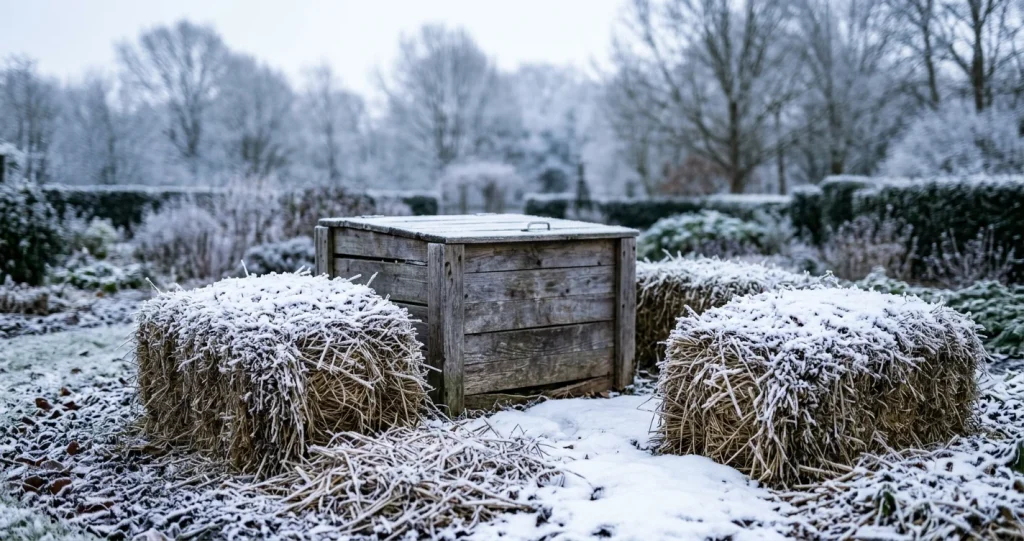
Possible materials include straw bales, dry leaves held in mesh, or other suitable insulating barriers.
Keep ventilation openings functional.
Avoid wrapping the bin so tightly that moisture accumulates and airflow becomes restricted.
6. Protect the Pile From Excess Rain and Snow
A simple cover can help prevent the pile from becoming waterlogged.
A fitted compost-bin lid or a secured tarp may be useful.
The cover should reduce direct precipitation while still allowing appropriate ventilation.
Avoid sealing the pile inside an airtight enclosure.
Some snow on the outside is not necessarily harmful, but repeated soaking can create problems.
7. Avoid Turning the Pile Too Frequently
Turning introduces oxygen and redistributes materials.
During warm weather, frequent turning can support rapid decomposition.
In winter, however, turning may release accumulated heat.
If the pile has adequate structure and does not smell unpleasant, leaving it relatively undisturbed may be beneficial.
Turn when necessary to correct serious compaction, excessive moisture, or poor aeration rather than following an aggressive summer schedule.
8. Add Fresh Scraps to the Center
The center of a compost pile is often warmer than the outer edges.
When adding kitchen scraps, open a small space near the middle, place the scraps inside, and cover them with existing compost and dry browns.
This helps reduce exposure and may discourage pests.
Do not leave fresh food scraps uncovered on the surface.
In very cold conditions, the new material may freeze before it begins decomposing.
That is normal.
9. Maintain Suitable Moisture
Check the pile when temperatures allow.
If the material is extremely dry, a modest amount of water may help, but avoid adding large quantities immediately before freezing weather.
If the pile is wet and compacted, add dry browns and improve its structure.
Protecting the pile from excessive precipitation is often more useful than frequent watering during winter.
10. Use a Compost Thermometer
A long-stem compost thermometer can reveal conditions that are difficult to judge from the outside.
Insert it into the center of the pile.
A temperature above the surrounding air suggests that microbial activity may be generating heat.
If the center remains warm, avoid unnecessary disturbance.
If it cools, consider whether the pile lacks sufficient mass, moisture, oxygen, or available organic material.
A cool reading alone does not mean the compost is ruined.
11. Keep the Compost Area Accessible
Snow and ice can make backyard compost bins difficult to reach.
Before winter arrives, choose a safe access route.
Keep a covered container of dry browns nearby so each addition of food scraps can be covered immediately.
A convenient setup encourages consistent composting even during unpleasant weather.
Avoid walking across icy ground unnecessarily.
12. Accept a Slower Winter Pace
One of the most important winter composting tips is to adjust expectations.
A small backyard pile may not maintain high temperatures through a long northern winter.
That does not mean the system has failed.
Continue collecting suitable organic materials, maintain reasonable moisture and airflow, and allow the pile to resume faster decomposition when temperatures rise.
Winter composting can be successful even when the main benefit is preserving materials for spring.
Choosing the Best Winter Composting System
Different composting systems respond differently to cold weather.
The best option depends on available space, local climate, and how much organic material your household produces.
Open Compost Piles
Open piles are inexpensive and easy to expand.
They work well when gardeners have plenty of leaves and yard debris.
However, they are exposed to wind, precipitation, and temperature changes.
A larger pile and a suitable cover can help.
Enclosed Compost Bins
Enclosed bins provide some protection from wind and precipitation.
They may also help contain food scraps and discourage animals.
Their effectiveness depends on size, ventilation, construction, and how much material they contain.
A small plastic bin can still freeze during prolonged cold weather.
Compost Tumblers
Tumblers are convenient for mixing materials and keeping scraps contained.
However, many are relatively small and exposed on all sides.
They can lose heat quickly during freezing weather.
Some gardeners use them primarily for collecting and mixing scraps during winter, allowing decomposition to accelerate in spring.
Indoor Worm Composting
Vermicomposting can provide a useful alternative when outdoor composting becomes difficult.
A properly managed indoor worm bin can process suitable food scraps in a temperature-controlled environment.
Composting worms generally need moderate temperatures and protection from freezing.
An indoor worm system requires different management from an outdoor hot compost pile.
Common Winter Composting Mistakes
Several common habits can make cold-weather composting less effective.
Adding Too Many Food Scraps Without Browns
Excess food scraps may create wet, compacted pockets.
These conditions can encourage odors and attract pests.
Keep a supply of dry leaves or shredded cardboard available.
Cover fresh scraps thoroughly.
Letting the Pile Become Waterlogged
Rain and melting snow can saturate compost.
When air spaces fill with water, aerobic decomposition becomes more difficult.
Use an appropriate cover and maintain a loose structure.
Expecting a Small Bin to Stay Hot
Small bins have limited heat-retaining capacity.
Even with good ingredients, they may freeze during severe weather.
Treat winter as a collection and preparation season when necessary.
Adding Unsuitable Materials
Avoid meat, fish, dairy products, grease, and oily cooked foods in ordinary backyard compost piles, especially where they may attract animals.
Also avoid pet waste, coal ash, and materials contaminated with harmful chemicals.
Local composting programs may have different rules and capabilities.
Ignoring Animal Activity
Food scraps can attract rodents, raccoons, and other animals.
Use a secure bin when wildlife pressure is high.
Bury scraps within the pile and cover them with browns.
Avoid adding foods likely to attract pests.
What to Do When Your Compost Pile Freezes
A frozen compost pile can look discouraging, but it is usually not a disaster.
The most important response is often to avoid unnecessary intervention.
Do Not Force Apart Frozen Material
Trying to break up a frozen pile can damage containers and tools.
It may also expose the interior to additional cold.
Allow the material to thaw naturally when conditions improve.
Store Scraps Separately if Necessary
If the pile is frozen solid, collect suitable kitchen scraps in a secure covered container.
Depending on your setup, you may be able to add them to the top of the pile and cover them with dry browns.
If the bin is inaccessible or wildlife is a concern, temporary storage in a freezer or another suitable system may be more practical.
Avoid leaving exposed food waste outdoors.
Prepare for Spring Activity
When temperatures rise, the pile will begin thawing.
Check moisture, structure, and the balance of ingredients.
If the material is compacted, turning may help restore airflow.
Add dry browns if the pile is excessively wet.
Decomposition will often accelerate as the environment becomes warmer.
How to Know Whether Your Compost Is Working
Winter composting does not always produce obvious changes.
However, several observations can help you evaluate the pile.
Internal Temperature
A compost thermometer can indicate whether the center is warmer than the surrounding air.
A warm center suggests ongoing biological activity.
Earthy Smell
Healthy aerobic compost often has an earthy odor.
Strong rotten or sour smells may indicate excessive moisture or inadequate oxygen.
Gradual Material Breakdown
Over time, recognizable leaves and food scraps become darker and less distinct.
During winter, this change may happen slowly.
Reduced Volume
As organic material decomposes, the pile often settles and decreases in volume.
However, settling can also result from compaction, so it should not be used as the only measure of progress.
Appearance of Finished Compost
Mature compost is generally dark, crumbly, and earthy-smelling, with most original ingredients no longer recognizable.
Some woody pieces may remain and can be screened out.
A warm pile is not automatically finished compost; maturity depends on the extent and stability of decomposition.
In Your Own Yard: A Practical Winter Composting Routine
A successful winter composting routine begins before the coldest weather arrives.
During fall, gather dry leaves and store them somewhere protected from excessive rain.
Build or enlarge your compost pile using a mixture of carbon-rich and nitrogen-rich materials.
If possible, aim for enough volume to retain some heat while maintaining good airflow.
Place the pile or bin where it remains accessible during winter.
Protect it from excessive precipitation, and consider insulating exposed sides in very cold climates.
When adding kitchen scraps, chop large pieces, place them near the center, and cover them with dry browns.
Check the pile periodically rather than disturbing it every day.
Use a compost thermometer if you want to monitor internal activity.
If the pile freezes, continue collecting suitable materials safely and allow the composting process to resume as conditions improve.
In spring, assess moisture and structure, turn the pile if needed, and allow unfinished materials to continue decomposing.
This simple routine keeps organic waste out of the trash where practical and prepares valuable soil amendments for the growing season.
Frequently Asked Questions
1. Can compost stay active below freezing?
Yes, in some circumstances.
A sufficiently large and biologically active compost pile may retain a warm center even when outdoor temperatures fall below 32°F (0°C).
However, small piles often cool or freeze, and decomposition slows considerably.
2. Should I turn my compost pile during winter?
Not necessarily.
Turning can introduce oxygen, but it also releases heat.
If the pile has good structure and no serious odor or moisture problems, frequent turning may be unnecessary.
Turn when conditions indicate that aeration or moisture correction is needed.
3. Can I add kitchen scraps to a frozen compost pile?
Yes, but decomposition may not begin until the material thaws.
Add suitable scraps only if they can be securely contained and covered to discourage pests.
If the pile is inaccessible or attracts animals, temporarily storing scraps may be a better option.
Conclusion
A compost pile does not need to be steaming in the middle of winter to remain useful.
Even when decomposition slows, the pile continues to hold organic materials that can become valuable compost as temperatures rise.
The most effective winter composting tips focus on conserving heat, maintaining a balanced mixture of greens and browns, managing moisture, protecting the pile from excess precipitation, and avoiding unnecessary disturbance.
Larger piles may retain enough warmth for continued microbial activity, while smaller systems may pause until spring.
Both approaches can contribute to a productive gardening routine.
The next time snow settles over your compost bin, remember that the quiet pile beneath it may still contain a surprisingly active community of decomposers.
And when spring returns, that winter collection of leaves and kitchen scraps can begin its transformation into rich material for the garden.
Internal Sources
1.How to Build an Easy Pallet Compost Bin for a Healthier Garden Help readers build a practical backyard compost bin using wooden pallets. This complements the winter composting article by showing how to create a composting area with enough space for organic materials and airflow. Secrets of the Green Garden.
How to Build an Easy Pallet Compost Bin for a Healthier Garden
2. Hot Compost vs. Cold Compost: Which Method Should You Use?
Explain the differences between hot and cold composting, including microbial activity, temperature, pile size, moisture, oxygen, and decomposition speed. This source helps readers understand why compost piles slow down during winter and how to maintain activity in cold weather. Secrets of the Green Garden. Hot Compost vs. Cold Compost: Which Method Should You Use?
External Sources
1.Winter Composting
Explain how freezing temperatures affect microbial activity and how increasing pile size, reducing turning, adding insulation, and protecting compost from excess moisture can support winter composting. University of Illinois Extension. Winter Composting — University of Illinois Extension (PDF)
2. Can I Compost in Freezing Temperatures?
Explain why small compost piles often freeze, how larger piles retain heat, and why composting may temporarily pause during severe winter weather without ruining the material. Oregon State University Extension Service. Can I Compost in Freezing Temperatures?
3. Turn Fall Yard Debris Into Compost for a Healthier Garden
Support recommendations about balancing organic materials, maintaining moisture and airflow, covering compost against excess precipitation, and using autumn leaves to create nutrient-rich compost. Oregon State University Extension Service. Turn Fall Yard Debris Into Compost for a Healthier Garden