
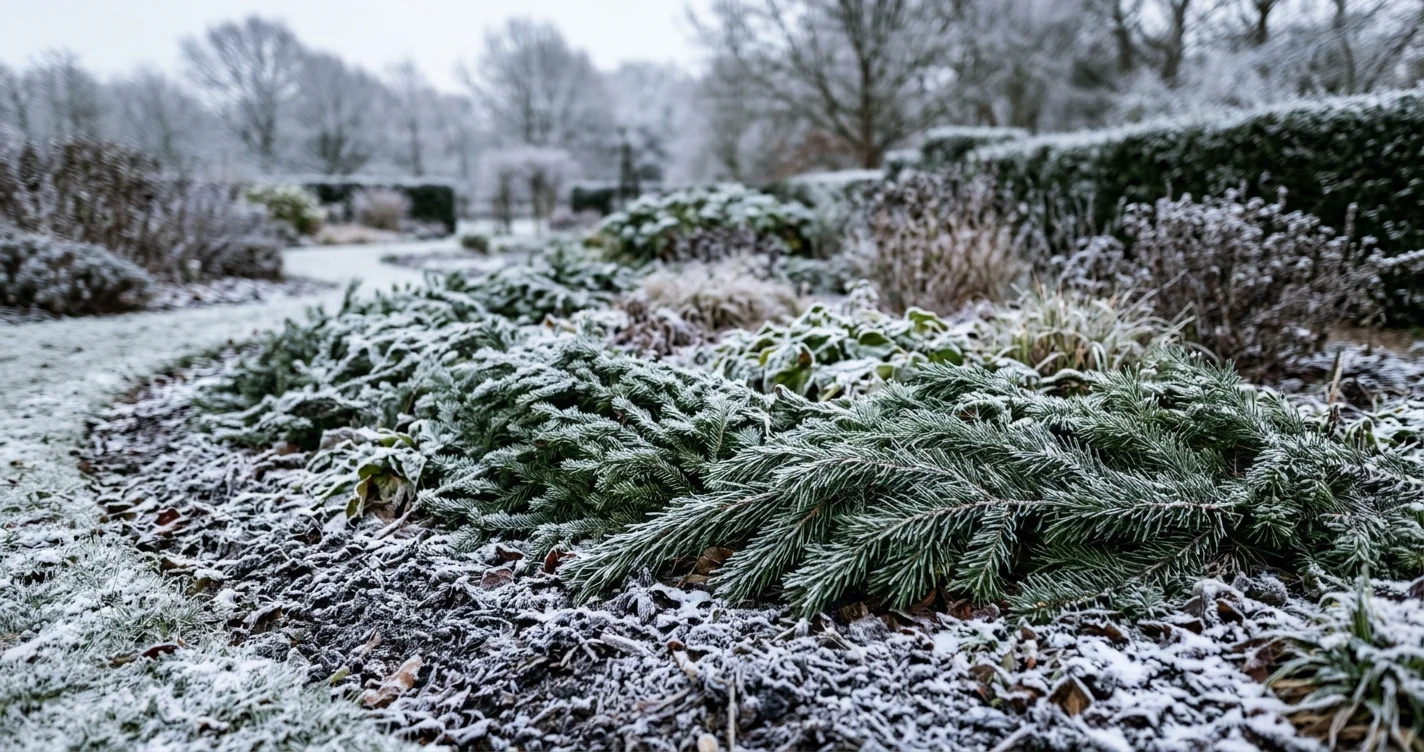
A handful of evergreen branches laid across a sleeping flower bed might look like leftover holiday decorations. But beneath those green needles, something important may be happening.
While the garden aboveground is exposed to freezing winds, winter sunshine, and sudden temperature changes, the soil below is home to living roots and dormant perennial crowns.
A simple layer of evergreen branches can help protect those plants from some of winter’s most damaging conditions.
Using winter mulch evergreen boughs is a traditional gardening technique that can reduce temperature fluctuations, trap insulating snow, and protect vulnerable perennials without creating a heavy, compacted covering.
The surprising part is that winter mulch isn’t primarily intended to keep the soil warm. Its greatest value often comes from keeping soil temperatures more stable.
With the right timing and placement, evergreen boughs can help your garden move safely through winter and return to growth in spring.
Table of Contents
- Why Perennials Need Winter Protection
- What Are Evergreen Boughs?
- When to Apply Winter Mulch
- How Winter Mulch Evergreen Boughs Protect Perennials
- How to Mulch Perennials With Evergreen Boughs
- Which Perennials Benefit Most?
- Common Winter Mulching Mistakes
- Evergreen Boughs vs. Other Winter Mulches
- When to Remove Evergreen Boughs in Spring
- In Your Own Yard: A Practical Winter Mulching Routine
- Frequently Asked Questions
Why Perennials Need Winter Protection
Perennials are plants that survive for multiple growing seasons, often dying back aboveground while their roots and crowns remain alive.
Many hardy perennials are naturally adapted to freezing temperatures. However, winter survival depends on more than the lowest temperature recorded.
Sudden warming, repeated freezing and thawing, drying winds, and insufficient snow cover can all create problems.
The Hidden Danger of Freeze-Thaw Cycles
During winter, the upper soil layers may freeze, thaw, and freeze again.
These changes can cause soil movement known as frost heaving.
When the soil expands and contracts, shallow-rooted plants may be pushed upward, exposing their crowns and roots to cold air.
Newly planted perennials are often especially vulnerable because their root systems may not yet be firmly established.
A protective mulch layer can help moderate the temperature changes that contribute to this movement.
Why Snow Can Be Helpful
Although snow looks cold, it can act as insulation.
A consistent snow layer reduces the exposure of soil to rapid changes in air temperature.
Problems may arise when snow cover is thin or intermittent.
In these situations, evergreen branches can help trap drifting snow and provide additional protection near the soil surface.
Not Every Perennial Needs Mulch
Many established, cold-hardy perennials survive winter without additional covering.
Plants growing in well-drained soil and climates suited to their hardiness are often naturally resilient.
Winter mulching is most useful when a plant is newly established, marginally hardy, shallow-rooted, or exposed to challenging winter conditions.
What Are Evergreen Boughs?
Evergreen boughs are cut branches from needle-bearing trees and shrubs that retain their foliage through winter.
Common examples include spruce, pine, and fir branches.
They are often available after seasonal pruning or from discarded natural Christmas trees.
Unlike dense layers of wet leaves, evergreen branches form a loose, airy covering.
Why Gardeners Use Evergreen Branches
Evergreen boughs have several useful characteristics.
Their needles and branching structure create small pockets of air near the ground.
They can help shade the soil from direct winter sunshine and reduce the effects of drying winds.
They may also hold snow in place rather than allowing it to blow away.
Because the branches remain relatively open, they are less likely to form a compacted, waterlogged mat than some other organic materials.
Choosing Suitable Branches
Healthy branches from spruce, fir, or pine are often appropriate.
Avoid branches showing obvious disease symptoms or significant pest infestations.
Use material from trees that have not been treated with artificial snow, glitter, paint, or other decorative coatings.
If recycling a Christmas tree, remove all ornaments, tinsel, wires, and lights before cutting the branches.
Avoid collecting branches from protected natural areas or removing material from trees without permission.
When to Apply Winter Mulch
Timing is one of the most important factors in successful winter mulching.
Applying mulch too early can interfere with the natural cooling and dormancy process.
Waiting until the ground has begun to freeze is often more effective in cold-winter regions.
Wait Until the Soil Is Cold
For many northern U.S. gardens, the recommended time to apply protective winter mulch is after the ground has frozen or after several hard freezes.
This often occurs in late fall or early winter, depending on the region.
The goal is to keep the soil cold and relatively stable rather than insulating warm soil before plants have entered dormancy.
Why Early Mulching Can Cause Problems
A thick protective layer applied while the soil is still warm may delay cooling.
In some situations, this can interfere with dormancy or create conditions favorable to unwanted moisture accumulation.
Early mulch can also provide shelter for rodents near susceptible plants.
Waiting until consistently cold conditions arrive helps reduce these concerns.
Adjust Timing to Your Climate
In northern states with prolonged freezing winters, late November or December may be appropriate.
In milder regions, the ground may rarely freeze deeply enough to require traditional winter protection.
Gardeners should use local weather and soil conditions rather than a fixed calendar date.
Local Cooperative Extension recommendations can help determine appropriate timing.
How Winter Mulch Evergreen Boughs Protect Perennials
Evergreen boughs work differently from a thick blanket of compost or shredded bark.
Their protective value comes from their open structure and the way they interact with air, sunlight, snow, and the soil surface.
1. Reducing Soil Temperature Fluctuations
Bare soil absorbs solar energy during sunny winter days and loses heat when temperatures fall.
These changes can contribute to repeated thawing and freezing near the surface.
A loose covering of evergreen branches shades portions of the soil and reduces direct exposure.
This can help moderate temperature swings around dormant plant crowns.
The branches do not generate heat. Instead, they influence how quickly the soil gains and loses it.
2. Helping Prevent Frost Heaving
Frost heaving occurs when freezing conditions cause soil movement that can lift plants from the ground.
Repeated freeze-thaw cycles can increase the risk.
By helping stabilize near-surface temperatures, winter mulch may reduce the frequency or severity of these changes.
This is particularly valuable for newly planted perennials and plants with shallow root systems.
However, mulch cannot correct severe drainage problems or guarantee protection against all frost heaving.
3. Trapping an Insulating Layer of Snow
Evergreen branches create a network of twigs and needles above the soil.
When snow falls, this structure can help hold some of it in place.
Snow trapped among the branches adds insulation.
This effect can be especially useful in windy gardens where snow otherwise blows away from exposed beds.
The amount of protection depends on snowfall, wind exposure, branch arrangement, and local conditions.
4. Reducing Winter Sun and Wind Exposure
Some evergreen or semi-evergreen perennials retain foliage through winter.
These leaves may lose moisture during sunny, windy weather, even when frozen soil limits water uptake.
Evergreen boughs can provide partial shade and reduce direct wind exposure.
This may help protect vulnerable foliage from winter drying.
However, the covering should remain loose enough to avoid crushing the plants.
5. Allowing Air to Move Around Plant Crowns
A major advantage of evergreen branches is their relatively open structure.
Dense, wet mulch pressed directly against a plant crown can encourage moisture-related problems in susceptible species.
Boughs create a more breathable covering when arranged loosely.
Airflow does not eliminate the risk of decay, but it can make evergreen branches useful for plants that dislike heavy winter coverings.
How to Mulch Perennials With Evergreen Boughs
The process is simple, but careful placement makes a difference.
Step 1: Prepare the Flower Bed
Wait until plants have entered dormancy and the soil has cooled sufficiently.
Remove obviously diseased plant material and debris that could contribute to disease problems.
Healthy standing stems and seed heads can often remain in place, providing winter habitat and food for wildlife.
Avoid unnecessary disturbance of dormant crowns.
Step 2: Gather Clean Evergreen Branches
Choose flexible, healthy branches from suitable evergreen trees.
Shorter pieces are often easier to arrange around individual plants.
Branches from a natural Christmas tree can be useful after the holiday season, provided they are free from decorations and chemical coatings.
Step 3: Lay Branches Loosely Over the Plants
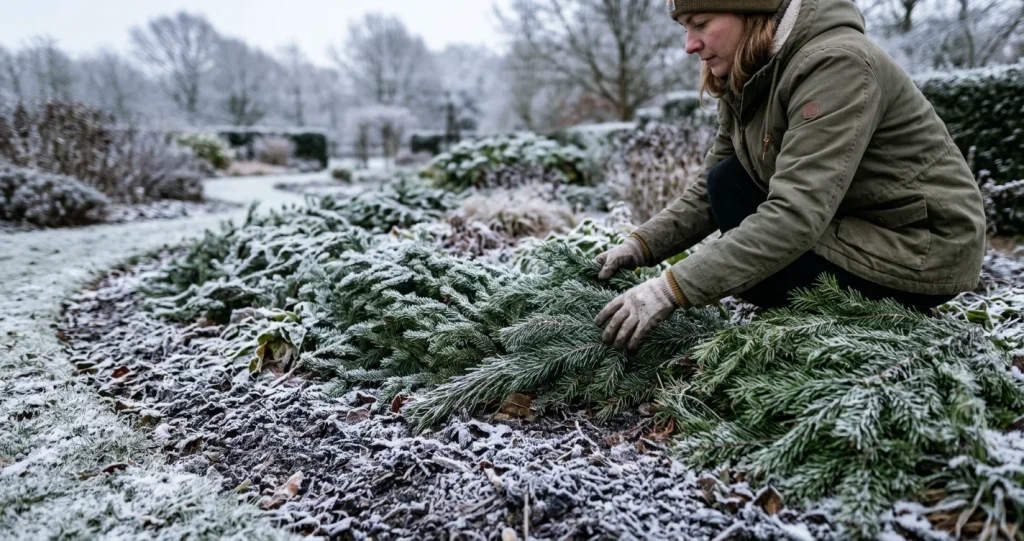
Place the boughs across the soil and dormant perennial crowns.
Allow the branching structure to create an airy covering rather than pressing everything flat.
For low-growing plants, a light overlapping arrangement is usually preferable to a heavy pile.
The goal is to reduce exposure, not bury the plant under a dense mass of vegetation.
Step 4: Secure Branches if Necessary
In windy locations, branches may shift.
Larger boughs can sometimes be arranged so their stems overlap and help hold one another in place.
Small garden staples may be useful when necessary, provided they do not damage plant crowns or underground structures.
Avoid heavy objects that could compact the soil or crush dormant plants.
Step 5: Leave the Covering in Place Through Winter
Once installed, evergreen boughs generally require little maintenance.
Check occasionally after severe winds or storms.
If branches become displaced, reposition them carefully.
Avoid repeatedly lifting and disturbing the covering during freezing weather.
Which Perennials Benefit Most?
Not every perennial responds to winter mulch in the same way.
The greatest benefits are often seen in plants vulnerable to frost heaving or exposed winter conditions.
Newly Planted Perennials
Perennials installed in late summer or fall may not have fully developed root systems before winter.
These plants can be more susceptible to soil movement.
A loose evergreen covering may help stabilize conditions around their crowns.
Coral Bells
Coral bells (Heuchera) have relatively shallow root systems and crowns that can be affected by frost heaving.
Winter protection may be useful in cold regions, particularly for recently planted specimens.
Good drainage remains essential.
Strawberries
Although strawberries are commonly protected with clean straw, evergreen branches may sometimes provide supplementary protection in small garden beds.
Strawberry crowns can be vulnerable to winter injury, especially when snow cover is unreliable.
For productive strawberry plantings, follow region-specific recommendations for mulch materials and timing.
Lavender and Other Drainage-Sensitive Plants
Lavender generally prefers well-drained soil and may suffer when its crown remains excessively wet.
In some cold climates, loose evergreen branches can provide winter shading or wind protection without the same degree of contact as dense organic mulch.
However, lavender’s winter survival depends heavily on species, cultivar, drainage, and local climate.
Mulching should not trap moisture against the crown.
Marginally Hardy Perennials
Some plants are grown near the colder edge of their recommended hardiness range.
Evergreen boughs may offer modest protection from exposure and temperature fluctuations.
They cannot reliably make a plant hardy in a climate far colder than it can tolerate.
Common Winter Mulching Mistakes
Even a useful technique can cause problems when applied incorrectly.
Mulching Before the Ground Cools
Applying winter protection too early may keep the soil warmer than intended.
Wait until plants are dormant and freezing conditions have begun in regions where traditional winter mulching is appropriate.
Using Too Many Branches
A thick, tangled pile can crush delicate foliage and restrict airflow.
Use enough branches to provide light coverage without creating a dense barrier.
Covering Diseased Plant Material
Branches collected from visibly diseased trees may introduce unwanted problems into the garden.
Choose clean material and avoid transferring suspected pests or pathogens.
Ignoring Drainage
Winter mulch cannot compensate for consistently waterlogged soil.
Plants susceptible to crown rot may still suffer if their roots remain saturated.
Improving drainage is often more important than increasing the amount of mulch.
Forgetting Spring Removal
Leaving heavy winter coverings in place after growth begins can shade emerging shoots and interfere with development.
Monitor spring conditions and remove or reposition branches at the appropriate time.
Evergreen Boughs vs. Other Winter Mulches
Different materials provide different benefits.
| Material | Main advantage | Main consideration |
|---|---|---|
| Evergreen boughs | Loose covering that can trap snow and provide shade | May shift in strong winds |
| Clean straw | Effective insulation for certain garden crops | Can blow away or harbor rodents |
| Shredded leaves | Readily available organic material | Thick wet layers may mat together |
| Pine needles | Light, breathable organic covering | May need replenishment |
| Wood chips | Useful for long-term soil surface protection | Keep away from sensitive crowns |
Evergreen boughs are especially appealing when gardeners want a temporary winter covering that can be removed easily in spring.
They also offer a practical way to reuse clean evergreen pruning material.
When to Remove Evergreen Boughs in Spring
Winter protection should not remain in place indefinitely.
As temperatures moderate and perennial growth resumes, the covering may no longer be necessary.
Watch for New Growth
Begin checking the garden as the soil thaws.
When the risk of severe repeated freezing decreases and new shoots begin emerging, gradually remove or reposition the branches.
The ideal timing varies by region and plant species.
Remove Branches Carefully
Lift branches gently to avoid damaging tender shoots.
If new growth has already emerged through the covering, separate the branches rather than pulling them forcefully.
Remove material during suitable weather when plants are less likely to experience sudden exposure to severe cold.
Reuse the Branches
Clean evergreen boughs can sometimes be chipped or composted where local conditions and composting practices permit.
They may also be used in brush piles that provide shelter for wildlife.
Avoid moving material suspected of carrying serious pests or diseases into other parts of the garden.
In Your Own Yard: A Practical Winter Mulching Routine
Start by identifying the perennial beds most likely to benefit from winter protection.
Newly planted coral bells, shallow-rooted perennials, and plants exposed to strong winter winds may deserve special attention.
As autumn progresses, allow the plants to enter dormancy naturally.
Monitor soil temperatures and local forecasts.
Once the ground begins freezing consistently, gather clean spruce, pine, or fir branches.
Arrange them loosely over vulnerable plants, leaving enough space for air movement.
Avoid covering wet or diseased foliage with dense layers of material.
If snow arrives, allow it to settle naturally among the branches.
During winter, check occasionally for displaced boughs after strong winds.
When spring approaches, watch for thawing soil and emerging growth.
Remove the covering gradually when conditions are suitable.
This routine requires little equipment and can often be completed using materials already available in the garden.
It also encourages a thoughtful approach to winter care: protect vulnerable plants without unnecessarily disturbing the rest of the landscape.
Frequently Asked Questions
1. Can I use branches from my Christmas tree as winter mulch?
Yes, natural Christmas tree branches can often be reused as winter protection for perennial beds.
Remove all decorations, wires, and artificial materials first.
Avoid flocked, painted, or otherwise chemically treated trees.
Choose clean branches and arrange them loosely over dormant plants.
2. Should evergreen boughs touch the perennial crowns?
Light contact is generally acceptable for many dormant, cold-hardy perennials.
However, avoid pressing heavy branches tightly against sensitive crowns or evergreen foliage.
The goal is an airy protective covering rather than a dense, moisture-trapping pile.
3. Do evergreen boughs keep perennial roots from freezing?
Not necessarily.
In cold climates, perennial roots and surrounding soil may still freeze.
The main purpose of winter mulch is often to moderate temperature fluctuations, reduce frost heaving, and help maintain protective snow cover.
A stable frozen soil environment can be less damaging than repeated freezing and thawing.
Conclusion
A few evergreen branches may seem like a simple addition to a winter garden, but their protective value comes from several important effects.
They can help moderate soil temperature changes, reduce exposure to drying winds, trap insulating snow, and limit some of the conditions associated with frost heaving.
Using winter mulch evergreen boughs is especially useful for certain newly planted, shallow-rooted, or marginally hardy perennials in cold-winter regions.
The most important details are timing, placement, and restraint. Apply the covering after the soil has cooled, keep the branches loose, and remove them as spring growth returns.
The next time you see a pile of evergreen branches after seasonal pruning or the holidays, consider what they could do for a vulnerable flower bed.
What looks like discarded greenery may become a practical layer of protection for the garden waiting beneath winter’s surface.
Internal Sources
How the Mulch You Choose Changes Your Soil Beneath the Surface
Connect winter mulching with the broader effects of different mulch materials on soil conditions. This provides readers with additional information about choosing suitable mulch for their gardens. Secrets of the Green Garden
External Sources
1. Mulch Perennials and Bulbs After the Soil Freezes
Explain why winter mulch should be applied after the soil begins freezing, how mulch reduces freeze-thaw fluctuations, and why early application may interfere with plant dormancy. University of Minnesota Extension
2. How Should I Prepare My Perennial Beds for Winter?
Explain frost heaving, identify vulnerable perennials, and support recommendations for applying protective mulch after the ground freezes and removing excess covering in early spring. Iowa State University Extension and Outreach