
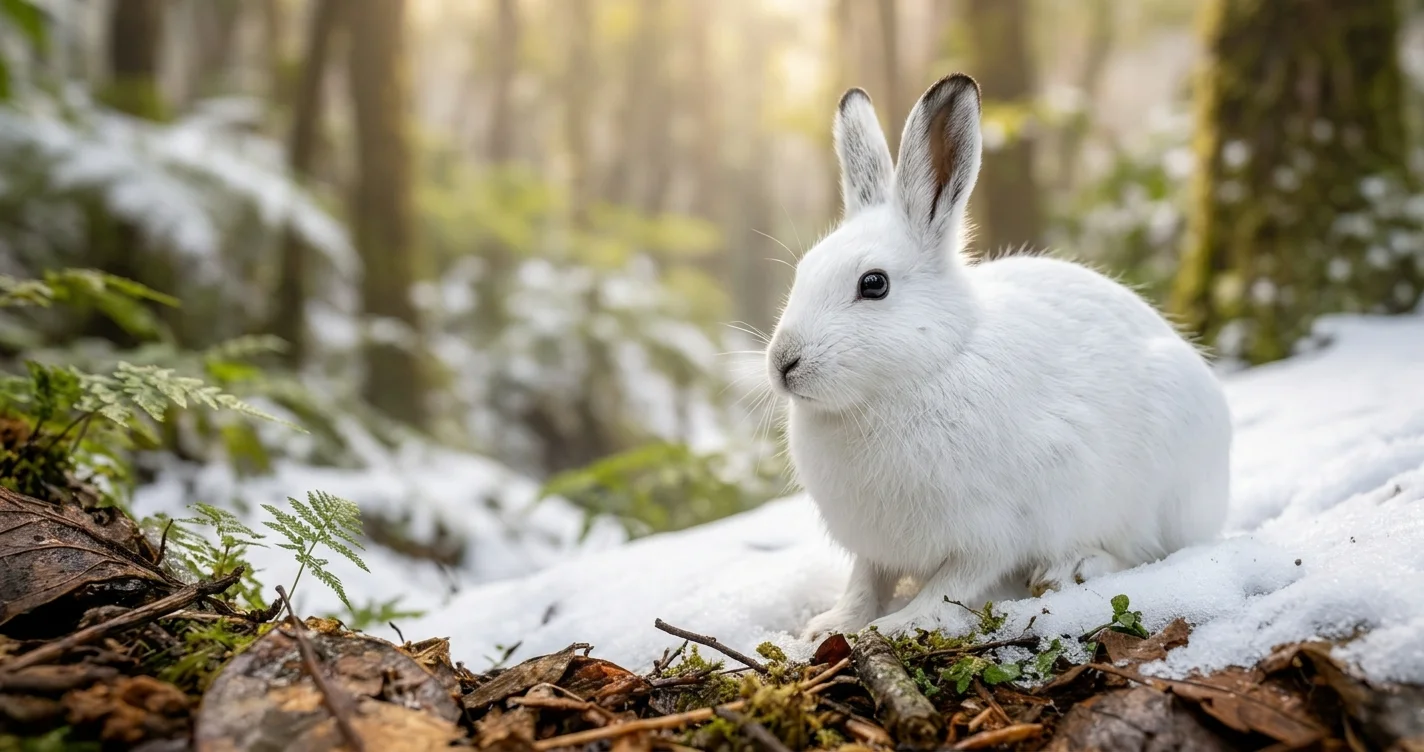
Imagine a white animal standing almost upright in the middle of a frozen Arctic landscape. Its long ears point toward the horizon, its powerful hind legs are ready to move, and its thick fur blends into the surrounding snow.
Suddenly, it begins moving across the tundra with surprisingly tall, energetic hops.
This is the Arctic hare, one of the most remarkable mammals living in Earth’s cold northern regions.
While many animals avoid the harshest winter conditions by migrating or entering periods of dormancy, Arctic hares remain active throughout the year.
Their survival depends on a remarkable combination of adaptations: dense insulating fur, powerful hind legs, compact ears, specialized feet, and behaviors that help them conserve energy.
Some Arctic hares can even move in an unusually upright posture, making their movements look almost like those of a small kangaroo.
But their most impressive ability is not simply hopping through snow. It is surviving in an environment where food is scarce, temperatures can become dangerously low, and predators are constantly searching for their next meal.
Table of Contents
- What Is an Arctic Hare?
- Why Arctic Hares Have White Winter Coats
- How Arctic Hares Survive Extreme Winter Conditions
- Why Arctic Hares Sometimes Hop Upright
- What Arctic Hares Eat in Winter
- Arctic Hare Predators and Defense Strategies
- Arctic Hare Social Behavior and Reproduction
- How Climate Change May Affect Arctic Hares
- In Your Own Yard: Helping Wildlife Survive Winter
- Frequently Asked Questions
What Is an Arctic Hare?
The Arctic hare (Lepus arcticus) is a large hare adapted to life in northern environments.
It belongs to the family Leporidae, which includes rabbits and other hares.
Arctic hares are especially associated with the tundra, rocky landscapes, and open northern habitats where winters are long and vegetation can be sparse.
Unlike animals that rely on deep burrows for protection, Arctic hares often remain aboveground, using natural terrain and their insulating coats to withstand cold conditions.
Where Arctic Hares Live
Arctic hares inhabit parts of northern Canada, the Canadian Arctic Archipelago, and Greenland.
Their distribution varies with geography, climate, vegetation, and available habitat.
They are particularly well suited to open tundra environments, where trees are scarce and strong winds can sweep across the landscape.
These habitats may appear empty, but they support specialized communities of mammals, birds, and plants.
Arctic Hares vs. Rabbits
Although Arctic hares resemble rabbits, they are not the same animals.
Hares generally have longer legs and are adapted for rapid movement across open ground.
Their young, called leverets, are usually born with fur and open eyes.
Rabbit young, by comparison, are commonly born less developed and depend more heavily on sheltered nests.
Arctic hares also tend to rely on their powerful hind legs and camouflage rather than escaping into extensive underground burrow systems.
Why Arctic Hares Have White Winter Coats
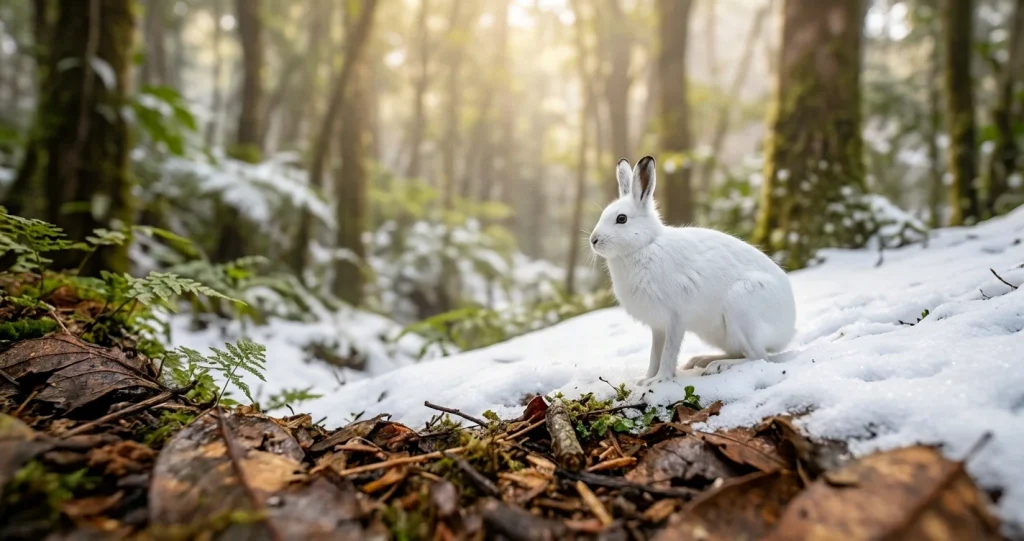
The Arctic hare’s white fur is one of its most recognizable features.
Against a snowy landscape, the coat can make the animal surprisingly difficult to see.
However, camouflage is only one part of the story.
Camouflage in Snow
A white coat reduces visual contrast between the hare and its surroundings.
This may make it harder for predators to detect a resting animal, especially when it remains motionless.
The effectiveness of camouflage depends on lighting, snow conditions, background color, and the predator’s visual abilities.
White fur does not make a hare invisible, but it can provide an important advantage in snowy environments.
Seasonal Color Changes
Not every Arctic hare has an identical coat throughout the year.
In some southern parts of the species’ range, individuals develop darker summer coats that better match exposed rocks and vegetation.
In more northern populations, the coat may remain predominantly white year-round.
These differences reflect adaptation to local environmental conditions.
Seasonal changes in daylight help regulate coat changes in many northern mammals, although the exact processes vary among species.
The Arctic hare’s appearance is therefore closely connected to the environment in which it lives.
How Arctic Hares Survive Extreme Winter Conditions
Arctic winters create serious challenges for warm-blooded animals.
Cold temperatures increase the energy required to maintain body heat, while snow and ice can make food difficult to reach.
Arctic hares survive through a combination of physical adaptations and behavior.
Thick Fur and Natural Insulation
The Arctic hare has a dense coat that helps reduce heat loss.
Its fur traps air close to the body, creating an insulating layer between the animal and the surrounding environment.
The coat is especially important when temperatures fall and strong winds increase exposure.
Fur also covers much of the feet, helping protect them from contact with frozen surfaces.
Insulation does not eliminate the need for food, but it helps reduce the energy required to remain warm.
Compact Ears and Heat Conservation
Compared with many hares living in warmer environments, Arctic hares have relatively short ears.
This is an example of how body proportions can influence heat exchange.
Large ears provide more exposed surface area through which heat can escape.
Shorter ears can help limit that exposure.
The relationship between body shape and climate is often discussed in connection with Allen’s rule, an ecological principle describing patterns in appendage size among some warm-blooded animals.
However, actual heat loss depends on several factors, including blood circulation, fur coverage, wind, and temperature.
Powerful Feet for Snow and Ice
Arctic hares have strong hind legs and broad, fur-covered feet.
These features help them move across uneven, snowy terrain.
The feet provide traction and can distribute body weight across soft surfaces.
They are not identical to snowshoes, but their structure can help reduce some of the difficulties associated with traveling over snow.
Their powerful legs also allow rapid acceleration when danger appears.
Energy-Saving Behavior
Surviving winter requires more than insulation.
Animals must balance energy expenditure with the calories they obtain from food.
Arctic hares often rest in sheltered locations and may use natural depressions or areas protected from strong winds.
They can also reduce unnecessary movement when conditions are especially demanding.
In some regions and seasons, Arctic hares gather in groups.
Group living may influence vigilance and predator detection, although its benefits depend on the circumstances.
Their survival strategy combines staying warm, finding food, and avoiding danger.
Why Arctic Hares Sometimes Hop Upright
One of the most visually surprising Arctic hare behaviors is their ability to move with the body held unusually upright.
In photographs or short videos, this movement can resemble the hopping of a miniature kangaroo.
However, it is important to distinguish an occasional upright posture from the animal’s normal locomotion.
The Unusual Upright Posture
Arctic hares usually move using the hopping and bounding patterns typical of hares.
Their hind legs provide much of the propulsion, while their forelegs help support the body during movement.
At times, an Arctic hare may rise onto its hind legs or make short movements while holding its front body relatively high.
This posture can be especially noticeable when the animal is alert or moving through uneven terrain.
It does not mean Arctic hares routinely travel long distances using the same locomotion as kangaroos.
Powerful Hind Legs
The hind legs of Arctic hares are built for strong, rapid movement.
Large muscles provide propulsion, while the long hind limbs help generate powerful bounds.
This is particularly useful in open habitats where reaching cover may be difficult.
A hare that detects danger can quickly accelerate and change direction.
Its body is adapted for movement across exposed landscapes rather than climbing or digging elaborate tunnels.
Does Upright Hopping Help Them Escape?
The Arctic hare’s powerful hopping ability is clearly important for escaping predators.
However, the specific survival advantage of unusually upright hopping has not been firmly established.
Some upright movements may be associated with vigilance, balance, or changes in speed and direction.
Without controlled behavioral research, it would be misleading to claim that this posture evolved specifically to confuse predators.
The most defensible explanation is that Arctic hares possess flexible movement patterns supported by strong hind legs.
Their unusual upright appearance is one fascinating expression of that mobility.
What Arctic Hares Eat in Winter
Finding food is one of the greatest challenges of Arctic life.
During the growing season, Arctic hares can feed on available grasses, herbs, leaves, and other plant material.
Winter brings a different situation.
Snow covers much of the vegetation, and many plants stop producing new growth.
Woody Plants and Twigs
Arctic hares are herbivores.
Depending on habitat and season, they may eat woody plants, buds, twigs, bark, and other available vegetation.
Willows are important food plants in many Arctic environments.
The exact diet varies according to local plant communities.
In some locations, the available winter diet may be relatively limited.
The ability to consume tough plant material helps Arctic hares survive when fresh green vegetation is unavailable.
Finding Food Beneath Snow
Arctic hares may dig or scrape through snow to reach vegetation.
They can also feed on exposed twigs and plant parts that extend above the snow surface.
Wind can create patches where snow is thinner or where vegetation becomes accessible.
These locations may offer valuable feeding opportunities.
Food availability changes with snowfall, temperature, and local habitat conditions.
A winter that appears uniformly white to a human observer may contain many small differences that matter to a foraging hare.
Arctic Hare Predators and Defense Strategies
Despite their impressive adaptations, Arctic hares face several natural predators.
These may include Arctic foxes, wolves, and large birds of prey, depending on location.
Predation pressure varies among regions and seasons.
Camouflage as a First Defense
A resting hare may remain still when a predator is nearby.
Its coat can make it difficult to distinguish from snow or pale ground.
This strategy is most useful when the animal has not yet been detected.
Speed as a Second Defense
When concealment fails, Arctic hares can rely on powerful running and bounding movements.
Their long hind legs help them accelerate across open ground.
They may also change direction rapidly.
Escape success depends on the predator, terrain, snow conditions, and distance between the animals.
Staying Alert
Arctic hares have well-developed senses that help them detect potential threats.
Their ears can respond to surrounding sounds, while their eyes provide a broad field of view.
In groups, individuals may benefit from the presence of other alert animals.
However, group living can also make animals more conspicuous.
The balance between these effects depends on environmental conditions.
Arctic Hare Social Behavior and Reproduction
Arctic hares are sometimes described as solitary animals, but their social behavior is more varied.
They may occur alone or in groups, depending on season, location, and population conditions.
Why Arctic Hares Gather
In some areas, Arctic hares form groups that may include numerous individuals.
Grouping can affect how animals locate food and respond to predators.
The reasons for aggregation are not always straightforward.
Food distribution, seasonal conditions, and reproductive behavior may all play roles.
Breeding and Young Hares
Arctic hares generally breed during the warmer part of the year.
Females give birth to leverets that are already covered in fur and have open eyes.
This advanced development helps young hares function in exposed environments.
However, leverets remain vulnerable to predators and harsh weather.
Their survival depends on maternal care, suitable shelter, and access to food as they grow.
How Climate Change May Affect Arctic Hares
The Arctic is experiencing substantial environmental change.
Rising temperatures, changing snow conditions, and shifts in vegetation can influence wildlife habitats.
For Arctic hares, potential effects are complex.
Changes in Snow Cover
Snow provides both camouflage and access challenges.
When white-coated animals occupy snow-free landscapes, they may become more visible to predators.
The importance of this mismatch depends on local coat-color patterns and the timing of seasonal snow cover.
Researchers have studied similar concerns in several seasonally white mammals.
However, the consequences for Arctic hares should not be assumed to match those of every other species.
Changes in Vegetation
Warming can alter the distribution and growth of Arctic plants.
Some areas may experience increased shrub growth, while others face changes associated with moisture, snow, or disturbance.
These shifts could affect food availability and habitat structure.
The outcomes may differ across the Arctic hare’s range.
A Changing Ecosystem
Arctic hares are connected to broader food webs.
Changes affecting predators, vegetation, or snow conditions can influence their survival.
Understanding these relationships requires long-term monitoring and region-specific research.
The Arctic hare’s adaptations are impressive, but they evolved under environmental conditions that are now changing.
In Your Own Yard: Helping Wildlife Survive Winter
Most American homeowners will never see an Arctic hare outside a wildlife documentary or a visit to northern Canada or Greenland.
However, the same basic challenges of winter survival affect many familiar backyard animals.
Rabbits, squirrels, birds, and other wildlife must find food, shelter, and protection from cold weather.
A thoughtful garden can help provide some of these resources.
Provide Natural Shelter
Native shrubs, evergreen plants, and other vegetation can create sheltered spaces.
Dense branches may reduce exposure to wind and provide hiding places.
Leaving suitable natural cover in less frequently used parts of the yard can benefit wildlife.
Avoid creating habitat features that attract animals into unsafe areas near roads or heavy traffic.
Protect Native Vegetation
Native plants support local food webs.
Their seeds, fruits, leaves, and structures may provide resources for birds, insects, and mammals.
Where appropriate, maintaining a mixture of plant heights and growth forms can improve habitat diversity.
Avoid removing every fallen leaf or dead plant stem when these materials can safely remain.
Avoid Unnecessary Disturbance
Wild animals may conserve energy by resting in sheltered locations.
Repeated disturbance can force them to move unnecessarily.
Observe animals from a respectful distance.
Avoid approaching resting wildlife for photographs.
Do not attempt to handle or relocate animals without appropriate professional guidance.
Observe Wildlife Responsibly
Winter is an excellent time to notice animal tracks and movement patterns.
Look for rabbit tracks, squirrel footprints, or bird activity after fresh snowfall.
Tracks can reveal how animals move between feeding areas and shelter.
Watching these patterns can deepen your appreciation of the survival strategies used by wildlife in your own neighborhood.
Frequently Asked Questions
1. Why do Arctic hares have white fur?
White fur provides camouflage in snowy environments and may make Arctic hares harder for predators to detect.
Their dense coats also provide insulation against cold weather.
Some populations develop darker coats during warmer months, while others remain mostly white throughout the year.
2. Do Arctic hares really hop like kangaroos?
Arctic hares have powerful hind legs and can sometimes move with an unusually upright posture.
However, their normal movement is hopping and bounding on all four limbs.
They are not specialized for sustained kangaroo-style locomotion.
3. How do Arctic hares survive without hibernating?
Arctic hares remain active throughout winter.
They rely on thick insulating fur, relatively compact ears, powerful feet, sheltered resting locations, and the ability to eat available winter vegetation.
Their behavior helps balance energy use with the challenge of finding food.
Conclusion
A white animal standing upright in a snowy landscape may look delicate, but the Arctic hare is remarkably well equipped for life in the far north.
Its dense coat helps retain warmth. Its powerful legs support rapid movement. Its winter camouflage can make it difficult to detect.
And its occasional upright hopping reminds us that familiar animals can display surprisingly unusual behavior.
Arctic hares demonstrate how physical adaptations and behavior work together in demanding environments.
The next time you see one bounding across a frozen landscape, remember that every movement is part of a remarkable story of survival.
External Sources
1. Canadian Geographic — Animal Facts: Arctic Hare
Support information about upright hopping, powerful hind legs, white winter coats, camouflage, and survival in freezing temperatures. Read the source — Canadian Geographic
2. National Geographic — Arctic Hare
Explain how Arctic hares survive extreme cold through thick fur, shortened ears, and behavioral adaptations. Read the source — National Geographic
3. Animal Diversity Web — Lepus arcticus
Provide scientific information about Arctic hare classification, geographic distribution, habitat, seasonal coat changes, diet, reproduction, and predators. Read the source — University of Michigan
4. Gray (1993) — Behavioural Adaptations to Arctic Winter: Shelter Seeking by Arctic Hare
Support the winter-survival section with peer-reviewed research on resting posture, shelter use, wind exposure, and thermoregulation. Read the scientific study — ARCTIC Journal