
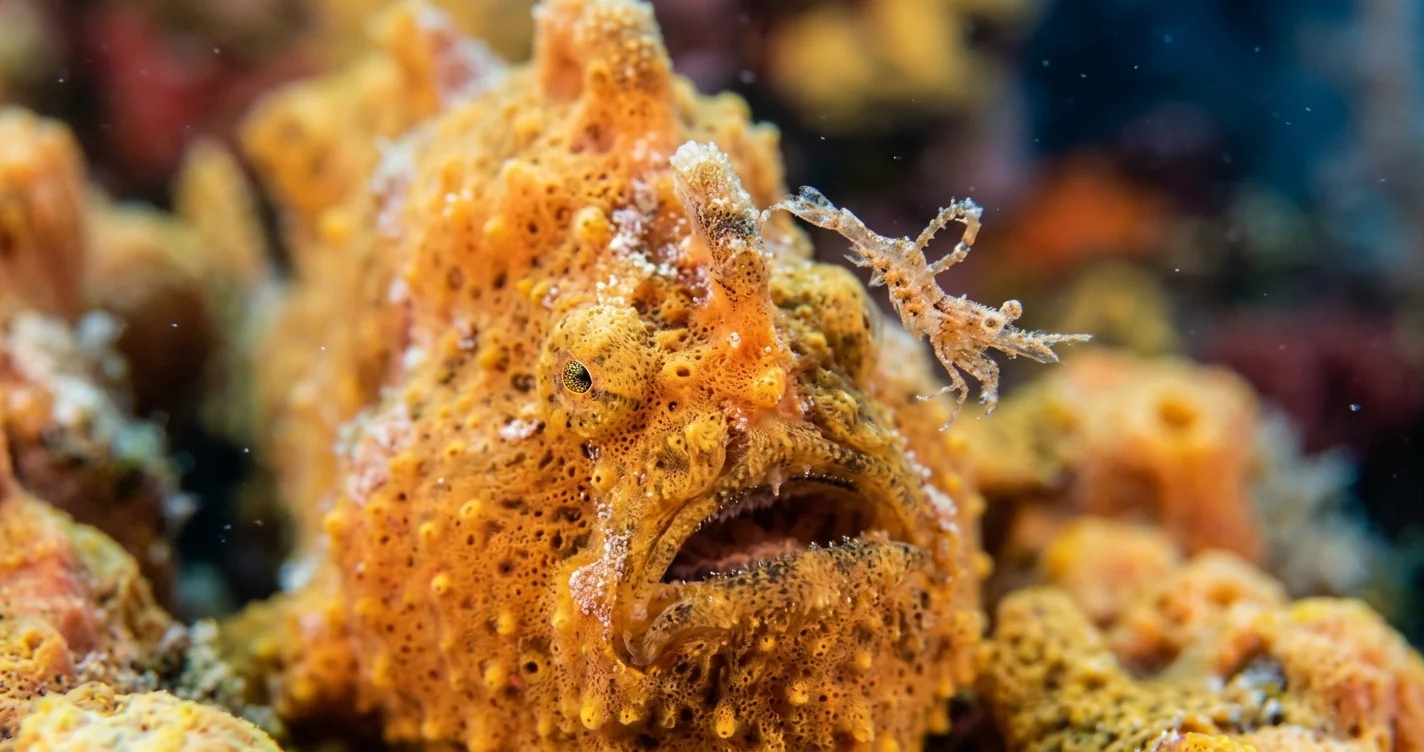
Imagine watching a colorful coral reef when a small piece of sponge suddenly opens its mouth and swallows a passing fish. What looked like an ordinary part of the underwater landscape was actually a predator waiting for its next meal.
Meet the frogfish, one of the ocean’s most unusual hunters.
These remarkable fish can resemble sponges, algae-covered rocks, or patches of coral. Some have bright orange, yellow, or pink bodies, while others blend into brown, green, or nearly black surroundings.
Their greatest advantage is not speed or strength. It is the ability to remain almost invisible until prey comes close enough to capture.
Even more surprisingly, many frogfish carry a specialized fishing lure on their heads.
By combining camouflage, patience, and an extraordinarily fast feeding mechanism, these marine predators have developed a hunting strategy unlike that of most familiar fish.
Table of Contents
- What Is a Frogfish?
- Masters of Underwater Camouflage
- How Frogfish Hunt With a Built-In Fishing Rod
- Frogfish Can Walk Along the Seafloor
- Where Do Frogfish Live?
- Are Frogfish Dangerous to Humans?
- Frogfish Reproduction and Their Life Cycle
- Why Frogfish Matter to Marine Ecosystems
- In Your Own Yard: Connecting Frogfish to Backyard Wildlife
- Frequently Asked Questions About Frogfish
What Is a Frogfish?
Frogfish are marine fish belonging to the family Antennariidae, a group within the anglerfish order Lophiiformes.
Unlike the deep-sea anglerfish commonly depicted with glowing lures, most frogfish inhabit relatively shallow tropical and subtropical marine environments.
They are found in different parts of the Atlantic, Indian, and Pacific oceans, depending on the species.
Many live around coral reefs, rocky bottoms, sponge gardens, and other habitats that provide opportunities for concealment.
Why Are They Called Frogfish?
Their name comes partly from their unusual appearance and movement.
Frogfish have rounded bodies, large mouths, and modified pectoral fins that can resemble small limbs.
Instead of swimming continuously like many other fish, they often rest on the seafloor or move slowly across surfaces.
Some appear to walk by pushing against the bottom with their fins.
Their movements can resemble the awkward steps of a tiny underwater frog.
However, frogfish are true fish. They breathe through gills and are not closely related to amphibians.
How Large Do Frogfish Grow?
Size varies considerably among species.
Some remain only a few inches long, while larger species can reach approximately a foot or more.
Their bodies are often short, rounded, and highly flexible.
A frogfish may appear much larger when it opens its enormous mouth to capture prey.
Despite their sometimes bulky appearance, these predators are capable of remarkably rapid feeding movements.
Masters of Underwater Camouflage
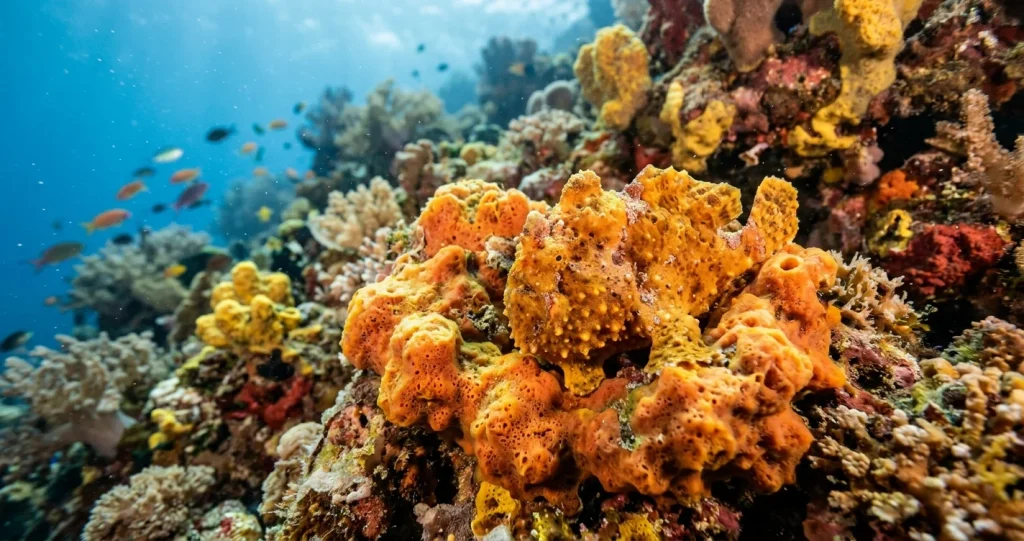
The most recognizable frogfish adaptation is its extraordinary camouflage.
In many species, body color, texture, and shape help the animal blend into its surroundings.
A yellow frogfish may resemble a brightly colored sponge. A brown individual may disappear against a rocky reef.
Some species have irregular skin projections that resemble algae, coral fragments, or other marine growth.
These features help disrupt the fish’s outline.
Camouflage Through Color
Frogfish occur in an impressive range of colors.
Depending on the species and individual, they may display shades of:
- Yellow and orange
- Red and pink
- Brown and tan
- Green and olive
- White and cream
- Dark gray or black
These colors are not simply decorative.
They can make a frogfish difficult for prey and potential predators to recognize against a complex underwater background.
Some frogfish can change coloration over time, although the speed and extent of these changes vary.
They do not all change color rapidly or perfectly match every surface.
Skin That Resembles the Reef
Color is only part of the disguise.
Many frogfish have textured skin with bumps, spots, or small projections.
These structures can make them resemble sponges, algae-covered rocks, or other stationary reef organisms.
A frogfish resting beside a sponge may be surprisingly difficult to distinguish from its surroundings.
The disguise becomes especially effective when the animal remains motionless.
For underwater photographers and divers, spotting one can feel like discovering a hidden creature in plain sight.
Why Remaining Still Matters
Many predators rely on movement to locate prey.
A motionless frogfish is less likely to attract attention from passing fish or crustaceans.
Instead of chasing prey across the reef, it often waits in a favorable position.
This strategy reduces unnecessary movement while allowing the predator to take advantage of nearby feeding opportunities.
Camouflage also provides protection from animals that might attack the frogfish itself.
How Frogfish Hunt With a Built-In Fishing Rod
The most fascinating part of frogfish biology is the specialized structure that gives these animals their reputation as underwater anglers.
Many species possess a modified dorsal-fin spine called an illicium.
At its tip is a lure known as an esca.
Together, these structures function like a miniature fishing rod and bait.
The Fishing Rod on Its Head
The illicium extends from the front of the frogfish’s head.
The esca at its tip may resemble a worm, small crustacean, or another potential food item.
The exact appearance differs among species.
A frogfish can move this structure in ways that attract the attention of nearby prey.
To a small fish searching for food, the moving lure may look like an easy meal.
The frogfish itself remains almost motionless.
Why the Lure Works
The lure exploits the feeding behavior of other marine animals.
Small fish and crustaceans often investigate objects that resemble familiar prey.
When an animal approaches the moving esca, it may unknowingly enter the frogfish’s striking range.
The predator does not need to pursue it over a long distance.
Instead, it brings the potential meal close enough for a sudden attack.
This is an example of aggressive mimicry: a predator uses a deceptive signal or appearance to attract prey.
Not every frogfish species uses its lure in exactly the same way, and hunting behavior can vary with habitat and available prey.
An Exceptionally Fast Mouth
Once prey is within reach, the frogfish uses a powerful suction-feeding mechanism.
Its mouth opens rapidly while the oral cavity expands.
This creates water movement that helps draw nearby prey into the mouth.
The entire capture can happen in a fraction of a second.
Frogfish can swallow relatively large prey because their mouths and stomachs are highly expandable.
Their diet commonly includes small fish and crustaceans.
Some frogfish may also consume other frogfish when the opportunity arises.
This combination of deception and rapid suction feeding makes them effective ambush predators.
Why Frogfish Rarely Need to Chase Prey
A frogfish’s body is not designed for sustained, high-speed pursuit.
Its hunting strategy depends on selecting a suitable location, remaining concealed, and waiting for prey to approach.
The fishing lure helps increase the chances of attracting a potential meal.
Its fast mouth then provides the final advantage.
The result is a predator that can be highly effective without constantly swimming after food.
Frogfish Can Walk Along the Seafloor
Frogfish are also known for their unusual movements.
Their modified pectoral fins help support and move their bodies across the seafloor.
Rather than swimming in a typical side-to-side motion, they may push themselves forward in a slow, stepping movement.
This behavior is especially noticeable when a frogfish travels between resting positions.
Fins That Function Like Small Limbs
The pectoral fins are positioned and shaped in ways that allow frogfish to brace themselves against surfaces.
Some species also use their pelvic fins during movement.
These adaptations help them navigate uneven reef environments.
Their movement may look clumsy, but it is well suited to a life spent resting, hiding, and hunting near the bottom.
Can Frogfish Swim?
Yes.
Although they often move slowly along the seafloor, frogfish are capable of swimming.
They may use their tails for propulsion and can also move water through their gill openings.
However, swimming is not usually the behavior that makes them successful hunters.
Their camouflage and ambush-feeding abilities are far more distinctive.
Where Do Frogfish Live?
Frogfish occupy a variety of marine habitats.
Many species are associated with tropical and subtropical waters, particularly areas that provide complex structures for hiding.
Coral Reefs
Coral reefs offer numerous places where frogfish can conceal themselves.
Sponges, coral formations, rocks, and algae provide backgrounds that help break up their body outlines.
A frogfish may remain in a favorable location while waiting for prey to pass.
Rocky and Sandy Seafloors
Not all frogfish live directly among colorful corals.
Some species inhabit rocky bottoms, sandy areas, rubble fields, and other coastal environments.
Their coloration and skin texture may help them blend into these different habitats.
Floating Sargassum
One especially unusual species is the sargassum frogfish (Histrio histrio).
It lives among floating mats of Sargassum seaweed.
Its irregular body shape and coloration help it resemble the surrounding vegetation.
This habitat differs from the bottom-dwelling environments occupied by many other frogfish.
Floating Sargassum provides shelter and feeding opportunities for numerous marine organisms, including young fish and invertebrates.
The sargassum frogfish is part of this complex floating ecosystem.
Are Frogfish Dangerous to Humans?
Frogfish are not generally considered dangerous to people.
They are predators of relatively small marine animals and do not normally pursue or attack humans.
However, divers should avoid touching or handling them.
Unnecessary contact can stress the animal or damage its delicate habitat.
A frogfish’s camouflage can also make it easy to overlook, so careful observation is important when moving near reef surfaces.
Are Frogfish Poisonous?
Frogfish are sometimes confused with other unusual-looking fish that possess venomous spines.
Frogfish are not generally recognized as venomous fish.
Nevertheless, wildlife should be observed without handling it.
This protects both the animal and the observer.
Frogfish Reproduction and Their Life Cycle
Frogfish reproduce by releasing eggs into the water, but reproductive details vary among species.
In many species, females produce a gelatinous egg mass or floating egg raft.
After hatching, larvae spend an early stage of life in the water column.
As they develop, young frogfish eventually settle into suitable habitats.
Their appearance and behavior change as they grow.
Why Young Frogfish Are Difficult to Find
Juvenile frogfish can be extremely small.
Their unusual shapes and camouflage make them challenging to identify.
Some young individuals resemble pieces of drifting vegetation or small marine invertebrates.
Their survival depends on avoiding predators while finding enough food to grow.
Why Frogfish Matter to Marine Ecosystems
Frogfish are part of the complex food webs found in marine habitats.
As predators, they consume small fish and crustaceans.
They are also potential prey for larger marine animals.
Their presence reflects the remarkable variety of feeding strategies that have evolved in the ocean.
An Example of Evolutionary Specialization
The frogfish’s combination of camouflage, modified fins, specialized lure, and rapid suction feeding demonstrates how different anatomical adaptations can work together.
Each feature contributes to its way of life.
Camouflage helps conceal the predator.
The lure may attract prey.
The expandable mouth allows rapid capture.
Modified fins help the animal move across surfaces.
Together, these adaptations make frogfish a memorable example of specialization in marine evolution.
Why Habitat Protection Matters
Many frogfish depend on healthy marine habitats.
Coral reefs, coastal vegetation, and other underwater environments face pressures from pollution, habitat destruction, and changing ocean conditions.
The effects vary among species and locations.
Protecting marine ecosystems helps preserve the many organisms that depend on them, including specialized predators such as frogfish.
In Your Own Yard: Connecting Frogfish to Backyard Wildlife
Frogfish live in the ocean, so most people will never encounter one in their gardens.
However, their behavior offers an interesting way to understand wildlife closer to home.
Many familiar animals also rely on camouflage, patience, and carefully chosen hunting positions.
Look for Ambush Predators
A praying mantis waiting among leaves uses a strategy that shares some similarities with frogfish hunting.
Instead of chasing insects over long distances, it may remain still until prey moves within reach.
Crab spiders can also wait on flowers for visiting insects.
Their colors sometimes help them blend into petals or other plant structures.
These animals are not closely related to frogfish, but they illustrate how ambush hunting has evolved in very different environments.
Create Habitat for Small Wildlife
A garden with varied vegetation can support a wider range of insects and other small animals.
Native flowering plants, shrubs, and undisturbed habitat areas can provide shelter and feeding opportunities.
Avoiding unnecessary pesticide use may also help protect beneficial insects.
The goal is not to introduce marine animals into a backyard.
Instead, it is to recognize that the same ecological principles—shelter, concealment, food, and predator-prey relationships—operate in many habitats.
Practice Careful Wildlife Observation
Frogfish are difficult to spot because they blend into their surroundings.
Backyard wildlife can be similarly easy to overlook.
Spend a few minutes watching a patch of flowers, a shrub, or a garden pond.
You may notice spiders waiting for insects, birds searching through foliage, or other animals using surprisingly subtle hunting techniques.
Observing without disturbing wildlife is one of the simplest ways to appreciate these behaviors.
Frequently Asked Questions About Frogfish
1. Do frogfish actually use a fishing lure?
Yes. Many frogfish species possess a modified dorsal-fin spine called an illicium, which carries a lure known as an esca.
The lure can resemble a small prey animal and may attract fish or crustaceans close enough for the frogfish to capture.
Its appearance and use vary among species.
2. Can frogfish change color?
Some frogfish can change coloration over time.
However, the ability differs among species and individuals.
They generally do not transform instantly to match every background.
Their camouflage also depends on body shape, skin texture, and remaining still.
3. Are frogfish related to frogs?
No. Despite their name and unusual walking-like movements, frogfish are marine fish.
They belong to the anglerfish order and breathe through gills.
Their resemblance to frogs is superficial rather than evidence of a close evolutionary relationship.
Conclusion
A frogfish may look like a sponge, a rock, or a patch of seaweed until the moment it strikes.
Its remarkable camouflage, specialized fishing lure, and lightning-fast suction feeding reveal how much complexity can hide in an apparently ordinary underwater scene.
These unusual predators remind us that survival does not always depend on being the fastest animal.
Sometimes, the greatest advantage comes from blending into the environment and waiting for the perfect opportunity.
External Sources
- Natural History Museum — The Fish That Walk: Explain how frogfish use their modified fins to move along the seafloor. Source
- Australian Museum — Striate Anglerfish: Support information about frogfish coloration, camouflage, fishing lures, and feeding behavior. Source
- Florida Museum — Frogfishes (Antennariidae): Provide scientific background on frogfish classification, anatomy, distribution, and physical characteristics.
Source - Florida Museum — Sargassumfish
Goal: Explain how the sargassum frogfish survives and hunts among floating seaweed. Source - Fishes of Australia — Antennariidae
Goal: Support scientific information about frogfish anatomy, habitat, feeding strategies, and reproduction. Source